🎉 Up to 70% Off Selected ItemsShop Sale

8 PIECES, OP. 83
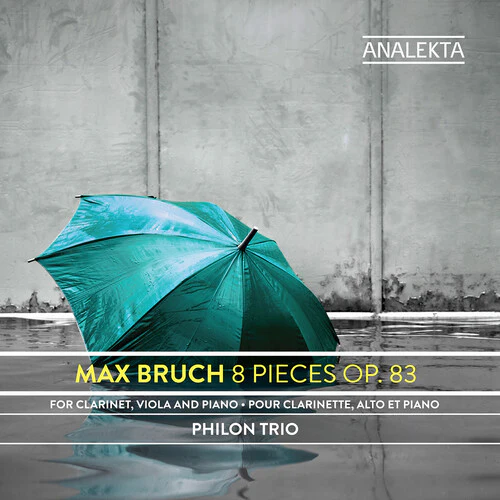
Founded at the Musik Akademie der Stadt Basel, Switzerland, Philon Trio is a chamber ensemble consisting of David Dias da Silva on clarinet, Adam Newman on viola, and Camilla Köhnken on piano. It’s in the context of a residency at Canada’s Banff Center for Arts and Creativity in Alberta that they recorded the excellent work 8 Pieces, Op. 83 by the German composer Max Bruch. Bruch was 72 in 1910 when he composed Acht Stucke Op. 83 for his son, Max Felix, already a professional clarinetist. Written in a late but conservative Romantic style, far removed from the language of Bruch’s contemporaries Stravinsky, Bartók, and Schoenberg, this work is deep, intense, passionate and intimate.
Founded at the Musik Akademie der Stadt Basel, Switzerland, Philon Trio is a chamber ensemble consisting of David Dias da Silva on clarinet, Adam Newman on viola, and Camilla Köhnken on piano. It’s in the context of a residency at Canada’s Banff Center for Arts and Creativity in Alberta that they recorded the excellent work 8 Pieces, Op. 83 by the German composer Max Bruch. Bruch was 72 in 1910 when he composed Acht Stucke Op. 83 for his son, Max Felix, already a professional clarinetist. Written in a late but conservative Romantic style, far removed from the language of Bruch’s contemporaries Stravinsky, Bartók, and Schoenberg, this work is deep, intense, passionate and intimate.
$20.99
8 PIECES, OP. 83—
$20.99
Description
Founded at the Musik Akademie der Stadt Basel, Switzerland, Philon Trio is a chamber ensemble consisting of David Dias da Silva on clarinet, Adam Newman on viola, and Camilla Köhnken on piano. It’s in the context of a residency at Canada’s Banff Center for Arts and Creativity in Alberta that they recorded the excellent work 8 Pieces, Op. 83 by the German composer Max Bruch. Bruch was 72 in 1910 when he composed Acht Stucke Op. 83 for his son, Max Felix, already a professional clarinetist. Written in a late but conservative Romantic style, far removed from the language of Bruch’s contemporaries Stravinsky, Bartók, and Schoenberg, this work is deep, intense, passionate and intimate.