🎉 Up to 70% Off Selected ItemsShop Sale

1 / 2
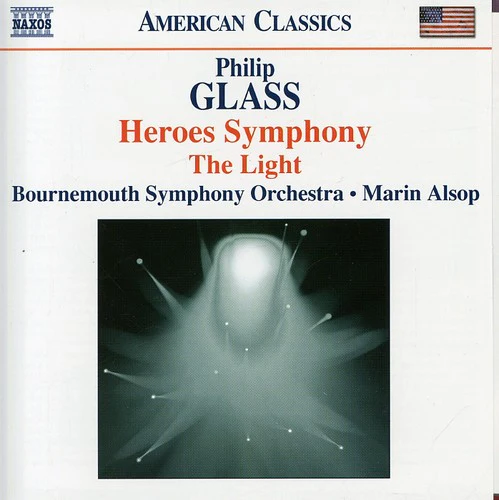
American Classics - Glass: Heroes Symphony, The Light
In his 1996 Fourth Symphony, Philip Glass reworked six out of the ten tracks from David Bowie's Heroes album into orchestral pieces that function both as independent entities and integral symphonic components. It isn't necessary to know the original Heroes in order to appreciate how Glass manipulates the essentially simplistic melodic content by way of striking harmonic juxtapositions, rhythmic vamps laced with unpredictable accents from the percussion, and orchestration that's cannily varied yet clear enough to take down by dictation. In The Light, Glass also generates considerable textural and dramatic mileage from the simple, undulating motives heard at the work's outset. What prevents the signature repetitive modules from running into the ground or sticking in the mud is the composer's unerring sense of when to introduce a new idea, slightly alter a chord voicing, or vary the instrumentation.
One main difference between Marin Alsop's interpretations and Dennis Russell Davies' premiere recordings on Nonesuch concerns engineering philosophy. On Naxos, the Bournemouth Symphony emerges in a more natural, concert-hall perspective as you might perceive from a dead-center orchestra seat in a vibrant but not overly resonant hall. The Russell Davies recordings reproduce their orchestras (the American Composers Orchestra in the Symphony, the Vienna Radio Symphony Orchestra in The Light) at relatively close, detail -oriented range and pack a more immediate punch. For example, in Alsop's slightly faster rendition of the symphony's fourth-movement Sons of the Silent Age, the antiphonal cross-rhythms midway through the work converge to more fluid and blended effect. By contrast, Russell Davies' slower, more heavily accented version beefs up the harps and low brass. And while Alsop begins V 2 Schneider (the final movement) at a bright clip that ever-so-slightly slows down within the first minute, Russell Davies is rock steady. Although I lean toward Russell Davies' recordings (which result from the composer's production team), Alsop's equally world-class interpretations unquestionably convey their own character and validity.
--Jed Distler, ClassicsToday.com
One main difference between Marin Alsop's interpretations and Dennis Russell Davies' premiere recordings on Nonesuch concerns engineering philosophy. On Naxos, the Bournemouth Symphony emerges in a more natural, concert-hall perspective as you might perceive from a dead-center orchestra seat in a vibrant but not overly resonant hall. The Russell Davies recordings reproduce their orchestras (the American Composers Orchestra in the Symphony, the Vienna Radio Symphony Orchestra in The Light) at relatively close, detail -oriented range and pack a more immediate punch. For example, in Alsop's slightly faster rendition of the symphony's fourth-movement Sons of the Silent Age, the antiphonal cross-rhythms midway through the work converge to more fluid and blended effect. By contrast, Russell Davies' slower, more heavily accented version beefs up the harps and low brass. And while Alsop begins V 2 Schneider (the final movement) at a bright clip that ever-so-slightly slows down within the first minute, Russell Davies is rock steady. Although I lean toward Russell Davies' recordings (which result from the composer's production team), Alsop's equally world-class interpretations unquestionably convey their own character and validity.
--Jed Distler, ClassicsToday.com
In his 1996 Fourth Symphony, Philip Glass reworked six out of the ten tracks from David Bowie's Heroes album into orchestral pieces that function both as independent entities and integral symphonic components. It isn't necessary to know the original Heroes in order to appreciate how Glass manipulates the essentially simplistic melodic content by way of striking harmonic juxtapositions, rhythmic vamps laced with unpredictable accents from the percussion, and orchestration that's cannily varied yet clear enough to take down by dictation. In The Light, Glass also generates considerable textural and dramatic mileage from the simple, undulating motives heard at the work's outset. What prevents the signature repetitive modules from running into the ground or sticking in the mud is the composer's unerring sense of when to introduce a new idea, slightly alter a chord voicing, or vary the instrumentation.
One main difference between Marin Alsop's interpretations and Dennis Russell Davies' premiere recordings on Nonesuch concerns engineering philosophy. On Naxos, the Bournemouth Symphony emerges in a more natural, concert-hall perspective as you might perceive from a dead-center orchestra seat in a vibrant but not overly resonant hall. The Russell Davies recordings reproduce their orchestras (the American Composers Orchestra in the Symphony, the Vienna Radio Symphony Orchestra in The Light) at relatively close, detail -oriented range and pack a more immediate punch. For example, in Alsop's slightly faster rendition of the symphony's fourth-movement Sons of the Silent Age, the antiphonal cross-rhythms midway through the work converge to more fluid and blended effect. By contrast, Russell Davies' slower, more heavily accented version beefs up the harps and low brass. And while Alsop begins V 2 Schneider (the final movement) at a bright clip that ever-so-slightly slows down within the first minute, Russell Davies is rock steady. Although I lean toward Russell Davies' recordings (which result from the composer's production team), Alsop's equally world-class interpretations unquestionably convey their own character and validity.
--Jed Distler, ClassicsToday.com
One main difference between Marin Alsop's interpretations and Dennis Russell Davies' premiere recordings on Nonesuch concerns engineering philosophy. On Naxos, the Bournemouth Symphony emerges in a more natural, concert-hall perspective as you might perceive from a dead-center orchestra seat in a vibrant but not overly resonant hall. The Russell Davies recordings reproduce their orchestras (the American Composers Orchestra in the Symphony, the Vienna Radio Symphony Orchestra in The Light) at relatively close, detail -oriented range and pack a more immediate punch. For example, in Alsop's slightly faster rendition of the symphony's fourth-movement Sons of the Silent Age, the antiphonal cross-rhythms midway through the work converge to more fluid and blended effect. By contrast, Russell Davies' slower, more heavily accented version beefs up the harps and low brass. And while Alsop begins V 2 Schneider (the final movement) at a bright clip that ever-so-slightly slows down within the first minute, Russell Davies is rock steady. Although I lean toward Russell Davies' recordings (which result from the composer's production team), Alsop's equally world-class interpretations unquestionably convey their own character and validity.
--Jed Distler, ClassicsToday.com
$19.99
American Classics - Glass: Heroes Symphony, The Light—
$19.99
Description
In his 1996 Fourth Symphony, Philip Glass reworked six out of the ten tracks from David Bowie's Heroes album into orchestral pieces that function both as independent entities and integral symphonic components. It isn't necessary to know the original Heroes in order to appreciate how Glass manipulates the essentially simplistic melodic content by way of striking harmonic juxtapositions, rhythmic vamps laced with unpredictable accents from the percussion, and orchestration that's cannily varied yet clear enough to take down by dictation. In The Light, Glass also generates considerable textural and dramatic mileage from the simple, undulating motives heard at the work's outset. What prevents the signature repetitive modules from running into the ground or sticking in the mud is the composer's unerring sense of when to introduce a new idea, slightly alter a chord voicing, or vary the instrumentation.
One main difference between Marin Alsop's interpretations and Dennis Russell Davies' premiere recordings on Nonesuch concerns engineering philosophy. On Naxos, the Bournemouth Symphony emerges in a more natural, concert-hall perspective as you might perceive from a dead-center orchestra seat in a vibrant but not overly resonant hall. The Russell Davies recordings reproduce their orchestras (the American Composers Orchestra in the Symphony, the Vienna Radio Symphony Orchestra in The Light) at relatively close, detail -oriented range and pack a more immediate punch. For example, in Alsop's slightly faster rendition of the symphony's fourth-movement Sons of the Silent Age, the antiphonal cross-rhythms midway through the work converge to more fluid and blended effect. By contrast, Russell Davies' slower, more heavily accented version beefs up the harps and low brass. And while Alsop begins V 2 Schneider (the final movement) at a bright clip that ever-so-slightly slows down within the first minute, Russell Davies is rock steady. Although I lean toward Russell Davies' recordings (which result from the composer's production team), Alsop's equally world-class interpretations unquestionably convey their own character and validity.
--Jed Distler, ClassicsToday.com
One main difference between Marin Alsop's interpretations and Dennis Russell Davies' premiere recordings on Nonesuch concerns engineering philosophy. On Naxos, the Bournemouth Symphony emerges in a more natural, concert-hall perspective as you might perceive from a dead-center orchestra seat in a vibrant but not overly resonant hall. The Russell Davies recordings reproduce their orchestras (the American Composers Orchestra in the Symphony, the Vienna Radio Symphony Orchestra in The Light) at relatively close, detail -oriented range and pack a more immediate punch. For example, in Alsop's slightly faster rendition of the symphony's fourth-movement Sons of the Silent Age, the antiphonal cross-rhythms midway through the work converge to more fluid and blended effect. By contrast, Russell Davies' slower, more heavily accented version beefs up the harps and low brass. And while Alsop begins V 2 Schneider (the final movement) at a bright clip that ever-so-slightly slows down within the first minute, Russell Davies is rock steady. Although I lean toward Russell Davies' recordings (which result from the composer's production team), Alsop's equally world-class interpretations unquestionably convey their own character and validity.
--Jed Distler, ClassicsToday.com