🎉 Up to 70% Off Selected ItemsShop Sale

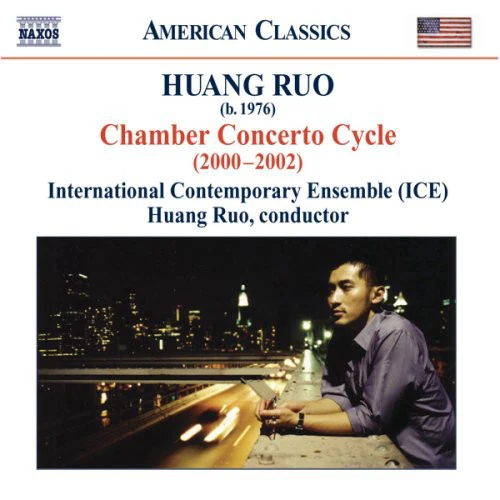
American Classics - Huang Ruo: Chamber Concerto Cycle
HUANG Chamber Concertos: No. 1, “Yueh Fei”; No. 2, “The Lost Garden”; No. 3, “Divergence”; No. 4, “Confluence” • Huang Ruo, cond; Int’l Contemporary Ens • NAXOS 8.559322 (63: 48)
Born on Hainan Island, China, in 1976, Huang Ruo moved to the US in 1995 and is now an American citizen. He has won several prizes, and his music has been conducted by Sawallisch, James Condon, and Dennis Russell Davies, among others. Huang is currently completing a D.M.A. degree in composition at Juilliard. In the week this review was written, his cello concerto People Mountain People Sea (commissioned by Chinese-born cellist Jian Wang) was premiered in New York to some acclaim. Huang’s chamber concertos were composed between 2000 and 2002, for varying sizes of ensemble: a quintet in the case of No. 3 (flute/piccolo, clarinet, violin, cello, and piano), an octet for Nos. 1 and 2 (adding a second violin, viola, and percussion), and 15 players for No. 4 (adding more strings, a brass section, and harp).
An anonymous reviewer from VPRO Radio Guide describes Huang’s style as “a convincing synthesis between the hushed Chinese sound world and modernist composition techniques.” That synthesis is the basis and raison d’etre of these colorful works. Certain instrumental signposts common to both idioms occur frequently, such as timpani “tattoos,” string glissandos, and drones. Forceful statements from timpani and other percussion often serve to separate musical segments, as in Chinese opera, and we hear imitations of Chinese stringed instruments (No. 1, first movement) and Chinese flute (much of No. 2). Western influences are equally present: the use of ostinato (No. 3, first movement) and the syncopated, aggressive rhythmic bite of jazz/rock (No. 1, fourth movement). Online reviewer David Toub of Sequenza21 found this to be problematical, dubbing Huang a synthesist but not a composer—unlike Ives who, in cramming various influences together, created a uniquely individual voice. I don’t have that problem with Huang’s music—cutting-and-pasting is a perfectly legitimate procedure—but, because these pieces are so segmented, it inevitably means some parts are likely to be stronger than others without an obvious through-line to connect them.
Then, there is the contentious matter of asking the musicians to sing, chant, or recite. While this sometimes contributes to the texture in a satisfying way (as in the final movement of No. 1), in Nos. 2 and 3 the effect puts a brake on the music’s progress, robbing it of force. And, it must be said, the expert instrumentalists of the International Contemporary Ensemble are less expert when it comes to vocalizing.
Concerto No. 2 is probably where the pros and cons of Huang’s synthesizing approach are at their most extreme. The concerto is subtitled “The Lost Garden.” The composer claims in his note that “one can feel the wind and hear the birds singing,” which is true, but we don’t reach that pastoral vision until the very end. Because of the segmentary nature of the preceding music, one has little sense of a peaceful conclusion having been earned. It feels tacked on; in this instance, the language of expressionism sits awkwardly with Asian detachment. Even so, Huang provides spine-tingling moments along the way, such as a passage featuring a long slow descent in double stops from the violin, falling into the black hole of a reverberant bass cluster from piano and tam-tam (very George Crumb), which slowly rises again as piano figuration like a flock of Messiaen’s birds.
My favorite among these concertos is No. 4 (originally premiered alone by the AKSO Ensemble). Formally, it is the tightest and most coherent of the four, as you would expect from the title “Confluence.” The larger ensemble enables Huang to command greater textural variety: indeed, the loveliest passage on the entire disc is the wind-dominated second movement, anchored by the warm tone of the bassoon. Another plus: in this work the musicians are not required to vocalize. Concerto No. 4 brings together musical ideas from the three preceding concertos, but I think that the parts of this cycle are greater than their sum and are best listened to separately.
It is thought provoking to hear Chinese-accented music emanating from a CD in the “American Classics” series— it speaks volumes about diversity in Western musical culture—and Naxos is to be commended for putting this young composer on its roster. The sound quality is excellent, and the musicianship of a very high standard. Despite my reservations above, Huang’s music is undeniably vibrant, visceral, and full of color.
FANFARE: Phillip Scott
HUANG Chamber Concertos: No. 1, “Yueh Fei”; No. 2, “The Lost Garden”; No. 3, “Divergence”; No. 4, “Confluence” • Huang Ruo, cond; Int’l Contemporary Ens • NAXOS 8.559322 (63: 48)
Born on Hainan Island, China, in 1976, Huang Ruo moved to the US in 1995 and is now an American citizen. He has won several prizes, and his music has been conducted by Sawallisch, James Condon, and Dennis Russell Davies, among others. Huang is currently completing a D.M.A. degree in composition at Juilliard. In the week this review was written, his cello concerto People Mountain People Sea (commissioned by Chinese-born cellist Jian Wang) was premiered in New York to some acclaim. Huang’s chamber concertos were composed between 2000 and 2002, for varying sizes of ensemble: a quintet in the case of No. 3 (flute/piccolo, clarinet, violin, cello, and piano), an octet for Nos. 1 and 2 (adding a second violin, viola, and percussion), and 15 players for No. 4 (adding more strings, a brass section, and harp).
An anonymous reviewer from VPRO Radio Guide describes Huang’s style as “a convincing synthesis between the hushed Chinese sound world and modernist composition techniques.” That synthesis is the basis and raison d’etre of these colorful works. Certain instrumental signposts common to both idioms occur frequently, such as timpani “tattoos,” string glissandos, and drones. Forceful statements from timpani and other percussion often serve to separate musical segments, as in Chinese opera, and we hear imitations of Chinese stringed instruments (No. 1, first movement) and Chinese flute (much of No. 2). Western influences are equally present: the use of ostinato (No. 3, first movement) and the syncopated, aggressive rhythmic bite of jazz/rock (No. 1, fourth movement). Online reviewer David Toub of Sequenza21 found this to be problematical, dubbing Huang a synthesist but not a composer—unlike Ives who, in cramming various influences together, created a uniquely individual voice. I don’t have that problem with Huang’s music—cutting-and-pasting is a perfectly legitimate procedure—but, because these pieces are so segmented, it inevitably means some parts are likely to be stronger than others without an obvious through-line to connect them.
Then, there is the contentious matter of asking the musicians to sing, chant, or recite. While this sometimes contributes to the texture in a satisfying way (as in the final movement of No. 1), in Nos. 2 and 3 the effect puts a brake on the music’s progress, robbing it of force. And, it must be said, the expert instrumentalists of the International Contemporary Ensemble are less expert when it comes to vocalizing.
Concerto No. 2 is probably where the pros and cons of Huang’s synthesizing approach are at their most extreme. The concerto is subtitled “The Lost Garden.” The composer claims in his note that “one can feel the wind and hear the birds singing,” which is true, but we don’t reach that pastoral vision until the very end. Because of the segmentary nature of the preceding music, one has little sense of a peaceful conclusion having been earned. It feels tacked on; in this instance, the language of expressionism sits awkwardly with Asian detachment. Even so, Huang provides spine-tingling moments along the way, such as a passage featuring a long slow descent in double stops from the violin, falling into the black hole of a reverberant bass cluster from piano and tam-tam (very George Crumb), which slowly rises again as piano figuration like a flock of Messiaen’s birds.
My favorite among these concertos is No. 4 (originally premiered alone by the AKSO Ensemble). Formally, it is the tightest and most coherent of the four, as you would expect from the title “Confluence.” The larger ensemble enables Huang to command greater textural variety: indeed, the loveliest passage on the entire disc is the wind-dominated second movement, anchored by the warm tone of the bassoon. Another plus: in this work the musicians are not required to vocalize. Concerto No. 4 brings together musical ideas from the three preceding concertos, but I think that the parts of this cycle are greater than their sum and are best listened to separately.
It is thought provoking to hear Chinese-accented music emanating from a CD in the “American Classics” series— it speaks volumes about diversity in Western musical culture—and Naxos is to be commended for putting this young composer on its roster. The sound quality is excellent, and the musicianship of a very high standard. Despite my reservations above, Huang’s music is undeniably vibrant, visceral, and full of color.
FANFARE: Phillip Scott
$13.99
American Classics - Huang Ruo: Chamber Concerto Cycle—
$13.99
Description
HUANG Chamber Concertos: No. 1, “Yueh Fei”; No. 2, “The Lost Garden”; No. 3, “Divergence”; No. 4, “Confluence” • Huang Ruo, cond; Int’l Contemporary Ens • NAXOS 8.559322 (63: 48)
Born on Hainan Island, China, in 1976, Huang Ruo moved to the US in 1995 and is now an American citizen. He has won several prizes, and his music has been conducted by Sawallisch, James Condon, and Dennis Russell Davies, among others. Huang is currently completing a D.M.A. degree in composition at Juilliard. In the week this review was written, his cello concerto People Mountain People Sea (commissioned by Chinese-born cellist Jian Wang) was premiered in New York to some acclaim. Huang’s chamber concertos were composed between 2000 and 2002, for varying sizes of ensemble: a quintet in the case of No. 3 (flute/piccolo, clarinet, violin, cello, and piano), an octet for Nos. 1 and 2 (adding a second violin, viola, and percussion), and 15 players for No. 4 (adding more strings, a brass section, and harp).
An anonymous reviewer from VPRO Radio Guide describes Huang’s style as “a convincing synthesis between the hushed Chinese sound world and modernist composition techniques.” That synthesis is the basis and raison d’etre of these colorful works. Certain instrumental signposts common to both idioms occur frequently, such as timpani “tattoos,” string glissandos, and drones. Forceful statements from timpani and other percussion often serve to separate musical segments, as in Chinese opera, and we hear imitations of Chinese stringed instruments (No. 1, first movement) and Chinese flute (much of No. 2). Western influences are equally present: the use of ostinato (No. 3, first movement) and the syncopated, aggressive rhythmic bite of jazz/rock (No. 1, fourth movement). Online reviewer David Toub of Sequenza21 found this to be problematical, dubbing Huang a synthesist but not a composer—unlike Ives who, in cramming various influences together, created a uniquely individual voice. I don’t have that problem with Huang’s music—cutting-and-pasting is a perfectly legitimate procedure—but, because these pieces are so segmented, it inevitably means some parts are likely to be stronger than others without an obvious through-line to connect them.
Then, there is the contentious matter of asking the musicians to sing, chant, or recite. While this sometimes contributes to the texture in a satisfying way (as in the final movement of No. 1), in Nos. 2 and 3 the effect puts a brake on the music’s progress, robbing it of force. And, it must be said, the expert instrumentalists of the International Contemporary Ensemble are less expert when it comes to vocalizing.
Concerto No. 2 is probably where the pros and cons of Huang’s synthesizing approach are at their most extreme. The concerto is subtitled “The Lost Garden.” The composer claims in his note that “one can feel the wind and hear the birds singing,” which is true, but we don’t reach that pastoral vision until the very end. Because of the segmentary nature of the preceding music, one has little sense of a peaceful conclusion having been earned. It feels tacked on; in this instance, the language of expressionism sits awkwardly with Asian detachment. Even so, Huang provides spine-tingling moments along the way, such as a passage featuring a long slow descent in double stops from the violin, falling into the black hole of a reverberant bass cluster from piano and tam-tam (very George Crumb), which slowly rises again as piano figuration like a flock of Messiaen’s birds.
My favorite among these concertos is No. 4 (originally premiered alone by the AKSO Ensemble). Formally, it is the tightest and most coherent of the four, as you would expect from the title “Confluence.” The larger ensemble enables Huang to command greater textural variety: indeed, the loveliest passage on the entire disc is the wind-dominated second movement, anchored by the warm tone of the bassoon. Another plus: in this work the musicians are not required to vocalize. Concerto No. 4 brings together musical ideas from the three preceding concertos, but I think that the parts of this cycle are greater than their sum and are best listened to separately.
It is thought provoking to hear Chinese-accented music emanating from a CD in the “American Classics” series— it speaks volumes about diversity in Western musical culture—and Naxos is to be commended for putting this young composer on its roster. The sound quality is excellent, and the musicianship of a very high standard. Despite my reservations above, Huang’s music is undeniably vibrant, visceral, and full of color.
FANFARE: Phillip Scott