🎉 Up to 70% Off Selected ItemsShop Sale

1 / 2
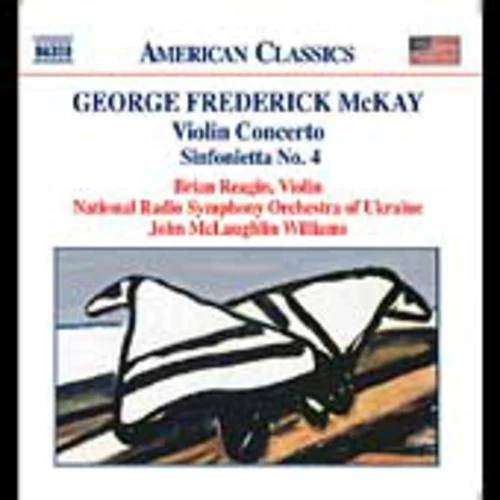
American Classics - McKay: Violin Concerto, Etc
We start with a pretty conventional three-movement, neo-Romantic Violin Concerto, written in 1940. The conductor’s program notes equate it with Bruch, but it’s not that old fashioned; there are hints of Bloch as well. Still, I find the opening Allegro too predictable and, at 14 minutes, too long. The Bruch connection could be some actual quotations in the violin part, but there are also some original ideas presented. McKay’s music is strongest, and most original, in his slow movements; he had a gift for the long melody and knew exactly what to do with one. Right from the opening note, the Andante quasi adagio rings true. Even the solo part changes instantly: the ultra-conventional figurations and filigree of the first movement give way to a soaring, wide-ranging line, which shares and exchanges ideas with solo woodwinds. Did the soloist feel the same way? His earlier cadenzas sound uncommitted; now he is all heart and beauty. A happy, lively finale also makes more use of winds than did the opening movement, and the solo line becomes more brilliant. One can’t help liking it.
The Suite on 16th-Century Hymn Tunes (an homage to one Louis Bourgeois) relapses into convention, recalling Vaughan Williams without matching him. It was written for organ in 1945, scored for strings shortly thereafter, and rescored for two string orchestras in 1962, the version heard here. A celesta joins in the fourth (Choeur céleste) of five movements; the work’s slow movement, it again stands out. A cogent listener (she doesn’t like being identified as my wife) thought the piece might be William Boyce, and English for sure. The Sinfonietta (1942) is a surprise: romantic excess has abdicated in favor of sharp, clean harmonies and rhythms. McKay has jumped a musical generation in the two years since the Violin Concerto; he seems as much at home in what was a very modern idiom for its day as he was in the earlier style. An Allegro . . . con brio (he writes verbose movement indications) has bite and wit; the Moderato pastorale makes varying use of a ripe oboe tune, enriching a nearly 10-minute movement at every turn. The colorfully scored finale, Allegro . . . molto, is brilliant fun.
Song over the Great Plains (1953) is a serious 14-minute tone poem, looking backward to Howard Hanson from McKay’s days at the Eastman School. Rich, mildly dissonant harmonies and heavy-duty scoring dominate, as trombones prevail. There is an occasional piano obbligato, played by Ludmilla Kovaleva, which serves primarily as respite from the tense atmosphere. The whole is not quite convincing, running just a touch too close to Hollywood. On another day, I might fall for it. All the performances are expert and seem sympathetic; the recordings are satisfactory.
James H. North, FANFARE
The Suite on 16th-Century Hymn Tunes (an homage to one Louis Bourgeois) relapses into convention, recalling Vaughan Williams without matching him. It was written for organ in 1945, scored for strings shortly thereafter, and rescored for two string orchestras in 1962, the version heard here. A celesta joins in the fourth (Choeur céleste) of five movements; the work’s slow movement, it again stands out. A cogent listener (she doesn’t like being identified as my wife) thought the piece might be William Boyce, and English for sure. The Sinfonietta (1942) is a surprise: romantic excess has abdicated in favor of sharp, clean harmonies and rhythms. McKay has jumped a musical generation in the two years since the Violin Concerto; he seems as much at home in what was a very modern idiom for its day as he was in the earlier style. An Allegro . . . con brio (he writes verbose movement indications) has bite and wit; the Moderato pastorale makes varying use of a ripe oboe tune, enriching a nearly 10-minute movement at every turn. The colorfully scored finale, Allegro . . . molto, is brilliant fun.
Song over the Great Plains (1953) is a serious 14-minute tone poem, looking backward to Howard Hanson from McKay’s days at the Eastman School. Rich, mildly dissonant harmonies and heavy-duty scoring dominate, as trombones prevail. There is an occasional piano obbligato, played by Ludmilla Kovaleva, which serves primarily as respite from the tense atmosphere. The whole is not quite convincing, running just a touch too close to Hollywood. On another day, I might fall for it. All the performances are expert and seem sympathetic; the recordings are satisfactory.
James H. North, FANFARE
We start with a pretty conventional three-movement, neo-Romantic Violin Concerto, written in 1940. The conductor’s program notes equate it with Bruch, but it’s not that old fashioned; there are hints of Bloch as well. Still, I find the opening Allegro too predictable and, at 14 minutes, too long. The Bruch connection could be some actual quotations in the violin part, but there are also some original ideas presented. McKay’s music is strongest, and most original, in his slow movements; he had a gift for the long melody and knew exactly what to do with one. Right from the opening note, the Andante quasi adagio rings true. Even the solo part changes instantly: the ultra-conventional figurations and filigree of the first movement give way to a soaring, wide-ranging line, which shares and exchanges ideas with solo woodwinds. Did the soloist feel the same way? His earlier cadenzas sound uncommitted; now he is all heart and beauty. A happy, lively finale also makes more use of winds than did the opening movement, and the solo line becomes more brilliant. One can’t help liking it.
The Suite on 16th-Century Hymn Tunes (an homage to one Louis Bourgeois) relapses into convention, recalling Vaughan Williams without matching him. It was written for organ in 1945, scored for strings shortly thereafter, and rescored for two string orchestras in 1962, the version heard here. A celesta joins in the fourth (Choeur céleste) of five movements; the work’s slow movement, it again stands out. A cogent listener (she doesn’t like being identified as my wife) thought the piece might be William Boyce, and English for sure. The Sinfonietta (1942) is a surprise: romantic excess has abdicated in favor of sharp, clean harmonies and rhythms. McKay has jumped a musical generation in the two years since the Violin Concerto; he seems as much at home in what was a very modern idiom for its day as he was in the earlier style. An Allegro . . . con brio (he writes verbose movement indications) has bite and wit; the Moderato pastorale makes varying use of a ripe oboe tune, enriching a nearly 10-minute movement at every turn. The colorfully scored finale, Allegro . . . molto, is brilliant fun.
Song over the Great Plains (1953) is a serious 14-minute tone poem, looking backward to Howard Hanson from McKay’s days at the Eastman School. Rich, mildly dissonant harmonies and heavy-duty scoring dominate, as trombones prevail. There is an occasional piano obbligato, played by Ludmilla Kovaleva, which serves primarily as respite from the tense atmosphere. The whole is not quite convincing, running just a touch too close to Hollywood. On another day, I might fall for it. All the performances are expert and seem sympathetic; the recordings are satisfactory.
James H. North, FANFARE
The Suite on 16th-Century Hymn Tunes (an homage to one Louis Bourgeois) relapses into convention, recalling Vaughan Williams without matching him. It was written for organ in 1945, scored for strings shortly thereafter, and rescored for two string orchestras in 1962, the version heard here. A celesta joins in the fourth (Choeur céleste) of five movements; the work’s slow movement, it again stands out. A cogent listener (she doesn’t like being identified as my wife) thought the piece might be William Boyce, and English for sure. The Sinfonietta (1942) is a surprise: romantic excess has abdicated in favor of sharp, clean harmonies and rhythms. McKay has jumped a musical generation in the two years since the Violin Concerto; he seems as much at home in what was a very modern idiom for its day as he was in the earlier style. An Allegro . . . con brio (he writes verbose movement indications) has bite and wit; the Moderato pastorale makes varying use of a ripe oboe tune, enriching a nearly 10-minute movement at every turn. The colorfully scored finale, Allegro . . . molto, is brilliant fun.
Song over the Great Plains (1953) is a serious 14-minute tone poem, looking backward to Howard Hanson from McKay’s days at the Eastman School. Rich, mildly dissonant harmonies and heavy-duty scoring dominate, as trombones prevail. There is an occasional piano obbligato, played by Ludmilla Kovaleva, which serves primarily as respite from the tense atmosphere. The whole is not quite convincing, running just a touch too close to Hollywood. On another day, I might fall for it. All the performances are expert and seem sympathetic; the recordings are satisfactory.
James H. North, FANFARE
$7.00
Original: $19.99
-65%American Classics - McKay: Violin Concerto, Etc—
$19.99
$7.00Description
We start with a pretty conventional three-movement, neo-Romantic Violin Concerto, written in 1940. The conductor’s program notes equate it with Bruch, but it’s not that old fashioned; there are hints of Bloch as well. Still, I find the opening Allegro too predictable and, at 14 minutes, too long. The Bruch connection could be some actual quotations in the violin part, but there are also some original ideas presented. McKay’s music is strongest, and most original, in his slow movements; he had a gift for the long melody and knew exactly what to do with one. Right from the opening note, the Andante quasi adagio rings true. Even the solo part changes instantly: the ultra-conventional figurations and filigree of the first movement give way to a soaring, wide-ranging line, which shares and exchanges ideas with solo woodwinds. Did the soloist feel the same way? His earlier cadenzas sound uncommitted; now he is all heart and beauty. A happy, lively finale also makes more use of winds than did the opening movement, and the solo line becomes more brilliant. One can’t help liking it.
The Suite on 16th-Century Hymn Tunes (an homage to one Louis Bourgeois) relapses into convention, recalling Vaughan Williams without matching him. It was written for organ in 1945, scored for strings shortly thereafter, and rescored for two string orchestras in 1962, the version heard here. A celesta joins in the fourth (Choeur céleste) of five movements; the work’s slow movement, it again stands out. A cogent listener (she doesn’t like being identified as my wife) thought the piece might be William Boyce, and English for sure. The Sinfonietta (1942) is a surprise: romantic excess has abdicated in favor of sharp, clean harmonies and rhythms. McKay has jumped a musical generation in the two years since the Violin Concerto; he seems as much at home in what was a very modern idiom for its day as he was in the earlier style. An Allegro . . . con brio (he writes verbose movement indications) has bite and wit; the Moderato pastorale makes varying use of a ripe oboe tune, enriching a nearly 10-minute movement at every turn. The colorfully scored finale, Allegro . . . molto, is brilliant fun.
Song over the Great Plains (1953) is a serious 14-minute tone poem, looking backward to Howard Hanson from McKay’s days at the Eastman School. Rich, mildly dissonant harmonies and heavy-duty scoring dominate, as trombones prevail. There is an occasional piano obbligato, played by Ludmilla Kovaleva, which serves primarily as respite from the tense atmosphere. The whole is not quite convincing, running just a touch too close to Hollywood. On another day, I might fall for it. All the performances are expert and seem sympathetic; the recordings are satisfactory.
James H. North, FANFARE
The Suite on 16th-Century Hymn Tunes (an homage to one Louis Bourgeois) relapses into convention, recalling Vaughan Williams without matching him. It was written for organ in 1945, scored for strings shortly thereafter, and rescored for two string orchestras in 1962, the version heard here. A celesta joins in the fourth (Choeur céleste) of five movements; the work’s slow movement, it again stands out. A cogent listener (she doesn’t like being identified as my wife) thought the piece might be William Boyce, and English for sure. The Sinfonietta (1942) is a surprise: romantic excess has abdicated in favor of sharp, clean harmonies and rhythms. McKay has jumped a musical generation in the two years since the Violin Concerto; he seems as much at home in what was a very modern idiom for its day as he was in the earlier style. An Allegro . . . con brio (he writes verbose movement indications) has bite and wit; the Moderato pastorale makes varying use of a ripe oboe tune, enriching a nearly 10-minute movement at every turn. The colorfully scored finale, Allegro . . . molto, is brilliant fun.
Song over the Great Plains (1953) is a serious 14-minute tone poem, looking backward to Howard Hanson from McKay’s days at the Eastman School. Rich, mildly dissonant harmonies and heavy-duty scoring dominate, as trombones prevail. There is an occasional piano obbligato, played by Ludmilla Kovaleva, which serves primarily as respite from the tense atmosphere. The whole is not quite convincing, running just a touch too close to Hollywood. On another day, I might fall for it. All the performances are expert and seem sympathetic; the recordings are satisfactory.
James H. North, FANFARE