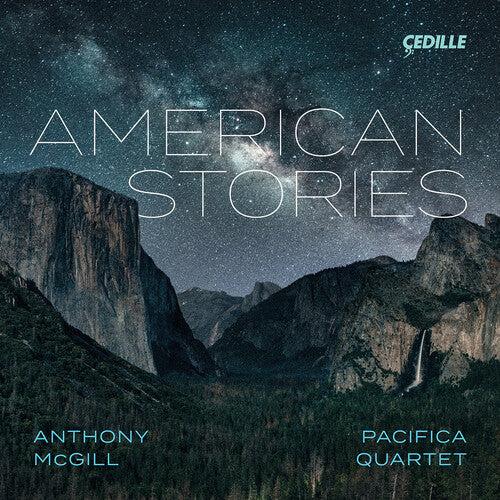
American Stories / McGill, Pacifica Quartet
Anthony McGill, New York Philharmonic principal clarinet and 2020 Avery Fisher Prize winner, and the multiple Grammy Award-winning Pacifica Quartet join forces on an album illuminating the diversity of the American experience through works by Richard Danielpour, James Lee III, Ben Shirley (all three world-premiere recordings), and Valerie Coleman. McGill describes it as a project driven by the desire to “expand the capacity for art and music to change the world.” Clarinetist McGill and the Pacific Quartet’s previous collaboration on Cedille Records, Mozart & Brahms Clarinet Quintets, garnered widespread critical acclaim and continues to be a staple of classical radio programming. “The pure, gorgeous tone and expressive musicianship of the clarinetist Anthony McGill meshes with the talents of the excellent Pacifica Quartet for thoroughly enjoyable readings” (The New York Times).
REVIEWS:
The stories in question here are wide-ranging, often concerned with issues of social justice and racial intolerance which, however noble in concept, can’t really be expressed in absolute musical terms–never mind as works for clarinet and string quartet. Fortunately the music works perfectly well on its own, and it’s stunningly played and recorded, so you can either ignore the externals entirely or take them for what they’re worth.
Richard Danielpour is a composer whose ambition often exceeds his grasp, never mind his titles, but Four Angels is a sensitive, single-movement piece that would have been better had it simply been called “Elegy for Clarinet and String Quartet,” or words to that effect. James Lee III’s Quintet makes reference to Native American music and history in its four concise movements, which you may or may not notice and which makes little difference one way or the other. The music is fresh, appealing, and extremely well-crafted. Ben Shirley’s High Sierra Sonata does exactly what its title suggests: this is music about nature, wide-open spaces, and interior reflection. Heard in the context of the program as a whole, it constitutes a moment of relative repose, even though it has a central movement marked “Angry Secrets.”
Last, but certainly not least, Valerie Coleman’s “Shotgun Houses” is the first in a triptych of works inspired by the life and legacy of Muhammad Ali. Its third movement, “Rome 1960” features a musical boxing match, no less, and does it rather well. Again, it’s not really necessary to know any of this to enjoy the music, and Coleman deserves credit for avoiding any suggestion of parody or silliness. Of course, much of the credit for the success of this program belongs to the performers. McGill, with his colorful range of timbres and effortless virtuosity, brings his instrument to life in the most expressively direct way, while the Pacifica Quartet plays as well as any chamber group active today. Cedille’s sonics are positively luminous, and every work (Coleman’s aside) is a world premiere recording. In short, a remarkable achievement by all concerned.
-- ClassicsToday.com (10/10; David Hurwitz)
Here is an interesting album of contemporary American music played by veteran clarinetist Anthony McGill, who has worked as a soloist with various American orchestras as well as being an active chamber musician. He is paired on this album by the well-known Pacifica Quartet.
First up is the best-known composer of the four, Richard Danielpour, who tends to write in a tonal, accessible style yet who always seems to include in that music elements of subtle yet advanced harmonies to make it interesting. Four Angels, composed specifically for McGill and the Catalyst Quartet, is no exception: a lyrical, melodic theme that suddenly morphs a couple of minutes into the piece as edgier harmonies and rhythms suddenly erupt. Yet the music always seems to return to its lyrical roots as it continues to develop.
I was not previously familiar with James Lee III (b. 1973), who studied both composition and conducting. Lee’s music is rather interesting, using unusual rhythmic and harmonic figures including a fair amount of syncopation (but not really jazz syncopation). It is a joyous work in the end, but in a quirky, irregular meter as if danced by someone with wobbly legs!
Shotgun Houses by Valerie Coleman, another composer I was not previously familiar with, is described as the first of “three installments that celebrate the life of Muhammad Ali. The three movements, titled “ShotGun Houses,” “Grand Ave.” and “Rome 1960” refer to places and incidents in his early life. Coleman’s music...struck me as some of the most creative in the entire album—creative in the sense that it sounded much more the product of inspiration and not merely working out themes in one’s mind. Coleman captures her moods as well as Danielpour and Lee, but the musical progression is more varied and unusual. It’s quite an inventive as well as a thrilling piece!
This, then, is a very nice album, the kind one can use to take a mental break from the more convoluted modern music out there. McGill has a rich, luscious tone and outstanding musicianship. The sound is also outstanding, giving a bit of natural room reverb to the instruments without having them wallowing in an echo.
-- The Art Music Lounge (Lynn René Bayley)
Anthony McGill, New York Philharmonic principal clarinet and 2020 Avery Fisher Prize winner, and the multiple Grammy Award-winning Pacifica Quartet join forces on an album illuminating the diversity of the American experience through works by Richard Danielpour, James Lee III, Ben Shirley (all three world-premiere recordings), and Valerie Coleman. McGill describes it as a project driven by the desire to “expand the capacity for art and music to change the world.” Clarinetist McGill and the Pacific Quartet’s previous collaboration on Cedille Records, Mozart & Brahms Clarinet Quintets, garnered widespread critical acclaim and continues to be a staple of classical radio programming. “The pure, gorgeous tone and expressive musicianship of the clarinetist Anthony McGill meshes with the talents of the excellent Pacifica Quartet for thoroughly enjoyable readings” (The New York Times).
REVIEWS:
The stories in question here are wide-ranging, often concerned with issues of social justice and racial intolerance which, however noble in concept, can’t really be expressed in absolute musical terms–never mind as works for clarinet and string quartet. Fortunately the music works perfectly well on its own, and it’s stunningly played and recorded, so you can either ignore the externals entirely or take them for what they’re worth.
Richard Danielpour is a composer whose ambition often exceeds his grasp, never mind his titles, but Four Angels is a sensitive, single-movement piece that would have been better had it simply been called “Elegy for Clarinet and String Quartet,” or words to that effect. James Lee III’s Quintet makes reference to Native American music and history in its four concise movements, which you may or may not notice and which makes little difference one way or the other. The music is fresh, appealing, and extremely well-crafted. Ben Shirley’s High Sierra Sonata does exactly what its title suggests: this is music about nature, wide-open spaces, and interior reflection. Heard in the context of the program as a whole, it constitutes a moment of relative repose, even though it has a central movement marked “Angry Secrets.”
Last, but certainly not least, Valerie Coleman’s “Shotgun Houses” is the first in a triptych of works inspired by the life and legacy of Muhammad Ali. Its third movement, “Rome 1960” features a musical boxing match, no less, and does it rather well. Again, it’s not really necessary to know any of this to enjoy the music, and Coleman deserves credit for avoiding any suggestion of parody or silliness. Of course, much of the credit for the success of this program belongs to the performers. McGill, with his colorful range of timbres and effortless virtuosity, brings his instrument to life in the most expressively direct way, while the Pacifica Quartet plays as well as any chamber group active today. Cedille’s sonics are positively luminous, and every work (Coleman’s aside) is a world premiere recording. In short, a remarkable achievement by all concerned.
-- ClassicsToday.com (10/10; David Hurwitz)
Here is an interesting album of contemporary American music played by veteran clarinetist Anthony McGill, who has worked as a soloist with various American orchestras as well as being an active chamber musician. He is paired on this album by the well-known Pacifica Quartet.
First up is the best-known composer of the four, Richard Danielpour, who tends to write in a tonal, accessible style yet who always seems to include in that music elements of subtle yet advanced harmonies to make it interesting. Four Angels, composed specifically for McGill and the Catalyst Quartet, is no exception: a lyrical, melodic theme that suddenly morphs a couple of minutes into the piece as edgier harmonies and rhythms suddenly erupt. Yet the music always seems to return to its lyrical roots as it continues to develop.
I was not previously familiar with James Lee III (b. 1973), who studied both composition and conducting. Lee’s music is rather interesting, using unusual rhythmic and harmonic figures including a fair amount of syncopation (but not really jazz syncopation). It is a joyous work in the end, but in a quirky, irregular meter as if danced by someone with wobbly legs!
Shotgun Houses by Valerie Coleman, another composer I was not previously familiar with, is described as the first of “three installments that celebrate the life of Muhammad Ali. The three movements, titled “ShotGun Houses,” “Grand Ave.” and “Rome 1960” refer to places and incidents in his early life. Coleman’s music...struck me as some of the most creative in the entire album—creative in the sense that it sounded much more the product of inspiration and not merely working out themes in one’s mind. Coleman captures her moods as well as Danielpour and Lee, but the musical progression is more varied and unusual. It’s quite an inventive as well as a thrilling piece!
This, then, is a very nice album, the kind one can use to take a mental break from the more convoluted modern music out there. McGill has a rich, luscious tone and outstanding musicianship. The sound is also outstanding, giving a bit of natural room reverb to the instruments without having them wallowing in an echo.
-- The Art Music Lounge (Lynn René Bayley)
Original: $19.99
-65%$19.99
$7.00Description
Anthony McGill, New York Philharmonic principal clarinet and 2020 Avery Fisher Prize winner, and the multiple Grammy Award-winning Pacifica Quartet join forces on an album illuminating the diversity of the American experience through works by Richard Danielpour, James Lee III, Ben Shirley (all three world-premiere recordings), and Valerie Coleman. McGill describes it as a project driven by the desire to “expand the capacity for art and music to change the world.” Clarinetist McGill and the Pacific Quartet’s previous collaboration on Cedille Records, Mozart & Brahms Clarinet Quintets, garnered widespread critical acclaim and continues to be a staple of classical radio programming. “The pure, gorgeous tone and expressive musicianship of the clarinetist Anthony McGill meshes with the talents of the excellent Pacifica Quartet for thoroughly enjoyable readings” (The New York Times).
REVIEWS:
The stories in question here are wide-ranging, often concerned with issues of social justice and racial intolerance which, however noble in concept, can’t really be expressed in absolute musical terms–never mind as works for clarinet and string quartet. Fortunately the music works perfectly well on its own, and it’s stunningly played and recorded, so you can either ignore the externals entirely or take them for what they’re worth.
Richard Danielpour is a composer whose ambition often exceeds his grasp, never mind his titles, but Four Angels is a sensitive, single-movement piece that would have been better had it simply been called “Elegy for Clarinet and String Quartet,” or words to that effect. James Lee III’s Quintet makes reference to Native American music and history in its four concise movements, which you may or may not notice and which makes little difference one way or the other. The music is fresh, appealing, and extremely well-crafted. Ben Shirley’s High Sierra Sonata does exactly what its title suggests: this is music about nature, wide-open spaces, and interior reflection. Heard in the context of the program as a whole, it constitutes a moment of relative repose, even though it has a central movement marked “Angry Secrets.”
Last, but certainly not least, Valerie Coleman’s “Shotgun Houses” is the first in a triptych of works inspired by the life and legacy of Muhammad Ali. Its third movement, “Rome 1960” features a musical boxing match, no less, and does it rather well. Again, it’s not really necessary to know any of this to enjoy the music, and Coleman deserves credit for avoiding any suggestion of parody or silliness. Of course, much of the credit for the success of this program belongs to the performers. McGill, with his colorful range of timbres and effortless virtuosity, brings his instrument to life in the most expressively direct way, while the Pacifica Quartet plays as well as any chamber group active today. Cedille’s sonics are positively luminous, and every work (Coleman’s aside) is a world premiere recording. In short, a remarkable achievement by all concerned.
-- ClassicsToday.com (10/10; David Hurwitz)
Here is an interesting album of contemporary American music played by veteran clarinetist Anthony McGill, who has worked as a soloist with various American orchestras as well as being an active chamber musician. He is paired on this album by the well-known Pacifica Quartet.
First up is the best-known composer of the four, Richard Danielpour, who tends to write in a tonal, accessible style yet who always seems to include in that music elements of subtle yet advanced harmonies to make it interesting. Four Angels, composed specifically for McGill and the Catalyst Quartet, is no exception: a lyrical, melodic theme that suddenly morphs a couple of minutes into the piece as edgier harmonies and rhythms suddenly erupt. Yet the music always seems to return to its lyrical roots as it continues to develop.
I was not previously familiar with James Lee III (b. 1973), who studied both composition and conducting. Lee’s music is rather interesting, using unusual rhythmic and harmonic figures including a fair amount of syncopation (but not really jazz syncopation). It is a joyous work in the end, but in a quirky, irregular meter as if danced by someone with wobbly legs!
Shotgun Houses by Valerie Coleman, another composer I was not previously familiar with, is described as the first of “three installments that celebrate the life of Muhammad Ali. The three movements, titled “ShotGun Houses,” “Grand Ave.” and “Rome 1960” refer to places and incidents in his early life. Coleman’s music...struck me as some of the most creative in the entire album—creative in the sense that it sounded much more the product of inspiration and not merely working out themes in one’s mind. Coleman captures her moods as well as Danielpour and Lee, but the musical progression is more varied and unusual. It’s quite an inventive as well as a thrilling piece!
This, then, is a very nice album, the kind one can use to take a mental break from the more convoluted modern music out there. McGill has a rich, luscious tone and outstanding musicianship. The sound is also outstanding, giving a bit of natural room reverb to the instruments without having them wallowing in an echo.
-- The Art Music Lounge (Lynn René Bayley)