🎉 Up to 70% Off Selected ItemsShop Sale

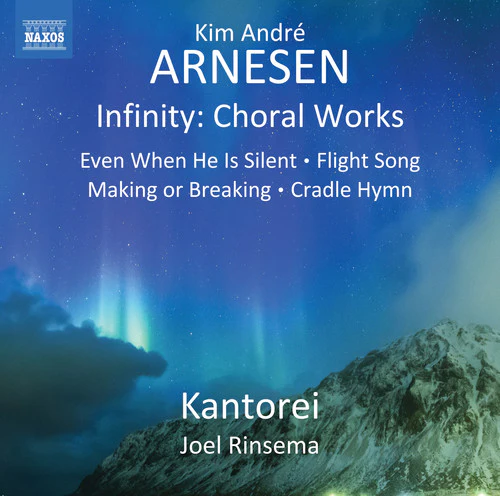
Arnesen: Infinity / Rinsema, Kantorei
Whenever the words “among the most frequently performed” are used in a description of a contemporary choral composer, we usually can expect (if the claim is true) that the music is not only singable by good choral singers (not just professionals) but is also enjoyable to sing–and that it’s readily listenable by most anyone who loves choral music–certainly tonal (usually free of confounding quirks and troublesome crags), with attractive melodies. Even better is if the texts are interesting (unusual, even), enhanced by clever and competently realized music. And, for those who aren’t familiar with Kim André Arnesen–“one of Norway’s most frequently performed contemporary composers”–that’s pretty much what you get on this program of 12 works, several of them receiving their recording premieres.
None of this says anything about how “good” the music is; in fact, some listeners will likely find these pieces not challenging enough–a little too easy to listen to, a little too similar in style and mood. But I wouldn’t go that far. Arnesen builds his music on rich, lush harmonic structures–so yes, there are lots of chords, beautiful, flowing, often the foundation for melody (Flight Song), but sometimes the vibrant, resonating clusters of tones make their own powerful effect without need for a real tune–for example in O Sacrum Convivium, which will remind some listeners of the style of Morten Lauridsen.
Versions of the text in the opening work, lines discovered on a Nazi concentration camp wall (it begins, “I believe in the sun even when it’s not shining…”) have been set by many composers, and Arnesen’s proves as poignant as any, particularly as it focuses so pointedly on the few words–three short lines–capturing in varied musical repetitions the deeply felt, personal, truthful sentiment expressed by that anonymous author in that awful, desperate time and place. Arnesen’s melodic facility appears perhaps most strongly in his Flight Song, which he wrote for Anton Armstrong’s 25th year as St. Olaf Choir conductor–a lovely melody you might have heard someplace before, but not quite. Throughout the program you notice how Arnesen often manages to create engaging pieces of five, six, or seven minutes seemingly without a whole lot of material–again, somewhat in the mold of Lauridsen, but less prone to direct repetition, so the music is more open, more expansive–and we’re just carried along by the dynamic flow of harmony and the beauty of these voices. What finer advocates for his music could a composer have than these excellent singers of Kantorei?
And as for the music itself, I’ve said before: any competent composer can write really difficult music intended only for professional singers (not that there’s anything wrong with that); but it takes a special kind of composer–such as Arnesen–who understands the nature and complexities of choral composition and knows the nature and complexities of singers and singing–and is able to create music of high quality and sophistication that’s both satisfying and accessible to a vast community of accomplished yet non-professional musicians and legions of serious listeners, most of whom appreciate an occasional challenge but who also crave the pure pleasure of musical experience where voices simply soar and harmonies shimmer and there are no grimaces or gritted teeth or ruffled ears anywhere to be found. Yes, there are one or two pieces here that push the schmaltz level slightly past my limit–but even so, that’s a small price to pay for the hour of “pure pleasure” on the rest of the program.
– David Vernier (ClassicsToday)
None of this says anything about how “good” the music is; in fact, some listeners will likely find these pieces not challenging enough–a little too easy to listen to, a little too similar in style and mood. But I wouldn’t go that far. Arnesen builds his music on rich, lush harmonic structures–so yes, there are lots of chords, beautiful, flowing, often the foundation for melody (Flight Song), but sometimes the vibrant, resonating clusters of tones make their own powerful effect without need for a real tune–for example in O Sacrum Convivium, which will remind some listeners of the style of Morten Lauridsen.
Versions of the text in the opening work, lines discovered on a Nazi concentration camp wall (it begins, “I believe in the sun even when it’s not shining…”) have been set by many composers, and Arnesen’s proves as poignant as any, particularly as it focuses so pointedly on the few words–three short lines–capturing in varied musical repetitions the deeply felt, personal, truthful sentiment expressed by that anonymous author in that awful, desperate time and place. Arnesen’s melodic facility appears perhaps most strongly in his Flight Song, which he wrote for Anton Armstrong’s 25th year as St. Olaf Choir conductor–a lovely melody you might have heard someplace before, but not quite. Throughout the program you notice how Arnesen often manages to create engaging pieces of five, six, or seven minutes seemingly without a whole lot of material–again, somewhat in the mold of Lauridsen, but less prone to direct repetition, so the music is more open, more expansive–and we’re just carried along by the dynamic flow of harmony and the beauty of these voices. What finer advocates for his music could a composer have than these excellent singers of Kantorei?
And as for the music itself, I’ve said before: any competent composer can write really difficult music intended only for professional singers (not that there’s anything wrong with that); but it takes a special kind of composer–such as Arnesen–who understands the nature and complexities of choral composition and knows the nature and complexities of singers and singing–and is able to create music of high quality and sophistication that’s both satisfying and accessible to a vast community of accomplished yet non-professional musicians and legions of serious listeners, most of whom appreciate an occasional challenge but who also crave the pure pleasure of musical experience where voices simply soar and harmonies shimmer and there are no grimaces or gritted teeth or ruffled ears anywhere to be found. Yes, there are one or two pieces here that push the schmaltz level slightly past my limit–but even so, that’s a small price to pay for the hour of “pure pleasure” on the rest of the program.
– David Vernier (ClassicsToday)
Whenever the words “among the most frequently performed” are used in a description of a contemporary choral composer, we usually can expect (if the claim is true) that the music is not only singable by good choral singers (not just professionals) but is also enjoyable to sing–and that it’s readily listenable by most anyone who loves choral music–certainly tonal (usually free of confounding quirks and troublesome crags), with attractive melodies. Even better is if the texts are interesting (unusual, even), enhanced by clever and competently realized music. And, for those who aren’t familiar with Kim André Arnesen–“one of Norway’s most frequently performed contemporary composers”–that’s pretty much what you get on this program of 12 works, several of them receiving their recording premieres.
None of this says anything about how “good” the music is; in fact, some listeners will likely find these pieces not challenging enough–a little too easy to listen to, a little too similar in style and mood. But I wouldn’t go that far. Arnesen builds his music on rich, lush harmonic structures–so yes, there are lots of chords, beautiful, flowing, often the foundation for melody (Flight Song), but sometimes the vibrant, resonating clusters of tones make their own powerful effect without need for a real tune–for example in O Sacrum Convivium, which will remind some listeners of the style of Morten Lauridsen.
Versions of the text in the opening work, lines discovered on a Nazi concentration camp wall (it begins, “I believe in the sun even when it’s not shining…”) have been set by many composers, and Arnesen’s proves as poignant as any, particularly as it focuses so pointedly on the few words–three short lines–capturing in varied musical repetitions the deeply felt, personal, truthful sentiment expressed by that anonymous author in that awful, desperate time and place. Arnesen’s melodic facility appears perhaps most strongly in his Flight Song, which he wrote for Anton Armstrong’s 25th year as St. Olaf Choir conductor–a lovely melody you might have heard someplace before, but not quite. Throughout the program you notice how Arnesen often manages to create engaging pieces of five, six, or seven minutes seemingly without a whole lot of material–again, somewhat in the mold of Lauridsen, but less prone to direct repetition, so the music is more open, more expansive–and we’re just carried along by the dynamic flow of harmony and the beauty of these voices. What finer advocates for his music could a composer have than these excellent singers of Kantorei?
And as for the music itself, I’ve said before: any competent composer can write really difficult music intended only for professional singers (not that there’s anything wrong with that); but it takes a special kind of composer–such as Arnesen–who understands the nature and complexities of choral composition and knows the nature and complexities of singers and singing–and is able to create music of high quality and sophistication that’s both satisfying and accessible to a vast community of accomplished yet non-professional musicians and legions of serious listeners, most of whom appreciate an occasional challenge but who also crave the pure pleasure of musical experience where voices simply soar and harmonies shimmer and there are no grimaces or gritted teeth or ruffled ears anywhere to be found. Yes, there are one or two pieces here that push the schmaltz level slightly past my limit–but even so, that’s a small price to pay for the hour of “pure pleasure” on the rest of the program.
– David Vernier (ClassicsToday)
None of this says anything about how “good” the music is; in fact, some listeners will likely find these pieces not challenging enough–a little too easy to listen to, a little too similar in style and mood. But I wouldn’t go that far. Arnesen builds his music on rich, lush harmonic structures–so yes, there are lots of chords, beautiful, flowing, often the foundation for melody (Flight Song), but sometimes the vibrant, resonating clusters of tones make their own powerful effect without need for a real tune–for example in O Sacrum Convivium, which will remind some listeners of the style of Morten Lauridsen.
Versions of the text in the opening work, lines discovered on a Nazi concentration camp wall (it begins, “I believe in the sun even when it’s not shining…”) have been set by many composers, and Arnesen’s proves as poignant as any, particularly as it focuses so pointedly on the few words–three short lines–capturing in varied musical repetitions the deeply felt, personal, truthful sentiment expressed by that anonymous author in that awful, desperate time and place. Arnesen’s melodic facility appears perhaps most strongly in his Flight Song, which he wrote for Anton Armstrong’s 25th year as St. Olaf Choir conductor–a lovely melody you might have heard someplace before, but not quite. Throughout the program you notice how Arnesen often manages to create engaging pieces of five, six, or seven minutes seemingly without a whole lot of material–again, somewhat in the mold of Lauridsen, but less prone to direct repetition, so the music is more open, more expansive–and we’re just carried along by the dynamic flow of harmony and the beauty of these voices. What finer advocates for his music could a composer have than these excellent singers of Kantorei?
And as for the music itself, I’ve said before: any competent composer can write really difficult music intended only for professional singers (not that there’s anything wrong with that); but it takes a special kind of composer–such as Arnesen–who understands the nature and complexities of choral composition and knows the nature and complexities of singers and singing–and is able to create music of high quality and sophistication that’s both satisfying and accessible to a vast community of accomplished yet non-professional musicians and legions of serious listeners, most of whom appreciate an occasional challenge but who also crave the pure pleasure of musical experience where voices simply soar and harmonies shimmer and there are no grimaces or gritted teeth or ruffled ears anywhere to be found. Yes, there are one or two pieces here that push the schmaltz level slightly past my limit–but even so, that’s a small price to pay for the hour of “pure pleasure” on the rest of the program.
– David Vernier (ClassicsToday)
$7.00
Original: $19.99
-65%Arnesen: Infinity / Rinsema, Kantorei—
$19.99
$7.00Description
Whenever the words “among the most frequently performed” are used in a description of a contemporary choral composer, we usually can expect (if the claim is true) that the music is not only singable by good choral singers (not just professionals) but is also enjoyable to sing–and that it’s readily listenable by most anyone who loves choral music–certainly tonal (usually free of confounding quirks and troublesome crags), with attractive melodies. Even better is if the texts are interesting (unusual, even), enhanced by clever and competently realized music. And, for those who aren’t familiar with Kim André Arnesen–“one of Norway’s most frequently performed contemporary composers”–that’s pretty much what you get on this program of 12 works, several of them receiving their recording premieres.
None of this says anything about how “good” the music is; in fact, some listeners will likely find these pieces not challenging enough–a little too easy to listen to, a little too similar in style and mood. But I wouldn’t go that far. Arnesen builds his music on rich, lush harmonic structures–so yes, there are lots of chords, beautiful, flowing, often the foundation for melody (Flight Song), but sometimes the vibrant, resonating clusters of tones make their own powerful effect without need for a real tune–for example in O Sacrum Convivium, which will remind some listeners of the style of Morten Lauridsen.
Versions of the text in the opening work, lines discovered on a Nazi concentration camp wall (it begins, “I believe in the sun even when it’s not shining…”) have been set by many composers, and Arnesen’s proves as poignant as any, particularly as it focuses so pointedly on the few words–three short lines–capturing in varied musical repetitions the deeply felt, personal, truthful sentiment expressed by that anonymous author in that awful, desperate time and place. Arnesen’s melodic facility appears perhaps most strongly in his Flight Song, which he wrote for Anton Armstrong’s 25th year as St. Olaf Choir conductor–a lovely melody you might have heard someplace before, but not quite. Throughout the program you notice how Arnesen often manages to create engaging pieces of five, six, or seven minutes seemingly without a whole lot of material–again, somewhat in the mold of Lauridsen, but less prone to direct repetition, so the music is more open, more expansive–and we’re just carried along by the dynamic flow of harmony and the beauty of these voices. What finer advocates for his music could a composer have than these excellent singers of Kantorei?
And as for the music itself, I’ve said before: any competent composer can write really difficult music intended only for professional singers (not that there’s anything wrong with that); but it takes a special kind of composer–such as Arnesen–who understands the nature and complexities of choral composition and knows the nature and complexities of singers and singing–and is able to create music of high quality and sophistication that’s both satisfying and accessible to a vast community of accomplished yet non-professional musicians and legions of serious listeners, most of whom appreciate an occasional challenge but who also crave the pure pleasure of musical experience where voices simply soar and harmonies shimmer and there are no grimaces or gritted teeth or ruffled ears anywhere to be found. Yes, there are one or two pieces here that push the schmaltz level slightly past my limit–but even so, that’s a small price to pay for the hour of “pure pleasure” on the rest of the program.
– David Vernier (ClassicsToday)
None of this says anything about how “good” the music is; in fact, some listeners will likely find these pieces not challenging enough–a little too easy to listen to, a little too similar in style and mood. But I wouldn’t go that far. Arnesen builds his music on rich, lush harmonic structures–so yes, there are lots of chords, beautiful, flowing, often the foundation for melody (Flight Song), but sometimes the vibrant, resonating clusters of tones make their own powerful effect without need for a real tune–for example in O Sacrum Convivium, which will remind some listeners of the style of Morten Lauridsen.
Versions of the text in the opening work, lines discovered on a Nazi concentration camp wall (it begins, “I believe in the sun even when it’s not shining…”) have been set by many composers, and Arnesen’s proves as poignant as any, particularly as it focuses so pointedly on the few words–three short lines–capturing in varied musical repetitions the deeply felt, personal, truthful sentiment expressed by that anonymous author in that awful, desperate time and place. Arnesen’s melodic facility appears perhaps most strongly in his Flight Song, which he wrote for Anton Armstrong’s 25th year as St. Olaf Choir conductor–a lovely melody you might have heard someplace before, but not quite. Throughout the program you notice how Arnesen often manages to create engaging pieces of five, six, or seven minutes seemingly without a whole lot of material–again, somewhat in the mold of Lauridsen, but less prone to direct repetition, so the music is more open, more expansive–and we’re just carried along by the dynamic flow of harmony and the beauty of these voices. What finer advocates for his music could a composer have than these excellent singers of Kantorei?
And as for the music itself, I’ve said before: any competent composer can write really difficult music intended only for professional singers (not that there’s anything wrong with that); but it takes a special kind of composer–such as Arnesen–who understands the nature and complexities of choral composition and knows the nature and complexities of singers and singing–and is able to create music of high quality and sophistication that’s both satisfying and accessible to a vast community of accomplished yet non-professional musicians and legions of serious listeners, most of whom appreciate an occasional challenge but who also crave the pure pleasure of musical experience where voices simply soar and harmonies shimmer and there are no grimaces or gritted teeth or ruffled ears anywhere to be found. Yes, there are one or two pieces here that push the schmaltz level slightly past my limit–but even so, that’s a small price to pay for the hour of “pure pleasure” on the rest of the program.
– David Vernier (ClassicsToday)