🎉 Up to 70% Off Selected ItemsShop Sale

1 / 2
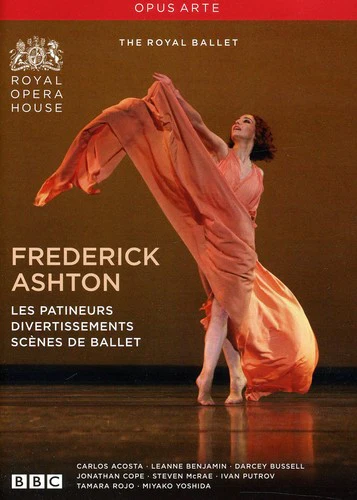
Ashton: Les Patineurs, Divertissements, Scenes De Ballet / Royal Opera House Ballet
An all-Ashton DVD is a treat, for apart from several full-length ballets we have been lacking examples of the choreographer’s work in shorter pieces. Les Patineurs is a hardy classic, dating from 1937, and makes a wonderful introduction to the work of one of the major choreographers of the 20th century. Meyerbeer’s catchy music inspires Ashton not only in the pas de deux with its fan lifts, but also the male solo, which is as virtuoso as can be. The dancers maintain a skating step throughout, but it is the variety of which Ashton is master that continues to astound us. The dueling girls who try to outdo one another offer further examples of virtuosity, which make us wonder at the qualities of the dancers of 75 years ago. Today, with Stephen McRae as the Blue Boy and Sarah Lamb and Rupert Pennefeather as the Lovers, we can still sense the excitement of balletgoers of an earlier epoch.
Scènes de Ballet is a postwar creation that has never achieved the widespread currency of Patineurs , yet remains a signal piece in Ashton’s oeuvre, much as Symphonic Variations, of which we desperately need documentation. A lead couple is supported by four men and a corps of women, and the choreographer continually astounds us with the patterns he weaves. His response to Stravinsky is perhaps not as direct as that of Balanchine, but then Mr. B never gave us his version of this “dancy” work. It is nonetheless fascinating to watch the Ashtonian sensibility at work, while Miyako Yoshida and Ivan Putrov show off both the music and the choreography. Ashton’s delicate references to such classics as the Rose Adagio from Sleeping Beauty cannot be missed. André Beaurepaire’s sets and costumes are the only things that appear dated in what is otherwise a major contribution to the repertoire of the Royal Ballet.
The divertissements show Ashton’s craftsmanship in the “Awakening” pas de deux from Sleeping Beauty with the ravishing Darcey Bussell and Jonathan Cope; two excerpts from a wartime ballet created for American Ballet Theatre; Devil’s Holiday , especially the man’s solo eloquently danced by Viacheslav Samodurov; and three pièces d’occasion : a duet to the Méditation from Massenet’s Thaïs (Mara Galeazzi and Thiago Soares), Five Brahms Waltzes in the Manner of Isadora Duncan (Tamara Rojo), and the Voices of Spring pas de deux (Leanne Benjamin and Carlos Acosta). The Brahms is the most interesting of the lot as Ashton had seen Duncan when he was a young man, and later created his own work for Lynn Seymour. Rojo is astounding in this re-creation, as she conveys Ashton’s own impressions but also embodies much of what one has read about Duncan in other sources.
FANFARE: Joel Kasow
Scènes de Ballet is a postwar creation that has never achieved the widespread currency of Patineurs , yet remains a signal piece in Ashton’s oeuvre, much as Symphonic Variations, of which we desperately need documentation. A lead couple is supported by four men and a corps of women, and the choreographer continually astounds us with the patterns he weaves. His response to Stravinsky is perhaps not as direct as that of Balanchine, but then Mr. B never gave us his version of this “dancy” work. It is nonetheless fascinating to watch the Ashtonian sensibility at work, while Miyako Yoshida and Ivan Putrov show off both the music and the choreography. Ashton’s delicate references to such classics as the Rose Adagio from Sleeping Beauty cannot be missed. André Beaurepaire’s sets and costumes are the only things that appear dated in what is otherwise a major contribution to the repertoire of the Royal Ballet.
The divertissements show Ashton’s craftsmanship in the “Awakening” pas de deux from Sleeping Beauty with the ravishing Darcey Bussell and Jonathan Cope; two excerpts from a wartime ballet created for American Ballet Theatre; Devil’s Holiday , especially the man’s solo eloquently danced by Viacheslav Samodurov; and three pièces d’occasion : a duet to the Méditation from Massenet’s Thaïs (Mara Galeazzi and Thiago Soares), Five Brahms Waltzes in the Manner of Isadora Duncan (Tamara Rojo), and the Voices of Spring pas de deux (Leanne Benjamin and Carlos Acosta). The Brahms is the most interesting of the lot as Ashton had seen Duncan when he was a young man, and later created his own work for Lynn Seymour. Rojo is astounding in this re-creation, as she conveys Ashton’s own impressions but also embodies much of what one has read about Duncan in other sources.
FANFARE: Joel Kasow
An all-Ashton DVD is a treat, for apart from several full-length ballets we have been lacking examples of the choreographer’s work in shorter pieces. Les Patineurs is a hardy classic, dating from 1937, and makes a wonderful introduction to the work of one of the major choreographers of the 20th century. Meyerbeer’s catchy music inspires Ashton not only in the pas de deux with its fan lifts, but also the male solo, which is as virtuoso as can be. The dancers maintain a skating step throughout, but it is the variety of which Ashton is master that continues to astound us. The dueling girls who try to outdo one another offer further examples of virtuosity, which make us wonder at the qualities of the dancers of 75 years ago. Today, with Stephen McRae as the Blue Boy and Sarah Lamb and Rupert Pennefeather as the Lovers, we can still sense the excitement of balletgoers of an earlier epoch.
Scènes de Ballet is a postwar creation that has never achieved the widespread currency of Patineurs , yet remains a signal piece in Ashton’s oeuvre, much as Symphonic Variations, of which we desperately need documentation. A lead couple is supported by four men and a corps of women, and the choreographer continually astounds us with the patterns he weaves. His response to Stravinsky is perhaps not as direct as that of Balanchine, but then Mr. B never gave us his version of this “dancy” work. It is nonetheless fascinating to watch the Ashtonian sensibility at work, while Miyako Yoshida and Ivan Putrov show off both the music and the choreography. Ashton’s delicate references to such classics as the Rose Adagio from Sleeping Beauty cannot be missed. André Beaurepaire’s sets and costumes are the only things that appear dated in what is otherwise a major contribution to the repertoire of the Royal Ballet.
The divertissements show Ashton’s craftsmanship in the “Awakening” pas de deux from Sleeping Beauty with the ravishing Darcey Bussell and Jonathan Cope; two excerpts from a wartime ballet created for American Ballet Theatre; Devil’s Holiday , especially the man’s solo eloquently danced by Viacheslav Samodurov; and three pièces d’occasion : a duet to the Méditation from Massenet’s Thaïs (Mara Galeazzi and Thiago Soares), Five Brahms Waltzes in the Manner of Isadora Duncan (Tamara Rojo), and the Voices of Spring pas de deux (Leanne Benjamin and Carlos Acosta). The Brahms is the most interesting of the lot as Ashton had seen Duncan when he was a young man, and later created his own work for Lynn Seymour. Rojo is astounding in this re-creation, as she conveys Ashton’s own impressions but also embodies much of what one has read about Duncan in other sources.
FANFARE: Joel Kasow
Scènes de Ballet is a postwar creation that has never achieved the widespread currency of Patineurs , yet remains a signal piece in Ashton’s oeuvre, much as Symphonic Variations, of which we desperately need documentation. A lead couple is supported by four men and a corps of women, and the choreographer continually astounds us with the patterns he weaves. His response to Stravinsky is perhaps not as direct as that of Balanchine, but then Mr. B never gave us his version of this “dancy” work. It is nonetheless fascinating to watch the Ashtonian sensibility at work, while Miyako Yoshida and Ivan Putrov show off both the music and the choreography. Ashton’s delicate references to such classics as the Rose Adagio from Sleeping Beauty cannot be missed. André Beaurepaire’s sets and costumes are the only things that appear dated in what is otherwise a major contribution to the repertoire of the Royal Ballet.
The divertissements show Ashton’s craftsmanship in the “Awakening” pas de deux from Sleeping Beauty with the ravishing Darcey Bussell and Jonathan Cope; two excerpts from a wartime ballet created for American Ballet Theatre; Devil’s Holiday , especially the man’s solo eloquently danced by Viacheslav Samodurov; and three pièces d’occasion : a duet to the Méditation from Massenet’s Thaïs (Mara Galeazzi and Thiago Soares), Five Brahms Waltzes in the Manner of Isadora Duncan (Tamara Rojo), and the Voices of Spring pas de deux (Leanne Benjamin and Carlos Acosta). The Brahms is the most interesting of the lot as Ashton had seen Duncan when he was a young man, and later created his own work for Lynn Seymour. Rojo is astounding in this re-creation, as she conveys Ashton’s own impressions but also embodies much of what one has read about Duncan in other sources.
FANFARE: Joel Kasow
$9.45
Original: $26.99
-65%Ashton: Les Patineurs, Divertissements, Scenes De Ballet / Royal Opera House Ballet—
$26.99
$9.45Description
An all-Ashton DVD is a treat, for apart from several full-length ballets we have been lacking examples of the choreographer’s work in shorter pieces. Les Patineurs is a hardy classic, dating from 1937, and makes a wonderful introduction to the work of one of the major choreographers of the 20th century. Meyerbeer’s catchy music inspires Ashton not only in the pas de deux with its fan lifts, but also the male solo, which is as virtuoso as can be. The dancers maintain a skating step throughout, but it is the variety of which Ashton is master that continues to astound us. The dueling girls who try to outdo one another offer further examples of virtuosity, which make us wonder at the qualities of the dancers of 75 years ago. Today, with Stephen McRae as the Blue Boy and Sarah Lamb and Rupert Pennefeather as the Lovers, we can still sense the excitement of balletgoers of an earlier epoch.
Scènes de Ballet is a postwar creation that has never achieved the widespread currency of Patineurs , yet remains a signal piece in Ashton’s oeuvre, much as Symphonic Variations, of which we desperately need documentation. A lead couple is supported by four men and a corps of women, and the choreographer continually astounds us with the patterns he weaves. His response to Stravinsky is perhaps not as direct as that of Balanchine, but then Mr. B never gave us his version of this “dancy” work. It is nonetheless fascinating to watch the Ashtonian sensibility at work, while Miyako Yoshida and Ivan Putrov show off both the music and the choreography. Ashton’s delicate references to such classics as the Rose Adagio from Sleeping Beauty cannot be missed. André Beaurepaire’s sets and costumes are the only things that appear dated in what is otherwise a major contribution to the repertoire of the Royal Ballet.
The divertissements show Ashton’s craftsmanship in the “Awakening” pas de deux from Sleeping Beauty with the ravishing Darcey Bussell and Jonathan Cope; two excerpts from a wartime ballet created for American Ballet Theatre; Devil’s Holiday , especially the man’s solo eloquently danced by Viacheslav Samodurov; and three pièces d’occasion : a duet to the Méditation from Massenet’s Thaïs (Mara Galeazzi and Thiago Soares), Five Brahms Waltzes in the Manner of Isadora Duncan (Tamara Rojo), and the Voices of Spring pas de deux (Leanne Benjamin and Carlos Acosta). The Brahms is the most interesting of the lot as Ashton had seen Duncan when he was a young man, and later created his own work for Lynn Seymour. Rojo is astounding in this re-creation, as she conveys Ashton’s own impressions but also embodies much of what one has read about Duncan in other sources.
FANFARE: Joel Kasow
Scènes de Ballet is a postwar creation that has never achieved the widespread currency of Patineurs , yet remains a signal piece in Ashton’s oeuvre, much as Symphonic Variations, of which we desperately need documentation. A lead couple is supported by four men and a corps of women, and the choreographer continually astounds us with the patterns he weaves. His response to Stravinsky is perhaps not as direct as that of Balanchine, but then Mr. B never gave us his version of this “dancy” work. It is nonetheless fascinating to watch the Ashtonian sensibility at work, while Miyako Yoshida and Ivan Putrov show off both the music and the choreography. Ashton’s delicate references to such classics as the Rose Adagio from Sleeping Beauty cannot be missed. André Beaurepaire’s sets and costumes are the only things that appear dated in what is otherwise a major contribution to the repertoire of the Royal Ballet.
The divertissements show Ashton’s craftsmanship in the “Awakening” pas de deux from Sleeping Beauty with the ravishing Darcey Bussell and Jonathan Cope; two excerpts from a wartime ballet created for American Ballet Theatre; Devil’s Holiday , especially the man’s solo eloquently danced by Viacheslav Samodurov; and three pièces d’occasion : a duet to the Méditation from Massenet’s Thaïs (Mara Galeazzi and Thiago Soares), Five Brahms Waltzes in the Manner of Isadora Duncan (Tamara Rojo), and the Voices of Spring pas de deux (Leanne Benjamin and Carlos Acosta). The Brahms is the most interesting of the lot as Ashton had seen Duncan when he was a young man, and later created his own work for Lynn Seymour. Rojo is astounding in this re-creation, as she conveys Ashton’s own impressions but also embodies much of what one has read about Duncan in other sources.
FANFARE: Joel Kasow