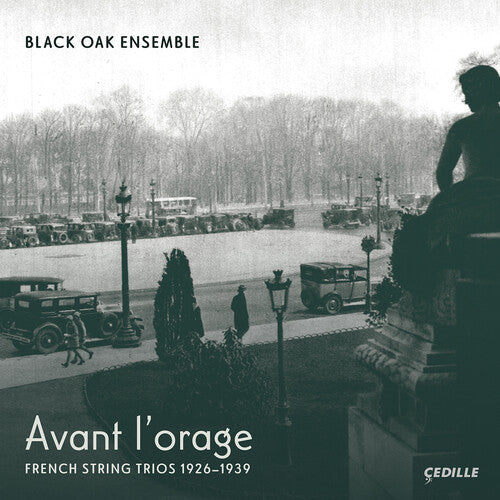
Avant l’orage - French String Trios 1926-1939 / Black Oak Ensemble
Black Oak Ensemble, the Chicago-based string trio with an international following, treats listeners to a double-album of stylish and often witty French treasures written between the World Wars. The ensemble offers seven rarely heard delicacies from the 1920s and 30s, including world premiere recordings of trios by Henri Tomasi, Robert Casadesus, and Gustave Samazeuilh, along with works by Jean Cras, Emile Goué, Jean Françaix, and Gabriel Pierné. Most were written for and dedicated to the virtuosic Trio Pasquier, which ranked among the era’s chamber music superstars.
Tomasi’s Mediterranean roots are heard in the Provençal folk melody referenced in his Trio à cordes en forme de divertissement, noted for its colorful, kaleidoscopic finale. Casadesus’s Trio à cordes combines fine craftsmanship and poetic sincerity. Samazeuilh, a disciple of Claude Debussy, wrote his Suite en trio in the form of a Baroque dance suite. Celtic-infused folk music of his native Brittany emerges in Cras’s Trio pour violon, alto et violoncelle, as does an homage to Beethoven’s Op. 132 string quartet. Goué wrote his Trio pour violon, alto et violoncelle, energized with folk-dance elements, on the eve of his World War II army deployment. Françaix’s Trio displays his trademark textural clarity, agility, and sense of humor. Pierné’s Trois pièces en trio has even more fun with the listener with its satirical finale conjuring intoxicated, stumbling house cats out on the town.
REVIEWS:
Occasionally you hear a commentator use the term “accessible” to describe a musical work or style. Yet, as with other terms such as “affordable” in reference to housing, without context it is virtually meaningless: we need to know who is applying the term and to what it’s being compared. So, when I assert that most listeners will find the seven works on these two smartly programmed discs “accessible”, it is as much about what they are not than what they exhibit in style and musical substance.
For anyone at all concerned about setting forth on a journey through two hours of unfamiliar 20th century chamber works–string trios, no less!–be assured that throughout this program you will encounter nothing of the atonal, anti-melodic, thematically ambiguous, or deliberately arcane efforts that characterize many works from this same period (“Avant l’orage”, “before the storm”). Regarding the term “accessible”, you will find in each of these works not only a “way in” that’s familiar and (to most listeners) comprehensible, but music that is unfailingly captivating, thought-provoking, and challenging, all in ways that both entertain and enlighten. Now how can you do better than that?
Henri Tomasi’s Trio (1938), one of three recording world premieres on the disc, makes an excellent opener, its pleasingly assertive Prélude, an uneasy, restless Nocturne, mischievous Scherzo, and relentlessly energetic, folk-like Final drawing us in with an irresistible, festive air that also shows off the Black Oak Ensemble’s range of virtuosity, color, and style.
Jean Cras’ 1926 Trio has many highlights throughout its four substantial movements (24 minutes), but the fourth may be the most notable–a dance, whose rhythmic progression and character is anything but predictable!
Jean Françaix, successful performer and prolific composer who early on caught the attention of Ravel, dedicated his 1933 Trio to the three brothers who made up the Pasquier Trio (also the dedicatees of Tomasi’s Trio). You may never have seen a tempo designation of “Allegretto vivo” (this work’s first movement), but in their delightful, dexterous, precisely controlled moto perpetuo frenzy the Black Oak musicians leave no question as to their interpretation of the term! And has there ever been a Scherzo more deserving, or illustrative, of its name? Or played with a truer sense of joy and humor? The final Rondo is a fabulously virtuosic complex of rhythm and meter changes, and again these players nail the shifts and turns with requisite technical precision and musical flair.
If you know Robert Casadesus primarily–or exclusively–as a pianist, here’s your chance to get to know some of his scarce yet very fine work as a composer. His Trio à cordes from 1938, also dedicated to the Pasquier Trio–and also a world-premiere recording–may not be the most sophisticated or inventive work on the program, but it shows an intriguing interplay among instruments and well-developed sense of momentum by force of melodic/thematic development and strong rhythmic presence.
The third premiere recording is Gustave Samazeuilh’s 1937 Suite. Although its six movements are modeled on “the form of a Baroque dance suite”, you won’t hear anything stylistically related in the music itself. Yes, it’s very tonal, but has more in common with 19th-century Romanticism. And it’s all very lovely, originally written for piano and re-scored for, you guessed it, the Trio Pasquier. Here the Black Oak players seem to revel in the inherent opportunities for highlighting the music’s richness of timbre and singing melodies.
There are many other discoveries and delights to be found in the remaining trios by Émile Goué and Gabriel Pierné–which by now you will hopefully be looking forward to hearing for yourself. And I have to say that if I were one of the composers represented here I would feel blessed to have such advocates as the three musicians of Black Oak Ensemble: Desirée Ruhstrat (violin); Aurélien Fort Pederzoli (viola); David Cunliffe (violoncello).
This is difficult, challenging music that requires not only a comprehensive, deeply felt sense of style and prodigious technical facility, but an understanding of how to differentiate the expressive demands of a collection of pieces that are in some ways similar, but in more ways quite different, and how as an ensemble to make each stand out and stand in its own deserving space. Not only does the Black Oak Ensemble achieve this, but their effort makes you more than eager to hear the whole thing again. I’m happy to say that you’ll also learn a lot from the excellent notes by Elinor Olin. Accessible, enduring, enlightening, and highly recommended.
-- ClassicsToday.com (10/10, David Vernier)
Henri Tomasi’s vital and communicative string trio is a very satisfying work written in the minor, alternating some Debussy-isms with a Stravinskian touches. The third movement includes some truly fascinating polyrhythmic figures that drive the music forward through its bitonal theme and variants, and the Finale is even more interesting, including quite a bit of non-jazz syncopation.
The trio by Jean Cras is a little more old-style but not ultra-Romantic, at least not the way it’s played here. The music uses bitonality but is not as much on the edge as the Tomasi piece, yet it is still an interesting, well-written work.
The Goué Trio is bouncy and sprightly. It contains some novel ideas as well as shifting meters and tempi in its first movement, and the last movement is an ingenious recasting of tarantella rhythms.
The Françaix trio is in his usual modern-but-entertaining style, including funny “drunk”-sounding passages in the first and last movements, although it is not one of his works most frequently recorded, and the Black Oak Ensemble again plays this, as all the other works, in a peppy manner.
Unlike most of the other composers presented here, Robert Casedesus’ compositions are relatively few. This one has some fun with overlapping and interlocking rhythmic patterns, which the notes suggest might resemble some of his train travel. The music is interesting and a little eerie-sounding—at least, until a full stop introduces a surprisingly sprightly new theme in a fast 6/8. Once again, we have here a formerly unheard gem.
Gustave Samazeuilh’s trio is the most old-fashioned-sounding, by far, in this entire collection, a real late-Romantic piece played in a post-modern manner by the ensemble. The fourth-movement “Divertissement” uses some extended chords in its harmonic base, lively use of 3/4 rhythm, as well as interesting harmonic touches in the last-movement “Forlane.”
[This] is clearly an important release for its inclusion of so much good but rarely-heard and some formerly unrecorded music. It is definitely one of the best classical releases of the year.
--The Art Music Lounge (Lynn René Bayley)
Black Oak Ensemble, the Chicago-based string trio with an international following, treats listeners to a double-album of stylish and often witty French treasures written between the World Wars. The ensemble offers seven rarely heard delicacies from the 1920s and 30s, including world premiere recordings of trios by Henri Tomasi, Robert Casadesus, and Gustave Samazeuilh, along with works by Jean Cras, Emile Goué, Jean Françaix, and Gabriel Pierné. Most were written for and dedicated to the virtuosic Trio Pasquier, which ranked among the era’s chamber music superstars.
Tomasi’s Mediterranean roots are heard in the Provençal folk melody referenced in his Trio à cordes en forme de divertissement, noted for its colorful, kaleidoscopic finale. Casadesus’s Trio à cordes combines fine craftsmanship and poetic sincerity. Samazeuilh, a disciple of Claude Debussy, wrote his Suite en trio in the form of a Baroque dance suite. Celtic-infused folk music of his native Brittany emerges in Cras’s Trio pour violon, alto et violoncelle, as does an homage to Beethoven’s Op. 132 string quartet. Goué wrote his Trio pour violon, alto et violoncelle, energized with folk-dance elements, on the eve of his World War II army deployment. Françaix’s Trio displays his trademark textural clarity, agility, and sense of humor. Pierné’s Trois pièces en trio has even more fun with the listener with its satirical finale conjuring intoxicated, stumbling house cats out on the town.
REVIEWS:
Occasionally you hear a commentator use the term “accessible” to describe a musical work or style. Yet, as with other terms such as “affordable” in reference to housing, without context it is virtually meaningless: we need to know who is applying the term and to what it’s being compared. So, when I assert that most listeners will find the seven works on these two smartly programmed discs “accessible”, it is as much about what they are not than what they exhibit in style and musical substance.
For anyone at all concerned about setting forth on a journey through two hours of unfamiliar 20th century chamber works–string trios, no less!–be assured that throughout this program you will encounter nothing of the atonal, anti-melodic, thematically ambiguous, or deliberately arcane efforts that characterize many works from this same period (“Avant l’orage”, “before the storm”). Regarding the term “accessible”, you will find in each of these works not only a “way in” that’s familiar and (to most listeners) comprehensible, but music that is unfailingly captivating, thought-provoking, and challenging, all in ways that both entertain and enlighten. Now how can you do better than that?
Henri Tomasi’s Trio (1938), one of three recording world premieres on the disc, makes an excellent opener, its pleasingly assertive Prélude, an uneasy, restless Nocturne, mischievous Scherzo, and relentlessly energetic, folk-like Final drawing us in with an irresistible, festive air that also shows off the Black Oak Ensemble’s range of virtuosity, color, and style.
Jean Cras’ 1926 Trio has many highlights throughout its four substantial movements (24 minutes), but the fourth may be the most notable–a dance, whose rhythmic progression and character is anything but predictable!
Jean Françaix, successful performer and prolific composer who early on caught the attention of Ravel, dedicated his 1933 Trio to the three brothers who made up the Pasquier Trio (also the dedicatees of Tomasi’s Trio). You may never have seen a tempo designation of “Allegretto vivo” (this work’s first movement), but in their delightful, dexterous, precisely controlled moto perpetuo frenzy the Black Oak musicians leave no question as to their interpretation of the term! And has there ever been a Scherzo more deserving, or illustrative, of its name? Or played with a truer sense of joy and humor? The final Rondo is a fabulously virtuosic complex of rhythm and meter changes, and again these players nail the shifts and turns with requisite technical precision and musical flair.
If you know Robert Casadesus primarily–or exclusively–as a pianist, here’s your chance to get to know some of his scarce yet very fine work as a composer. His Trio à cordes from 1938, also dedicated to the Pasquier Trio–and also a world-premiere recording–may not be the most sophisticated or inventive work on the program, but it shows an intriguing interplay among instruments and well-developed sense of momentum by force of melodic/thematic development and strong rhythmic presence.
The third premiere recording is Gustave Samazeuilh’s 1937 Suite. Although its six movements are modeled on “the form of a Baroque dance suite”, you won’t hear anything stylistically related in the music itself. Yes, it’s very tonal, but has more in common with 19th-century Romanticism. And it’s all very lovely, originally written for piano and re-scored for, you guessed it, the Trio Pasquier. Here the Black Oak players seem to revel in the inherent opportunities for highlighting the music’s richness of timbre and singing melodies.
There are many other discoveries and delights to be found in the remaining trios by Émile Goué and Gabriel Pierné–which by now you will hopefully be looking forward to hearing for yourself. And I have to say that if I were one of the composers represented here I would feel blessed to have such advocates as the three musicians of Black Oak Ensemble: Desirée Ruhstrat (violin); Aurélien Fort Pederzoli (viola); David Cunliffe (violoncello).
This is difficult, challenging music that requires not only a comprehensive, deeply felt sense of style and prodigious technical facility, but an understanding of how to differentiate the expressive demands of a collection of pieces that are in some ways similar, but in more ways quite different, and how as an ensemble to make each stand out and stand in its own deserving space. Not only does the Black Oak Ensemble achieve this, but their effort makes you more than eager to hear the whole thing again. I’m happy to say that you’ll also learn a lot from the excellent notes by Elinor Olin. Accessible, enduring, enlightening, and highly recommended.
-- ClassicsToday.com (10/10, David Vernier)
Henri Tomasi’s vital and communicative string trio is a very satisfying work written in the minor, alternating some Debussy-isms with a Stravinskian touches. The third movement includes some truly fascinating polyrhythmic figures that drive the music forward through its bitonal theme and variants, and the Finale is even more interesting, including quite a bit of non-jazz syncopation.
The trio by Jean Cras is a little more old-style but not ultra-Romantic, at least not the way it’s played here. The music uses bitonality but is not as much on the edge as the Tomasi piece, yet it is still an interesting, well-written work.
The Goué Trio is bouncy and sprightly. It contains some novel ideas as well as shifting meters and tempi in its first movement, and the last movement is an ingenious recasting of tarantella rhythms.
The Françaix trio is in his usual modern-but-entertaining style, including funny “drunk”-sounding passages in the first and last movements, although it is not one of his works most frequently recorded, and the Black Oak Ensemble again plays this, as all the other works, in a peppy manner.
Unlike most of the other composers presented here, Robert Casedesus’ compositions are relatively few. This one has some fun with overlapping and interlocking rhythmic patterns, which the notes suggest might resemble some of his train travel. The music is interesting and a little eerie-sounding—at least, until a full stop introduces a surprisingly sprightly new theme in a fast 6/8. Once again, we have here a formerly unheard gem.
Gustave Samazeuilh’s trio is the most old-fashioned-sounding, by far, in this entire collection, a real late-Romantic piece played in a post-modern manner by the ensemble. The fourth-movement “Divertissement” uses some extended chords in its harmonic base, lively use of 3/4 rhythm, as well as interesting harmonic touches in the last-movement “Forlane.”
[This] is clearly an important release for its inclusion of so much good but rarely-heard and some formerly unrecorded music. It is definitely one of the best classical releases of the year.
--The Art Music Lounge (Lynn René Bayley)
Original: $14.99
-65%$14.99
$5.25Description
Black Oak Ensemble, the Chicago-based string trio with an international following, treats listeners to a double-album of stylish and often witty French treasures written between the World Wars. The ensemble offers seven rarely heard delicacies from the 1920s and 30s, including world premiere recordings of trios by Henri Tomasi, Robert Casadesus, and Gustave Samazeuilh, along with works by Jean Cras, Emile Goué, Jean Françaix, and Gabriel Pierné. Most were written for and dedicated to the virtuosic Trio Pasquier, which ranked among the era’s chamber music superstars.
Tomasi’s Mediterranean roots are heard in the Provençal folk melody referenced in his Trio à cordes en forme de divertissement, noted for its colorful, kaleidoscopic finale. Casadesus’s Trio à cordes combines fine craftsmanship and poetic sincerity. Samazeuilh, a disciple of Claude Debussy, wrote his Suite en trio in the form of a Baroque dance suite. Celtic-infused folk music of his native Brittany emerges in Cras’s Trio pour violon, alto et violoncelle, as does an homage to Beethoven’s Op. 132 string quartet. Goué wrote his Trio pour violon, alto et violoncelle, energized with folk-dance elements, on the eve of his World War II army deployment. Françaix’s Trio displays his trademark textural clarity, agility, and sense of humor. Pierné’s Trois pièces en trio has even more fun with the listener with its satirical finale conjuring intoxicated, stumbling house cats out on the town.
REVIEWS:
Occasionally you hear a commentator use the term “accessible” to describe a musical work or style. Yet, as with other terms such as “affordable” in reference to housing, without context it is virtually meaningless: we need to know who is applying the term and to what it’s being compared. So, when I assert that most listeners will find the seven works on these two smartly programmed discs “accessible”, it is as much about what they are not than what they exhibit in style and musical substance.
For anyone at all concerned about setting forth on a journey through two hours of unfamiliar 20th century chamber works–string trios, no less!–be assured that throughout this program you will encounter nothing of the atonal, anti-melodic, thematically ambiguous, or deliberately arcane efforts that characterize many works from this same period (“Avant l’orage”, “before the storm”). Regarding the term “accessible”, you will find in each of these works not only a “way in” that’s familiar and (to most listeners) comprehensible, but music that is unfailingly captivating, thought-provoking, and challenging, all in ways that both entertain and enlighten. Now how can you do better than that?
Henri Tomasi’s Trio (1938), one of three recording world premieres on the disc, makes an excellent opener, its pleasingly assertive Prélude, an uneasy, restless Nocturne, mischievous Scherzo, and relentlessly energetic, folk-like Final drawing us in with an irresistible, festive air that also shows off the Black Oak Ensemble’s range of virtuosity, color, and style.
Jean Cras’ 1926 Trio has many highlights throughout its four substantial movements (24 minutes), but the fourth may be the most notable–a dance, whose rhythmic progression and character is anything but predictable!
Jean Françaix, successful performer and prolific composer who early on caught the attention of Ravel, dedicated his 1933 Trio to the three brothers who made up the Pasquier Trio (also the dedicatees of Tomasi’s Trio). You may never have seen a tempo designation of “Allegretto vivo” (this work’s first movement), but in their delightful, dexterous, precisely controlled moto perpetuo frenzy the Black Oak musicians leave no question as to their interpretation of the term! And has there ever been a Scherzo more deserving, or illustrative, of its name? Or played with a truer sense of joy and humor? The final Rondo is a fabulously virtuosic complex of rhythm and meter changes, and again these players nail the shifts and turns with requisite technical precision and musical flair.
If you know Robert Casadesus primarily–or exclusively–as a pianist, here’s your chance to get to know some of his scarce yet very fine work as a composer. His Trio à cordes from 1938, also dedicated to the Pasquier Trio–and also a world-premiere recording–may not be the most sophisticated or inventive work on the program, but it shows an intriguing interplay among instruments and well-developed sense of momentum by force of melodic/thematic development and strong rhythmic presence.
The third premiere recording is Gustave Samazeuilh’s 1937 Suite. Although its six movements are modeled on “the form of a Baroque dance suite”, you won’t hear anything stylistically related in the music itself. Yes, it’s very tonal, but has more in common with 19th-century Romanticism. And it’s all very lovely, originally written for piano and re-scored for, you guessed it, the Trio Pasquier. Here the Black Oak players seem to revel in the inherent opportunities for highlighting the music’s richness of timbre and singing melodies.
There are many other discoveries and delights to be found in the remaining trios by Émile Goué and Gabriel Pierné–which by now you will hopefully be looking forward to hearing for yourself. And I have to say that if I were one of the composers represented here I would feel blessed to have such advocates as the three musicians of Black Oak Ensemble: Desirée Ruhstrat (violin); Aurélien Fort Pederzoli (viola); David Cunliffe (violoncello).
This is difficult, challenging music that requires not only a comprehensive, deeply felt sense of style and prodigious technical facility, but an understanding of how to differentiate the expressive demands of a collection of pieces that are in some ways similar, but in more ways quite different, and how as an ensemble to make each stand out and stand in its own deserving space. Not only does the Black Oak Ensemble achieve this, but their effort makes you more than eager to hear the whole thing again. I’m happy to say that you’ll also learn a lot from the excellent notes by Elinor Olin. Accessible, enduring, enlightening, and highly recommended.
-- ClassicsToday.com (10/10, David Vernier)
Henri Tomasi’s vital and communicative string trio is a very satisfying work written in the minor, alternating some Debussy-isms with a Stravinskian touches. The third movement includes some truly fascinating polyrhythmic figures that drive the music forward through its bitonal theme and variants, and the Finale is even more interesting, including quite a bit of non-jazz syncopation.
The trio by Jean Cras is a little more old-style but not ultra-Romantic, at least not the way it’s played here. The music uses bitonality but is not as much on the edge as the Tomasi piece, yet it is still an interesting, well-written work.
The Goué Trio is bouncy and sprightly. It contains some novel ideas as well as shifting meters and tempi in its first movement, and the last movement is an ingenious recasting of tarantella rhythms.
The Françaix trio is in his usual modern-but-entertaining style, including funny “drunk”-sounding passages in the first and last movements, although it is not one of his works most frequently recorded, and the Black Oak Ensemble again plays this, as all the other works, in a peppy manner.
Unlike most of the other composers presented here, Robert Casedesus’ compositions are relatively few. This one has some fun with overlapping and interlocking rhythmic patterns, which the notes suggest might resemble some of his train travel. The music is interesting and a little eerie-sounding—at least, until a full stop introduces a surprisingly sprightly new theme in a fast 6/8. Once again, we have here a formerly unheard gem.
Gustave Samazeuilh’s trio is the most old-fashioned-sounding, by far, in this entire collection, a real late-Romantic piece played in a post-modern manner by the ensemble. The fourth-movement “Divertissement” uses some extended chords in its harmonic base, lively use of 3/4 rhythm, as well as interesting harmonic touches in the last-movement “Forlane.”
[This] is clearly an important release for its inclusion of so much good but rarely-heard and some formerly unrecorded music. It is definitely one of the best classical releases of the year.
--The Art Music Lounge (Lynn René Bayley)