Bach - Aufs Lautenwerk / Lippel
In a historic first, critically acclaimed Guitarist Daniel Lippel brings these three beloved masterworks in their original keys to a classical guitar refretted in Baroque well temperament. They were written at & for the keyboard, where each key has its own unique Affekt. What a joy it is to finally hear them in all of their original key-colored glory. Composer/critic Kyle Gann has said, “Playing Bach's Well-Tempered Clavier in today's equal temperament is like exhibiting Rembrandt paintings with wax paper taped over them.” The same may well be said of Bach played on the modern equal tempered guitar. "Aufs Lautenwerk" is a co-release with John Schneider's Los Angeles based MicroFest Records and available in digital format through their catalogue.
REVIEW:
In his notes prefacing the recording, guitarist Daniel Lippel acknowledges the validity of many different approaches to Bach performance practice, and assures his listeners that his own approach, while certainly distinctive, is in no way meant to make a definitive argument–“after all,” he continues, “I am playing an instrument that didn’t exist when the music was written.”
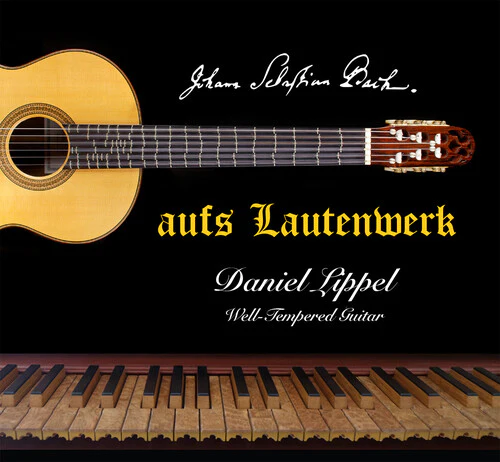
The instrument in question is a guitar invented and built by German luthier Walter Vogt; its fingerboard (as you can see in the CD cover photo) consists of movable (sliding) frets, allowing each note to be adjusted to a very specific tuning, in this case a temperament devised during Bach’s time by one of the composer’s students, Johann Kirnberger. Unlike today’s system of equal temperament, Kirnberger’s “well-tempered” structure (this one known as Kirnberger III) adjusts certain intervals to allow all keys to be played “in tune” while celebrating each key’s distinctive “color”–thus, E-flat major will have a quality different from A major.
If you happened to first listen to this recording unaware of the above details, you may, as I did, notice something special about the sound of this guitar, about the character of the chords and melodic lines–a full-bodied, pleasing resonance, and an especially vibrant quality overall. Of course, much of this could just be due to the nature of the instrument itself, and to Daniel Lippel’s clear, even execution and particularly well-managed fingering technique. But no doubt the unique resonating properties of strings differently tuned to conform to key-specific relationships also is a significant factor–anyone who’s spent time tuning and re-tuning and playing various keyboard and/or plucked-string instruments will confirm this. Even singers in a cappella ensembles are very aware of these key differences.
I’m not sure how many guitarists would devote the effort to mastering the technique required to play on a fingerboard virtually remade and fraught with dozens of slight but potentially disorienting alterations, but Lippel has done it, and the whole experience for the listener is pure delight. Lippel treats these three Bach works–usually heard these days on guitar, but originally either for lute-harpsichord or lute or some other keyboard instrument–with a style that keeps melodic lines flowing yet allows some breathing room for expressive phrasing.
The difficulties of playing these works on the lute–or guitar–are notorious, but unless you’re a serious student of this repertoire, all you will notice here is how easy and natural Lippel makes everything sound. And speaking of sound, it couldn’t be better in its detail and in the way we are situated relative to the instrument–just the right distance to fully appreciate the marvelous tone, and to enjoy the satisfying few moments of a richly-resonant chord as it dies away.
– ClassicsToday.com (David Vernier)
In a historic first, critically acclaimed Guitarist Daniel Lippel brings these three beloved masterworks in their original keys to a classical guitar refretted in Baroque well temperament. They were written at & for the keyboard, where each key has its own unique Affekt. What a joy it is to finally hear them in all of their original key-colored glory. Composer/critic Kyle Gann has said, “Playing Bach's Well-Tempered Clavier in today's equal temperament is like exhibiting Rembrandt paintings with wax paper taped over them.” The same may well be said of Bach played on the modern equal tempered guitar. "Aufs Lautenwerk" is a co-release with John Schneider's Los Angeles based MicroFest Records and available in digital format through their catalogue.
REVIEW:
In his notes prefacing the recording, guitarist Daniel Lippel acknowledges the validity of many different approaches to Bach performance practice, and assures his listeners that his own approach, while certainly distinctive, is in no way meant to make a definitive argument–“after all,” he continues, “I am playing an instrument that didn’t exist when the music was written.”
The instrument in question is a guitar invented and built by German luthier Walter Vogt; its fingerboard (as you can see in the CD cover photo) consists of movable (sliding) frets, allowing each note to be adjusted to a very specific tuning, in this case a temperament devised during Bach’s time by one of the composer’s students, Johann Kirnberger. Unlike today’s system of equal temperament, Kirnberger’s “well-tempered” structure (this one known as Kirnberger III) adjusts certain intervals to allow all keys to be played “in tune” while celebrating each key’s distinctive “color”–thus, E-flat major will have a quality different from A major.
If you happened to first listen to this recording unaware of the above details, you may, as I did, notice something special about the sound of this guitar, about the character of the chords and melodic lines–a full-bodied, pleasing resonance, and an especially vibrant quality overall. Of course, much of this could just be due to the nature of the instrument itself, and to Daniel Lippel’s clear, even execution and particularly well-managed fingering technique. But no doubt the unique resonating properties of strings differently tuned to conform to key-specific relationships also is a significant factor–anyone who’s spent time tuning and re-tuning and playing various keyboard and/or plucked-string instruments will confirm this. Even singers in a cappella ensembles are very aware of these key differences.
I’m not sure how many guitarists would devote the effort to mastering the technique required to play on a fingerboard virtually remade and fraught with dozens of slight but potentially disorienting alterations, but Lippel has done it, and the whole experience for the listener is pure delight. Lippel treats these three Bach works–usually heard these days on guitar, but originally either for lute-harpsichord or lute or some other keyboard instrument–with a style that keeps melodic lines flowing yet allows some breathing room for expressive phrasing.
The difficulties of playing these works on the lute–or guitar–are notorious, but unless you’re a serious student of this repertoire, all you will notice here is how easy and natural Lippel makes everything sound. And speaking of sound, it couldn’t be better in its detail and in the way we are situated relative to the instrument–just the right distance to fully appreciate the marvelous tone, and to enjoy the satisfying few moments of a richly-resonant chord as it dies away.
– ClassicsToday.com (David Vernier)
Original: $20.99
-65%$20.99
$7.35Description
In a historic first, critically acclaimed Guitarist Daniel Lippel brings these three beloved masterworks in their original keys to a classical guitar refretted in Baroque well temperament. They were written at & for the keyboard, where each key has its own unique Affekt. What a joy it is to finally hear them in all of their original key-colored glory. Composer/critic Kyle Gann has said, “Playing Bach's Well-Tempered Clavier in today's equal temperament is like exhibiting Rembrandt paintings with wax paper taped over them.” The same may well be said of Bach played on the modern equal tempered guitar. "Aufs Lautenwerk" is a co-release with John Schneider's Los Angeles based MicroFest Records and available in digital format through their catalogue.
REVIEW:
In his notes prefacing the recording, guitarist Daniel Lippel acknowledges the validity of many different approaches to Bach performance practice, and assures his listeners that his own approach, while certainly distinctive, is in no way meant to make a definitive argument–“after all,” he continues, “I am playing an instrument that didn’t exist when the music was written.”
The instrument in question is a guitar invented and built by German luthier Walter Vogt; its fingerboard (as you can see in the CD cover photo) consists of movable (sliding) frets, allowing each note to be adjusted to a very specific tuning, in this case a temperament devised during Bach’s time by one of the composer’s students, Johann Kirnberger. Unlike today’s system of equal temperament, Kirnberger’s “well-tempered” structure (this one known as Kirnberger III) adjusts certain intervals to allow all keys to be played “in tune” while celebrating each key’s distinctive “color”–thus, E-flat major will have a quality different from A major.
If you happened to first listen to this recording unaware of the above details, you may, as I did, notice something special about the sound of this guitar, about the character of the chords and melodic lines–a full-bodied, pleasing resonance, and an especially vibrant quality overall. Of course, much of this could just be due to the nature of the instrument itself, and to Daniel Lippel’s clear, even execution and particularly well-managed fingering technique. But no doubt the unique resonating properties of strings differently tuned to conform to key-specific relationships also is a significant factor–anyone who’s spent time tuning and re-tuning and playing various keyboard and/or plucked-string instruments will confirm this. Even singers in a cappella ensembles are very aware of these key differences.
I’m not sure how many guitarists would devote the effort to mastering the technique required to play on a fingerboard virtually remade and fraught with dozens of slight but potentially disorienting alterations, but Lippel has done it, and the whole experience for the listener is pure delight. Lippel treats these three Bach works–usually heard these days on guitar, but originally either for lute-harpsichord or lute or some other keyboard instrument–with a style that keeps melodic lines flowing yet allows some breathing room for expressive phrasing.
The difficulties of playing these works on the lute–or guitar–are notorious, but unless you’re a serious student of this repertoire, all you will notice here is how easy and natural Lippel makes everything sound. And speaking of sound, it couldn’t be better in its detail and in the way we are situated relative to the instrument–just the right distance to fully appreciate the marvelous tone, and to enjoy the satisfying few moments of a richly-resonant chord as it dies away.
– ClassicsToday.com (David Vernier)