🎉 Up to 70% Off Selected ItemsShop Sale

1 / 2
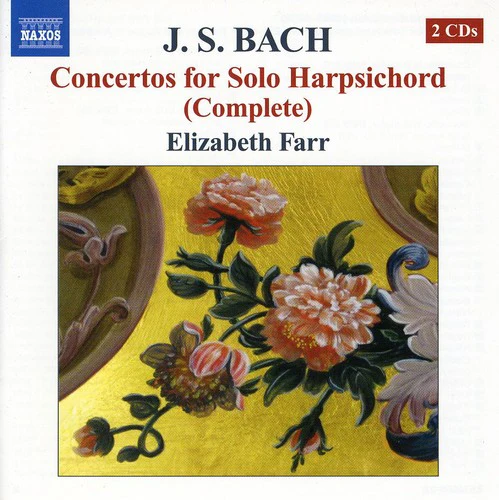
Bach: Complete Concertos For Solo Harpsichord / Elizabeth Farr
BACH Concertos for Solo Harpsichord: BWV 972-93, 975-76, 978, 980 (after Vivaldi); 974 (after A. Marcello); 979 (after Torrelli); 981 (after B. Marcello); 977, 983, 986, 985 (after Telemann); 982, 984, 987 (after Ernst). Prelude and Fugue in a, BWV 894 • Elizabeth Farr (hpd) • NAXOS 8572006-07 (2 CDs: 150:35)
This recording hit me like a ton of bricks in three ways. First, there is the music itself, not actually by J.S. Bach but rather transcriptions he made for harpsichord of concertos by Vivaldi, Torelli, Alessandro and Benedetto Marcello, Johann Ernst, Telemann, and unknown composers, in addition to his own Prelude and Fugue in A Minor. Second, there is the extraordinarily high quality of Elizabeth Farr’s performances, dramatic, nuanced, and extraordinarily colorful. And third, there is the sound of the instrument, a rare Baroque-era harpsichord with a 16’ set of strings as well as damper and sustain pedals. When this CD first started pouring out of my speakers, I thought I was listening to Wanda Landowska in digital stereo. It turns out that such fabulous beasts did exist, after all, in the Baroque era, in fact from as far back as the 16th century. Well, well, well. It turns out that Landowska, who has been lambasted for more than half a century for her “grotesque,” “gargantuan-sounding” instruments, was on the right track after all. Not having an authentic instrument to play, she simply had Pleyel create one for her. Granted, it had a grand piano frame because she was a touring musician and even a newly minted harpsichord with 16’ strings would have gotten pummeled on trains, but the sound was not that far removed from this.
Farr is also an interesting annotator. In order to save space I refer you to her liner notes, which explain why Bach transcribed 22 concertos by primarily Italian composers for harpsichord (six of them are for two harpsichords). The key to the project was young Prince Johann Ernst, the nephew of Duke Wilhelm, who in fact composed three of the concertos transcribed here. The young prince, an outstanding musician, wanted them to play on his instrument. Bach was willing to oblige for one particular reason: By writing out these concertos he could study their composing methods, and apply what he learned to his own “Italianate” music.
Farr’s playing is in the style of Leonhardt and Kipnis, using a great deal of rubato—some of it obvious, some of it quite subtle—to break up the very regular rhythms. I love this style. It is antithetical to British harpsichordists like Trevor Pinnock (whom I also highly admire), but very much in line with the type of “hesitating” style that Bach himself later employed in so many solo harpsichord works, a style he undoubtedly picked up from his friend and older colleague Buxtehude. She also plays very dramatically—heavy chording and rich textures when emulating the full tutti of the orchestral passages, lighter and airier in slow movements and when emulating solo passages. This took me some getting used to, but I came to enjoy this approach.
Some listeners may feel cheated that only one work (the Prelude and Fugue) is actually by Bach, but as a compendium of Baroque style transcribed by a musical genius, played to perfection and stunningly recorded, this set is very highly recommended.
FANFARE: Lynn René Bayley
BACH Concertos for Solo Harpsichord: BWV 972-93, 975-76, 978, 980 (after Vivaldi); 974 (after A. Marcello); 979 (after Torrelli); 981 (after B. Marcello); 977, 983, 986, 985 (after Telemann); 982, 984, 987 (after Ernst). Prelude and Fugue in a, BWV 894 • Elizabeth Farr (hpd) • NAXOS 8572006-07 (2 CDs: 150:35)
This recording hit me like a ton of bricks in three ways. First, there is the music itself, not actually by J.S. Bach but rather transcriptions he made for harpsichord of concertos by Vivaldi, Torelli, Alessandro and Benedetto Marcello, Johann Ernst, Telemann, and unknown composers, in addition to his own Prelude and Fugue in A Minor. Second, there is the extraordinarily high quality of Elizabeth Farr’s performances, dramatic, nuanced, and extraordinarily colorful. And third, there is the sound of the instrument, a rare Baroque-era harpsichord with a 16’ set of strings as well as damper and sustain pedals. When this CD first started pouring out of my speakers, I thought I was listening to Wanda Landowska in digital stereo. It turns out that such fabulous beasts did exist, after all, in the Baroque era, in fact from as far back as the 16th century. Well, well, well. It turns out that Landowska, who has been lambasted for more than half a century for her “grotesque,” “gargantuan-sounding” instruments, was on the right track after all. Not having an authentic instrument to play, she simply had Pleyel create one for her. Granted, it had a grand piano frame because she was a touring musician and even a newly minted harpsichord with 16’ strings would have gotten pummeled on trains, but the sound was not that far removed from this.
Farr is also an interesting annotator. In order to save space I refer you to her liner notes, which explain why Bach transcribed 22 concertos by primarily Italian composers for harpsichord (six of them are for two harpsichords). The key to the project was young Prince Johann Ernst, the nephew of Duke Wilhelm, who in fact composed three of the concertos transcribed here. The young prince, an outstanding musician, wanted them to play on his instrument. Bach was willing to oblige for one particular reason: By writing out these concertos he could study their composing methods, and apply what he learned to his own “Italianate” music.
Farr’s playing is in the style of Leonhardt and Kipnis, using a great deal of rubato—some of it obvious, some of it quite subtle—to break up the very regular rhythms. I love this style. It is antithetical to British harpsichordists like Trevor Pinnock (whom I also highly admire), but very much in line with the type of “hesitating” style that Bach himself later employed in so many solo harpsichord works, a style he undoubtedly picked up from his friend and older colleague Buxtehude. She also plays very dramatically—heavy chording and rich textures when emulating the full tutti of the orchestral passages, lighter and airier in slow movements and when emulating solo passages. This took me some getting used to, but I came to enjoy this approach.
Some listeners may feel cheated that only one work (the Prelude and Fugue) is actually by Bach, but as a compendium of Baroque style transcribed by a musical genius, played to perfection and stunningly recorded, this set is very highly recommended.
FANFARE: Lynn René Bayley
$10.50
Original: $29.99
-65%Bach: Complete Concertos For Solo Harpsichord / Elizabeth Farr—
$29.99
$10.50Description
BACH Concertos for Solo Harpsichord: BWV 972-93, 975-76, 978, 980 (after Vivaldi); 974 (after A. Marcello); 979 (after Torrelli); 981 (after B. Marcello); 977, 983, 986, 985 (after Telemann); 982, 984, 987 (after Ernst). Prelude and Fugue in a, BWV 894 • Elizabeth Farr (hpd) • NAXOS 8572006-07 (2 CDs: 150:35)
This recording hit me like a ton of bricks in three ways. First, there is the music itself, not actually by J.S. Bach but rather transcriptions he made for harpsichord of concertos by Vivaldi, Torelli, Alessandro and Benedetto Marcello, Johann Ernst, Telemann, and unknown composers, in addition to his own Prelude and Fugue in A Minor. Second, there is the extraordinarily high quality of Elizabeth Farr’s performances, dramatic, nuanced, and extraordinarily colorful. And third, there is the sound of the instrument, a rare Baroque-era harpsichord with a 16’ set of strings as well as damper and sustain pedals. When this CD first started pouring out of my speakers, I thought I was listening to Wanda Landowska in digital stereo. It turns out that such fabulous beasts did exist, after all, in the Baroque era, in fact from as far back as the 16th century. Well, well, well. It turns out that Landowska, who has been lambasted for more than half a century for her “grotesque,” “gargantuan-sounding” instruments, was on the right track after all. Not having an authentic instrument to play, she simply had Pleyel create one for her. Granted, it had a grand piano frame because she was a touring musician and even a newly minted harpsichord with 16’ strings would have gotten pummeled on trains, but the sound was not that far removed from this.
Farr is also an interesting annotator. In order to save space I refer you to her liner notes, which explain why Bach transcribed 22 concertos by primarily Italian composers for harpsichord (six of them are for two harpsichords). The key to the project was young Prince Johann Ernst, the nephew of Duke Wilhelm, who in fact composed three of the concertos transcribed here. The young prince, an outstanding musician, wanted them to play on his instrument. Bach was willing to oblige for one particular reason: By writing out these concertos he could study their composing methods, and apply what he learned to his own “Italianate” music.
Farr’s playing is in the style of Leonhardt and Kipnis, using a great deal of rubato—some of it obvious, some of it quite subtle—to break up the very regular rhythms. I love this style. It is antithetical to British harpsichordists like Trevor Pinnock (whom I also highly admire), but very much in line with the type of “hesitating” style that Bach himself later employed in so many solo harpsichord works, a style he undoubtedly picked up from his friend and older colleague Buxtehude. She also plays very dramatically—heavy chording and rich textures when emulating the full tutti of the orchestral passages, lighter and airier in slow movements and when emulating solo passages. This took me some getting used to, but I came to enjoy this approach.
Some listeners may feel cheated that only one work (the Prelude and Fugue) is actually by Bach, but as a compendium of Baroque style transcribed by a musical genius, played to perfection and stunningly recorded, this set is very highly recommended.
FANFARE: Lynn René Bayley