Bach: Secular Cantatas Vol 3 / Suzuki, Bach Collegium Japan
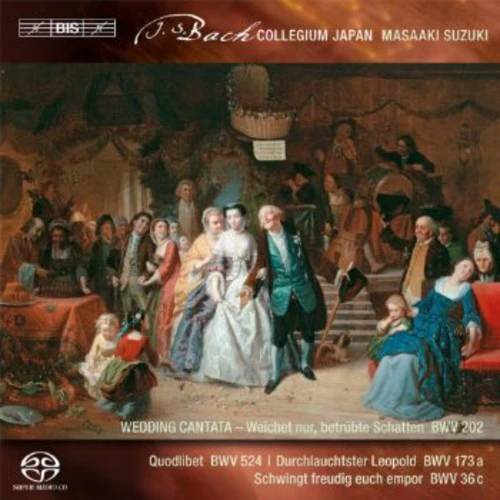
Although two of the works on this disc were composed for weddings, they are completely different in character. Weichet nur, betrübte Schatten is a charming and gracious garland of recitatives and arias for soprano solo in which Spring, Flora, Apollo and Amor are all invoked in a blessing of the newly wedded couple and their union. The Quodlibet (Latin for ‘what pleases’) on the other hand, is an altogether unceremonious composition which was probably intended for a private function in Bach’s own circle or family. All we have is a fragment of the work – in Bach’s own hand – and the beginning and ending of the piece, including the title page, are missing. It is therefore not even certain that it is Bach’s own work, but may have been a collaboration between several of the wedding guests. Compositions of this kind belong to a tradition which combines quotations from songs, toasts, market traders’ calls, proverbs and puns, and were especially popular at weddings – where they frequently got out of hand! The third disc in Bach Collegium Japan’s series of secular cantatas also includes a birthday cantata composed in the honour of Prince Leopold of Anhalt-Köthen, Bach’s employer during years 1717–23. Durchlauchtster Leopold (‘Most illustrious Leopold’) celebrates the ‘propitious day’ while extolling the ruler’s ‘excellent attributes’ and ‘princely renown’. Two duets in minuet form lend the work the character of a courtly serenade, which didn’t stop Bach from reusing it, with a new text, as a church cantata a few years later. The name of the recipient of Schwingt freudig euch empor , another congratulatory cantata, is no longer known, but the text tells us that he was a teacher of high standing and of an advanced age. Once again Bach, who must have been attached to the work, reused it as a church cantata, but also, with the new title Steigt freudig in die Luft , as a birthday tribute to Charlotte Friederike of Anhalt-Köthen, the wife of Prince Leopold.
Although two of the works on this disc were composed for weddings, they are completely different in character. Weichet nur, betrübte Schatten is a charming and gracious garland of recitatives and arias for soprano solo in which Spring, Flora, Apollo and Amor are all invoked in a blessing of the newly wedded couple and their union. The Quodlibet (Latin for ‘what pleases’) on the other hand, is an altogether unceremonious composition which was probably intended for a private function in Bach’s own circle or family. All we have is a fragment of the work – in Bach’s own hand – and the beginning and ending of the piece, including the title page, are missing. It is therefore not even certain that it is Bach’s own work, but may have been a collaboration between several of the wedding guests. Compositions of this kind belong to a tradition which combines quotations from songs, toasts, market traders’ calls, proverbs and puns, and were especially popular at weddings – where they frequently got out of hand! The third disc in Bach Collegium Japan’s series of secular cantatas also includes a birthday cantata composed in the honour of Prince Leopold of Anhalt-Köthen, Bach’s employer during years 1717–23. Durchlauchtster Leopold (‘Most illustrious Leopold’) celebrates the ‘propitious day’ while extolling the ruler’s ‘excellent attributes’ and ‘princely renown’. Two duets in minuet form lend the work the character of a courtly serenade, which didn’t stop Bach from reusing it, with a new text, as a church cantata a few years later. The name of the recipient of Schwingt freudig euch empor , another congratulatory cantata, is no longer known, but the text tells us that he was a teacher of high standing and of an advanced age. Once again Bach, who must have been attached to the work, reused it as a church cantata, but also, with the new title Steigt freudig in die Luft , as a birthday tribute to Charlotte Friederike of Anhalt-Köthen, the wife of Prince Leopold.
Description
Although two of the works on this disc were composed for weddings, they are completely different in character. Weichet nur, betrübte Schatten is a charming and gracious garland of recitatives and arias for soprano solo in which Spring, Flora, Apollo and Amor are all invoked in a blessing of the newly wedded couple and their union. The Quodlibet (Latin for ‘what pleases’) on the other hand, is an altogether unceremonious composition which was probably intended for a private function in Bach’s own circle or family. All we have is a fragment of the work – in Bach’s own hand – and the beginning and ending of the piece, including the title page, are missing. It is therefore not even certain that it is Bach’s own work, but may have been a collaboration between several of the wedding guests. Compositions of this kind belong to a tradition which combines quotations from songs, toasts, market traders’ calls, proverbs and puns, and were especially popular at weddings – where they frequently got out of hand! The third disc in Bach Collegium Japan’s series of secular cantatas also includes a birthday cantata composed in the honour of Prince Leopold of Anhalt-Köthen, Bach’s employer during years 1717–23. Durchlauchtster Leopold (‘Most illustrious Leopold’) celebrates the ‘propitious day’ while extolling the ruler’s ‘excellent attributes’ and ‘princely renown’. Two duets in minuet form lend the work the character of a courtly serenade, which didn’t stop Bach from reusing it, with a new text, as a church cantata a few years later. The name of the recipient of Schwingt freudig euch empor , another congratulatory cantata, is no longer known, but the text tells us that he was a teacher of high standing and of an advanced age. Once again Bach, who must have been attached to the work, reused it as a church cantata, but also, with the new title Steigt freudig in die Luft , as a birthday tribute to Charlotte Friederike of Anhalt-Köthen, the wife of Prince Leopold.