Bach: Solo Keyboard Music, Vol. 33 / Spanyi
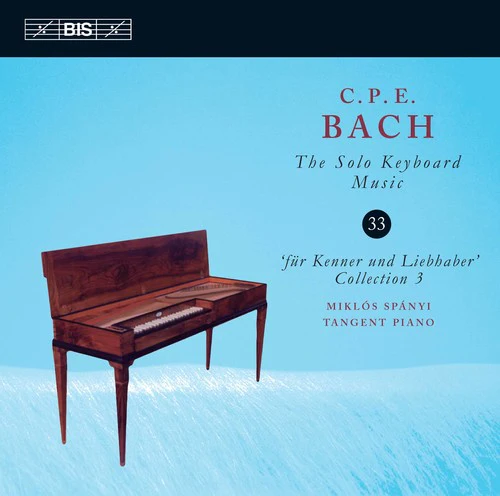
Issued between 1779 and 1787, the six collections of sonatas, rondos, and fantasias “fur Kenner und Liebhaber” constitute Carl Philipp Emanuel Bach’s largest-scale publishing venture. Aimed at ‘Connaisseurs and Amateurs’, the first collection was a retrospective selection of six sonatas but when this became a commercial success Bach expanded and varied the scheme, adding rondos (a recently popular form) for the second and third collection and, in the final three collections, samples of his free fantasies. On the previous two discs in his acclaimed series, Miklós SpAnyi combined pieces from Collection 1 and 2, performing them on the clavichord (Volume 31) and the tangent piano (Volume 32). For the present disc, SpAnyi has chosen to remain with the tangent piano, an early form of the piano with strings that are struck by small wooden slips (‘tangents’). The basic sound of the instrument is reminiscent of the harpsichord, but this can be modified in a number of ways through the use of various devices. In Collection 3, Bach provided variety by alternating previously composed sonatas with newly written rondos and Miklós SpAnyi adds to this by appending an independent set of variations to the collection. Probably intended for amateur keyboard players, the Canzonetta with 6 Variations was composed in 1781, and described by Bach in the catalogue of his works as ‘Canzonetta by the Duchess of Gotha with my 6 variations’.
Issued between 1779 and 1787, the six collections of sonatas, rondos, and fantasias “fur Kenner und Liebhaber” constitute Carl Philipp Emanuel Bach’s largest-scale publishing venture. Aimed at ‘Connaisseurs and Amateurs’, the first collection was a retrospective selection of six sonatas but when this became a commercial success Bach expanded and varied the scheme, adding rondos (a recently popular form) for the second and third collection and, in the final three collections, samples of his free fantasies. On the previous two discs in his acclaimed series, Miklós SpAnyi combined pieces from Collection 1 and 2, performing them on the clavichord (Volume 31) and the tangent piano (Volume 32). For the present disc, SpAnyi has chosen to remain with the tangent piano, an early form of the piano with strings that are struck by small wooden slips (‘tangents’). The basic sound of the instrument is reminiscent of the harpsichord, but this can be modified in a number of ways through the use of various devices. In Collection 3, Bach provided variety by alternating previously composed sonatas with newly written rondos and Miklós SpAnyi adds to this by appending an independent set of variations to the collection. Probably intended for amateur keyboard players, the Canzonetta with 6 Variations was composed in 1781, and described by Bach in the catalogue of his works as ‘Canzonetta by the Duchess of Gotha with my 6 variations’.
Description
Issued between 1779 and 1787, the six collections of sonatas, rondos, and fantasias “fur Kenner und Liebhaber” constitute Carl Philipp Emanuel Bach’s largest-scale publishing venture. Aimed at ‘Connaisseurs and Amateurs’, the first collection was a retrospective selection of six sonatas but when this became a commercial success Bach expanded and varied the scheme, adding rondos (a recently popular form) for the second and third collection and, in the final three collections, samples of his free fantasies. On the previous two discs in his acclaimed series, Miklós SpAnyi combined pieces from Collection 1 and 2, performing them on the clavichord (Volume 31) and the tangent piano (Volume 32). For the present disc, SpAnyi has chosen to remain with the tangent piano, an early form of the piano with strings that are struck by small wooden slips (‘tangents’). The basic sound of the instrument is reminiscent of the harpsichord, but this can be modified in a number of ways through the use of various devices. In Collection 3, Bach provided variety by alternating previously composed sonatas with newly written rondos and Miklós SpAnyi adds to this by appending an independent set of variations to the collection. Probably intended for amateur keyboard players, the Canzonetta with 6 Variations was composed in 1781, and described by Bach in the catalogue of his works as ‘Canzonetta by the Duchess of Gotha with my 6 variations’.