🎉 Up to 70% Off Selected ItemsShop Sale

1 / 2
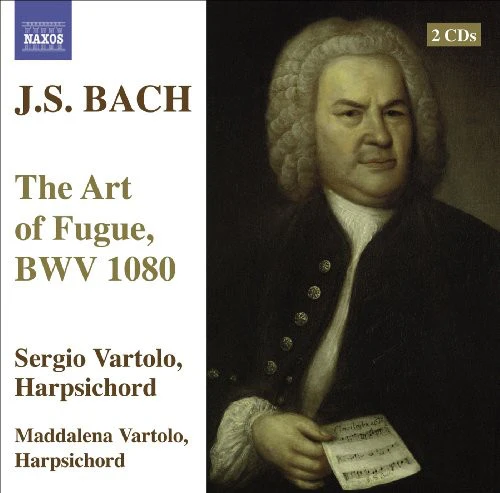
Bach: The Art Of Fugue / Sergio Vartolo, Maddalena Vartolo
BACH The Art of Fugue • Sergio Vartolo (hpd); Maddalena Vartolo (hpd) • NAXOS 8.570577 (2 CDs: 102: 13)
Some recordings deserve high praise, some deserve faint praise, and some earn their fair share of ridicule. Then there is the category of those that earn your respect over time, if you have the stamina to hang in. Bach’s The Art of Fugue , BWV 1080, usually considered an intellectually “dry” work, as played on the harpsichord by Sergio Vartolo (with Maddalena Vartolo on the final two pieces for two harpsichords), won me over after a struggle. The first time through, I experienced a rash of negative judgments: the tempo was too slow, the beat was too regular, the dynamic range was too narrow (only from p to f , while the piano could cover from ppp to fff ), the soloist is an academic (and you know how they are), and there was no exhilaration by acceleration. Everything was too risk free, too free of passion. I was under the spell of the modern piano readings of Bach’s music. But after putting these discs aside for about a week, I asked myself: “If the disc is all that, why did Naxos offer it?” I concluded that I must not have been listening with both frontal lobes of my brain operating. Or, maybe the first time through I’d put too much Kirsch in the fondue for lunch, and it affected my judgment. In any event, I didn’t “get it.”
So I listened to all 102:13 of it, again. This time I realized what I’d forgotten in my prejudice. Of course, the harpsichord had a limited dynamic range with each string being plucked by a leather plectrum under uniform pressure each time its keyboard note was struck (no matter how heartily or delicately). That is one of the limiting factors of its design, which became an incentive in the development of the forte piano. As for the tempo and the rhythm, I realized these were likely a secondary concern to Bach, a champion of well-tempered tuning, in these contrapuntal but equally harmonic exercises. The metronome had not yet been developed, so there couldn’t have been exact instructions from the composer as would become the later practice. There were likely “conventions,” probably issued verbally on the signature score, as to the approximate tempo the composer recommended for each section.
In my bifurcated Oblomovian mind, I decided to concede the tempo to the performer, especially as Vartolo is a highly prolific recording artist, a regular medal winner, as well as a professor at the Accademia Filarmonica of Bologna, where, in 1770, a new member—W. A. Mozart—was installed. I reasoned if there were existing instructions from Bach, or conventions that were observed concerning tempo, rubato, syncopation, etc., Vartolo (as scholar) would know them. And this time I enjoyed my listening much more. But I still wasn’t sold.
During my third trip through the Art of Fugue with Vartolo, I got so into the music I could forget about dynamic range and tempo and appreciate the gorgeous sound of the harpsichord, the skill of the Naxos recording engineers, as well as the spellbinding quality of Vartolo’s playing. I’ve taken to putting it in my CD player first thing in the morning, and (setting it on automatic repeat) letting it play all day while I am at my computer. The presentation of the music is so inevitable, the playing and recording so clean, that I’ve come to hear the clarity of the argument for original instruments, something I had thought too doctrinaire. Certainly, this music—when played on a modern piano, even by soloists who loved Bach (like Glenn Gould)—takes on a quite different mode of presentation. But I can hear the case for equally expert playing on the harpsichord.
In conclusion, I’m not too proud to climb down off my high horse and recommend this two-CD set. It has won me over by overcoming my knee-jerk reactions. If you are interested in Bach, or the fugue, or the harpsichord, or the body of work known as The Art of Fugue , I recommend this recording with high praise. Both the playing and the recording are damn fine. The lesson I’ve learned here, and hope to share with you is that in judging music, it seems best to admit your prejudices to yourself. If you can keep aware of your own preferences, education, music you exclude on specious grounds, you might discover the value of music that is new to you. As I have. Music loving ought to be inclusive. It depends on how you do it. I recommend that you Zen yourself out with Vartolo’s The Art of Fugue during a rainy weekend. You could be pleasantly surprised! And for you harpsichord players out there, you already knew all this. But isn’t it cool to see it in print?
FANFARE: Ilya Oblomov
BACH The Art of Fugue • Sergio Vartolo (hpd); Maddalena Vartolo (hpd) • NAXOS 8.570577 (2 CDs: 102: 13)
Some recordings deserve high praise, some deserve faint praise, and some earn their fair share of ridicule. Then there is the category of those that earn your respect over time, if you have the stamina to hang in. Bach’s The Art of Fugue , BWV 1080, usually considered an intellectually “dry” work, as played on the harpsichord by Sergio Vartolo (with Maddalena Vartolo on the final two pieces for two harpsichords), won me over after a struggle. The first time through, I experienced a rash of negative judgments: the tempo was too slow, the beat was too regular, the dynamic range was too narrow (only from p to f , while the piano could cover from ppp to fff ), the soloist is an academic (and you know how they are), and there was no exhilaration by acceleration. Everything was too risk free, too free of passion. I was under the spell of the modern piano readings of Bach’s music. But after putting these discs aside for about a week, I asked myself: “If the disc is all that, why did Naxos offer it?” I concluded that I must not have been listening with both frontal lobes of my brain operating. Or, maybe the first time through I’d put too much Kirsch in the fondue for lunch, and it affected my judgment. In any event, I didn’t “get it.”
So I listened to all 102:13 of it, again. This time I realized what I’d forgotten in my prejudice. Of course, the harpsichord had a limited dynamic range with each string being plucked by a leather plectrum under uniform pressure each time its keyboard note was struck (no matter how heartily or delicately). That is one of the limiting factors of its design, which became an incentive in the development of the forte piano. As for the tempo and the rhythm, I realized these were likely a secondary concern to Bach, a champion of well-tempered tuning, in these contrapuntal but equally harmonic exercises. The metronome had not yet been developed, so there couldn’t have been exact instructions from the composer as would become the later practice. There were likely “conventions,” probably issued verbally on the signature score, as to the approximate tempo the composer recommended for each section.
In my bifurcated Oblomovian mind, I decided to concede the tempo to the performer, especially as Vartolo is a highly prolific recording artist, a regular medal winner, as well as a professor at the Accademia Filarmonica of Bologna, where, in 1770, a new member—W. A. Mozart—was installed. I reasoned if there were existing instructions from Bach, or conventions that were observed concerning tempo, rubato, syncopation, etc., Vartolo (as scholar) would know them. And this time I enjoyed my listening much more. But I still wasn’t sold.
During my third trip through the Art of Fugue with Vartolo, I got so into the music I could forget about dynamic range and tempo and appreciate the gorgeous sound of the harpsichord, the skill of the Naxos recording engineers, as well as the spellbinding quality of Vartolo’s playing. I’ve taken to putting it in my CD player first thing in the morning, and (setting it on automatic repeat) letting it play all day while I am at my computer. The presentation of the music is so inevitable, the playing and recording so clean, that I’ve come to hear the clarity of the argument for original instruments, something I had thought too doctrinaire. Certainly, this music—when played on a modern piano, even by soloists who loved Bach (like Glenn Gould)—takes on a quite different mode of presentation. But I can hear the case for equally expert playing on the harpsichord.
In conclusion, I’m not too proud to climb down off my high horse and recommend this two-CD set. It has won me over by overcoming my knee-jerk reactions. If you are interested in Bach, or the fugue, or the harpsichord, or the body of work known as The Art of Fugue , I recommend this recording with high praise. Both the playing and the recording are damn fine. The lesson I’ve learned here, and hope to share with you is that in judging music, it seems best to admit your prejudices to yourself. If you can keep aware of your own preferences, education, music you exclude on specious grounds, you might discover the value of music that is new to you. As I have. Music loving ought to be inclusive. It depends on how you do it. I recommend that you Zen yourself out with Vartolo’s The Art of Fugue during a rainy weekend. You could be pleasantly surprised! And for you harpsichord players out there, you already knew all this. But isn’t it cool to see it in print?
FANFARE: Ilya Oblomov
$29.99
Bach: The Art Of Fugue / Sergio Vartolo, Maddalena Vartolo—
$29.99
Description
BACH The Art of Fugue • Sergio Vartolo (hpd); Maddalena Vartolo (hpd) • NAXOS 8.570577 (2 CDs: 102: 13)
Some recordings deserve high praise, some deserve faint praise, and some earn their fair share of ridicule. Then there is the category of those that earn your respect over time, if you have the stamina to hang in. Bach’s The Art of Fugue , BWV 1080, usually considered an intellectually “dry” work, as played on the harpsichord by Sergio Vartolo (with Maddalena Vartolo on the final two pieces for two harpsichords), won me over after a struggle. The first time through, I experienced a rash of negative judgments: the tempo was too slow, the beat was too regular, the dynamic range was too narrow (only from p to f , while the piano could cover from ppp to fff ), the soloist is an academic (and you know how they are), and there was no exhilaration by acceleration. Everything was too risk free, too free of passion. I was under the spell of the modern piano readings of Bach’s music. But after putting these discs aside for about a week, I asked myself: “If the disc is all that, why did Naxos offer it?” I concluded that I must not have been listening with both frontal lobes of my brain operating. Or, maybe the first time through I’d put too much Kirsch in the fondue for lunch, and it affected my judgment. In any event, I didn’t “get it.”
So I listened to all 102:13 of it, again. This time I realized what I’d forgotten in my prejudice. Of course, the harpsichord had a limited dynamic range with each string being plucked by a leather plectrum under uniform pressure each time its keyboard note was struck (no matter how heartily or delicately). That is one of the limiting factors of its design, which became an incentive in the development of the forte piano. As for the tempo and the rhythm, I realized these were likely a secondary concern to Bach, a champion of well-tempered tuning, in these contrapuntal but equally harmonic exercises. The metronome had not yet been developed, so there couldn’t have been exact instructions from the composer as would become the later practice. There were likely “conventions,” probably issued verbally on the signature score, as to the approximate tempo the composer recommended for each section.
In my bifurcated Oblomovian mind, I decided to concede the tempo to the performer, especially as Vartolo is a highly prolific recording artist, a regular medal winner, as well as a professor at the Accademia Filarmonica of Bologna, where, in 1770, a new member—W. A. Mozart—was installed. I reasoned if there were existing instructions from Bach, or conventions that were observed concerning tempo, rubato, syncopation, etc., Vartolo (as scholar) would know them. And this time I enjoyed my listening much more. But I still wasn’t sold.
During my third trip through the Art of Fugue with Vartolo, I got so into the music I could forget about dynamic range and tempo and appreciate the gorgeous sound of the harpsichord, the skill of the Naxos recording engineers, as well as the spellbinding quality of Vartolo’s playing. I’ve taken to putting it in my CD player first thing in the morning, and (setting it on automatic repeat) letting it play all day while I am at my computer. The presentation of the music is so inevitable, the playing and recording so clean, that I’ve come to hear the clarity of the argument for original instruments, something I had thought too doctrinaire. Certainly, this music—when played on a modern piano, even by soloists who loved Bach (like Glenn Gould)—takes on a quite different mode of presentation. But I can hear the case for equally expert playing on the harpsichord.
In conclusion, I’m not too proud to climb down off my high horse and recommend this two-CD set. It has won me over by overcoming my knee-jerk reactions. If you are interested in Bach, or the fugue, or the harpsichord, or the body of work known as The Art of Fugue , I recommend this recording with high praise. Both the playing and the recording are damn fine. The lesson I’ve learned here, and hope to share with you is that in judging music, it seems best to admit your prejudices to yourself. If you can keep aware of your own preferences, education, music you exclude on specious grounds, you might discover the value of music that is new to you. As I have. Music loving ought to be inclusive. It depends on how you do it. I recommend that you Zen yourself out with Vartolo’s The Art of Fugue during a rainy weekend. You could be pleasantly surprised! And for you harpsichord players out there, you already knew all this. But isn’t it cool to see it in print?
FANFARE: Ilya Oblomov