🎉 Up to 70% Off Selected ItemsShop Sale

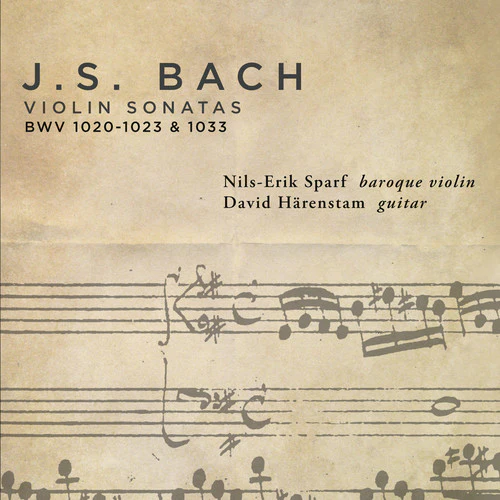
Bach: Violin Sonatas / Sparf, Harenstam
Putting aside any presumption of “authentic performance”–which guitarist David Härenstam acknowledges at the outset of his informative liner notes–this turns out to be a very engaging, entertaining project that honors Bach’s music while offering a thoughtful interpretation and uniquely distinct and vibrant sonic result. Although Bach didn’t write these sonatas (or any works) for violin and guitar, there’s no reason why two skilled and creative performers shouldn’t explore the possibilities, taking on the challenges of contrast and compatibility with guitar rather than keyboard as continuo.
Nils-Erik Sparf, whose recording resumé is quite respectable and varied, is not a baroque specialist–his use of baroque violin here was more for aesthetic and technical reasons related to learning and understanding the music than for any attempt at period “authenticity”–but he’s an experienced practitioner of 18th-century music and is well-versed in style. He employs a restrained vibrato technique that’s mostly used on longer-held notes, an approach that allows a compatible match and favorable balance between the bowed and plucked instruments. Härenstam also notes that to help make the tonal balance even better between his modern guitar (built in Holland in 1994) and Sparf’s early-1700s violin, he “tuned the guitar down in pitch” (he doesn’t give details).
The playing and interaction between the performers is expert and exciting, with the melodies more exposed against the quick-decaying notes of the guitar than we would experience with a harpsichord continuo. There are some very beautiful moments (the gentle interplay between violin and guitar in the Andante and Adagio of BWV 1033), and even surprising ones, as in the first movement (Adagio) of BWV 1021, where you might think you’ve temporarily wandered into a rendition of some French love song. In that same movement we also encounter some of Sparf’s consistently tasteful and affecting ornamentation. Härenstam offers his own improvisational expressive touches, and although the violin has the dominant role, the accompaniments clearly have a certain independence even as they support the “soloist”, and with his clear articulation Härenstam makes sure we don’t miss the interesting happenings in his own part.
The sonatas featured on this program are not among the six (BWV 1014-1019) usually performed and recorded, the ones with fully written out keyboard accompaniments. Two of them–BWV 1020 and BWV 1022–are of disputed provenance–and another two (BWV 1021 and BWV 1023) are for violin and continuo with only a written out figured bass line (the accompanist, within certain rules, freely fills in the harmonies). BWV 1033 exists as a sonata for flute and continuo in the hand of C.P.E. Bach, and its attribution to J.S. is not certain. All of which provides no end of interesting study and investigation for historians and musicologists, and is certainly worthy of notice by anyone who is a lover of Bach’s music. However, for the purposes of listening to this recording, it matters little: these two performers have made these pieces work very well in a context that’s both stimulating to the ear and artistically fulfilling. The studio sound is intimate without being too close (you do hear an occasional squeak or click of fingers on guitar strings or fingerboard), while the instruments have a natural presence and pleasingly resonant, realistic timbral quality. Strongly recommended.
-- David Vernier, ClassicsToday.com
Nils-Erik Sparf, whose recording resumé is quite respectable and varied, is not a baroque specialist–his use of baroque violin here was more for aesthetic and technical reasons related to learning and understanding the music than for any attempt at period “authenticity”–but he’s an experienced practitioner of 18th-century music and is well-versed in style. He employs a restrained vibrato technique that’s mostly used on longer-held notes, an approach that allows a compatible match and favorable balance between the bowed and plucked instruments. Härenstam also notes that to help make the tonal balance even better between his modern guitar (built in Holland in 1994) and Sparf’s early-1700s violin, he “tuned the guitar down in pitch” (he doesn’t give details).
The playing and interaction between the performers is expert and exciting, with the melodies more exposed against the quick-decaying notes of the guitar than we would experience with a harpsichord continuo. There are some very beautiful moments (the gentle interplay between violin and guitar in the Andante and Adagio of BWV 1033), and even surprising ones, as in the first movement (Adagio) of BWV 1021, where you might think you’ve temporarily wandered into a rendition of some French love song. In that same movement we also encounter some of Sparf’s consistently tasteful and affecting ornamentation. Härenstam offers his own improvisational expressive touches, and although the violin has the dominant role, the accompaniments clearly have a certain independence even as they support the “soloist”, and with his clear articulation Härenstam makes sure we don’t miss the interesting happenings in his own part.
The sonatas featured on this program are not among the six (BWV 1014-1019) usually performed and recorded, the ones with fully written out keyboard accompaniments. Two of them–BWV 1020 and BWV 1022–are of disputed provenance–and another two (BWV 1021 and BWV 1023) are for violin and continuo with only a written out figured bass line (the accompanist, within certain rules, freely fills in the harmonies). BWV 1033 exists as a sonata for flute and continuo in the hand of C.P.E. Bach, and its attribution to J.S. is not certain. All of which provides no end of interesting study and investigation for historians and musicologists, and is certainly worthy of notice by anyone who is a lover of Bach’s music. However, for the purposes of listening to this recording, it matters little: these two performers have made these pieces work very well in a context that’s both stimulating to the ear and artistically fulfilling. The studio sound is intimate without being too close (you do hear an occasional squeak or click of fingers on guitar strings or fingerboard), while the instruments have a natural presence and pleasingly resonant, realistic timbral quality. Strongly recommended.
-- David Vernier, ClassicsToday.com
Putting aside any presumption of “authentic performance”–which guitarist David Härenstam acknowledges at the outset of his informative liner notes–this turns out to be a very engaging, entertaining project that honors Bach’s music while offering a thoughtful interpretation and uniquely distinct and vibrant sonic result. Although Bach didn’t write these sonatas (or any works) for violin and guitar, there’s no reason why two skilled and creative performers shouldn’t explore the possibilities, taking on the challenges of contrast and compatibility with guitar rather than keyboard as continuo.
Nils-Erik Sparf, whose recording resumé is quite respectable and varied, is not a baroque specialist–his use of baroque violin here was more for aesthetic and technical reasons related to learning and understanding the music than for any attempt at period “authenticity”–but he’s an experienced practitioner of 18th-century music and is well-versed in style. He employs a restrained vibrato technique that’s mostly used on longer-held notes, an approach that allows a compatible match and favorable balance between the bowed and plucked instruments. Härenstam also notes that to help make the tonal balance even better between his modern guitar (built in Holland in 1994) and Sparf’s early-1700s violin, he “tuned the guitar down in pitch” (he doesn’t give details).
The playing and interaction between the performers is expert and exciting, with the melodies more exposed against the quick-decaying notes of the guitar than we would experience with a harpsichord continuo. There are some very beautiful moments (the gentle interplay between violin and guitar in the Andante and Adagio of BWV 1033), and even surprising ones, as in the first movement (Adagio) of BWV 1021, where you might think you’ve temporarily wandered into a rendition of some French love song. In that same movement we also encounter some of Sparf’s consistently tasteful and affecting ornamentation. Härenstam offers his own improvisational expressive touches, and although the violin has the dominant role, the accompaniments clearly have a certain independence even as they support the “soloist”, and with his clear articulation Härenstam makes sure we don’t miss the interesting happenings in his own part.
The sonatas featured on this program are not among the six (BWV 1014-1019) usually performed and recorded, the ones with fully written out keyboard accompaniments. Two of them–BWV 1020 and BWV 1022–are of disputed provenance–and another two (BWV 1021 and BWV 1023) are for violin and continuo with only a written out figured bass line (the accompanist, within certain rules, freely fills in the harmonies). BWV 1033 exists as a sonata for flute and continuo in the hand of C.P.E. Bach, and its attribution to J.S. is not certain. All of which provides no end of interesting study and investigation for historians and musicologists, and is certainly worthy of notice by anyone who is a lover of Bach’s music. However, for the purposes of listening to this recording, it matters little: these two performers have made these pieces work very well in a context that’s both stimulating to the ear and artistically fulfilling. The studio sound is intimate without being too close (you do hear an occasional squeak or click of fingers on guitar strings or fingerboard), while the instruments have a natural presence and pleasingly resonant, realistic timbral quality. Strongly recommended.
-- David Vernier, ClassicsToday.com
Nils-Erik Sparf, whose recording resumé is quite respectable and varied, is not a baroque specialist–his use of baroque violin here was more for aesthetic and technical reasons related to learning and understanding the music than for any attempt at period “authenticity”–but he’s an experienced practitioner of 18th-century music and is well-versed in style. He employs a restrained vibrato technique that’s mostly used on longer-held notes, an approach that allows a compatible match and favorable balance between the bowed and plucked instruments. Härenstam also notes that to help make the tonal balance even better between his modern guitar (built in Holland in 1994) and Sparf’s early-1700s violin, he “tuned the guitar down in pitch” (he doesn’t give details).
The playing and interaction between the performers is expert and exciting, with the melodies more exposed against the quick-decaying notes of the guitar than we would experience with a harpsichord continuo. There are some very beautiful moments (the gentle interplay between violin and guitar in the Andante and Adagio of BWV 1033), and even surprising ones, as in the first movement (Adagio) of BWV 1021, where you might think you’ve temporarily wandered into a rendition of some French love song. In that same movement we also encounter some of Sparf’s consistently tasteful and affecting ornamentation. Härenstam offers his own improvisational expressive touches, and although the violin has the dominant role, the accompaniments clearly have a certain independence even as they support the “soloist”, and with his clear articulation Härenstam makes sure we don’t miss the interesting happenings in his own part.
The sonatas featured on this program are not among the six (BWV 1014-1019) usually performed and recorded, the ones with fully written out keyboard accompaniments. Two of them–BWV 1020 and BWV 1022–are of disputed provenance–and another two (BWV 1021 and BWV 1023) are for violin and continuo with only a written out figured bass line (the accompanist, within certain rules, freely fills in the harmonies). BWV 1033 exists as a sonata for flute and continuo in the hand of C.P.E. Bach, and its attribution to J.S. is not certain. All of which provides no end of interesting study and investigation for historians and musicologists, and is certainly worthy of notice by anyone who is a lover of Bach’s music. However, for the purposes of listening to this recording, it matters little: these two performers have made these pieces work very well in a context that’s both stimulating to the ear and artistically fulfilling. The studio sound is intimate without being too close (you do hear an occasional squeak or click of fingers on guitar strings or fingerboard), while the instruments have a natural presence and pleasingly resonant, realistic timbral quality. Strongly recommended.
-- David Vernier, ClassicsToday.com
$7.35
Original: $20.99
-65%Bach: Violin Sonatas / Sparf, Harenstam—
$20.99
$7.35Description
Putting aside any presumption of “authentic performance”–which guitarist David Härenstam acknowledges at the outset of his informative liner notes–this turns out to be a very engaging, entertaining project that honors Bach’s music while offering a thoughtful interpretation and uniquely distinct and vibrant sonic result. Although Bach didn’t write these sonatas (or any works) for violin and guitar, there’s no reason why two skilled and creative performers shouldn’t explore the possibilities, taking on the challenges of contrast and compatibility with guitar rather than keyboard as continuo.
Nils-Erik Sparf, whose recording resumé is quite respectable and varied, is not a baroque specialist–his use of baroque violin here was more for aesthetic and technical reasons related to learning and understanding the music than for any attempt at period “authenticity”–but he’s an experienced practitioner of 18th-century music and is well-versed in style. He employs a restrained vibrato technique that’s mostly used on longer-held notes, an approach that allows a compatible match and favorable balance between the bowed and plucked instruments. Härenstam also notes that to help make the tonal balance even better between his modern guitar (built in Holland in 1994) and Sparf’s early-1700s violin, he “tuned the guitar down in pitch” (he doesn’t give details).
The playing and interaction between the performers is expert and exciting, with the melodies more exposed against the quick-decaying notes of the guitar than we would experience with a harpsichord continuo. There are some very beautiful moments (the gentle interplay between violin and guitar in the Andante and Adagio of BWV 1033), and even surprising ones, as in the first movement (Adagio) of BWV 1021, where you might think you’ve temporarily wandered into a rendition of some French love song. In that same movement we also encounter some of Sparf’s consistently tasteful and affecting ornamentation. Härenstam offers his own improvisational expressive touches, and although the violin has the dominant role, the accompaniments clearly have a certain independence even as they support the “soloist”, and with his clear articulation Härenstam makes sure we don’t miss the interesting happenings in his own part.
The sonatas featured on this program are not among the six (BWV 1014-1019) usually performed and recorded, the ones with fully written out keyboard accompaniments. Two of them–BWV 1020 and BWV 1022–are of disputed provenance–and another two (BWV 1021 and BWV 1023) are for violin and continuo with only a written out figured bass line (the accompanist, within certain rules, freely fills in the harmonies). BWV 1033 exists as a sonata for flute and continuo in the hand of C.P.E. Bach, and its attribution to J.S. is not certain. All of which provides no end of interesting study and investigation for historians and musicologists, and is certainly worthy of notice by anyone who is a lover of Bach’s music. However, for the purposes of listening to this recording, it matters little: these two performers have made these pieces work very well in a context that’s both stimulating to the ear and artistically fulfilling. The studio sound is intimate without being too close (you do hear an occasional squeak or click of fingers on guitar strings or fingerboard), while the instruments have a natural presence and pleasingly resonant, realistic timbral quality. Strongly recommended.
-- David Vernier, ClassicsToday.com
Nils-Erik Sparf, whose recording resumé is quite respectable and varied, is not a baroque specialist–his use of baroque violin here was more for aesthetic and technical reasons related to learning and understanding the music than for any attempt at period “authenticity”–but he’s an experienced practitioner of 18th-century music and is well-versed in style. He employs a restrained vibrato technique that’s mostly used on longer-held notes, an approach that allows a compatible match and favorable balance between the bowed and plucked instruments. Härenstam also notes that to help make the tonal balance even better between his modern guitar (built in Holland in 1994) and Sparf’s early-1700s violin, he “tuned the guitar down in pitch” (he doesn’t give details).
The playing and interaction between the performers is expert and exciting, with the melodies more exposed against the quick-decaying notes of the guitar than we would experience with a harpsichord continuo. There are some very beautiful moments (the gentle interplay between violin and guitar in the Andante and Adagio of BWV 1033), and even surprising ones, as in the first movement (Adagio) of BWV 1021, where you might think you’ve temporarily wandered into a rendition of some French love song. In that same movement we also encounter some of Sparf’s consistently tasteful and affecting ornamentation. Härenstam offers his own improvisational expressive touches, and although the violin has the dominant role, the accompaniments clearly have a certain independence even as they support the “soloist”, and with his clear articulation Härenstam makes sure we don’t miss the interesting happenings in his own part.
The sonatas featured on this program are not among the six (BWV 1014-1019) usually performed and recorded, the ones with fully written out keyboard accompaniments. Two of them–BWV 1020 and BWV 1022–are of disputed provenance–and another two (BWV 1021 and BWV 1023) are for violin and continuo with only a written out figured bass line (the accompanist, within certain rules, freely fills in the harmonies). BWV 1033 exists as a sonata for flute and continuo in the hand of C.P.E. Bach, and its attribution to J.S. is not certain. All of which provides no end of interesting study and investigation for historians and musicologists, and is certainly worthy of notice by anyone who is a lover of Bach’s music. However, for the purposes of listening to this recording, it matters little: these two performers have made these pieces work very well in a context that’s both stimulating to the ear and artistically fulfilling. The studio sound is intimate without being too close (you do hear an occasional squeak or click of fingers on guitar strings or fingerboard), while the instruments have a natural presence and pleasingly resonant, realistic timbral quality. Strongly recommended.
-- David Vernier, ClassicsToday.com