🎉 Up to 70% Off Selected ItemsShop Sale

1 / 2
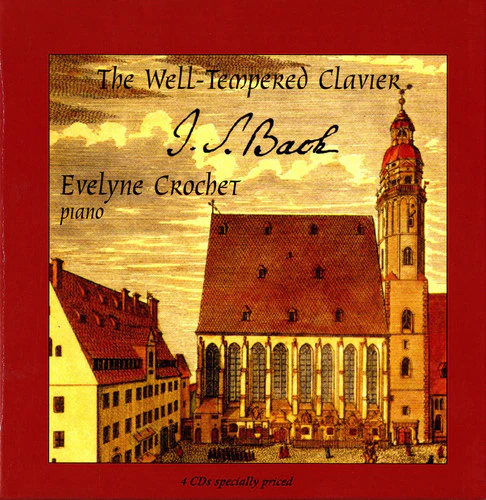
Bach: Well-tempered Clavier / Evelyne Crochet
BACH The Well-Tempered Clavier ? Evelyn Crochet (pn) ? MUSIC & ARTS CD-1180 (4 CDs: 259:36)
The last I?d heard of Evelyn Crochet was on my turntable last year, when I listened once again to her cycle of Fauré?s piano music on Vox LPs issued during the 1960s. In their own quiet, understated way, I think they remain among the pleasures of that audio period, both for their sensitivity and core of robust strength. Now, Music & Arts has released a 2002 recording of the complete Well-Tempered Clavier featuring Crochet. When our beloved Editor mentioned it, I immediately requested a copy for review?despite knowing that present day disappointments from respected artists of yore do occur, and more often than we care to admit.
My concerns were largely unjustified, however. Crochet is in excellent form. She offers gracious playing, unsentimental but not without warmth when required, as the serenely smiling E?-Major Prelude (Book 2) demonstrates. Another Prelude, that of B? Major (Book 1), demonstrates the state of her current technique with fleet, perfectly even passagework. The chords that break and resolve the linear movement aren?t milked in the Romantic manner, but allowed to fall naturally in place.
So an informed style is a factor in these performances, as it was in Crochet?s Fauré. The C-Major Prelude, the one that leads off the entire set, is again luminous while avoiding anachronisms: the bass line makes its vital presence known without drawing undo attention, and discreet changes in dynamics between each repetition of the arpeggiated cell facilitate the music?s flow without drawing attention to themselves. It is an example the pianist gives repeatedly throughout the album.
If I find the fugues overall just slightly less good, it?s because of the more incisive voicing offered by Angela Hewitt in her recording (Hyperion CDA 67301/2, CDA 67303/4). Crochet?s approach seems more generalized in the slower, calmer fugues, including the one in C Minor (Book 2). These are subtle performances where minute changes in tempo, volume, articulation, or dominance between the hands create the final effect, and the fugal textures are downplayed a bit too much for my taste. That noted, those fugues that offer what we would consider a more expressive character are highly enjoyable under her hands. To the A-Major Fugue (Book 1), for example, Crochet supplies a puckish, almost truculent humor that results from the sharp accent given to the first note, contrasted against the delicate filigree work in the left hand.
The miking is close, always a good thing where the piano is concerned, but with a slightly glassy sound in loud passages, and a slightly dull one in quieter moments. The liner notes provided by Crochet appear aimed at musical novices, but would they really form the natural audience for this release? In any case, these are quibbles that shouldn?t stand in the way of purchasing this attractive set. It offers no revelations but solid, inspired music-making, and that?s enough for me.
FANFARE: Barry Brenesal
BACH The Well-Tempered Clavier ? Evelyn Crochet (pn) ? MUSIC & ARTS CD-1180 (4 CDs: 259:36)
The last I?d heard of Evelyn Crochet was on my turntable last year, when I listened once again to her cycle of Fauré?s piano music on Vox LPs issued during the 1960s. In their own quiet, understated way, I think they remain among the pleasures of that audio period, both for their sensitivity and core of robust strength. Now, Music & Arts has released a 2002 recording of the complete Well-Tempered Clavier featuring Crochet. When our beloved Editor mentioned it, I immediately requested a copy for review?despite knowing that present day disappointments from respected artists of yore do occur, and more often than we care to admit.
My concerns were largely unjustified, however. Crochet is in excellent form. She offers gracious playing, unsentimental but not without warmth when required, as the serenely smiling E?-Major Prelude (Book 2) demonstrates. Another Prelude, that of B? Major (Book 1), demonstrates the state of her current technique with fleet, perfectly even passagework. The chords that break and resolve the linear movement aren?t milked in the Romantic manner, but allowed to fall naturally in place.
So an informed style is a factor in these performances, as it was in Crochet?s Fauré. The C-Major Prelude, the one that leads off the entire set, is again luminous while avoiding anachronisms: the bass line makes its vital presence known without drawing undo attention, and discreet changes in dynamics between each repetition of the arpeggiated cell facilitate the music?s flow without drawing attention to themselves. It is an example the pianist gives repeatedly throughout the album.
If I find the fugues overall just slightly less good, it?s because of the more incisive voicing offered by Angela Hewitt in her recording (Hyperion CDA 67301/2, CDA 67303/4). Crochet?s approach seems more generalized in the slower, calmer fugues, including the one in C Minor (Book 2). These are subtle performances where minute changes in tempo, volume, articulation, or dominance between the hands create the final effect, and the fugal textures are downplayed a bit too much for my taste. That noted, those fugues that offer what we would consider a more expressive character are highly enjoyable under her hands. To the A-Major Fugue (Book 1), for example, Crochet supplies a puckish, almost truculent humor that results from the sharp accent given to the first note, contrasted against the delicate filigree work in the left hand.
The miking is close, always a good thing where the piano is concerned, but with a slightly glassy sound in loud passages, and a slightly dull one in quieter moments. The liner notes provided by Crochet appear aimed at musical novices, but would they really form the natural audience for this release? In any case, these are quibbles that shouldn?t stand in the way of purchasing this attractive set. It offers no revelations but solid, inspired music-making, and that?s enough for me.
FANFARE: Barry Brenesal
$17.15
Original: $48.99
-65%Bach: Well-tempered Clavier / Evelyne Crochet—
$48.99
$17.15Description
BACH The Well-Tempered Clavier ? Evelyn Crochet (pn) ? MUSIC & ARTS CD-1180 (4 CDs: 259:36)
The last I?d heard of Evelyn Crochet was on my turntable last year, when I listened once again to her cycle of Fauré?s piano music on Vox LPs issued during the 1960s. In their own quiet, understated way, I think they remain among the pleasures of that audio period, both for their sensitivity and core of robust strength. Now, Music & Arts has released a 2002 recording of the complete Well-Tempered Clavier featuring Crochet. When our beloved Editor mentioned it, I immediately requested a copy for review?despite knowing that present day disappointments from respected artists of yore do occur, and more often than we care to admit.
My concerns were largely unjustified, however. Crochet is in excellent form. She offers gracious playing, unsentimental but not without warmth when required, as the serenely smiling E?-Major Prelude (Book 2) demonstrates. Another Prelude, that of B? Major (Book 1), demonstrates the state of her current technique with fleet, perfectly even passagework. The chords that break and resolve the linear movement aren?t milked in the Romantic manner, but allowed to fall naturally in place.
So an informed style is a factor in these performances, as it was in Crochet?s Fauré. The C-Major Prelude, the one that leads off the entire set, is again luminous while avoiding anachronisms: the bass line makes its vital presence known without drawing undo attention, and discreet changes in dynamics between each repetition of the arpeggiated cell facilitate the music?s flow without drawing attention to themselves. It is an example the pianist gives repeatedly throughout the album.
If I find the fugues overall just slightly less good, it?s because of the more incisive voicing offered by Angela Hewitt in her recording (Hyperion CDA 67301/2, CDA 67303/4). Crochet?s approach seems more generalized in the slower, calmer fugues, including the one in C Minor (Book 2). These are subtle performances where minute changes in tempo, volume, articulation, or dominance between the hands create the final effect, and the fugal textures are downplayed a bit too much for my taste. That noted, those fugues that offer what we would consider a more expressive character are highly enjoyable under her hands. To the A-Major Fugue (Book 1), for example, Crochet supplies a puckish, almost truculent humor that results from the sharp accent given to the first note, contrasted against the delicate filigree work in the left hand.
The miking is close, always a good thing where the piano is concerned, but with a slightly glassy sound in loud passages, and a slightly dull one in quieter moments. The liner notes provided by Crochet appear aimed at musical novices, but would they really form the natural audience for this release? In any case, these are quibbles that shouldn?t stand in the way of purchasing this attractive set. It offers no revelations but solid, inspired music-making, and that?s enough for me.
FANFARE: Barry Brenesal