Without Borders / Can Cakmur
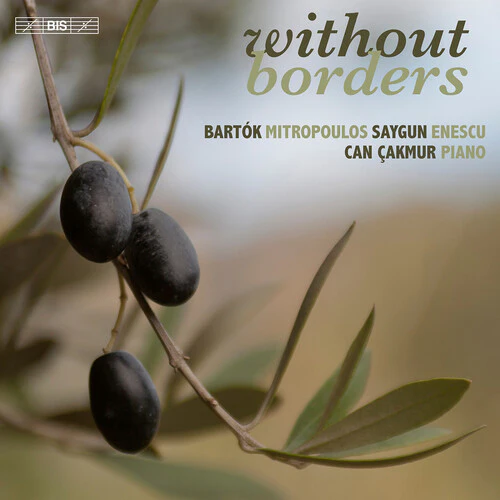
Towards the end of the 19th century, ´several composers were taking a new interest in folk music. Folk tunes, or imitations of them, had previously mainly been used in order to provide ‘local colour’ or as a way of catering to nationalist sentiments, but it was now seen as a means to revitalize art music itself, opening up for new possibilities in terms of rhythm and harmony as well as melody. At the forefront of this development was Béla Bartók, who also considered the use of folk elements as a tool to transcend boundaries – to achieve a ‘brotherhood of peoples’. For his new recital disc, Can Çakmur has devised a program which juxtaposes four composers’ different responses to folk music. Bartók’s Piano Sonata is followed by Passacaglia, Intermezzo e Fuga with which Dimitri Mitropoulos made a clean break with earlier works in a more nationalistic vein. Next comes Çakmur’s compatriot, the Turkish composer Ahmed Adnan Saygun, who in 1936 accompanied Bartók on a field trip in Turkey collecting music. His Piano Sonata was composed some fifty years later, however, and refers to folk music primarily on a theoretical level. Closing the disc is George Enescu’s Piano Sonata No.?3 in D major, which Çakmur in his own liner notes describes as ‘radiating a natural affinity for the village, without sacrificing the compositional value of the work.’
Towards the end of the 19th century, ´several composers were taking a new interest in folk music. Folk tunes, or imitations of them, had previously mainly been used in order to provide ‘local colour’ or as a way of catering to nationalist sentiments, but it was now seen as a means to revitalize art music itself, opening up for new possibilities in terms of rhythm and harmony as well as melody. At the forefront of this development was Béla Bartók, who also considered the use of folk elements as a tool to transcend boundaries – to achieve a ‘brotherhood of peoples’. For his new recital disc, Can Çakmur has devised a program which juxtaposes four composers’ different responses to folk music. Bartók’s Piano Sonata is followed by Passacaglia, Intermezzo e Fuga with which Dimitri Mitropoulos made a clean break with earlier works in a more nationalistic vein. Next comes Çakmur’s compatriot, the Turkish composer Ahmed Adnan Saygun, who in 1936 accompanied Bartók on a field trip in Turkey collecting music. His Piano Sonata was composed some fifty years later, however, and refers to folk music primarily on a theoretical level. Closing the disc is George Enescu’s Piano Sonata No.?3 in D major, which Çakmur in his own liner notes describes as ‘radiating a natural affinity for the village, without sacrificing the compositional value of the work.’
Original: $10.99
-65%$10.99
$3.85Description
Towards the end of the 19th century, ´several composers were taking a new interest in folk music. Folk tunes, or imitations of them, had previously mainly been used in order to provide ‘local colour’ or as a way of catering to nationalist sentiments, but it was now seen as a means to revitalize art music itself, opening up for new possibilities in terms of rhythm and harmony as well as melody. At the forefront of this development was Béla Bartók, who also considered the use of folk elements as a tool to transcend boundaries – to achieve a ‘brotherhood of peoples’. For his new recital disc, Can Çakmur has devised a program which juxtaposes four composers’ different responses to folk music. Bartók’s Piano Sonata is followed by Passacaglia, Intermezzo e Fuga with which Dimitri Mitropoulos made a clean break with earlier works in a more nationalistic vein. Next comes Çakmur’s compatriot, the Turkish composer Ahmed Adnan Saygun, who in 1936 accompanied Bartók on a field trip in Turkey collecting music. His Piano Sonata was composed some fifty years later, however, and refers to folk music primarily on a theoretical level. Closing the disc is George Enescu’s Piano Sonata No.?3 in D major, which Çakmur in his own liner notes describes as ‘radiating a natural affinity for the village, without sacrificing the compositional value of the work.’