🎉 Up to 70% Off Selected ItemsShop Sale

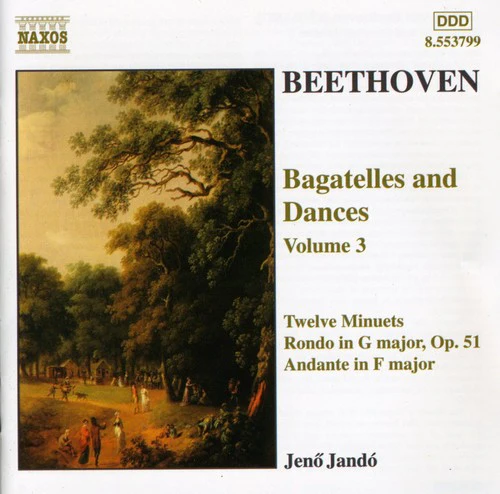
Beethoven: Bagatelles And Dances Vol 3 / Jenö Jandó
Jenó Jandó's Naxos survey of Beethoven's Bagatelles and dances for solo piano reaches Volume 3. Jandó's adroit and stylish readings have much to commend them, especially in their technical agility and clarity of execution. The greater part of this release is given over to the 12 Minuets--not normally the kind of music that lends itself usefully to cyclical hearing. But in these performances Jandó manages to get away from any repetitiveness and predictability, a potential danger in genre pieces, particularly when heard en masse. That he characterises each so effectively comes down to taut rhythms and clinical exactitude in matters of dynamics and articulation.
The disc opens with six more substantial items, including the two Op. 51 Rondos, the A major Rondo WoO 49, the so-called "Andante favori" (Andante in F WoO 57), and the famous "Rage over a lost penny", otherwise the Rondo a Capriccio in G Op. 129. Again, Jandó's performances are enjoyable and illuminating. Note for example how he highlights contrasts of mood and dynamics so effectively in the last of these works, sharpening the acerbity of its more fevered passages through a clarity of attack that owes more to keyboard articulation than to the pedal--commendable, given his brisk tempo. The two Op. 51 Rondos are also more tersely etched and rigorous than you'll often hear, so I'm inclined to rate Jandó's accounts more highly than Brendel's here. Another welcome addition to a useful budget series.
--Michael Jameson, ClassicsToday.com
The disc opens with six more substantial items, including the two Op. 51 Rondos, the A major Rondo WoO 49, the so-called "Andante favori" (Andante in F WoO 57), and the famous "Rage over a lost penny", otherwise the Rondo a Capriccio in G Op. 129. Again, Jandó's performances are enjoyable and illuminating. Note for example how he highlights contrasts of mood and dynamics so effectively in the last of these works, sharpening the acerbity of its more fevered passages through a clarity of attack that owes more to keyboard articulation than to the pedal--commendable, given his brisk tempo. The two Op. 51 Rondos are also more tersely etched and rigorous than you'll often hear, so I'm inclined to rate Jandó's accounts more highly than Brendel's here. Another welcome addition to a useful budget series.
--Michael Jameson, ClassicsToday.com
Jenó Jandó's Naxos survey of Beethoven's Bagatelles and dances for solo piano reaches Volume 3. Jandó's adroit and stylish readings have much to commend them, especially in their technical agility and clarity of execution. The greater part of this release is given over to the 12 Minuets--not normally the kind of music that lends itself usefully to cyclical hearing. But in these performances Jandó manages to get away from any repetitiveness and predictability, a potential danger in genre pieces, particularly when heard en masse. That he characterises each so effectively comes down to taut rhythms and clinical exactitude in matters of dynamics and articulation.
The disc opens with six more substantial items, including the two Op. 51 Rondos, the A major Rondo WoO 49, the so-called "Andante favori" (Andante in F WoO 57), and the famous "Rage over a lost penny", otherwise the Rondo a Capriccio in G Op. 129. Again, Jandó's performances are enjoyable and illuminating. Note for example how he highlights contrasts of mood and dynamics so effectively in the last of these works, sharpening the acerbity of its more fevered passages through a clarity of attack that owes more to keyboard articulation than to the pedal--commendable, given his brisk tempo. The two Op. 51 Rondos are also more tersely etched and rigorous than you'll often hear, so I'm inclined to rate Jandó's accounts more highly than Brendel's here. Another welcome addition to a useful budget series.
--Michael Jameson, ClassicsToday.com
The disc opens with six more substantial items, including the two Op. 51 Rondos, the A major Rondo WoO 49, the so-called "Andante favori" (Andante in F WoO 57), and the famous "Rage over a lost penny", otherwise the Rondo a Capriccio in G Op. 129. Again, Jandó's performances are enjoyable and illuminating. Note for example how he highlights contrasts of mood and dynamics so effectively in the last of these works, sharpening the acerbity of its more fevered passages through a clarity of attack that owes more to keyboard articulation than to the pedal--commendable, given his brisk tempo. The two Op. 51 Rondos are also more tersely etched and rigorous than you'll often hear, so I'm inclined to rate Jandó's accounts more highly than Brendel's here. Another welcome addition to a useful budget series.
--Michael Jameson, ClassicsToday.com
$7.00
Original: $19.99
-65%Beethoven: Bagatelles And Dances Vol 3 / Jenö Jandó—
$19.99
$7.00Description
Jenó Jandó's Naxos survey of Beethoven's Bagatelles and dances for solo piano reaches Volume 3. Jandó's adroit and stylish readings have much to commend them, especially in their technical agility and clarity of execution. The greater part of this release is given over to the 12 Minuets--not normally the kind of music that lends itself usefully to cyclical hearing. But in these performances Jandó manages to get away from any repetitiveness and predictability, a potential danger in genre pieces, particularly when heard en masse. That he characterises each so effectively comes down to taut rhythms and clinical exactitude in matters of dynamics and articulation.
The disc opens with six more substantial items, including the two Op. 51 Rondos, the A major Rondo WoO 49, the so-called "Andante favori" (Andante in F WoO 57), and the famous "Rage over a lost penny", otherwise the Rondo a Capriccio in G Op. 129. Again, Jandó's performances are enjoyable and illuminating. Note for example how he highlights contrasts of mood and dynamics so effectively in the last of these works, sharpening the acerbity of its more fevered passages through a clarity of attack that owes more to keyboard articulation than to the pedal--commendable, given his brisk tempo. The two Op. 51 Rondos are also more tersely etched and rigorous than you'll often hear, so I'm inclined to rate Jandó's accounts more highly than Brendel's here. Another welcome addition to a useful budget series.
--Michael Jameson, ClassicsToday.com
The disc opens with six more substantial items, including the two Op. 51 Rondos, the A major Rondo WoO 49, the so-called "Andante favori" (Andante in F WoO 57), and the famous "Rage over a lost penny", otherwise the Rondo a Capriccio in G Op. 129. Again, Jandó's performances are enjoyable and illuminating. Note for example how he highlights contrasts of mood and dynamics so effectively in the last of these works, sharpening the acerbity of its more fevered passages through a clarity of attack that owes more to keyboard articulation than to the pedal--commendable, given his brisk tempo. The two Op. 51 Rondos are also more tersely etched and rigorous than you'll often hear, so I'm inclined to rate Jandó's accounts more highly than Brendel's here. Another welcome addition to a useful budget series.
--Michael Jameson, ClassicsToday.com