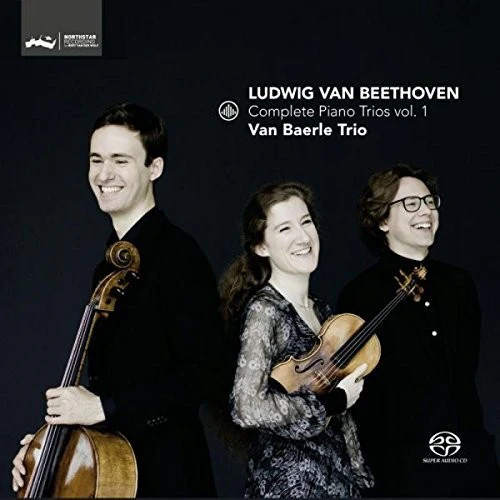
Beethoven: Complete Piano Trios, Vol. 1 / Van Baerle Trio
Beethoven’s primary reason for settling in Vienna in 1792 was to study with Joseph Haydn, who at the time was widely considered the greatest living composer. Beethoven’s three Piano Trios op. 1 were the first compositions that he deemed important enough to give an opus number. They were dedicated to Prince Karl Lichnowsky, a patron of Beethoven in whose house he lived for some time. According to Beethoven’s lifelong friend Ferdinand Ries, Haydn was complimentary about the set of trios. The trios combine various elements that would have been familiar to Beethoven’s contemporaries. Less familiar, however, would be the fact that the trios contain four movements rather than the three that had been traditional in this genre. Although changes from major to minor had been common in the music of previous generations, where they would normally apply to just the last chord, Beethoven employs this technique more extensively here than was probably common at that time. This recording was made using a Chris Maene Concert Grand built in 2017. This remarkable instrument combines the knowledge and materials used in modern piano building with those found in older historical instruments.
Beethoven’s primary reason for settling in Vienna in 1792 was to study with Joseph Haydn, who at the time was widely considered the greatest living composer. Beethoven’s three Piano Trios op. 1 were the first compositions that he deemed important enough to give an opus number. They were dedicated to Prince Karl Lichnowsky, a patron of Beethoven in whose house he lived for some time. According to Beethoven’s lifelong friend Ferdinand Ries, Haydn was complimentary about the set of trios. The trios combine various elements that would have been familiar to Beethoven’s contemporaries. Less familiar, however, would be the fact that the trios contain four movements rather than the three that had been traditional in this genre. Although changes from major to minor had been common in the music of previous generations, where they would normally apply to just the last chord, Beethoven employs this technique more extensively here than was probably common at that time. This recording was made using a Chris Maene Concert Grand built in 2017. This remarkable instrument combines the knowledge and materials used in modern piano building with those found in older historical instruments.
Original: $19.99
-65%$19.99
$7.00Description
Beethoven’s primary reason for settling in Vienna in 1792 was to study with Joseph Haydn, who at the time was widely considered the greatest living composer. Beethoven’s three Piano Trios op. 1 were the first compositions that he deemed important enough to give an opus number. They were dedicated to Prince Karl Lichnowsky, a patron of Beethoven in whose house he lived for some time. According to Beethoven’s lifelong friend Ferdinand Ries, Haydn was complimentary about the set of trios. The trios combine various elements that would have been familiar to Beethoven’s contemporaries. Less familiar, however, would be the fact that the trios contain four movements rather than the three that had been traditional in this genre. Although changes from major to minor had been common in the music of previous generations, where they would normally apply to just the last chord, Beethoven employs this technique more extensively here than was probably common at that time. This recording was made using a Chris Maene Concert Grand built in 2017. This remarkable instrument combines the knowledge and materials used in modern piano building with those found in older historical instruments.