🎉 Up to 70% Off Selected ItemsShop Sale

1 / 2
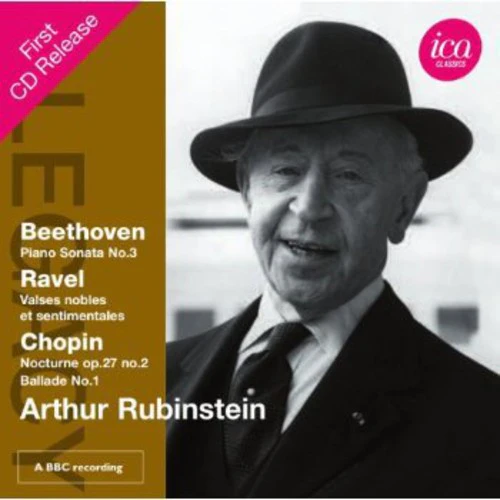
Beethoven: Piano Sonata No 3; Ravel, Chopin / Arthur Rubinstein
BEETHOVEN Piano Sonata No. 3 in C, Op. 2/3 1. RAVEL Valses nobles et sentimentales 1. CHOPIN Nocturne in D?, Op. 27/2 1. Ballade No. 1 in g, Op. 23 1. Andante spianato et Grande Polonaise brillante, Op. 22 2 • Artur Rubinstein (pn) • ICA 5095 (73:00) Live: London 3/17/1963 1 and 10/6/1959 2
If ever there were a pianist who could be considered the aristocrat of the instrument for the 20th century it would surely be Artur Rubinstein, so full of intelligence, nobility, and remarkable simplicity are his interpretations. He was, above all else, a direct communicator of ideas. Throughout his career he always played to the audience, making them feel part of the show, of the whole experience itself; they in turn loved him for it. And though he was not always the most secure technician (in terms of playing the correct notes, not in terms of his overall musical interpretations) he is in especially fine form here.
His direct approach to the music can be witnessed from the very beginning of the recital. Rubinstein’s Beethoven was always interesting to me depending on the particular repertoire he was approaching—his recordings of the “Appassionata” Piano Sonata or the Fourth Piano Concerto are some of the pinnacles of the recorded performances that have been bequeathed to us in the 20th century. His Beethoven Third Sonata is good—it is straightforward; he has little fluctuation of tempo (though the forte outburst in the first movement at 0:25 does push it a bit); his articulation is crisp when required, and he brings a fine joie de vivre in this bright, but not always sunny C-Major work. There is something lacking for me, though—a tension, a drama that I find inherent in this work. Everything here is just too smooth. In Rubinstein’s Ravel there is a tinge (but just a tinge!) of the percussive quality of a Prokofiev: One can almost see Rubinstein’s grin as he lets the rest of us in on what he knows to be Ravel’s true intentions in this work. Too often are these waltzes performed in a flowery manner. The pianist’s approach is subtle in his carefully calculated tonal shadings and in his elegant way of always maintaining the sense of the beat, of the dance, which inspired one of this composer’s loveliest creations. Rubinstein is in especially fine form in Chopin—his composer. The D?-Major Nocturne is the crowning jewel in this recital: Once again everything that makes a Rubinstein performance special is in evidence here, from the continuous flow of the accompaniment to the way in which he approaches each and every phrase, from the highly lyrical to the highly ornamented. Anyone who questions Rubinstein’s mechanism needs to behold the ease in which he plays each and every note in the rapid flourishes that pervade this work. Not only are all of the individual notes crystal clear, each also has a beautiful ringing tone. The G-Minor Ballade was one of the pianist’s favorite works and he is in spectacular form here. He captures that wonderful sense of the narrative—not only can he make the piano sing, he can make it speak. Unfortunately there is an issue here. A sound anomaly mars this otherwise fantastic recording at around 8:30. The Andante spianato and Grand Polonaise act as encores, coming from a much earlier recital. Here too Rubinstein’s magical qualities come out in the ease in which he projects the gentleness of the nocturne-like introduction and the elegance of the dance that follows. It is not the most dynamic reading of the Polonaise I know, but it is powerful nonetheless.
The sound throughout the recording is fine given its vintage (other than the aforementioned issue in the Ballade). What is most remarkable about Rubinstein for me is his naturalness—there seems to be not even a strand of the eccentric in his playing. His Chopin will always remain a favorite because of its elegance, its straightforwardness, and its rejection of the picture of the composer as a frail and meek individual. His Chopin is timeless. His Ravel too is fascinating. In his hands the music retains its modern aura. This is one disc that you’ll be sure to want in your collection; I’m all too happy to make it part of mine.
FANFARE: Scott Noriega
BEETHOVEN Piano Sonata No. 3 in C, Op. 2/3 1. RAVEL Valses nobles et sentimentales 1. CHOPIN Nocturne in D?, Op. 27/2 1. Ballade No. 1 in g, Op. 23 1. Andante spianato et Grande Polonaise brillante, Op. 22 2 • Artur Rubinstein (pn) • ICA 5095 (73:00) Live: London 3/17/1963 1 and 10/6/1959 2
If ever there were a pianist who could be considered the aristocrat of the instrument for the 20th century it would surely be Artur Rubinstein, so full of intelligence, nobility, and remarkable simplicity are his interpretations. He was, above all else, a direct communicator of ideas. Throughout his career he always played to the audience, making them feel part of the show, of the whole experience itself; they in turn loved him for it. And though he was not always the most secure technician (in terms of playing the correct notes, not in terms of his overall musical interpretations) he is in especially fine form here.
His direct approach to the music can be witnessed from the very beginning of the recital. Rubinstein’s Beethoven was always interesting to me depending on the particular repertoire he was approaching—his recordings of the “Appassionata” Piano Sonata or the Fourth Piano Concerto are some of the pinnacles of the recorded performances that have been bequeathed to us in the 20th century. His Beethoven Third Sonata is good—it is straightforward; he has little fluctuation of tempo (though the forte outburst in the first movement at 0:25 does push it a bit); his articulation is crisp when required, and he brings a fine joie de vivre in this bright, but not always sunny C-Major work. There is something lacking for me, though—a tension, a drama that I find inherent in this work. Everything here is just too smooth. In Rubinstein’s Ravel there is a tinge (but just a tinge!) of the percussive quality of a Prokofiev: One can almost see Rubinstein’s grin as he lets the rest of us in on what he knows to be Ravel’s true intentions in this work. Too often are these waltzes performed in a flowery manner. The pianist’s approach is subtle in his carefully calculated tonal shadings and in his elegant way of always maintaining the sense of the beat, of the dance, which inspired one of this composer’s loveliest creations. Rubinstein is in especially fine form in Chopin—his composer. The D?-Major Nocturne is the crowning jewel in this recital: Once again everything that makes a Rubinstein performance special is in evidence here, from the continuous flow of the accompaniment to the way in which he approaches each and every phrase, from the highly lyrical to the highly ornamented. Anyone who questions Rubinstein’s mechanism needs to behold the ease in which he plays each and every note in the rapid flourishes that pervade this work. Not only are all of the individual notes crystal clear, each also has a beautiful ringing tone. The G-Minor Ballade was one of the pianist’s favorite works and he is in spectacular form here. He captures that wonderful sense of the narrative—not only can he make the piano sing, he can make it speak. Unfortunately there is an issue here. A sound anomaly mars this otherwise fantastic recording at around 8:30. The Andante spianato and Grand Polonaise act as encores, coming from a much earlier recital. Here too Rubinstein’s magical qualities come out in the ease in which he projects the gentleness of the nocturne-like introduction and the elegance of the dance that follows. It is not the most dynamic reading of the Polonaise I know, but it is powerful nonetheless.
The sound throughout the recording is fine given its vintage (other than the aforementioned issue in the Ballade). What is most remarkable about Rubinstein for me is his naturalness—there seems to be not even a strand of the eccentric in his playing. His Chopin will always remain a favorite because of its elegance, its straightforwardness, and its rejection of the picture of the composer as a frail and meek individual. His Chopin is timeless. His Ravel too is fascinating. In his hands the music retains its modern aura. This is one disc that you’ll be sure to want in your collection; I’m all too happy to make it part of mine.
FANFARE: Scott Noriega
$14.99
Beethoven: Piano Sonata No 3; Ravel, Chopin / Arthur Rubinstein—
$14.99
Description
BEETHOVEN Piano Sonata No. 3 in C, Op. 2/3 1. RAVEL Valses nobles et sentimentales 1. CHOPIN Nocturne in D?, Op. 27/2 1. Ballade No. 1 in g, Op. 23 1. Andante spianato et Grande Polonaise brillante, Op. 22 2 • Artur Rubinstein (pn) • ICA 5095 (73:00) Live: London 3/17/1963 1 and 10/6/1959 2
If ever there were a pianist who could be considered the aristocrat of the instrument for the 20th century it would surely be Artur Rubinstein, so full of intelligence, nobility, and remarkable simplicity are his interpretations. He was, above all else, a direct communicator of ideas. Throughout his career he always played to the audience, making them feel part of the show, of the whole experience itself; they in turn loved him for it. And though he was not always the most secure technician (in terms of playing the correct notes, not in terms of his overall musical interpretations) he is in especially fine form here.
His direct approach to the music can be witnessed from the very beginning of the recital. Rubinstein’s Beethoven was always interesting to me depending on the particular repertoire he was approaching—his recordings of the “Appassionata” Piano Sonata or the Fourth Piano Concerto are some of the pinnacles of the recorded performances that have been bequeathed to us in the 20th century. His Beethoven Third Sonata is good—it is straightforward; he has little fluctuation of tempo (though the forte outburst in the first movement at 0:25 does push it a bit); his articulation is crisp when required, and he brings a fine joie de vivre in this bright, but not always sunny C-Major work. There is something lacking for me, though—a tension, a drama that I find inherent in this work. Everything here is just too smooth. In Rubinstein’s Ravel there is a tinge (but just a tinge!) of the percussive quality of a Prokofiev: One can almost see Rubinstein’s grin as he lets the rest of us in on what he knows to be Ravel’s true intentions in this work. Too often are these waltzes performed in a flowery manner. The pianist’s approach is subtle in his carefully calculated tonal shadings and in his elegant way of always maintaining the sense of the beat, of the dance, which inspired one of this composer’s loveliest creations. Rubinstein is in especially fine form in Chopin—his composer. The D?-Major Nocturne is the crowning jewel in this recital: Once again everything that makes a Rubinstein performance special is in evidence here, from the continuous flow of the accompaniment to the way in which he approaches each and every phrase, from the highly lyrical to the highly ornamented. Anyone who questions Rubinstein’s mechanism needs to behold the ease in which he plays each and every note in the rapid flourishes that pervade this work. Not only are all of the individual notes crystal clear, each also has a beautiful ringing tone. The G-Minor Ballade was one of the pianist’s favorite works and he is in spectacular form here. He captures that wonderful sense of the narrative—not only can he make the piano sing, he can make it speak. Unfortunately there is an issue here. A sound anomaly mars this otherwise fantastic recording at around 8:30. The Andante spianato and Grand Polonaise act as encores, coming from a much earlier recital. Here too Rubinstein’s magical qualities come out in the ease in which he projects the gentleness of the nocturne-like introduction and the elegance of the dance that follows. It is not the most dynamic reading of the Polonaise I know, but it is powerful nonetheless.
The sound throughout the recording is fine given its vintage (other than the aforementioned issue in the Ballade). What is most remarkable about Rubinstein for me is his naturalness—there seems to be not even a strand of the eccentric in his playing. His Chopin will always remain a favorite because of its elegance, its straightforwardness, and its rejection of the picture of the composer as a frail and meek individual. His Chopin is timeless. His Ravel too is fascinating. In his hands the music retains its modern aura. This is one disc that you’ll be sure to want in your collection; I’m all too happy to make it part of mine.
FANFARE: Scott Noriega