🎉 Up to 70% Off Selected ItemsShop Sale

1 / 2
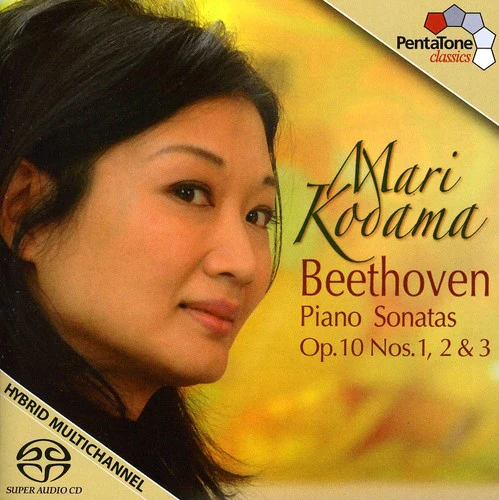
Beethoven: Piano Sonatas Op 10, No 1, 2 & 3 / Mari Kodama
BEETHOVEN Piano Sonatas , op. 10/1–3 • Mari Kodama (pn) • PENTATONE 5186 377 (SACD: 59:20)
This is the latest installment of a cycle-in-progress (though new to me) by Mari Kodama, a Japanese student of Nikolayeva and Brendel. Her playing is impressive in its refinement and control, if occasionally a little predictable. The three op. 10s make for a satisfying program, though they’re curiously presented in reverse order here (Beethoven’s own is more logical, with the biggest, most ambitious work placed last).
No. 1 in C Minor goes well, with few surprises. Kodama generally lets the outer movements speak for themselves—straight, incisive, dramatic, forceful, with effective lyrical contrasts. Tension is well maintained, with a convincing sense of real performance (vs. a recording-studio run-through). The Adagio is straightforward, perhaps to a fault—here I miss the imaginative flexibility and expressive depths others bring to the music (e.g., Schiff/ECM, Lewis/Harmonia Mundi, or the recently reviewed Ohlsson/Bridge and Ehlen/Azica). The recorded sound of her Steinway is rich, resonant, and close, but a little “plummy” for my taste, with a pronounced resonant overhang. Her playing is certainly not over-pedaled, but a real staccato articulation is in short supply.
This is a bigger drawback in the first movement of No. 2 in F where, for all the poise and polish, Beethoven’s numerous injunctions to very short articulations (e.g., at the beginning, bars 38 ff., and 47 ff.) are rarely effectively realized. The development has a slightly stolid feel (the second repeat is observed). The F-Minor Allegretto is taken slowly, to rather dour effect, with (for my taste) an insufficient variety of texture and attack; the Presto finale is kept well under control at a moderate tempo. In the last resort, I find this all a little too uneventful.
The big D Major receives the most consistently satisfying performance of the three. The opening Presto is richly varied, supple and sinuous, with an exciting surging momentum. The Largo e mesto is all dark, glinting marble, and in this instance the finale finds her relishing the music’s wide-ranging phrase and textural discontinuities.
So, a slightly mixed bag. But there’s much playing of real distinction here, and anyone wanting a high-quality version of the three op. 10s in state-of-the-art sound won’t go wrong. For the general collector, perhaps not a first choice (see alternatives mentioned above), but I’ll be keeping this in my collection, and can see returning to the first and third sonatas.
FANFARE: Boyd Pomeroy
This is a hybrid Super Audio CD playable on both regular and Super Audio CD players.
BEETHOVEN Piano Sonatas , op. 10/1–3 • Mari Kodama (pn) • PENTATONE 5186 377 (SACD: 59:20)
This is the latest installment of a cycle-in-progress (though new to me) by Mari Kodama, a Japanese student of Nikolayeva and Brendel. Her playing is impressive in its refinement and control, if occasionally a little predictable. The three op. 10s make for a satisfying program, though they’re curiously presented in reverse order here (Beethoven’s own is more logical, with the biggest, most ambitious work placed last).
No. 1 in C Minor goes well, with few surprises. Kodama generally lets the outer movements speak for themselves—straight, incisive, dramatic, forceful, with effective lyrical contrasts. Tension is well maintained, with a convincing sense of real performance (vs. a recording-studio run-through). The Adagio is straightforward, perhaps to a fault—here I miss the imaginative flexibility and expressive depths others bring to the music (e.g., Schiff/ECM, Lewis/Harmonia Mundi, or the recently reviewed Ohlsson/Bridge and Ehlen/Azica). The recorded sound of her Steinway is rich, resonant, and close, but a little “plummy” for my taste, with a pronounced resonant overhang. Her playing is certainly not over-pedaled, but a real staccato articulation is in short supply.
This is a bigger drawback in the first movement of No. 2 in F where, for all the poise and polish, Beethoven’s numerous injunctions to very short articulations (e.g., at the beginning, bars 38 ff., and 47 ff.) are rarely effectively realized. The development has a slightly stolid feel (the second repeat is observed). The F-Minor Allegretto is taken slowly, to rather dour effect, with (for my taste) an insufficient variety of texture and attack; the Presto finale is kept well under control at a moderate tempo. In the last resort, I find this all a little too uneventful.
The big D Major receives the most consistently satisfying performance of the three. The opening Presto is richly varied, supple and sinuous, with an exciting surging momentum. The Largo e mesto is all dark, glinting marble, and in this instance the finale finds her relishing the music’s wide-ranging phrase and textural discontinuities.
So, a slightly mixed bag. But there’s much playing of real distinction here, and anyone wanting a high-quality version of the three op. 10s in state-of-the-art sound won’t go wrong. For the general collector, perhaps not a first choice (see alternatives mentioned above), but I’ll be keeping this in my collection, and can see returning to the first and third sonatas.
FANFARE: Boyd Pomeroy
This is a hybrid Super Audio CD playable on both regular and Super Audio CD players.
$7.70
Original: $21.99
-65%Beethoven: Piano Sonatas Op 10, No 1, 2 & 3 / Mari Kodama—
$21.99
$7.70Description
BEETHOVEN Piano Sonatas , op. 10/1–3 • Mari Kodama (pn) • PENTATONE 5186 377 (SACD: 59:20)
This is the latest installment of a cycle-in-progress (though new to me) by Mari Kodama, a Japanese student of Nikolayeva and Brendel. Her playing is impressive in its refinement and control, if occasionally a little predictable. The three op. 10s make for a satisfying program, though they’re curiously presented in reverse order here (Beethoven’s own is more logical, with the biggest, most ambitious work placed last).
No. 1 in C Minor goes well, with few surprises. Kodama generally lets the outer movements speak for themselves—straight, incisive, dramatic, forceful, with effective lyrical contrasts. Tension is well maintained, with a convincing sense of real performance (vs. a recording-studio run-through). The Adagio is straightforward, perhaps to a fault—here I miss the imaginative flexibility and expressive depths others bring to the music (e.g., Schiff/ECM, Lewis/Harmonia Mundi, or the recently reviewed Ohlsson/Bridge and Ehlen/Azica). The recorded sound of her Steinway is rich, resonant, and close, but a little “plummy” for my taste, with a pronounced resonant overhang. Her playing is certainly not over-pedaled, but a real staccato articulation is in short supply.
This is a bigger drawback in the first movement of No. 2 in F where, for all the poise and polish, Beethoven’s numerous injunctions to very short articulations (e.g., at the beginning, bars 38 ff., and 47 ff.) are rarely effectively realized. The development has a slightly stolid feel (the second repeat is observed). The F-Minor Allegretto is taken slowly, to rather dour effect, with (for my taste) an insufficient variety of texture and attack; the Presto finale is kept well under control at a moderate tempo. In the last resort, I find this all a little too uneventful.
The big D Major receives the most consistently satisfying performance of the three. The opening Presto is richly varied, supple and sinuous, with an exciting surging momentum. The Largo e mesto is all dark, glinting marble, and in this instance the finale finds her relishing the music’s wide-ranging phrase and textural discontinuities.
So, a slightly mixed bag. But there’s much playing of real distinction here, and anyone wanting a high-quality version of the three op. 10s in state-of-the-art sound won’t go wrong. For the general collector, perhaps not a first choice (see alternatives mentioned above), but I’ll be keeping this in my collection, and can see returning to the first and third sonatas.
FANFARE: Boyd Pomeroy
This is a hybrid Super Audio CD playable on both regular and Super Audio CD players.