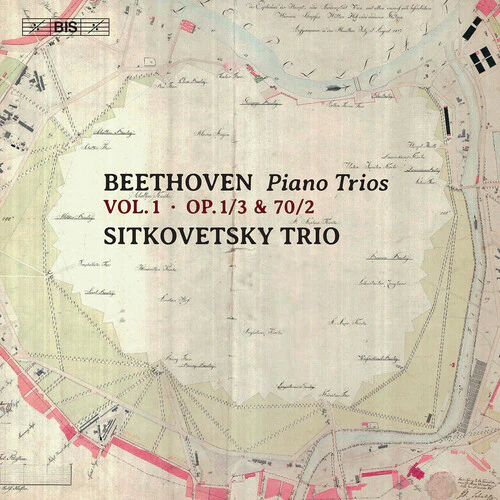
Beethoven: Piano Trios, Vol. 1 / Sitkovetsky Trio
With the three piano trios Op. 1 Ludwig van Beethoven took a genre still largely associated with entertaining salon music, and raised it up to rival the string quartet. The works are innovative in form as well as in content – especially so in the case of the Trio No. 3 in C minor, Beethoven’s trademark key. It is therefore fitting that the Sitkovetsky Trio has chosen this work to open their cycle of the composer’s piano trios. That the C minor trio was pioneering is illustrated by the fact that Haydn, who at the time was Beethoven’s teacher, advised against its publication. He feared that it would not ‘be understood so quickly and easily’ – but the world as Haydn knew it was clearly changing and the trios became a commercial success as well as harbingers of a new musical aesthetic. Some twenty years later, in 1813 when E. T.A. Hoffmann reviewed the two Op. 70 trios, the new era was firmly established, and to Hoffmann the works confirmed ‘how Beethoven carries the Romantic spirit of music deep within his soul’. Between the two complete trios recorded here, the Sitkovetskys include Beethoven’s last contribution to the piano trio genre, the little Allegretto in B flat major, WoO 39. It was composed in June 1812 for Maximiliane Brentano, the ten-year-old daughter of Franz and Antonie Brentano – or, as it says on the title page of the autograph manuscript, ‘for my little friend Maxe Brentano, to encourage her piano playing’.
With the three piano trios Op. 1 Ludwig van Beethoven took a genre still largely associated with entertaining salon music, and raised it up to rival the string quartet. The works are innovative in form as well as in content – especially so in the case of the Trio No. 3 in C minor, Beethoven’s trademark key. It is therefore fitting that the Sitkovetsky Trio has chosen this work to open their cycle of the composer’s piano trios. That the C minor trio was pioneering is illustrated by the fact that Haydn, who at the time was Beethoven’s teacher, advised against its publication. He feared that it would not ‘be understood so quickly and easily’ – but the world as Haydn knew it was clearly changing and the trios became a commercial success as well as harbingers of a new musical aesthetic. Some twenty years later, in 1813 when E. T.A. Hoffmann reviewed the two Op. 70 trios, the new era was firmly established, and to Hoffmann the works confirmed ‘how Beethoven carries the Romantic spirit of music deep within his soul’. Between the two complete trios recorded here, the Sitkovetskys include Beethoven’s last contribution to the piano trio genre, the little Allegretto in B flat major, WoO 39. It was composed in June 1812 for Maximiliane Brentano, the ten-year-old daughter of Franz and Antonie Brentano – or, as it says on the title page of the autograph manuscript, ‘for my little friend Maxe Brentano, to encourage her piano playing’.
Description
With the three piano trios Op. 1 Ludwig van Beethoven took a genre still largely associated with entertaining salon music, and raised it up to rival the string quartet. The works are innovative in form as well as in content – especially so in the case of the Trio No. 3 in C minor, Beethoven’s trademark key. It is therefore fitting that the Sitkovetsky Trio has chosen this work to open their cycle of the composer’s piano trios. That the C minor trio was pioneering is illustrated by the fact that Haydn, who at the time was Beethoven’s teacher, advised against its publication. He feared that it would not ‘be understood so quickly and easily’ – but the world as Haydn knew it was clearly changing and the trios became a commercial success as well as harbingers of a new musical aesthetic. Some twenty years later, in 1813 when E. T.A. Hoffmann reviewed the two Op. 70 trios, the new era was firmly established, and to Hoffmann the works confirmed ‘how Beethoven carries the Romantic spirit of music deep within his soul’. Between the two complete trios recorded here, the Sitkovetskys include Beethoven’s last contribution to the piano trio genre, the little Allegretto in B flat major, WoO 39. It was composed in June 1812 for Maximiliane Brentano, the ten-year-old daughter of Franz and Antonie Brentano – or, as it says on the title page of the autograph manuscript, ‘for my little friend Maxe Brentano, to encourage her piano playing’.