Beethoven: Sonatas & Overtures Arr String Quartet
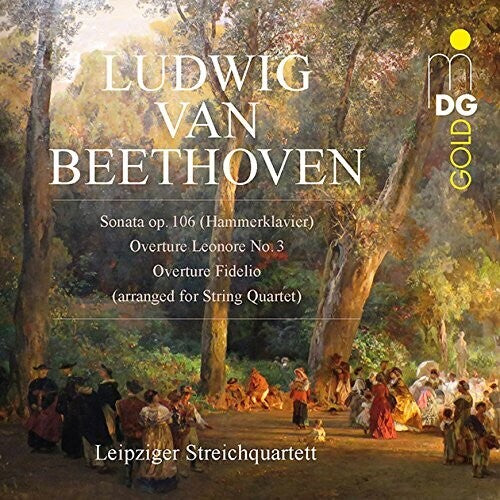
Beethoven’s Piano Sonata op. 106, the “Hammerklavier Sonata,” is regarded as the most complex and demanding piece among the complex and demanding works from his late period. It was not until Franz Liszt, decades after Beethoven’s death, that a pianist was able to master this sonata’s madcap technical challenges. The version for string quartet prepared by David Plylar, a curator at the Library of Congress, was initially intended as a guide through the structural thicket of this gigantic opus. In this rendering by the Leipzig String Quartet, however, it also turns out to be an extremely revealing expansion of our musical horizons. The extended polyphonic passages quite naturally profit from the new opportunities offered by ensemble playing: the canon at the beginning of the development section in the first movement or the mighty fugue in the finale. Beethoven calls for the use of all eighty-eight piano keys, which at the time was a sensational demand. The extreme registers are also represented in the quartet version. Only a top ensemble like the Leipzig String Quartet has the magic and mastery it takes to bring its gigantic leaps, flageolet chords, and intricate harmonic relations to the concert stage. Two transcriptions by Beethoven’s contemporary enrich the program. Along with the Gewandhaus violist Peter Michael Borck, the quartet members present Beethoven’s third attempt to write an overture for his opera Leonore. At the very latest when Borck reaches for the famous offstage trumpet, the last skeptic will become a firm believer in the quintet’s symphonic qualities. The considerably trimmer final version of the Fidelio overture impressively rounds off this extraordinary project.
Beethoven’s Piano Sonata op. 106, the “Hammerklavier Sonata,” is regarded as the most complex and demanding piece among the complex and demanding works from his late period. It was not until Franz Liszt, decades after Beethoven’s death, that a pianist was able to master this sonata’s madcap technical challenges. The version for string quartet prepared by David Plylar, a curator at the Library of Congress, was initially intended as a guide through the structural thicket of this gigantic opus. In this rendering by the Leipzig String Quartet, however, it also turns out to be an extremely revealing expansion of our musical horizons. The extended polyphonic passages quite naturally profit from the new opportunities offered by ensemble playing: the canon at the beginning of the development section in the first movement or the mighty fugue in the finale. Beethoven calls for the use of all eighty-eight piano keys, which at the time was a sensational demand. The extreme registers are also represented in the quartet version. Only a top ensemble like the Leipzig String Quartet has the magic and mastery it takes to bring its gigantic leaps, flageolet chords, and intricate harmonic relations to the concert stage. Two transcriptions by Beethoven’s contemporary enrich the program. Along with the Gewandhaus violist Peter Michael Borck, the quartet members present Beethoven’s third attempt to write an overture for his opera Leonore. At the very latest when Borck reaches for the famous offstage trumpet, the last skeptic will become a firm believer in the quintet’s symphonic qualities. The considerably trimmer final version of the Fidelio overture impressively rounds off this extraordinary project.
Original: $23.99
-65%$23.99
$8.40Description
Beethoven’s Piano Sonata op. 106, the “Hammerklavier Sonata,” is regarded as the most complex and demanding piece among the complex and demanding works from his late period. It was not until Franz Liszt, decades after Beethoven’s death, that a pianist was able to master this sonata’s madcap technical challenges. The version for string quartet prepared by David Plylar, a curator at the Library of Congress, was initially intended as a guide through the structural thicket of this gigantic opus. In this rendering by the Leipzig String Quartet, however, it also turns out to be an extremely revealing expansion of our musical horizons. The extended polyphonic passages quite naturally profit from the new opportunities offered by ensemble playing: the canon at the beginning of the development section in the first movement or the mighty fugue in the finale. Beethoven calls for the use of all eighty-eight piano keys, which at the time was a sensational demand. The extreme registers are also represented in the quartet version. Only a top ensemble like the Leipzig String Quartet has the magic and mastery it takes to bring its gigantic leaps, flageolet chords, and intricate harmonic relations to the concert stage. Two transcriptions by Beethoven’s contemporary enrich the program. Along with the Gewandhaus violist Peter Michael Borck, the quartet members present Beethoven’s third attempt to write an overture for his opera Leonore. At the very latest when Borck reaches for the famous offstage trumpet, the last skeptic will become a firm believer in the quintet’s symphonic qualities. The considerably trimmer final version of the Fidelio overture impressively rounds off this extraordinary project.