🎉 Up to 70% Off Selected ItemsShop Sale

1 / 2
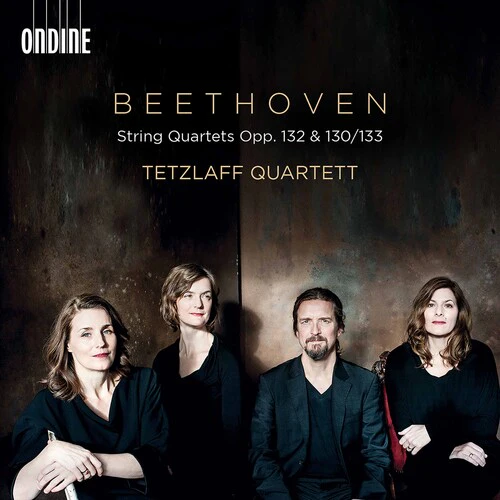
Beethoven: String Quartets Opp. 132, 130 & 133 / Tetzlaff Quartett
This new album of Beethoven’s late String Quartets by the prestigious Tetzlaff Quartett offers a fitting tribute to Beethoven’s 250th anniversary year. These monumental works which are given fresh interpretations by the quartet are among the greatest achievements in the history of Western art music written by a composer who had already largely lost contact with the world. When writing his final String Quartets (Op. 127–135) Beethoven was quickly becoming increasingly ill and understood that he would never be able to recover fully. Beethoven had just completed his 9th Symphony when he received a commission to write String Quartets. What resulted was a string of totally unique masterpieces highly individual in their language and unusual in their form. String Quartet in A minor, Op. 132 is a work in 5 movements with movements Nos. 1, 3, and 5 being the central bearers of meaning. The quartet’s hub and pivot is the middle part of the work, Heiliger Dankgesang eines Genesenen an die Gottheit, in der lidischen Tonart (Holy Song of Thanksgiving of a Convalescent to the Divinity, in the Lydian Mode). The biographical context of this title is obvious and specifically refers to the severe bout of illness experienced by Beethoven from the middle of April to the beginning of May 1825. The Grosse Fuge, Op. 133 is a work that has fascinated listeners for two centuries. Originally, String Quartet in B flat major, Op. 130 and Grosse Fuge Op. 133 were part of one and same work. Beethoven had written the Fuge as the final movement for the String Quartet, but his publisher urged him to write a new ending. For this album, Tetzlaff Quartett performs the String Quartet Op. 130 together with the Grosse Fuge, thus bringing the work back to its original form.
-----
REVIEW:
The immaculate execution prevailing throughout the Tetzlaff Quartett’s earlier Schubert/Haydn release for Ondine similarly yields top tier Beethoven. Before describing the performances, I should address one characteristic (or quirk, if you will) that crosses that tenuous line between painstaking calibration and micromanagement. It concerns an occasional yet slightly irritating tendency to telegraph Beethoven’s sforzandos with tiny gratuitous dynamic swells. At the same time, the ensemble applies infinite degrees of vibrato with the utmost sophistication and specificity, imparting a stinging intensity to unison passages and delicate contrapuntal interplay in Op. 132’s first movement.
They take the lilting second movement’s “ma non tanto” directive to heart, where minimum vibrato and disembodied tonal qualities transform the Trio section into a folk dance. Here, however, I like the Hagen Quartett’s faster pace and suaver ensemble, plus their unusual rendering of the“L’istesso tempo” over the four alla breve bars, where they create a jolting “four against three” effect. The Tetzlaffs conventionally apply the “L’istesso tempo” to the individual notes in these bars, so that the quarter note equals the quarter note throughout. The great central Adagio is on the cool side, yet the slow and sustained writing couldn’t be more beautifully controlled and modulated. But the fourth movement’s rigid dotted rhythms and arch diminuendos reduce the composer’s joy to cuteness.
Every detail of timbre and bowing seems worked out to the proverbial nines in Op. 130’s first movement, and befits the music’s mercurial nature. At first I felt the second movement’s main theme to be held back and self-aware, yet it provides a contrasting context for the faster and more boisterously rendered second theme to flourish. In the third movement the musicians give distinct points of view to the sustained and detached passages as if they were characters in a drama instead of abstract contrapuntal lines. They glibly toss off the fourth movement, as if embarrassed to dance, yet bring a heartfelt, singing sensibility to the swifter than usual Cavatina.
Instead of Beethoven’s revised finale, the Tetzlaff Quartett presents the composer’s original ending, namely the Grosse Fuge. On one hand, their clipped style and bottomless palette of low-level dynamics transforms the gnarly, combative string writing into something quite lithe, transparent, shimmering, and (dare I say it) fun. Not unlike turning a warty frog into a handsome prince! If you want a Grosse Fuge that scratches and screeches and spews venom on each sforzando hammer blow, look elsewhere. However one ultimately responds to these interpretations, the fact is that Christian Tetzlaff and his colleagues realize their conceptions without the least hindrance, hesitation, or compromise.
– ClassicsToday.com (Jed Distler)
-----
REVIEW:
The immaculate execution prevailing throughout the Tetzlaff Quartett’s earlier Schubert/Haydn release for Ondine similarly yields top tier Beethoven. Before describing the performances, I should address one characteristic (or quirk, if you will) that crosses that tenuous line between painstaking calibration and micromanagement. It concerns an occasional yet slightly irritating tendency to telegraph Beethoven’s sforzandos with tiny gratuitous dynamic swells. At the same time, the ensemble applies infinite degrees of vibrato with the utmost sophistication and specificity, imparting a stinging intensity to unison passages and delicate contrapuntal interplay in Op. 132’s first movement.
They take the lilting second movement’s “ma non tanto” directive to heart, where minimum vibrato and disembodied tonal qualities transform the Trio section into a folk dance. Here, however, I like the Hagen Quartett’s faster pace and suaver ensemble, plus their unusual rendering of the“L’istesso tempo” over the four alla breve bars, where they create a jolting “four against three” effect. The Tetzlaffs conventionally apply the “L’istesso tempo” to the individual notes in these bars, so that the quarter note equals the quarter note throughout. The great central Adagio is on the cool side, yet the slow and sustained writing couldn’t be more beautifully controlled and modulated. But the fourth movement’s rigid dotted rhythms and arch diminuendos reduce the composer’s joy to cuteness.
Every detail of timbre and bowing seems worked out to the proverbial nines in Op. 130’s first movement, and befits the music’s mercurial nature. At first I felt the second movement’s main theme to be held back and self-aware, yet it provides a contrasting context for the faster and more boisterously rendered second theme to flourish. In the third movement the musicians give distinct points of view to the sustained and detached passages as if they were characters in a drama instead of abstract contrapuntal lines. They glibly toss off the fourth movement, as if embarrassed to dance, yet bring a heartfelt, singing sensibility to the swifter than usual Cavatina.
Instead of Beethoven’s revised finale, the Tetzlaff Quartett presents the composer’s original ending, namely the Grosse Fuge. On one hand, their clipped style and bottomless palette of low-level dynamics transforms the gnarly, combative string writing into something quite lithe, transparent, shimmering, and (dare I say it) fun. Not unlike turning a warty frog into a handsome prince! If you want a Grosse Fuge that scratches and screeches and spews venom on each sforzando hammer blow, look elsewhere. However one ultimately responds to these interpretations, the fact is that Christian Tetzlaff and his colleagues realize their conceptions without the least hindrance, hesitation, or compromise.
– ClassicsToday.com (Jed Distler)
This new album of Beethoven’s late String Quartets by the prestigious Tetzlaff Quartett offers a fitting tribute to Beethoven’s 250th anniversary year. These monumental works which are given fresh interpretations by the quartet are among the greatest achievements in the history of Western art music written by a composer who had already largely lost contact with the world. When writing his final String Quartets (Op. 127–135) Beethoven was quickly becoming increasingly ill and understood that he would never be able to recover fully. Beethoven had just completed his 9th Symphony when he received a commission to write String Quartets. What resulted was a string of totally unique masterpieces highly individual in their language and unusual in their form. String Quartet in A minor, Op. 132 is a work in 5 movements with movements Nos. 1, 3, and 5 being the central bearers of meaning. The quartet’s hub and pivot is the middle part of the work, Heiliger Dankgesang eines Genesenen an die Gottheit, in der lidischen Tonart (Holy Song of Thanksgiving of a Convalescent to the Divinity, in the Lydian Mode). The biographical context of this title is obvious and specifically refers to the severe bout of illness experienced by Beethoven from the middle of April to the beginning of May 1825. The Grosse Fuge, Op. 133 is a work that has fascinated listeners for two centuries. Originally, String Quartet in B flat major, Op. 130 and Grosse Fuge Op. 133 were part of one and same work. Beethoven had written the Fuge as the final movement for the String Quartet, but his publisher urged him to write a new ending. For this album, Tetzlaff Quartett performs the String Quartet Op. 130 together with the Grosse Fuge, thus bringing the work back to its original form.
-----
REVIEW:
The immaculate execution prevailing throughout the Tetzlaff Quartett’s earlier Schubert/Haydn release for Ondine similarly yields top tier Beethoven. Before describing the performances, I should address one characteristic (or quirk, if you will) that crosses that tenuous line between painstaking calibration and micromanagement. It concerns an occasional yet slightly irritating tendency to telegraph Beethoven’s sforzandos with tiny gratuitous dynamic swells. At the same time, the ensemble applies infinite degrees of vibrato with the utmost sophistication and specificity, imparting a stinging intensity to unison passages and delicate contrapuntal interplay in Op. 132’s first movement.
They take the lilting second movement’s “ma non tanto” directive to heart, where minimum vibrato and disembodied tonal qualities transform the Trio section into a folk dance. Here, however, I like the Hagen Quartett’s faster pace and suaver ensemble, plus their unusual rendering of the“L’istesso tempo” over the four alla breve bars, where they create a jolting “four against three” effect. The Tetzlaffs conventionally apply the “L’istesso tempo” to the individual notes in these bars, so that the quarter note equals the quarter note throughout. The great central Adagio is on the cool side, yet the slow and sustained writing couldn’t be more beautifully controlled and modulated. But the fourth movement’s rigid dotted rhythms and arch diminuendos reduce the composer’s joy to cuteness.
Every detail of timbre and bowing seems worked out to the proverbial nines in Op. 130’s first movement, and befits the music’s mercurial nature. At first I felt the second movement’s main theme to be held back and self-aware, yet it provides a contrasting context for the faster and more boisterously rendered second theme to flourish. In the third movement the musicians give distinct points of view to the sustained and detached passages as if they were characters in a drama instead of abstract contrapuntal lines. They glibly toss off the fourth movement, as if embarrassed to dance, yet bring a heartfelt, singing sensibility to the swifter than usual Cavatina.
Instead of Beethoven’s revised finale, the Tetzlaff Quartett presents the composer’s original ending, namely the Grosse Fuge. On one hand, their clipped style and bottomless palette of low-level dynamics transforms the gnarly, combative string writing into something quite lithe, transparent, shimmering, and (dare I say it) fun. Not unlike turning a warty frog into a handsome prince! If you want a Grosse Fuge that scratches and screeches and spews venom on each sforzando hammer blow, look elsewhere. However one ultimately responds to these interpretations, the fact is that Christian Tetzlaff and his colleagues realize their conceptions without the least hindrance, hesitation, or compromise.
– ClassicsToday.com (Jed Distler)
-----
REVIEW:
The immaculate execution prevailing throughout the Tetzlaff Quartett’s earlier Schubert/Haydn release for Ondine similarly yields top tier Beethoven. Before describing the performances, I should address one characteristic (or quirk, if you will) that crosses that tenuous line between painstaking calibration and micromanagement. It concerns an occasional yet slightly irritating tendency to telegraph Beethoven’s sforzandos with tiny gratuitous dynamic swells. At the same time, the ensemble applies infinite degrees of vibrato with the utmost sophistication and specificity, imparting a stinging intensity to unison passages and delicate contrapuntal interplay in Op. 132’s first movement.
They take the lilting second movement’s “ma non tanto” directive to heart, where minimum vibrato and disembodied tonal qualities transform the Trio section into a folk dance. Here, however, I like the Hagen Quartett’s faster pace and suaver ensemble, plus their unusual rendering of the“L’istesso tempo” over the four alla breve bars, where they create a jolting “four against three” effect. The Tetzlaffs conventionally apply the “L’istesso tempo” to the individual notes in these bars, so that the quarter note equals the quarter note throughout. The great central Adagio is on the cool side, yet the slow and sustained writing couldn’t be more beautifully controlled and modulated. But the fourth movement’s rigid dotted rhythms and arch diminuendos reduce the composer’s joy to cuteness.
Every detail of timbre and bowing seems worked out to the proverbial nines in Op. 130’s first movement, and befits the music’s mercurial nature. At first I felt the second movement’s main theme to be held back and self-aware, yet it provides a contrasting context for the faster and more boisterously rendered second theme to flourish. In the third movement the musicians give distinct points of view to the sustained and detached passages as if they were characters in a drama instead of abstract contrapuntal lines. They glibly toss off the fourth movement, as if embarrassed to dance, yet bring a heartfelt, singing sensibility to the swifter than usual Cavatina.
Instead of Beethoven’s revised finale, the Tetzlaff Quartett presents the composer’s original ending, namely the Grosse Fuge. On one hand, their clipped style and bottomless palette of low-level dynamics transforms the gnarly, combative string writing into something quite lithe, transparent, shimmering, and (dare I say it) fun. Not unlike turning a warty frog into a handsome prince! If you want a Grosse Fuge that scratches and screeches and spews venom on each sforzando hammer blow, look elsewhere. However one ultimately responds to these interpretations, the fact is that Christian Tetzlaff and his colleagues realize their conceptions without the least hindrance, hesitation, or compromise.
– ClassicsToday.com (Jed Distler)
$14.99
Beethoven: String Quartets Opp. 132, 130 & 133 / Tetzlaff Quartett—
$14.99
Description
This new album of Beethoven’s late String Quartets by the prestigious Tetzlaff Quartett offers a fitting tribute to Beethoven’s 250th anniversary year. These monumental works which are given fresh interpretations by the quartet are among the greatest achievements in the history of Western art music written by a composer who had already largely lost contact with the world. When writing his final String Quartets (Op. 127–135) Beethoven was quickly becoming increasingly ill and understood that he would never be able to recover fully. Beethoven had just completed his 9th Symphony when he received a commission to write String Quartets. What resulted was a string of totally unique masterpieces highly individual in their language and unusual in their form. String Quartet in A minor, Op. 132 is a work in 5 movements with movements Nos. 1, 3, and 5 being the central bearers of meaning. The quartet’s hub and pivot is the middle part of the work, Heiliger Dankgesang eines Genesenen an die Gottheit, in der lidischen Tonart (Holy Song of Thanksgiving of a Convalescent to the Divinity, in the Lydian Mode). The biographical context of this title is obvious and specifically refers to the severe bout of illness experienced by Beethoven from the middle of April to the beginning of May 1825. The Grosse Fuge, Op. 133 is a work that has fascinated listeners for two centuries. Originally, String Quartet in B flat major, Op. 130 and Grosse Fuge Op. 133 were part of one and same work. Beethoven had written the Fuge as the final movement for the String Quartet, but his publisher urged him to write a new ending. For this album, Tetzlaff Quartett performs the String Quartet Op. 130 together with the Grosse Fuge, thus bringing the work back to its original form.
-----
REVIEW:
The immaculate execution prevailing throughout the Tetzlaff Quartett’s earlier Schubert/Haydn release for Ondine similarly yields top tier Beethoven. Before describing the performances, I should address one characteristic (or quirk, if you will) that crosses that tenuous line between painstaking calibration and micromanagement. It concerns an occasional yet slightly irritating tendency to telegraph Beethoven’s sforzandos with tiny gratuitous dynamic swells. At the same time, the ensemble applies infinite degrees of vibrato with the utmost sophistication and specificity, imparting a stinging intensity to unison passages and delicate contrapuntal interplay in Op. 132’s first movement.
They take the lilting second movement’s “ma non tanto” directive to heart, where minimum vibrato and disembodied tonal qualities transform the Trio section into a folk dance. Here, however, I like the Hagen Quartett’s faster pace and suaver ensemble, plus their unusual rendering of the“L’istesso tempo” over the four alla breve bars, where they create a jolting “four against three” effect. The Tetzlaffs conventionally apply the “L’istesso tempo” to the individual notes in these bars, so that the quarter note equals the quarter note throughout. The great central Adagio is on the cool side, yet the slow and sustained writing couldn’t be more beautifully controlled and modulated. But the fourth movement’s rigid dotted rhythms and arch diminuendos reduce the composer’s joy to cuteness.
Every detail of timbre and bowing seems worked out to the proverbial nines in Op. 130’s first movement, and befits the music’s mercurial nature. At first I felt the second movement’s main theme to be held back and self-aware, yet it provides a contrasting context for the faster and more boisterously rendered second theme to flourish. In the third movement the musicians give distinct points of view to the sustained and detached passages as if they were characters in a drama instead of abstract contrapuntal lines. They glibly toss off the fourth movement, as if embarrassed to dance, yet bring a heartfelt, singing sensibility to the swifter than usual Cavatina.
Instead of Beethoven’s revised finale, the Tetzlaff Quartett presents the composer’s original ending, namely the Grosse Fuge. On one hand, their clipped style and bottomless palette of low-level dynamics transforms the gnarly, combative string writing into something quite lithe, transparent, shimmering, and (dare I say it) fun. Not unlike turning a warty frog into a handsome prince! If you want a Grosse Fuge that scratches and screeches and spews venom on each sforzando hammer blow, look elsewhere. However one ultimately responds to these interpretations, the fact is that Christian Tetzlaff and his colleagues realize their conceptions without the least hindrance, hesitation, or compromise.
– ClassicsToday.com (Jed Distler)
-----
REVIEW:
The immaculate execution prevailing throughout the Tetzlaff Quartett’s earlier Schubert/Haydn release for Ondine similarly yields top tier Beethoven. Before describing the performances, I should address one characteristic (or quirk, if you will) that crosses that tenuous line between painstaking calibration and micromanagement. It concerns an occasional yet slightly irritating tendency to telegraph Beethoven’s sforzandos with tiny gratuitous dynamic swells. At the same time, the ensemble applies infinite degrees of vibrato with the utmost sophistication and specificity, imparting a stinging intensity to unison passages and delicate contrapuntal interplay in Op. 132’s first movement.
They take the lilting second movement’s “ma non tanto” directive to heart, where minimum vibrato and disembodied tonal qualities transform the Trio section into a folk dance. Here, however, I like the Hagen Quartett’s faster pace and suaver ensemble, plus their unusual rendering of the“L’istesso tempo” over the four alla breve bars, where they create a jolting “four against three” effect. The Tetzlaffs conventionally apply the “L’istesso tempo” to the individual notes in these bars, so that the quarter note equals the quarter note throughout. The great central Adagio is on the cool side, yet the slow and sustained writing couldn’t be more beautifully controlled and modulated. But the fourth movement’s rigid dotted rhythms and arch diminuendos reduce the composer’s joy to cuteness.
Every detail of timbre and bowing seems worked out to the proverbial nines in Op. 130’s first movement, and befits the music’s mercurial nature. At first I felt the second movement’s main theme to be held back and self-aware, yet it provides a contrasting context for the faster and more boisterously rendered second theme to flourish. In the third movement the musicians give distinct points of view to the sustained and detached passages as if they were characters in a drama instead of abstract contrapuntal lines. They glibly toss off the fourth movement, as if embarrassed to dance, yet bring a heartfelt, singing sensibility to the swifter than usual Cavatina.
Instead of Beethoven’s revised finale, the Tetzlaff Quartett presents the composer’s original ending, namely the Grosse Fuge. On one hand, their clipped style and bottomless palette of low-level dynamics transforms the gnarly, combative string writing into something quite lithe, transparent, shimmering, and (dare I say it) fun. Not unlike turning a warty frog into a handsome prince! If you want a Grosse Fuge that scratches and screeches and spews venom on each sforzando hammer blow, look elsewhere. However one ultimately responds to these interpretations, the fact is that Christian Tetzlaff and his colleagues realize their conceptions without the least hindrance, hesitation, or compromise.
– ClassicsToday.com (Jed Distler)