🎉 Up to 70% Off Selected ItemsShop Sale

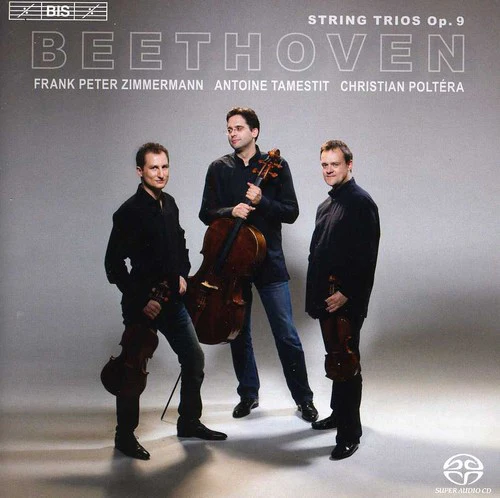
Beethoven: String Trios / Zimmermann, Tamestit, Poltera
This is a hybrid Super Audio CD playable on both regular and Super Audio CD players.

Beethoven’s three Op. 9 string trios are early masterpieces, every bit as fine as the later Op. 18 quartets. These performances are wonderful: there is nothing to criticize. The quality of ensemble is outstanding, perfectly balanced, always in tune, warmly sonorous, and stylish. The presto finale of the G major trio is impeccably light and fleet, all three slow movements beautifully singing and sustained. In the dramatic C minor trio these players (Frank Peter Zimmermann, Antoine Tamestit, and Christian Poltéra) offer a clinic on how to turn phrasing and accent to ear-catching account without a trace of ugliness or mannerism. The SACD sonics are every bit as fine. Don’t let this one slip by.
– David Hurwitz, ClassicsToday.com
-------
These three early trios by Beethoven are given brisk, lively, and well-detailed readings by the Zimmermann Trio, which was formed in 2007. Like so much of Beethoven’s music from the 1796–98 period, these pieces lie between the style of Haydn or Mozart and his own more imaginative manner, which was coming forward in those years. The addition of a fourth voice, in his early op. 18 string quartets, was obviously an extra inspiration for the composer, yet it was this set of trios on which he built those excellent structures.
If you are a fan of these string trios, this is certainly an outstanding recording to own of them. There is, really, nothing one can fault in the trio’s technical execution or musical style. Everything is there: the rhythmic spring, the little felicitous touches on the turns, the clarity in the interplay of voices. In addition, BIS’s hybrid SACD sound is simply splendid, sharp and clearly textured as a good recording of a small string ensemble should be.
FANFARE: Lynn René Bayley
Beethoven’s three Op. 9 string trios are early masterpieces, every bit as fine as the later Op. 18 quartets. These performances are wonderful: there is nothing to criticize. The quality of ensemble is outstanding, perfectly balanced, always in tune, warmly sonorous, and stylish. The presto finale of the G major trio is impeccably light and fleet, all three slow movements beautifully singing and sustained. In the dramatic C minor trio these players (Frank Peter Zimmermann, Antoine Tamestit, and Christian Poltéra) offer a clinic on how to turn phrasing and accent to ear-catching account without a trace of ugliness or mannerism. The SACD sonics are every bit as fine. Don’t let this one slip by.
– David Hurwitz, ClassicsToday.com
-------
These three early trios by Beethoven are given brisk, lively, and well-detailed readings by the Zimmermann Trio, which was formed in 2007. Like so much of Beethoven’s music from the 1796–98 period, these pieces lie between the style of Haydn or Mozart and his own more imaginative manner, which was coming forward in those years. The addition of a fourth voice, in his early op. 18 string quartets, was obviously an extra inspiration for the composer, yet it was this set of trios on which he built those excellent structures.
If you are a fan of these string trios, this is certainly an outstanding recording to own of them. There is, really, nothing one can fault in the trio’s technical execution or musical style. Everything is there: the rhythmic spring, the little felicitous touches on the turns, the clarity in the interplay of voices. In addition, BIS’s hybrid SACD sound is simply splendid, sharp and clearly textured as a good recording of a small string ensemble should be.
FANFARE: Lynn René Bayley
This is a hybrid Super Audio CD playable on both regular and Super Audio CD players.
Beethoven’s three Op. 9 string trios are early masterpieces, every bit as fine as the later Op. 18 quartets. These performances are wonderful: there is nothing to criticize. The quality of ensemble is outstanding, perfectly balanced, always in tune, warmly sonorous, and stylish. The presto finale of the G major trio is impeccably light and fleet, all three slow movements beautifully singing and sustained. In the dramatic C minor trio these players (Frank Peter Zimmermann, Antoine Tamestit, and Christian Poltéra) offer a clinic on how to turn phrasing and accent to ear-catching account without a trace of ugliness or mannerism. The SACD sonics are every bit as fine. Don’t let this one slip by.
– David Hurwitz, ClassicsToday.com
-------
These three early trios by Beethoven are given brisk, lively, and well-detailed readings by the Zimmermann Trio, which was formed in 2007. Like so much of Beethoven’s music from the 1796–98 period, these pieces lie between the style of Haydn or Mozart and his own more imaginative manner, which was coming forward in those years. The addition of a fourth voice, in his early op. 18 string quartets, was obviously an extra inspiration for the composer, yet it was this set of trios on which he built those excellent structures.
If you are a fan of these string trios, this is certainly an outstanding recording to own of them. There is, really, nothing one can fault in the trio’s technical execution or musical style. Everything is there: the rhythmic spring, the little felicitous touches on the turns, the clarity in the interplay of voices. In addition, BIS’s hybrid SACD sound is simply splendid, sharp and clearly textured as a good recording of a small string ensemble should be.
FANFARE: Lynn René Bayley
Beethoven’s three Op. 9 string trios are early masterpieces, every bit as fine as the later Op. 18 quartets. These performances are wonderful: there is nothing to criticize. The quality of ensemble is outstanding, perfectly balanced, always in tune, warmly sonorous, and stylish. The presto finale of the G major trio is impeccably light and fleet, all three slow movements beautifully singing and sustained. In the dramatic C minor trio these players (Frank Peter Zimmermann, Antoine Tamestit, and Christian Poltéra) offer a clinic on how to turn phrasing and accent to ear-catching account without a trace of ugliness or mannerism. The SACD sonics are every bit as fine. Don’t let this one slip by.
– David Hurwitz, ClassicsToday.com
-------
These three early trios by Beethoven are given brisk, lively, and well-detailed readings by the Zimmermann Trio, which was formed in 2007. Like so much of Beethoven’s music from the 1796–98 period, these pieces lie between the style of Haydn or Mozart and his own more imaginative manner, which was coming forward in those years. The addition of a fourth voice, in his early op. 18 string quartets, was obviously an extra inspiration for the composer, yet it was this set of trios on which he built those excellent structures.
If you are a fan of these string trios, this is certainly an outstanding recording to own of them. There is, really, nothing one can fault in the trio’s technical execution or musical style. Everything is there: the rhythmic spring, the little felicitous touches on the turns, the clarity in the interplay of voices. In addition, BIS’s hybrid SACD sound is simply splendid, sharp and clearly textured as a good recording of a small string ensemble should be.
FANFARE: Lynn René Bayley
$21.99
Beethoven: String Trios / Zimmermann, Tamestit, Poltera—
$21.99
Description
This is a hybrid Super Audio CD playable on both regular and Super Audio CD players.
Beethoven’s three Op. 9 string trios are early masterpieces, every bit as fine as the later Op. 18 quartets. These performances are wonderful: there is nothing to criticize. The quality of ensemble is outstanding, perfectly balanced, always in tune, warmly sonorous, and stylish. The presto finale of the G major trio is impeccably light and fleet, all three slow movements beautifully singing and sustained. In the dramatic C minor trio these players (Frank Peter Zimmermann, Antoine Tamestit, and Christian Poltéra) offer a clinic on how to turn phrasing and accent to ear-catching account without a trace of ugliness or mannerism. The SACD sonics are every bit as fine. Don’t let this one slip by.
– David Hurwitz, ClassicsToday.com
-------
These three early trios by Beethoven are given brisk, lively, and well-detailed readings by the Zimmermann Trio, which was formed in 2007. Like so much of Beethoven’s music from the 1796–98 period, these pieces lie between the style of Haydn or Mozart and his own more imaginative manner, which was coming forward in those years. The addition of a fourth voice, in his early op. 18 string quartets, was obviously an extra inspiration for the composer, yet it was this set of trios on which he built those excellent structures.
If you are a fan of these string trios, this is certainly an outstanding recording to own of them. There is, really, nothing one can fault in the trio’s technical execution or musical style. Everything is there: the rhythmic spring, the little felicitous touches on the turns, the clarity in the interplay of voices. In addition, BIS’s hybrid SACD sound is simply splendid, sharp and clearly textured as a good recording of a small string ensemble should be.
FANFARE: Lynn René Bayley
Beethoven’s three Op. 9 string trios are early masterpieces, every bit as fine as the later Op. 18 quartets. These performances are wonderful: there is nothing to criticize. The quality of ensemble is outstanding, perfectly balanced, always in tune, warmly sonorous, and stylish. The presto finale of the G major trio is impeccably light and fleet, all three slow movements beautifully singing and sustained. In the dramatic C minor trio these players (Frank Peter Zimmermann, Antoine Tamestit, and Christian Poltéra) offer a clinic on how to turn phrasing and accent to ear-catching account without a trace of ugliness or mannerism. The SACD sonics are every bit as fine. Don’t let this one slip by.
– David Hurwitz, ClassicsToday.com
-------
These three early trios by Beethoven are given brisk, lively, and well-detailed readings by the Zimmermann Trio, which was formed in 2007. Like so much of Beethoven’s music from the 1796–98 period, these pieces lie between the style of Haydn or Mozart and his own more imaginative manner, which was coming forward in those years. The addition of a fourth voice, in his early op. 18 string quartets, was obviously an extra inspiration for the composer, yet it was this set of trios on which he built those excellent structures.
If you are a fan of these string trios, this is certainly an outstanding recording to own of them. There is, really, nothing one can fault in the trio’s technical execution or musical style. Everything is there: the rhythmic spring, the little felicitous touches on the turns, the clarity in the interplay of voices. In addition, BIS’s hybrid SACD sound is simply splendid, sharp and clearly textured as a good recording of a small string ensemble should be.
FANFARE: Lynn René Bayley