🎉 Up to 70% Off Selected ItemsShop Sale

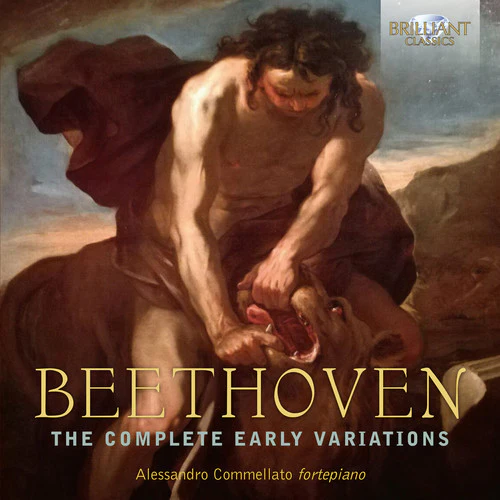
Beethoven: The Complete Early Variations / Commellato
An unrivalled compendium on disc of the Beethoven’s compositional laboratory, full of experiments that would be refined throughout his career to create the piano’s ‘New Testament’ of 32 sonatas. Under the title of ‘early variations’, Alessandro Commellato has brought together all those theme with variation sets for solo and four hands piano that were not included in the main catalogue of Beethoven's compositions. In fact not all of them are early: the imposing C minor 32 Variations WoO80 are the best-known work here, composed as late as 1806, and the sets on Rule Britannia and God save the King were written a year or two earlier, and perhaps not only for commercially expedient reasons, given Beethoven’s admiration for the British resistance to the proclamation of the French Empire. More common, however, are the variation sets where Beethoven was establishing his voice and refining his technique by exercising his imagination on melodies from popular marches and operas by Grétry, Paisiello and Mozart. The composer used these works to curry favour with patrons such as Prince Lichnowsky; even on occasion as dedicatory gifts in order to make amends for his notoriously obstreperous behaviour, such as the variations on a Dittersdorf arietta, ‘Es war einmal’ (Once upon a time) which he gave in the summer of 1792 to Eleonore von Breuning, daughter of Maria Helena, who had welcomed the young wayward artist into her home. Alessandro Commellato uses an 1823 fortepiano by Joseph Böhm, a Viennese piano-maker whose instruments were known to Beethoven, bestowing on this recording an unusual degree of authenticity. He is a specialist in historically informed performances of Viennese Classicism: previous discs for Brilliant Classics include music by Beethoven’s pupils such as the cello sonatas of Ferdinand Ries and piano concertos by Johann Nepomuk Hummel.
-----
REVIEW:
Commellato’s choice of specific instruments for particular works is a personal one, and it is always well-considered. There are five different fortepianos heard here, each with its own unique sound, with the earliest having very distinctly harpsichord-like characteristics and the latest (dating to 1823) beginning to possess some of the range and tone of the more-familiar instruments created later in the 19th century. All in all, this is a fascinating foray into less-known Beethoven and into a form that the composer used in his piano music throughout his life, right through to the second and concluding movement of his final piano sonata.
– Infodad.com
-----
REVIEW:
Commellato’s choice of specific instruments for particular works is a personal one, and it is always well-considered. There are five different fortepianos heard here, each with its own unique sound, with the earliest having very distinctly harpsichord-like characteristics and the latest (dating to 1823) beginning to possess some of the range and tone of the more-familiar instruments created later in the 19th century. All in all, this is a fascinating foray into less-known Beethoven and into a form that the composer used in his piano music throughout his life, right through to the second and concluding movement of his final piano sonata.
– Infodad.com
An unrivalled compendium on disc of the Beethoven’s compositional laboratory, full of experiments that would be refined throughout his career to create the piano’s ‘New Testament’ of 32 sonatas. Under the title of ‘early variations’, Alessandro Commellato has brought together all those theme with variation sets for solo and four hands piano that were not included in the main catalogue of Beethoven's compositions. In fact not all of them are early: the imposing C minor 32 Variations WoO80 are the best-known work here, composed as late as 1806, and the sets on Rule Britannia and God save the King were written a year or two earlier, and perhaps not only for commercially expedient reasons, given Beethoven’s admiration for the British resistance to the proclamation of the French Empire. More common, however, are the variation sets where Beethoven was establishing his voice and refining his technique by exercising his imagination on melodies from popular marches and operas by Grétry, Paisiello and Mozart. The composer used these works to curry favour with patrons such as Prince Lichnowsky; even on occasion as dedicatory gifts in order to make amends for his notoriously obstreperous behaviour, such as the variations on a Dittersdorf arietta, ‘Es war einmal’ (Once upon a time) which he gave in the summer of 1792 to Eleonore von Breuning, daughter of Maria Helena, who had welcomed the young wayward artist into her home. Alessandro Commellato uses an 1823 fortepiano by Joseph Böhm, a Viennese piano-maker whose instruments were known to Beethoven, bestowing on this recording an unusual degree of authenticity. He is a specialist in historically informed performances of Viennese Classicism: previous discs for Brilliant Classics include music by Beethoven’s pupils such as the cello sonatas of Ferdinand Ries and piano concertos by Johann Nepomuk Hummel.
-----
REVIEW:
Commellato’s choice of specific instruments for particular works is a personal one, and it is always well-considered. There are five different fortepianos heard here, each with its own unique sound, with the earliest having very distinctly harpsichord-like characteristics and the latest (dating to 1823) beginning to possess some of the range and tone of the more-familiar instruments created later in the 19th century. All in all, this is a fascinating foray into less-known Beethoven and into a form that the composer used in his piano music throughout his life, right through to the second and concluding movement of his final piano sonata.
– Infodad.com
-----
REVIEW:
Commellato’s choice of specific instruments for particular works is a personal one, and it is always well-considered. There are five different fortepianos heard here, each with its own unique sound, with the earliest having very distinctly harpsichord-like characteristics and the latest (dating to 1823) beginning to possess some of the range and tone of the more-familiar instruments created later in the 19th century. All in all, this is a fascinating foray into less-known Beethoven and into a form that the composer used in his piano music throughout his life, right through to the second and concluding movement of his final piano sonata.
– Infodad.com
$5.95
Original: $16.99
-65%Beethoven: The Complete Early Variations / Commellato—
$16.99
$5.95Description
An unrivalled compendium on disc of the Beethoven’s compositional laboratory, full of experiments that would be refined throughout his career to create the piano’s ‘New Testament’ of 32 sonatas. Under the title of ‘early variations’, Alessandro Commellato has brought together all those theme with variation sets for solo and four hands piano that were not included in the main catalogue of Beethoven's compositions. In fact not all of them are early: the imposing C minor 32 Variations WoO80 are the best-known work here, composed as late as 1806, and the sets on Rule Britannia and God save the King were written a year or two earlier, and perhaps not only for commercially expedient reasons, given Beethoven’s admiration for the British resistance to the proclamation of the French Empire. More common, however, are the variation sets where Beethoven was establishing his voice and refining his technique by exercising his imagination on melodies from popular marches and operas by Grétry, Paisiello and Mozart. The composer used these works to curry favour with patrons such as Prince Lichnowsky; even on occasion as dedicatory gifts in order to make amends for his notoriously obstreperous behaviour, such as the variations on a Dittersdorf arietta, ‘Es war einmal’ (Once upon a time) which he gave in the summer of 1792 to Eleonore von Breuning, daughter of Maria Helena, who had welcomed the young wayward artist into her home. Alessandro Commellato uses an 1823 fortepiano by Joseph Böhm, a Viennese piano-maker whose instruments were known to Beethoven, bestowing on this recording an unusual degree of authenticity. He is a specialist in historically informed performances of Viennese Classicism: previous discs for Brilliant Classics include music by Beethoven’s pupils such as the cello sonatas of Ferdinand Ries and piano concertos by Johann Nepomuk Hummel.
-----
REVIEW:
Commellato’s choice of specific instruments for particular works is a personal one, and it is always well-considered. There are five different fortepianos heard here, each with its own unique sound, with the earliest having very distinctly harpsichord-like characteristics and the latest (dating to 1823) beginning to possess some of the range and tone of the more-familiar instruments created later in the 19th century. All in all, this is a fascinating foray into less-known Beethoven and into a form that the composer used in his piano music throughout his life, right through to the second and concluding movement of his final piano sonata.
– Infodad.com
-----
REVIEW:
Commellato’s choice of specific instruments for particular works is a personal one, and it is always well-considered. There are five different fortepianos heard here, each with its own unique sound, with the earliest having very distinctly harpsichord-like characteristics and the latest (dating to 1823) beginning to possess some of the range and tone of the more-familiar instruments created later in the 19th century. All in all, this is a fascinating foray into less-known Beethoven and into a form that the composer used in his piano music throughout his life, right through to the second and concluding movement of his final piano sonata.
– Infodad.com