🎉 Up to 70% Off Selected ItemsShop Sale

1 / 2
Ben-Haim: Chamber Music for Strings
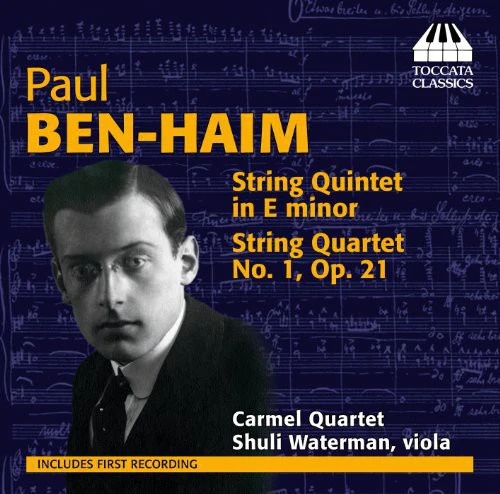
BEN-HAIM String Quartet No. 1, op. 21. String Quintet in e • Carmel Quartet; Shuli Waterman (va) • TOCCATA 0214 (61:37)
Here are two major chamber works by the Israeli composer Paul Ben-Haim (1897–1984), who began his career in Munich as Paul Frankenburger. His lengthy, three-movement String Quintet from 1919, which receives its first recording here, is a representative product of the composer’s early period. Its style might be described as early-20th-century German Romantic with leanings toward Franck and Liszt. It’s an ambitious, expertly scored, three-movement work, though its material might have been equally effectively scored as a symphony. There’s a somewhat Modernistic, Hindemith-like approach to the announcement of themes in the outer movements, before the music moves into nostalgic, 19th-century material reminiscent of Brahms or Mahler (Mahler’s work serving as Frankenburger’s model when, later on, as Ben-Haim, he turned to symphonic writing). In the quintet’s third movement, the music’s eclecticism starts to feel contrived, particularly with the commencement of a fugue two-thirds of the way through, a 19th-century compositional cliché. This is not to make light of a piece that contains much beautiful music, particularly an eloquent slow movement that quotes a theme from one of Frankenburger’s songs set to a Christian Morgenstern text.
Frankenburger/Ben-Haim immigrated to Palestine in 1933, in large part rejecting German musical style in favor of the influence of Debussy and Ravel, but more significantly, incorporating regional folk influences into his music. His close association with the Yemenite singer Bracha Zefira, a “walking anthology of Israeli folk music,” was his main source of inspiration.
The String Quartet No. 1, composed in 1937, was acclaimed at its premiere in 1939 as the first chamber work by an Israeli composer. The work remains popular in Israel, and it’s easy to hear why. The dimensions of its first three movements are more compact than those of the quintet, and the use of modal, ethnic-sounding motives sounds natural and eloquent in the first, third, and fourth. Toccata’s booklet notes compare the quartet’s fourth movement to the Finale of Shostakovich’s Piano Trio No. 2, composed seven years later. In both works, the finale is the most extended movement, and in each, a Jewish dance theme takes on a sense of catastrophe by the end. It’s an apt comparison, though the Ben-Haim Quartet doesn’t achieve (or attempt) the shattering impact of the Shostakovich.
I commend Toccata Classics for the high level of its presentation of two little-known works of very high quality, by a composer who, while hardly unknown, deserves much more attention on recordings. The Carmel Quartet and violist Shuli Waterman play with the technical polish that these colorful, dynamic scores demand, along with obvious commitment and feeling. The recorded sound has good definition and clarity, and the booklet offers two substantial essays by experts on Ben-Haim.
FANFARE: Paul Orgel
BEN-HAIM String Quartet No. 1, op. 21. String Quintet in e • Carmel Quartet; Shuli Waterman (va) • TOCCATA 0214 (61:37)
Here are two major chamber works by the Israeli composer Paul Ben-Haim (1897–1984), who began his career in Munich as Paul Frankenburger. His lengthy, three-movement String Quintet from 1919, which receives its first recording here, is a representative product of the composer’s early period. Its style might be described as early-20th-century German Romantic with leanings toward Franck and Liszt. It’s an ambitious, expertly scored, three-movement work, though its material might have been equally effectively scored as a symphony. There’s a somewhat Modernistic, Hindemith-like approach to the announcement of themes in the outer movements, before the music moves into nostalgic, 19th-century material reminiscent of Brahms or Mahler (Mahler’s work serving as Frankenburger’s model when, later on, as Ben-Haim, he turned to symphonic writing). In the quintet’s third movement, the music’s eclecticism starts to feel contrived, particularly with the commencement of a fugue two-thirds of the way through, a 19th-century compositional cliché. This is not to make light of a piece that contains much beautiful music, particularly an eloquent slow movement that quotes a theme from one of Frankenburger’s songs set to a Christian Morgenstern text.
Frankenburger/Ben-Haim immigrated to Palestine in 1933, in large part rejecting German musical style in favor of the influence of Debussy and Ravel, but more significantly, incorporating regional folk influences into his music. His close association with the Yemenite singer Bracha Zefira, a “walking anthology of Israeli folk music,” was his main source of inspiration.
The String Quartet No. 1, composed in 1937, was acclaimed at its premiere in 1939 as the first chamber work by an Israeli composer. The work remains popular in Israel, and it’s easy to hear why. The dimensions of its first three movements are more compact than those of the quintet, and the use of modal, ethnic-sounding motives sounds natural and eloquent in the first, third, and fourth. Toccata’s booklet notes compare the quartet’s fourth movement to the Finale of Shostakovich’s Piano Trio No. 2, composed seven years later. In both works, the finale is the most extended movement, and in each, a Jewish dance theme takes on a sense of catastrophe by the end. It’s an apt comparison, though the Ben-Haim Quartet doesn’t achieve (or attempt) the shattering impact of the Shostakovich.
I commend Toccata Classics for the high level of its presentation of two little-known works of very high quality, by a composer who, while hardly unknown, deserves much more attention on recordings. The Carmel Quartet and violist Shuli Waterman play with the technical polish that these colorful, dynamic scores demand, along with obvious commitment and feeling. The recorded sound has good definition and clarity, and the booklet offers two substantial essays by experts on Ben-Haim.
FANFARE: Paul Orgel
$15.99
Ben-Haim: Chamber Music for Strings—
$15.99
Description
BEN-HAIM String Quartet No. 1, op. 21. String Quintet in e • Carmel Quartet; Shuli Waterman (va) • TOCCATA 0214 (61:37)
Here are two major chamber works by the Israeli composer Paul Ben-Haim (1897–1984), who began his career in Munich as Paul Frankenburger. His lengthy, three-movement String Quintet from 1919, which receives its first recording here, is a representative product of the composer’s early period. Its style might be described as early-20th-century German Romantic with leanings toward Franck and Liszt. It’s an ambitious, expertly scored, three-movement work, though its material might have been equally effectively scored as a symphony. There’s a somewhat Modernistic, Hindemith-like approach to the announcement of themes in the outer movements, before the music moves into nostalgic, 19th-century material reminiscent of Brahms or Mahler (Mahler’s work serving as Frankenburger’s model when, later on, as Ben-Haim, he turned to symphonic writing). In the quintet’s third movement, the music’s eclecticism starts to feel contrived, particularly with the commencement of a fugue two-thirds of the way through, a 19th-century compositional cliché. This is not to make light of a piece that contains much beautiful music, particularly an eloquent slow movement that quotes a theme from one of Frankenburger’s songs set to a Christian Morgenstern text.
Frankenburger/Ben-Haim immigrated to Palestine in 1933, in large part rejecting German musical style in favor of the influence of Debussy and Ravel, but more significantly, incorporating regional folk influences into his music. His close association with the Yemenite singer Bracha Zefira, a “walking anthology of Israeli folk music,” was his main source of inspiration.
The String Quartet No. 1, composed in 1937, was acclaimed at its premiere in 1939 as the first chamber work by an Israeli composer. The work remains popular in Israel, and it’s easy to hear why. The dimensions of its first three movements are more compact than those of the quintet, and the use of modal, ethnic-sounding motives sounds natural and eloquent in the first, third, and fourth. Toccata’s booklet notes compare the quartet’s fourth movement to the Finale of Shostakovich’s Piano Trio No. 2, composed seven years later. In both works, the finale is the most extended movement, and in each, a Jewish dance theme takes on a sense of catastrophe by the end. It’s an apt comparison, though the Ben-Haim Quartet doesn’t achieve (or attempt) the shattering impact of the Shostakovich.
I commend Toccata Classics for the high level of its presentation of two little-known works of very high quality, by a composer who, while hardly unknown, deserves much more attention on recordings. The Carmel Quartet and violist Shuli Waterman play with the technical polish that these colorful, dynamic scores demand, along with obvious commitment and feeling. The recorded sound has good definition and clarity, and the booklet offers two substantial essays by experts on Ben-Haim.
FANFARE: Paul Orgel