🎉 Up to 70% Off Selected ItemsShop Sale

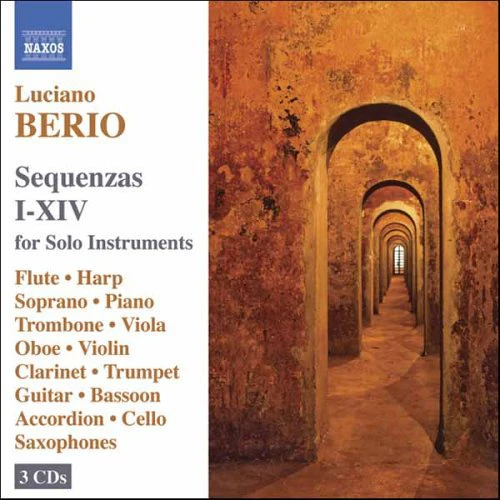
Berio: Sequenzas I - XIV
Between 1958 and 2002 Luciano Berio completed his 14 solo Sequenzas, a series of pieces that push not only each instrument's technical, textural, and expressive possibilities, but also those of the performer. Each work demands the utmost in technique, musicianship, tonal resources, theatricality, and stamina. Small wonder that the Sequenzas loom large in the active contemporary repertoire, while conservatories and competitions often assign them as test pieces. In 1998 Deutsche Grammophon brought out a three-disc set containing stunning interpretations of all 13 extant Sequenzas, plus the alto saxophone transcription of Sequenza IX for clarinet. Now Naxos enters the Sequenza playing field with equally world-class performances of the cycle, including the Cello Sequenza (No. XIV) written in 2002 (the year before Berio's death) plus the soprano saxophone version of the Oboe Sequenza (No. VII).
It might be helpful to describe some of the ways in which the DG and Naxos performances differ. In Sequenza XII for Bassoon, Pascal Gallois' rapid leaps and piercing multiphonics convey a sharper impact through DG's close microphone placement. By contrast, Naxos' more distantly miked Ken Munday sounds relatively less incisive yet fuller bodied in longer, sustained passages. DG's violist Christophe Desjardins plays Sequenza VI's cyclonic opening chordal section with lacerating intensity, whereas Naxos' Steven Dunn's slightly slower tempo allows the pitches and cross rhythms a little more room to breathe.
Naxos' Jaspar Wood does a fine job with Sequenza VIII, but DG's Jeanne-Marie Conquer's double stops boast more variety and tonal differentiation. Regarding Sequenza II, it's a toss-up between Frédérique Cambreling's pronounced dynamic contrasts (DG) and Erica Goodman's greater clarity in the scurrying, ethereal passages (Naxos). While Naxos' Tony Arnold's playful soprano makes the most of Sequenza III's madcap mood shifts, DG's Luisa Castellani's suppler voice employs wider register extremes (she was Berio's preferred singer in later years).
Had pianist Boris Berman's extraordinary marksmanship in Sequenza IV been captured in more colorful sonic splendor, his interpretation easily would hold its own next to Florent Boffard's elegant insouciance. In Sequenza X for C Trumpet Berio uses piano resonance to create continuity between phrases. On DG, Gabriele Cassone's fat, flügelhorn-like sonority and immaculate repeated-note technique have no peer, yet I like the jazziness with which Naxos' Guy Few leans into the beginnings of certain phrases. In all, this release stands as a viable alternative to the DG set, if not necessarily a replacement as we await Mode's forthcoming Sequenza cycle.
--Jed Distler, ClassicsToday.com
It might be helpful to describe some of the ways in which the DG and Naxos performances differ. In Sequenza XII for Bassoon, Pascal Gallois' rapid leaps and piercing multiphonics convey a sharper impact through DG's close microphone placement. By contrast, Naxos' more distantly miked Ken Munday sounds relatively less incisive yet fuller bodied in longer, sustained passages. DG's violist Christophe Desjardins plays Sequenza VI's cyclonic opening chordal section with lacerating intensity, whereas Naxos' Steven Dunn's slightly slower tempo allows the pitches and cross rhythms a little more room to breathe.
Naxos' Jaspar Wood does a fine job with Sequenza VIII, but DG's Jeanne-Marie Conquer's double stops boast more variety and tonal differentiation. Regarding Sequenza II, it's a toss-up between Frédérique Cambreling's pronounced dynamic contrasts (DG) and Erica Goodman's greater clarity in the scurrying, ethereal passages (Naxos). While Naxos' Tony Arnold's playful soprano makes the most of Sequenza III's madcap mood shifts, DG's Luisa Castellani's suppler voice employs wider register extremes (she was Berio's preferred singer in later years).
Had pianist Boris Berman's extraordinary marksmanship in Sequenza IV been captured in more colorful sonic splendor, his interpretation easily would hold its own next to Florent Boffard's elegant insouciance. In Sequenza X for C Trumpet Berio uses piano resonance to create continuity between phrases. On DG, Gabriele Cassone's fat, flügelhorn-like sonority and immaculate repeated-note technique have no peer, yet I like the jazziness with which Naxos' Guy Few leans into the beginnings of certain phrases. In all, this release stands as a viable alternative to the DG set, if not necessarily a replacement as we await Mode's forthcoming Sequenza cycle.
--Jed Distler, ClassicsToday.com
Between 1958 and 2002 Luciano Berio completed his 14 solo Sequenzas, a series of pieces that push not only each instrument's technical, textural, and expressive possibilities, but also those of the performer. Each work demands the utmost in technique, musicianship, tonal resources, theatricality, and stamina. Small wonder that the Sequenzas loom large in the active contemporary repertoire, while conservatories and competitions often assign them as test pieces. In 1998 Deutsche Grammophon brought out a three-disc set containing stunning interpretations of all 13 extant Sequenzas, plus the alto saxophone transcription of Sequenza IX for clarinet. Now Naxos enters the Sequenza playing field with equally world-class performances of the cycle, including the Cello Sequenza (No. XIV) written in 2002 (the year before Berio's death) plus the soprano saxophone version of the Oboe Sequenza (No. VII).
It might be helpful to describe some of the ways in which the DG and Naxos performances differ. In Sequenza XII for Bassoon, Pascal Gallois' rapid leaps and piercing multiphonics convey a sharper impact through DG's close microphone placement. By contrast, Naxos' more distantly miked Ken Munday sounds relatively less incisive yet fuller bodied in longer, sustained passages. DG's violist Christophe Desjardins plays Sequenza VI's cyclonic opening chordal section with lacerating intensity, whereas Naxos' Steven Dunn's slightly slower tempo allows the pitches and cross rhythms a little more room to breathe.
Naxos' Jaspar Wood does a fine job with Sequenza VIII, but DG's Jeanne-Marie Conquer's double stops boast more variety and tonal differentiation. Regarding Sequenza II, it's a toss-up between Frédérique Cambreling's pronounced dynamic contrasts (DG) and Erica Goodman's greater clarity in the scurrying, ethereal passages (Naxos). While Naxos' Tony Arnold's playful soprano makes the most of Sequenza III's madcap mood shifts, DG's Luisa Castellani's suppler voice employs wider register extremes (she was Berio's preferred singer in later years).
Had pianist Boris Berman's extraordinary marksmanship in Sequenza IV been captured in more colorful sonic splendor, his interpretation easily would hold its own next to Florent Boffard's elegant insouciance. In Sequenza X for C Trumpet Berio uses piano resonance to create continuity between phrases. On DG, Gabriele Cassone's fat, flügelhorn-like sonority and immaculate repeated-note technique have no peer, yet I like the jazziness with which Naxos' Guy Few leans into the beginnings of certain phrases. In all, this release stands as a viable alternative to the DG set, if not necessarily a replacement as we await Mode's forthcoming Sequenza cycle.
--Jed Distler, ClassicsToday.com
It might be helpful to describe some of the ways in which the DG and Naxos performances differ. In Sequenza XII for Bassoon, Pascal Gallois' rapid leaps and piercing multiphonics convey a sharper impact through DG's close microphone placement. By contrast, Naxos' more distantly miked Ken Munday sounds relatively less incisive yet fuller bodied in longer, sustained passages. DG's violist Christophe Desjardins plays Sequenza VI's cyclonic opening chordal section with lacerating intensity, whereas Naxos' Steven Dunn's slightly slower tempo allows the pitches and cross rhythms a little more room to breathe.
Naxos' Jaspar Wood does a fine job with Sequenza VIII, but DG's Jeanne-Marie Conquer's double stops boast more variety and tonal differentiation. Regarding Sequenza II, it's a toss-up between Frédérique Cambreling's pronounced dynamic contrasts (DG) and Erica Goodman's greater clarity in the scurrying, ethereal passages (Naxos). While Naxos' Tony Arnold's playful soprano makes the most of Sequenza III's madcap mood shifts, DG's Luisa Castellani's suppler voice employs wider register extremes (she was Berio's preferred singer in later years).
Had pianist Boris Berman's extraordinary marksmanship in Sequenza IV been captured in more colorful sonic splendor, his interpretation easily would hold its own next to Florent Boffard's elegant insouciance. In Sequenza X for C Trumpet Berio uses piano resonance to create continuity between phrases. On DG, Gabriele Cassone's fat, flügelhorn-like sonority and immaculate repeated-note technique have no peer, yet I like the jazziness with which Naxos' Guy Few leans into the beginnings of certain phrases. In all, this release stands as a viable alternative to the DG set, if not necessarily a replacement as we await Mode's forthcoming Sequenza cycle.
--Jed Distler, ClassicsToday.com
$12.60
Original: $35.99
-65%Berio: Sequenzas I - XIV—
$35.99
$12.60Description
Between 1958 and 2002 Luciano Berio completed his 14 solo Sequenzas, a series of pieces that push not only each instrument's technical, textural, and expressive possibilities, but also those of the performer. Each work demands the utmost in technique, musicianship, tonal resources, theatricality, and stamina. Small wonder that the Sequenzas loom large in the active contemporary repertoire, while conservatories and competitions often assign them as test pieces. In 1998 Deutsche Grammophon brought out a three-disc set containing stunning interpretations of all 13 extant Sequenzas, plus the alto saxophone transcription of Sequenza IX for clarinet. Now Naxos enters the Sequenza playing field with equally world-class performances of the cycle, including the Cello Sequenza (No. XIV) written in 2002 (the year before Berio's death) plus the soprano saxophone version of the Oboe Sequenza (No. VII).
It might be helpful to describe some of the ways in which the DG and Naxos performances differ. In Sequenza XII for Bassoon, Pascal Gallois' rapid leaps and piercing multiphonics convey a sharper impact through DG's close microphone placement. By contrast, Naxos' more distantly miked Ken Munday sounds relatively less incisive yet fuller bodied in longer, sustained passages. DG's violist Christophe Desjardins plays Sequenza VI's cyclonic opening chordal section with lacerating intensity, whereas Naxos' Steven Dunn's slightly slower tempo allows the pitches and cross rhythms a little more room to breathe.
Naxos' Jaspar Wood does a fine job with Sequenza VIII, but DG's Jeanne-Marie Conquer's double stops boast more variety and tonal differentiation. Regarding Sequenza II, it's a toss-up between Frédérique Cambreling's pronounced dynamic contrasts (DG) and Erica Goodman's greater clarity in the scurrying, ethereal passages (Naxos). While Naxos' Tony Arnold's playful soprano makes the most of Sequenza III's madcap mood shifts, DG's Luisa Castellani's suppler voice employs wider register extremes (she was Berio's preferred singer in later years).
Had pianist Boris Berman's extraordinary marksmanship in Sequenza IV been captured in more colorful sonic splendor, his interpretation easily would hold its own next to Florent Boffard's elegant insouciance. In Sequenza X for C Trumpet Berio uses piano resonance to create continuity between phrases. On DG, Gabriele Cassone's fat, flügelhorn-like sonority and immaculate repeated-note technique have no peer, yet I like the jazziness with which Naxos' Guy Few leans into the beginnings of certain phrases. In all, this release stands as a viable alternative to the DG set, if not necessarily a replacement as we await Mode's forthcoming Sequenza cycle.
--Jed Distler, ClassicsToday.com
It might be helpful to describe some of the ways in which the DG and Naxos performances differ. In Sequenza XII for Bassoon, Pascal Gallois' rapid leaps and piercing multiphonics convey a sharper impact through DG's close microphone placement. By contrast, Naxos' more distantly miked Ken Munday sounds relatively less incisive yet fuller bodied in longer, sustained passages. DG's violist Christophe Desjardins plays Sequenza VI's cyclonic opening chordal section with lacerating intensity, whereas Naxos' Steven Dunn's slightly slower tempo allows the pitches and cross rhythms a little more room to breathe.
Naxos' Jaspar Wood does a fine job with Sequenza VIII, but DG's Jeanne-Marie Conquer's double stops boast more variety and tonal differentiation. Regarding Sequenza II, it's a toss-up between Frédérique Cambreling's pronounced dynamic contrasts (DG) and Erica Goodman's greater clarity in the scurrying, ethereal passages (Naxos). While Naxos' Tony Arnold's playful soprano makes the most of Sequenza III's madcap mood shifts, DG's Luisa Castellani's suppler voice employs wider register extremes (she was Berio's preferred singer in later years).
Had pianist Boris Berman's extraordinary marksmanship in Sequenza IV been captured in more colorful sonic splendor, his interpretation easily would hold its own next to Florent Boffard's elegant insouciance. In Sequenza X for C Trumpet Berio uses piano resonance to create continuity between phrases. On DG, Gabriele Cassone's fat, flügelhorn-like sonority and immaculate repeated-note technique have no peer, yet I like the jazziness with which Naxos' Guy Few leans into the beginnings of certain phrases. In all, this release stands as a viable alternative to the DG set, if not necessarily a replacement as we await Mode's forthcoming Sequenza cycle.
--Jed Distler, ClassicsToday.com