🎉 Up to 70% Off Selected ItemsShop Sale

1 / 2
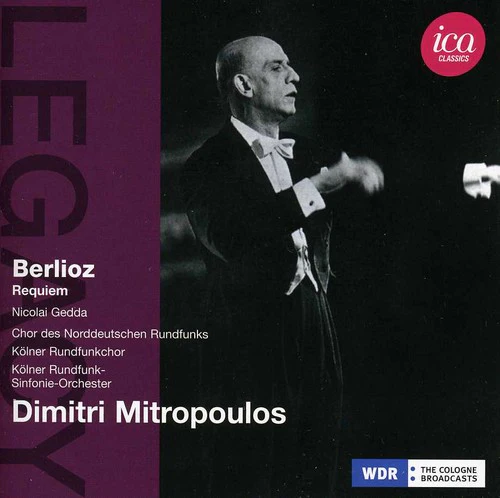
Berlioz: Requiem / Mitropoulos, Gedda, Cologne Radio Symphony
BERLIOZ Requiem • Dimitri Mitropoulos, cond; Nicolai Gedda (ten); Cologne RO & Ch • ICA 5075 (82:22) Live: Cologne 8/26/1956
Having been, for the most part (all but the “March to the Scaffold” and “Dream of a Witches’ Sabbath”), been impressed by Dimitri Mitropoulos’s studio recording of Berlioz’s Symphonie Fantastique with the New York Philharmonic, I was very curious to hear what the famed Greek conductor did with the Requiem. I hadn’t known that there was an alternative performance conducted by Mitropoulos from July 15, 1956, with tenor Leopold Simoneau and the Vienna Philharmonic, nor have I heard that performance (available on Orfeo d’Or 457971), but in listening to this Cologne performance from August all I could think was how absolutely wonderful it is from start to finish.
Granted, the Cologne Radio Choir is no match for Roger Norrington’s exquisitely blended forces in his recording for Hänssler (which I dubbed a Classical Hall of Fame item in the last issue), but in the 1950s there were few choruses that good … Bayreuth, perhaps, and Wilhelm Pitz’s magnificent Philharmonia Chorus, but not many others. Within the scope of radio choirs of that era, the Cologne singers acquit themselves very well. But even more impressive is the sound of the orchestra, the incredible wealth of textural detail that Mitropoulos is able to draw from it, and more importantly, how well it is recorded. For a 1956 mono radio broadcast, the sound on this disc is phenomenal—easily on par with the absolute best high-fidelity products issued by RCA, EMI, and even Decca-London. Just to give you the most crucial example, there is actually some depth to the sound when the four brass choirs enter in the Dies irae , in fact, more depth to the sound than Seiji Ozawa’s digital recording with the Boston Symphony on RCA-BMG.
But even better than the sound is the musical treatment of the score. As much as I like Norrington’s leisurely pacing, which matches so well the depth of sound he is able to elicit from his orchestra, Mitropoulos gives us what I would characterize as the true Berlioz style. This performance is only five minutes shorter than Norrington’s, but it sounds much faster because Mitropoulos never lets the momentum sag. He is continually nudging the beat forward, even in the quietest and slowest passages in the score, with the result that the listener hears much more of the work’s structure without sacrificing quality of emotion or depth of feeling. It’s like listening to Charles Munch’s Symphonie fantastique, Colin Davis’s early recording of Romeo et Juliette, and either the Toscanini or Fischer-Dieskau recordings of Harold in Italy. It’s that good, and it’s in the same style. It’s also astonishing how much hall ambience, and more importantly depth of sound, is captured here considering that this was recorded not in a church or concert hall, but in Studio 1 of the Cologne radio station. Taking all of that into consideration, the sonic results almost beggar belief.
It would take far more room that I have to describe all the stunning moments in this performance, but allow me to pinpoint one: the way Mitropoulos pulls back on the syncopated wind and string figures at the beginning of the Lacrimosa . This has a tautness, and almost a swagger, in the rhythm that I’ve not heard achieved by any other conductor in this work. Another interesting aspect of this performance is to compare its timings to the other Mitropoulos version as well as Norrington. As previously mentioned, this Cologne performance runs only five minutes shorter than the Norrington, but the Vienna version runs three minutes faster than this. Without having heard it, then, I would have to say that I think I’d prefer this recording anyway. I really don’t like my Berlioz Requiem rushed that much, which is another reason I don’t care for the Ozawa recording.
There is but one movement where more space is required, and that is the Sanctus. It is gorgeously sung by Nicolai Gedda in his best early voice—in stereo recordings, only Stuart Burrows is as good and only Leopold Simoneau and Toby Spence come close—but the tenor is up front and center in the soundspace, not recessed in the back as he is supposed to be. It’s a small flaw but a telling one.
Could this, then, be a first-choice Requiem? Yes, but only if you don’t mind monophonic sound and the up-front recording of the tenor soloist. If you do, Norrington is clearly your best choice, and as I said last issue, there are few better than his performance, but this is one of those few. Another small miracle is the fact that ICA has managed to cram 82 and a half minutes of music on one CD.
FANFARE: Lynn René Bayley
BERLIOZ Requiem • Dimitri Mitropoulos, cond; Nicolai Gedda (ten); Cologne RO & Ch • ICA 5075 (82:22) Live: Cologne 8/26/1956
Having been, for the most part (all but the “March to the Scaffold” and “Dream of a Witches’ Sabbath”), been impressed by Dimitri Mitropoulos’s studio recording of Berlioz’s Symphonie Fantastique with the New York Philharmonic, I was very curious to hear what the famed Greek conductor did with the Requiem. I hadn’t known that there was an alternative performance conducted by Mitropoulos from July 15, 1956, with tenor Leopold Simoneau and the Vienna Philharmonic, nor have I heard that performance (available on Orfeo d’Or 457971), but in listening to this Cologne performance from August all I could think was how absolutely wonderful it is from start to finish.
Granted, the Cologne Radio Choir is no match for Roger Norrington’s exquisitely blended forces in his recording for Hänssler (which I dubbed a Classical Hall of Fame item in the last issue), but in the 1950s there were few choruses that good … Bayreuth, perhaps, and Wilhelm Pitz’s magnificent Philharmonia Chorus, but not many others. Within the scope of radio choirs of that era, the Cologne singers acquit themselves very well. But even more impressive is the sound of the orchestra, the incredible wealth of textural detail that Mitropoulos is able to draw from it, and more importantly, how well it is recorded. For a 1956 mono radio broadcast, the sound on this disc is phenomenal—easily on par with the absolute best high-fidelity products issued by RCA, EMI, and even Decca-London. Just to give you the most crucial example, there is actually some depth to the sound when the four brass choirs enter in the Dies irae , in fact, more depth to the sound than Seiji Ozawa’s digital recording with the Boston Symphony on RCA-BMG.
But even better than the sound is the musical treatment of the score. As much as I like Norrington’s leisurely pacing, which matches so well the depth of sound he is able to elicit from his orchestra, Mitropoulos gives us what I would characterize as the true Berlioz style. This performance is only five minutes shorter than Norrington’s, but it sounds much faster because Mitropoulos never lets the momentum sag. He is continually nudging the beat forward, even in the quietest and slowest passages in the score, with the result that the listener hears much more of the work’s structure without sacrificing quality of emotion or depth of feeling. It’s like listening to Charles Munch’s Symphonie fantastique, Colin Davis’s early recording of Romeo et Juliette, and either the Toscanini or Fischer-Dieskau recordings of Harold in Italy. It’s that good, and it’s in the same style. It’s also astonishing how much hall ambience, and more importantly depth of sound, is captured here considering that this was recorded not in a church or concert hall, but in Studio 1 of the Cologne radio station. Taking all of that into consideration, the sonic results almost beggar belief.
It would take far more room that I have to describe all the stunning moments in this performance, but allow me to pinpoint one: the way Mitropoulos pulls back on the syncopated wind and string figures at the beginning of the Lacrimosa . This has a tautness, and almost a swagger, in the rhythm that I’ve not heard achieved by any other conductor in this work. Another interesting aspect of this performance is to compare its timings to the other Mitropoulos version as well as Norrington. As previously mentioned, this Cologne performance runs only five minutes shorter than the Norrington, but the Vienna version runs three minutes faster than this. Without having heard it, then, I would have to say that I think I’d prefer this recording anyway. I really don’t like my Berlioz Requiem rushed that much, which is another reason I don’t care for the Ozawa recording.
There is but one movement where more space is required, and that is the Sanctus. It is gorgeously sung by Nicolai Gedda in his best early voice—in stereo recordings, only Stuart Burrows is as good and only Leopold Simoneau and Toby Spence come close—but the tenor is up front and center in the soundspace, not recessed in the back as he is supposed to be. It’s a small flaw but a telling one.
Could this, then, be a first-choice Requiem? Yes, but only if you don’t mind monophonic sound and the up-front recording of the tenor soloist. If you do, Norrington is clearly your best choice, and as I said last issue, there are few better than his performance, but this is one of those few. Another small miracle is the fact that ICA has managed to cram 82 and a half minutes of music on one CD.
FANFARE: Lynn René Bayley
$5.25
Original: $14.99
-65%Berlioz: Requiem / Mitropoulos, Gedda, Cologne Radio Symphony—
$14.99
$5.25Description
BERLIOZ Requiem • Dimitri Mitropoulos, cond; Nicolai Gedda (ten); Cologne RO & Ch • ICA 5075 (82:22) Live: Cologne 8/26/1956
Having been, for the most part (all but the “March to the Scaffold” and “Dream of a Witches’ Sabbath”), been impressed by Dimitri Mitropoulos’s studio recording of Berlioz’s Symphonie Fantastique with the New York Philharmonic, I was very curious to hear what the famed Greek conductor did with the Requiem. I hadn’t known that there was an alternative performance conducted by Mitropoulos from July 15, 1956, with tenor Leopold Simoneau and the Vienna Philharmonic, nor have I heard that performance (available on Orfeo d’Or 457971), but in listening to this Cologne performance from August all I could think was how absolutely wonderful it is from start to finish.
Granted, the Cologne Radio Choir is no match for Roger Norrington’s exquisitely blended forces in his recording for Hänssler (which I dubbed a Classical Hall of Fame item in the last issue), but in the 1950s there were few choruses that good … Bayreuth, perhaps, and Wilhelm Pitz’s magnificent Philharmonia Chorus, but not many others. Within the scope of radio choirs of that era, the Cologne singers acquit themselves very well. But even more impressive is the sound of the orchestra, the incredible wealth of textural detail that Mitropoulos is able to draw from it, and more importantly, how well it is recorded. For a 1956 mono radio broadcast, the sound on this disc is phenomenal—easily on par with the absolute best high-fidelity products issued by RCA, EMI, and even Decca-London. Just to give you the most crucial example, there is actually some depth to the sound when the four brass choirs enter in the Dies irae , in fact, more depth to the sound than Seiji Ozawa’s digital recording with the Boston Symphony on RCA-BMG.
But even better than the sound is the musical treatment of the score. As much as I like Norrington’s leisurely pacing, which matches so well the depth of sound he is able to elicit from his orchestra, Mitropoulos gives us what I would characterize as the true Berlioz style. This performance is only five minutes shorter than Norrington’s, but it sounds much faster because Mitropoulos never lets the momentum sag. He is continually nudging the beat forward, even in the quietest and slowest passages in the score, with the result that the listener hears much more of the work’s structure without sacrificing quality of emotion or depth of feeling. It’s like listening to Charles Munch’s Symphonie fantastique, Colin Davis’s early recording of Romeo et Juliette, and either the Toscanini or Fischer-Dieskau recordings of Harold in Italy. It’s that good, and it’s in the same style. It’s also astonishing how much hall ambience, and more importantly depth of sound, is captured here considering that this was recorded not in a church or concert hall, but in Studio 1 of the Cologne radio station. Taking all of that into consideration, the sonic results almost beggar belief.
It would take far more room that I have to describe all the stunning moments in this performance, but allow me to pinpoint one: the way Mitropoulos pulls back on the syncopated wind and string figures at the beginning of the Lacrimosa . This has a tautness, and almost a swagger, in the rhythm that I’ve not heard achieved by any other conductor in this work. Another interesting aspect of this performance is to compare its timings to the other Mitropoulos version as well as Norrington. As previously mentioned, this Cologne performance runs only five minutes shorter than the Norrington, but the Vienna version runs three minutes faster than this. Without having heard it, then, I would have to say that I think I’d prefer this recording anyway. I really don’t like my Berlioz Requiem rushed that much, which is another reason I don’t care for the Ozawa recording.
There is but one movement where more space is required, and that is the Sanctus. It is gorgeously sung by Nicolai Gedda in his best early voice—in stereo recordings, only Stuart Burrows is as good and only Leopold Simoneau and Toby Spence come close—but the tenor is up front and center in the soundspace, not recessed in the back as he is supposed to be. It’s a small flaw but a telling one.
Could this, then, be a first-choice Requiem? Yes, but only if you don’t mind monophonic sound and the up-front recording of the tenor soloist. If you do, Norrington is clearly your best choice, and as I said last issue, there are few better than his performance, but this is one of those few. Another small miracle is the fact that ICA has managed to cram 82 and a half minutes of music on one CD.
FANFARE: Lynn René Bayley