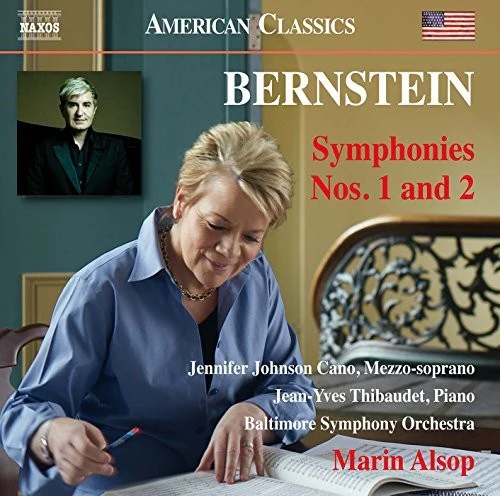
Bernstein: Symphonies Nos. 1 & 2 / Alsop, Baltimore Symphony
Leonard Bernstein’s legendary 1943 Carnegie Hall conducting début brought his name to national attention, and the event was followed a few months later by the triumphant reception of his Symphony No. 1 ‘Jeremiah.’ This major symphonic statement explores a crisis in faith and employs Jewish liturgical sources, its final movement, Lamentation, being an anguished cry at the destruction of Jerusalem. Sharing the theme of loss of faith, Symphony No. 2 ‘The Age of Anxiety’ takes W.H. Auden’s poem of the same name and follows its four characters in their spiritual journey to hard-won triumph.
REVIEW:
It’s great to see this music being played with such conviction. We all know that Alsop is a superb Bernstein conductor, and Naxos already has a terrific account of the First Symphony from James Judd and the New Zealand Symphony, but this newcomer is, if anything, even finer–certainly sonically–and conducted with even more pizzazz. In the central Profanation movement, Alsop really does outdo Bernstein himself; the playing of the Baltimore Symphony here is sensational, and in the finale Jennifer Johnson Cano sings with great sensitivity and a beautiful tone. The tragic climaxes hit you right in the gut.
In the Second Symphony, Jean-Yves Thibaudet offers a first class account of his solo part. The Masque is especially outstanding–virtuosic but at the same time nicely “cool.” Prior to that, in the opening variation sets, Alsop knits the music together expertly, ensuring that the glum bits never bog down, and that the entire first part builds inexorably to its exciting conclusion. The following Dirge is is a barn-burner, and somehow after all of this the Epilogue never turns hollow. Again, I don’t think that Bernstein could have done better, and as suggested above the engineering is also rock solid and brilliant by turns. A marvelous release by any standard.
– ClassicsToday (David Hurwitz, 10/10)
Leonard Bernstein’s legendary 1943 Carnegie Hall conducting début brought his name to national attention, and the event was followed a few months later by the triumphant reception of his Symphony No. 1 ‘Jeremiah.’ This major symphonic statement explores a crisis in faith and employs Jewish liturgical sources, its final movement, Lamentation, being an anguished cry at the destruction of Jerusalem. Sharing the theme of loss of faith, Symphony No. 2 ‘The Age of Anxiety’ takes W.H. Auden’s poem of the same name and follows its four characters in their spiritual journey to hard-won triumph.
REVIEW:
It’s great to see this music being played with such conviction. We all know that Alsop is a superb Bernstein conductor, and Naxos already has a terrific account of the First Symphony from James Judd and the New Zealand Symphony, but this newcomer is, if anything, even finer–certainly sonically–and conducted with even more pizzazz. In the central Profanation movement, Alsop really does outdo Bernstein himself; the playing of the Baltimore Symphony here is sensational, and in the finale Jennifer Johnson Cano sings with great sensitivity and a beautiful tone. The tragic climaxes hit you right in the gut.
In the Second Symphony, Jean-Yves Thibaudet offers a first class account of his solo part. The Masque is especially outstanding–virtuosic but at the same time nicely “cool.” Prior to that, in the opening variation sets, Alsop knits the music together expertly, ensuring that the glum bits never bog down, and that the entire first part builds inexorably to its exciting conclusion. The following Dirge is is a barn-burner, and somehow after all of this the Epilogue never turns hollow. Again, I don’t think that Bernstein could have done better, and as suggested above the engineering is also rock solid and brilliant by turns. A marvelous release by any standard.
– ClassicsToday (David Hurwitz, 10/10)
Original: $9.99
-65%$9.99
$3.50Description
Leonard Bernstein’s legendary 1943 Carnegie Hall conducting début brought his name to national attention, and the event was followed a few months later by the triumphant reception of his Symphony No. 1 ‘Jeremiah.’ This major symphonic statement explores a crisis in faith and employs Jewish liturgical sources, its final movement, Lamentation, being an anguished cry at the destruction of Jerusalem. Sharing the theme of loss of faith, Symphony No. 2 ‘The Age of Anxiety’ takes W.H. Auden’s poem of the same name and follows its four characters in their spiritual journey to hard-won triumph.
REVIEW:
It’s great to see this music being played with such conviction. We all know that Alsop is a superb Bernstein conductor, and Naxos already has a terrific account of the First Symphony from James Judd and the New Zealand Symphony, but this newcomer is, if anything, even finer–certainly sonically–and conducted with even more pizzazz. In the central Profanation movement, Alsop really does outdo Bernstein himself; the playing of the Baltimore Symphony here is sensational, and in the finale Jennifer Johnson Cano sings with great sensitivity and a beautiful tone. The tragic climaxes hit you right in the gut.
In the Second Symphony, Jean-Yves Thibaudet offers a first class account of his solo part. The Masque is especially outstanding–virtuosic but at the same time nicely “cool.” Prior to that, in the opening variation sets, Alsop knits the music together expertly, ensuring that the glum bits never bog down, and that the entire first part builds inexorably to its exciting conclusion. The following Dirge is is a barn-burner, and somehow after all of this the Epilogue never turns hollow. Again, I don’t think that Bernstein could have done better, and as suggested above the engineering is also rock solid and brilliant by turns. A marvelous release by any standard.
– ClassicsToday (David Hurwitz, 10/10)