🎉 Up to 70% Off Selected ItemsShop Sale

1 / 2
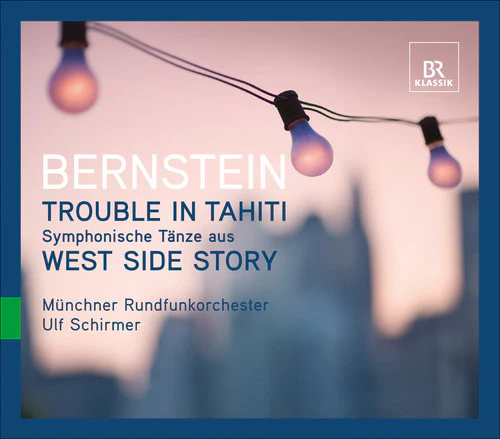
Bernstein: Trouble In Tahiti, Symphonic Dances From West Side Story / Schirmer, Munich Radio Orchestra
BERNSTEIN West Side Story: Symphonic Dances. Trouble in Tahiti 1 & • Ulf Schirmer, cond; Kim Criswell ( Dinah ); 1 Rodney Gilfry ( Sam ); 1 Marlene Grimson ( Trio sop ); 1 Adrian Dwyer ( Trio ten ); 1 Ronan Collett ( Trio bar ); 1 Munich RO • BR 719003 (77:43 Text and Translation) Live: Munich 10/12/2008
& German interview with Ulf Schirmer
I have not generally been impressed with German orchestral performances of distinctly American scores such as these by Leonard Bernstein—heavily dependent on Latin dance rhythms and jazz inflections, having found too many of them stiff and uncomfortable with the idiom. I rather imagine that Viennese listeners have a similar reaction when an American orchestra and conductor perform Johann Strauss. Like the subtle inflections of language, there are some things one just absorbs from the culture that are hard to master otherwise.
So it proves here, especially in the “Symphonic Dances.” The percussion get the rhythms, and the brass have the feel as well, though the trumpets seem reluctant to wail with sufficient abandon, but generally, the woodwinds just can’t quite bring themselves to let lose in the long stretches of exuberance, and the strings are too polite by half. Add to that Ulf Schirmer’s tendency to relax momentum in the more lyrical sections—something Bernstein never did—and you have a performance that is a little too pokerfaced to take flight. It is not bad by any means—Schirmer often generates a good deal of energy and excitement—but it is simply not competitive with more idiomatic performances by the composer and others.
Some of that same orchestral stiffness infects the performance of Bernstein’s heavily ironic, autobiographical one-act opera, Trouble in Tahiti —the characters almost certainly represent Bernstein’s mismatched parents, Jennie and Sam—but this performance is harder to pass over. First of all, there are not a lot of recordings around, and more important, these singers have the style to make it work. The issue raised by this interpretation is one of genre: is it opera or is it musical theater? While most performances are cast with classically trained singers who can act, this recording straddles the fence by using an operatic baritone and a Broadway mezzo. (They also appeared in Simon Rattle’s 1999 EMI Wonderful Town .) Both are very fine: Gilfry, with his virile, flexible instrument, is a perfect self-absorbed and egotistical Sam, and Criswell, a singer with a vibrant and colorful voice, though rather limited on top for “I was standing in a garden,” is an emotionally fragile and angry Dinah. Their voices never blend, but one has to wonder if the stylistic contrast is an interpretive choice. Certainly, even if the combination gives less aural pleasure than two matched operatic voices might, it makes some sense for the antagonistic characters. And the choice of Criswell, a brilliant actress, is vindicated by an absolutely stunning performance of the show-stopping, musical theater-style “What a movie!” The Greek-chorus jazz vocal trio is classy with a reasonable sense of swing, and though the balance between the voices is not always ideal, they create just the right balance of satire and empathy.
In the end though, effective as this performance is, it must still take second place to the 1973 Bernstein-led performance on Sony 60969: very stylish and expressive, with excellent soloists and a perfect trio. There are other performances on CD: the student-cast performance by the Manhattan School of Music Opera Theater on Newport Classic 85641 is quite good, and the 2006 Calliope recording (9391) in accented English with French performers, is an interesting novelty: urbane and very coolly jazzy. But once you have the Bernstein CD, Gilfry and Criswell make this new release an ideal supplement.
FANFARE: Ronald E. Grames
BERNSTEIN West Side Story: Symphonic Dances. Trouble in Tahiti 1 & • Ulf Schirmer, cond; Kim Criswell ( Dinah ); 1 Rodney Gilfry ( Sam ); 1 Marlene Grimson ( Trio sop ); 1 Adrian Dwyer ( Trio ten ); 1 Ronan Collett ( Trio bar ); 1 Munich RO • BR 719003 (77:43 Text and Translation) Live: Munich 10/12/2008
& German interview with Ulf Schirmer
I have not generally been impressed with German orchestral performances of distinctly American scores such as these by Leonard Bernstein—heavily dependent on Latin dance rhythms and jazz inflections, having found too many of them stiff and uncomfortable with the idiom. I rather imagine that Viennese listeners have a similar reaction when an American orchestra and conductor perform Johann Strauss. Like the subtle inflections of language, there are some things one just absorbs from the culture that are hard to master otherwise.
So it proves here, especially in the “Symphonic Dances.” The percussion get the rhythms, and the brass have the feel as well, though the trumpets seem reluctant to wail with sufficient abandon, but generally, the woodwinds just can’t quite bring themselves to let lose in the long stretches of exuberance, and the strings are too polite by half. Add to that Ulf Schirmer’s tendency to relax momentum in the more lyrical sections—something Bernstein never did—and you have a performance that is a little too pokerfaced to take flight. It is not bad by any means—Schirmer often generates a good deal of energy and excitement—but it is simply not competitive with more idiomatic performances by the composer and others.
Some of that same orchestral stiffness infects the performance of Bernstein’s heavily ironic, autobiographical one-act opera, Trouble in Tahiti —the characters almost certainly represent Bernstein’s mismatched parents, Jennie and Sam—but this performance is harder to pass over. First of all, there are not a lot of recordings around, and more important, these singers have the style to make it work. The issue raised by this interpretation is one of genre: is it opera or is it musical theater? While most performances are cast with classically trained singers who can act, this recording straddles the fence by using an operatic baritone and a Broadway mezzo. (They also appeared in Simon Rattle’s 1999 EMI Wonderful Town .) Both are very fine: Gilfry, with his virile, flexible instrument, is a perfect self-absorbed and egotistical Sam, and Criswell, a singer with a vibrant and colorful voice, though rather limited on top for “I was standing in a garden,” is an emotionally fragile and angry Dinah. Their voices never blend, but one has to wonder if the stylistic contrast is an interpretive choice. Certainly, even if the combination gives less aural pleasure than two matched operatic voices might, it makes some sense for the antagonistic characters. And the choice of Criswell, a brilliant actress, is vindicated by an absolutely stunning performance of the show-stopping, musical theater-style “What a movie!” The Greek-chorus jazz vocal trio is classy with a reasonable sense of swing, and though the balance between the voices is not always ideal, they create just the right balance of satire and empathy.
In the end though, effective as this performance is, it must still take second place to the 1973 Bernstein-led performance on Sony 60969: very stylish and expressive, with excellent soloists and a perfect trio. There are other performances on CD: the student-cast performance by the Manhattan School of Music Opera Theater on Newport Classic 85641 is quite good, and the 2006 Calliope recording (9391) in accented English with French performers, is an interesting novelty: urbane and very coolly jazzy. But once you have the Bernstein CD, Gilfry and Criswell make this new release an ideal supplement.
FANFARE: Ronald E. Grames
$4.55
Original: $12.99
-65%Bernstein: Trouble In Tahiti, Symphonic Dances From West Side Story / Schirmer, Munich Radio Orchestra—
$12.99
$4.55Description
BERNSTEIN West Side Story: Symphonic Dances. Trouble in Tahiti 1 & • Ulf Schirmer, cond; Kim Criswell ( Dinah ); 1 Rodney Gilfry ( Sam ); 1 Marlene Grimson ( Trio sop ); 1 Adrian Dwyer ( Trio ten ); 1 Ronan Collett ( Trio bar ); 1 Munich RO • BR 719003 (77:43 Text and Translation) Live: Munich 10/12/2008
& German interview with Ulf Schirmer
I have not generally been impressed with German orchestral performances of distinctly American scores such as these by Leonard Bernstein—heavily dependent on Latin dance rhythms and jazz inflections, having found too many of them stiff and uncomfortable with the idiom. I rather imagine that Viennese listeners have a similar reaction when an American orchestra and conductor perform Johann Strauss. Like the subtle inflections of language, there are some things one just absorbs from the culture that are hard to master otherwise.
So it proves here, especially in the “Symphonic Dances.” The percussion get the rhythms, and the brass have the feel as well, though the trumpets seem reluctant to wail with sufficient abandon, but generally, the woodwinds just can’t quite bring themselves to let lose in the long stretches of exuberance, and the strings are too polite by half. Add to that Ulf Schirmer’s tendency to relax momentum in the more lyrical sections—something Bernstein never did—and you have a performance that is a little too pokerfaced to take flight. It is not bad by any means—Schirmer often generates a good deal of energy and excitement—but it is simply not competitive with more idiomatic performances by the composer and others.
Some of that same orchestral stiffness infects the performance of Bernstein’s heavily ironic, autobiographical one-act opera, Trouble in Tahiti —the characters almost certainly represent Bernstein’s mismatched parents, Jennie and Sam—but this performance is harder to pass over. First of all, there are not a lot of recordings around, and more important, these singers have the style to make it work. The issue raised by this interpretation is one of genre: is it opera or is it musical theater? While most performances are cast with classically trained singers who can act, this recording straddles the fence by using an operatic baritone and a Broadway mezzo. (They also appeared in Simon Rattle’s 1999 EMI Wonderful Town .) Both are very fine: Gilfry, with his virile, flexible instrument, is a perfect self-absorbed and egotistical Sam, and Criswell, a singer with a vibrant and colorful voice, though rather limited on top for “I was standing in a garden,” is an emotionally fragile and angry Dinah. Their voices never blend, but one has to wonder if the stylistic contrast is an interpretive choice. Certainly, even if the combination gives less aural pleasure than two matched operatic voices might, it makes some sense for the antagonistic characters. And the choice of Criswell, a brilliant actress, is vindicated by an absolutely stunning performance of the show-stopping, musical theater-style “What a movie!” The Greek-chorus jazz vocal trio is classy with a reasonable sense of swing, and though the balance between the voices is not always ideal, they create just the right balance of satire and empathy.
In the end though, effective as this performance is, it must still take second place to the 1973 Bernstein-led performance on Sony 60969: very stylish and expressive, with excellent soloists and a perfect trio. There are other performances on CD: the student-cast performance by the Manhattan School of Music Opera Theater on Newport Classic 85641 is quite good, and the 2006 Calliope recording (9391) in accented English with French performers, is an interesting novelty: urbane and very coolly jazzy. But once you have the Bernstein CD, Gilfry and Criswell make this new release an ideal supplement.
FANFARE: Ronald E. Grames