🎉 Up to 70% Off Selected ItemsShop Sale

Beverly Sills - Plaisir d'Amour
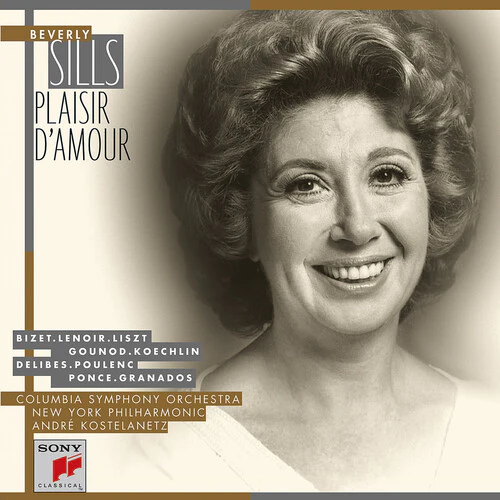
In the introduction to this disc, Beverly Sills notes that her 1975 album of French song came as a "wonderful change of pace . . . from the loony ladies of Donizetti and Bellini [she] was singing so often at that time." But aside from recalling her friendship and working relationship with conductor André Kostelanetz, her memories are vague. She was apparently quite ill, but the sessions ("with the New York Philharmonic," she writes, though the orchestra is listed as the Columbia Symphony) could not be rescheduled. And she admits to having no memory of recording the three Spanish items at all. These are from 1961, with the New York Philharmonic also under Kostelanetz, and released here for the very first time. Fortunately Sills's thoroughly committed, engaging singing speaks volumes. Yes, she was past her vocal prime by the mid-70s, and the recorded acoustic for the French recital is decidedly odd, the voice seeming to float about in some sort of over reverberant chamber. But no matter. Here is an artist fluent in French, with a secure knowledge of French musical style, and a thoroughly solid musical technique, putting this largely unfamiliar program across as well as can be imagined. Sills's vocal timbre is of course instantly identifiable and communicatively personal; thus the disc also succeeds in conveying her ability to make listeners feel she was singing just for them, a trait so consistently appreciated by her audiences throughout her career. The most familiar items are Liszt's Oh, quand je dors and Poulenc's Les chemins de l'amour, the latter sung with impressively compelling restraint. And few can have given truer, more meaningful voice to Koechlin's Si tu le veux ("Unseen by anyone . . . I shall tenderly sing you a song of love . . ."). The three Spanish numbers are a welcome bonus, even if the disc's overall timing remains noticeably short. The closing number, Castellanos's La morena de mi copia ("The dark woman"), gives Sills an opportunity to kick up her heels, but Ponce's gentle Estrellita ("Little star who shines so bright in heaven . . . and sees my broken heart . . .") will linger in the mind as well.
FANFARE: Marc Mandel
FANFARE: Marc Mandel
In the introduction to this disc, Beverly Sills notes that her 1975 album of French song came as a "wonderful change of pace . . . from the loony ladies of Donizetti and Bellini [she] was singing so often at that time." But aside from recalling her friendship and working relationship with conductor André Kostelanetz, her memories are vague. She was apparently quite ill, but the sessions ("with the New York Philharmonic," she writes, though the orchestra is listed as the Columbia Symphony) could not be rescheduled. And she admits to having no memory of recording the three Spanish items at all. These are from 1961, with the New York Philharmonic also under Kostelanetz, and released here for the very first time. Fortunately Sills's thoroughly committed, engaging singing speaks volumes. Yes, she was past her vocal prime by the mid-70s, and the recorded acoustic for the French recital is decidedly odd, the voice seeming to float about in some sort of over reverberant chamber. But no matter. Here is an artist fluent in French, with a secure knowledge of French musical style, and a thoroughly solid musical technique, putting this largely unfamiliar program across as well as can be imagined. Sills's vocal timbre is of course instantly identifiable and communicatively personal; thus the disc also succeeds in conveying her ability to make listeners feel she was singing just for them, a trait so consistently appreciated by her audiences throughout her career. The most familiar items are Liszt's Oh, quand je dors and Poulenc's Les chemins de l'amour, the latter sung with impressively compelling restraint. And few can have given truer, more meaningful voice to Koechlin's Si tu le veux ("Unseen by anyone . . . I shall tenderly sing you a song of love . . ."). The three Spanish numbers are a welcome bonus, even if the disc's overall timing remains noticeably short. The closing number, Castellanos's La morena de mi copia ("The dark woman"), gives Sills an opportunity to kick up her heels, but Ponce's gentle Estrellita ("Little star who shines so bright in heaven . . . and sees my broken heart . . .") will linger in the mind as well.
FANFARE: Marc Mandel
FANFARE: Marc Mandel
$4.19
Original: $11.98
-65%Beverly Sills - Plaisir d'Amour—
$11.98
$4.19Description
In the introduction to this disc, Beverly Sills notes that her 1975 album of French song came as a "wonderful change of pace . . . from the loony ladies of Donizetti and Bellini [she] was singing so often at that time." But aside from recalling her friendship and working relationship with conductor André Kostelanetz, her memories are vague. She was apparently quite ill, but the sessions ("with the New York Philharmonic," she writes, though the orchestra is listed as the Columbia Symphony) could not be rescheduled. And she admits to having no memory of recording the three Spanish items at all. These are from 1961, with the New York Philharmonic also under Kostelanetz, and released here for the very first time. Fortunately Sills's thoroughly committed, engaging singing speaks volumes. Yes, she was past her vocal prime by the mid-70s, and the recorded acoustic for the French recital is decidedly odd, the voice seeming to float about in some sort of over reverberant chamber. But no matter. Here is an artist fluent in French, with a secure knowledge of French musical style, and a thoroughly solid musical technique, putting this largely unfamiliar program across as well as can be imagined. Sills's vocal timbre is of course instantly identifiable and communicatively personal; thus the disc also succeeds in conveying her ability to make listeners feel she was singing just for them, a trait so consistently appreciated by her audiences throughout her career. The most familiar items are Liszt's Oh, quand je dors and Poulenc's Les chemins de l'amour, the latter sung with impressively compelling restraint. And few can have given truer, more meaningful voice to Koechlin's Si tu le veux ("Unseen by anyone . . . I shall tenderly sing you a song of love . . ."). The three Spanish numbers are a welcome bonus, even if the disc's overall timing remains noticeably short. The closing number, Castellanos's La morena de mi copia ("The dark woman"), gives Sills an opportunity to kick up her heels, but Ponce's gentle Estrellita ("Little star who shines so bright in heaven . . . and sees my broken heart . . .") will linger in the mind as well.
FANFARE: Marc Mandel
FANFARE: Marc Mandel