🎉 Up to 70% Off Selected ItemsShop Sale

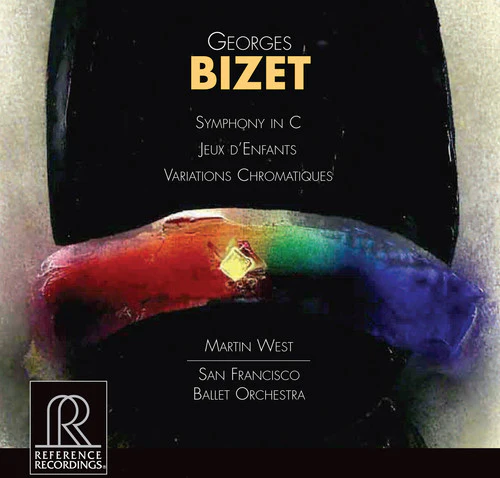
Bizet: Symphony In C, Jeux D'enfants, Variations Chromatiques / West, San Francisco Ballet Orchestra
BIZET Symphony No. 1 in C. Jeux d’enfants. Variations chromatiques (arr. Weingartner) • Martin West, cond; San Francisco Ballet O • REFERENCE 131 (75:27)
While we rightly lament the deaths of Mozart and Schubert, which came much too early, let us also save a few tears for Georges Bizet, who died at age 36 shortly after having composed what is, arguably, the most popular opera ever written, a piece that was admired by such disparate musical figures as Brahms, Tchaikovsky, and Wagner. He also left behind him such charming pieces as Jeux d’enfants , the L’Arlesienne incidental music, the Symphony in C, and The Pearl Fishers. Jeux d’enfants , a suite of 12 brief pieces, was originally composed for piano, four hands. To simplify my task, I’ll give the names in sequence since I will be referring to them again: 1) “L’Escarpolette” (The Swing), 2) “La Toupie” (The Top), 3) “La Poupée” (The Doll), 4) “Les Chevaux de bois” (Hobby Horses), 5) “Le Volant” (The Shuttlecock), 6) “Trompette et Tambour” (Trumpet and Drum), 7) “Les Bulles de savon” (Soap Bubbles), 8) “Les Quatre Coins” (Puss in the Corner), 9) “Colin-Maillard” (Blind Man’s Bluff), 10) “Saute-Mouton” (Leap Frog), 11) “Petit Mari, petite femme” (Little Husband, Little Wife), 12) “Le Bal” (The Ball). Bizet later orchestrated numbers 2, 3, 6, 11, and 12 and named the result the Petite Suite.
Given the ballet origins of this collection, a little history might be appropriate. In 1932, Leonide Massine choreographed Jeux d’enfants for the Ballet Russe de Monte Carlo, using the five pieces Bizet orchestrated with the rest orchestrated by (I’m guessing here) Sigfrid Karg-Elert. Unfortunately Massine’s autobiography only mentions the sets by Joan Miró—perhaps the name of the orchestrator did not interest him. Antal Doráti did not conduct the opening night, but I assume that as a conductor for the company he was familiar with the arrangement. In 1937, presumably with the limited space of 78s in mind, he recorded 10 of the pieces with the London Symphony Orchestra, omitting numbers 7 and 10, changing the order of two pieces, and making a cut in number one. Though he was quite capable of doing his own arrangements, I am assuming that the five non-Bizet orchestrations were by Karg-Elert. Later, Jeux d’enfants was choreographed by George Balanchine (2–8) and Francisco Moncion (9–12) with number one serving as an Overture. One reference book says the non-Bizet pieces were “orchestrated by an unidentified English composer.” Could it have been Roy Douglas? Still later, Balanchine used only numbers 6, 3, 11, and 12 for a pas de deux called The Steadfast Tin Soldier.
Several conductors have recorded the Petite Suite, but I guess this is the first recording of a complete orchestrated Jeux d’enfants . On this recording, in addition to the Petite Suite excerpts, the San Francisco Ballet Orchestra performs five orchestrations by Roy Douglas and two ( L’Escarpolette and La Volant ) by Hershey Kay. Whereas Doráti had to concern himself with fitting the music onto 78 sides and sometimes rushed the tempos, Martin West uses the time available to him and the result is moderate, danceable tempos—I particularly like his relaxed way with “Trompette et Tambour.” Throughout, he allows the music’s simple charm to come through.
I suppose most people are aware of the fact that Bizet’s Symphony in C is a student work, written in 1855 when he was merely 17. Bizet apparently forgot about it, and it did not receive its official premiere until 80 years later when Felix Weingartner led a performance in Basel, Switzerland. Later the music was the basis of one of George Balanchine’s signature ballets, Le Palais de Cristal , eventually simply called Symphony in C . I don’t think I’ve ever heard a recording that does the last movement repeat, but it is used in the choreographed version and West does it. He also does the first movement exposition repeat, which isn’t used in the ballet. Perhaps hearing the piece done by ballet orchestras (usually conducted by Robert Irving) is responsible for my affection for this performance, which is so pleasant and danceable. It is most definitely my favorite recording of the nine that I own (for the record, Ansermet, Beecham, Delacôte, Munch, Pons, Saraste, Stokowski 1 and 2, West) but I wonder if many people will favor it since everyone else takes it faster and skips some of the repeats.
Given that Felix Weingartner was the first conductor to lead a performance of the Symphony, it’s not inappropriate to complete the CD with his orchestration of Bizet’s Variations chromatiques , originally composed for piano in 1868. I imagine that Bizet’s piano music, other than Jeux d’enfants , hardly gets played at all. He wrote very little of it and, while Weingartner’s orchestration adds a welcome element of color and power, the piece still doesn’t exactly fly. Bizet’s biographer, Winton Dean, wrote, “It seems probable that, though he loved to play genuine keyboard music … his greatest interest in the piano lay in its power beneath his fingers to evoke the different colors of the orchestra….His original music for the piano suffers from a double disadvantage: it is too clumsy to reward the concert pianist and too difficult for the moderate amateur.” Even if one discounts the Variations chromatiques (and some may like it more than I do), that still leaves the CD with an hour of delightful music and music-making. It’s beautifully recorded, too.
FANFARE: James Miller
BIZET Symphony No. 1 in C. Jeux d’enfants. Variations chromatiques (arr. Weingartner) • Martin West, cond; San Francisco Ballet O • REFERENCE 131 (75:27)
While we rightly lament the deaths of Mozart and Schubert, which came much too early, let us also save a few tears for Georges Bizet, who died at age 36 shortly after having composed what is, arguably, the most popular opera ever written, a piece that was admired by such disparate musical figures as Brahms, Tchaikovsky, and Wagner. He also left behind him such charming pieces as Jeux d’enfants , the L’Arlesienne incidental music, the Symphony in C, and The Pearl Fishers. Jeux d’enfants , a suite of 12 brief pieces, was originally composed for piano, four hands. To simplify my task, I’ll give the names in sequence since I will be referring to them again: 1) “L’Escarpolette” (The Swing), 2) “La Toupie” (The Top), 3) “La Poupée” (The Doll), 4) “Les Chevaux de bois” (Hobby Horses), 5) “Le Volant” (The Shuttlecock), 6) “Trompette et Tambour” (Trumpet and Drum), 7) “Les Bulles de savon” (Soap Bubbles), 8) “Les Quatre Coins” (Puss in the Corner), 9) “Colin-Maillard” (Blind Man’s Bluff), 10) “Saute-Mouton” (Leap Frog), 11) “Petit Mari, petite femme” (Little Husband, Little Wife), 12) “Le Bal” (The Ball). Bizet later orchestrated numbers 2, 3, 6, 11, and 12 and named the result the Petite Suite.
Given the ballet origins of this collection, a little history might be appropriate. In 1932, Leonide Massine choreographed Jeux d’enfants for the Ballet Russe de Monte Carlo, using the five pieces Bizet orchestrated with the rest orchestrated by (I’m guessing here) Sigfrid Karg-Elert. Unfortunately Massine’s autobiography only mentions the sets by Joan Miró—perhaps the name of the orchestrator did not interest him. Antal Doráti did not conduct the opening night, but I assume that as a conductor for the company he was familiar with the arrangement. In 1937, presumably with the limited space of 78s in mind, he recorded 10 of the pieces with the London Symphony Orchestra, omitting numbers 7 and 10, changing the order of two pieces, and making a cut in number one. Though he was quite capable of doing his own arrangements, I am assuming that the five non-Bizet orchestrations were by Karg-Elert. Later, Jeux d’enfants was choreographed by George Balanchine (2–8) and Francisco Moncion (9–12) with number one serving as an Overture. One reference book says the non-Bizet pieces were “orchestrated by an unidentified English composer.” Could it have been Roy Douglas? Still later, Balanchine used only numbers 6, 3, 11, and 12 for a pas de deux called The Steadfast Tin Soldier.
Several conductors have recorded the Petite Suite, but I guess this is the first recording of a complete orchestrated Jeux d’enfants . On this recording, in addition to the Petite Suite excerpts, the San Francisco Ballet Orchestra performs five orchestrations by Roy Douglas and two ( L’Escarpolette and La Volant ) by Hershey Kay. Whereas Doráti had to concern himself with fitting the music onto 78 sides and sometimes rushed the tempos, Martin West uses the time available to him and the result is moderate, danceable tempos—I particularly like his relaxed way with “Trompette et Tambour.” Throughout, he allows the music’s simple charm to come through.
I suppose most people are aware of the fact that Bizet’s Symphony in C is a student work, written in 1855 when he was merely 17. Bizet apparently forgot about it, and it did not receive its official premiere until 80 years later when Felix Weingartner led a performance in Basel, Switzerland. Later the music was the basis of one of George Balanchine’s signature ballets, Le Palais de Cristal , eventually simply called Symphony in C . I don’t think I’ve ever heard a recording that does the last movement repeat, but it is used in the choreographed version and West does it. He also does the first movement exposition repeat, which isn’t used in the ballet. Perhaps hearing the piece done by ballet orchestras (usually conducted by Robert Irving) is responsible for my affection for this performance, which is so pleasant and danceable. It is most definitely my favorite recording of the nine that I own (for the record, Ansermet, Beecham, Delacôte, Munch, Pons, Saraste, Stokowski 1 and 2, West) but I wonder if many people will favor it since everyone else takes it faster and skips some of the repeats.
Given that Felix Weingartner was the first conductor to lead a performance of the Symphony, it’s not inappropriate to complete the CD with his orchestration of Bizet’s Variations chromatiques , originally composed for piano in 1868. I imagine that Bizet’s piano music, other than Jeux d’enfants , hardly gets played at all. He wrote very little of it and, while Weingartner’s orchestration adds a welcome element of color and power, the piece still doesn’t exactly fly. Bizet’s biographer, Winton Dean, wrote, “It seems probable that, though he loved to play genuine keyboard music … his greatest interest in the piano lay in its power beneath his fingers to evoke the different colors of the orchestra….His original music for the piano suffers from a double disadvantage: it is too clumsy to reward the concert pianist and too difficult for the moderate amateur.” Even if one discounts the Variations chromatiques (and some may like it more than I do), that still leaves the CD with an hour of delightful music and music-making. It’s beautifully recorded, too.
FANFARE: James Miller
$18.99
Bizet: Symphony In C, Jeux D'enfants, Variations Chromatiques / West, San Francisco Ballet Orchestra—
$18.99
Description
BIZET Symphony No. 1 in C. Jeux d’enfants. Variations chromatiques (arr. Weingartner) • Martin West, cond; San Francisco Ballet O • REFERENCE 131 (75:27)
While we rightly lament the deaths of Mozart and Schubert, which came much too early, let us also save a few tears for Georges Bizet, who died at age 36 shortly after having composed what is, arguably, the most popular opera ever written, a piece that was admired by such disparate musical figures as Brahms, Tchaikovsky, and Wagner. He also left behind him such charming pieces as Jeux d’enfants , the L’Arlesienne incidental music, the Symphony in C, and The Pearl Fishers. Jeux d’enfants , a suite of 12 brief pieces, was originally composed for piano, four hands. To simplify my task, I’ll give the names in sequence since I will be referring to them again: 1) “L’Escarpolette” (The Swing), 2) “La Toupie” (The Top), 3) “La Poupée” (The Doll), 4) “Les Chevaux de bois” (Hobby Horses), 5) “Le Volant” (The Shuttlecock), 6) “Trompette et Tambour” (Trumpet and Drum), 7) “Les Bulles de savon” (Soap Bubbles), 8) “Les Quatre Coins” (Puss in the Corner), 9) “Colin-Maillard” (Blind Man’s Bluff), 10) “Saute-Mouton” (Leap Frog), 11) “Petit Mari, petite femme” (Little Husband, Little Wife), 12) “Le Bal” (The Ball). Bizet later orchestrated numbers 2, 3, 6, 11, and 12 and named the result the Petite Suite.
Given the ballet origins of this collection, a little history might be appropriate. In 1932, Leonide Massine choreographed Jeux d’enfants for the Ballet Russe de Monte Carlo, using the five pieces Bizet orchestrated with the rest orchestrated by (I’m guessing here) Sigfrid Karg-Elert. Unfortunately Massine’s autobiography only mentions the sets by Joan Miró—perhaps the name of the orchestrator did not interest him. Antal Doráti did not conduct the opening night, but I assume that as a conductor for the company he was familiar with the arrangement. In 1937, presumably with the limited space of 78s in mind, he recorded 10 of the pieces with the London Symphony Orchestra, omitting numbers 7 and 10, changing the order of two pieces, and making a cut in number one. Though he was quite capable of doing his own arrangements, I am assuming that the five non-Bizet orchestrations were by Karg-Elert. Later, Jeux d’enfants was choreographed by George Balanchine (2–8) and Francisco Moncion (9–12) with number one serving as an Overture. One reference book says the non-Bizet pieces were “orchestrated by an unidentified English composer.” Could it have been Roy Douglas? Still later, Balanchine used only numbers 6, 3, 11, and 12 for a pas de deux called The Steadfast Tin Soldier.
Several conductors have recorded the Petite Suite, but I guess this is the first recording of a complete orchestrated Jeux d’enfants . On this recording, in addition to the Petite Suite excerpts, the San Francisco Ballet Orchestra performs five orchestrations by Roy Douglas and two ( L’Escarpolette and La Volant ) by Hershey Kay. Whereas Doráti had to concern himself with fitting the music onto 78 sides and sometimes rushed the tempos, Martin West uses the time available to him and the result is moderate, danceable tempos—I particularly like his relaxed way with “Trompette et Tambour.” Throughout, he allows the music’s simple charm to come through.
I suppose most people are aware of the fact that Bizet’s Symphony in C is a student work, written in 1855 when he was merely 17. Bizet apparently forgot about it, and it did not receive its official premiere until 80 years later when Felix Weingartner led a performance in Basel, Switzerland. Later the music was the basis of one of George Balanchine’s signature ballets, Le Palais de Cristal , eventually simply called Symphony in C . I don’t think I’ve ever heard a recording that does the last movement repeat, but it is used in the choreographed version and West does it. He also does the first movement exposition repeat, which isn’t used in the ballet. Perhaps hearing the piece done by ballet orchestras (usually conducted by Robert Irving) is responsible for my affection for this performance, which is so pleasant and danceable. It is most definitely my favorite recording of the nine that I own (for the record, Ansermet, Beecham, Delacôte, Munch, Pons, Saraste, Stokowski 1 and 2, West) but I wonder if many people will favor it since everyone else takes it faster and skips some of the repeats.
Given that Felix Weingartner was the first conductor to lead a performance of the Symphony, it’s not inappropriate to complete the CD with his orchestration of Bizet’s Variations chromatiques , originally composed for piano in 1868. I imagine that Bizet’s piano music, other than Jeux d’enfants , hardly gets played at all. He wrote very little of it and, while Weingartner’s orchestration adds a welcome element of color and power, the piece still doesn’t exactly fly. Bizet’s biographer, Winton Dean, wrote, “It seems probable that, though he loved to play genuine keyboard music … his greatest interest in the piano lay in its power beneath his fingers to evoke the different colors of the orchestra….His original music for the piano suffers from a double disadvantage: it is too clumsy to reward the concert pianist and too difficult for the moderate amateur.” Even if one discounts the Variations chromatiques (and some may like it more than I do), that still leaves the CD with an hour of delightful music and music-making. It’s beautifully recorded, too.
FANFARE: James Miller