Blech: Complete Orchestral Works & Songs / Gornik, Ward, Aachen Symphony Orchestra
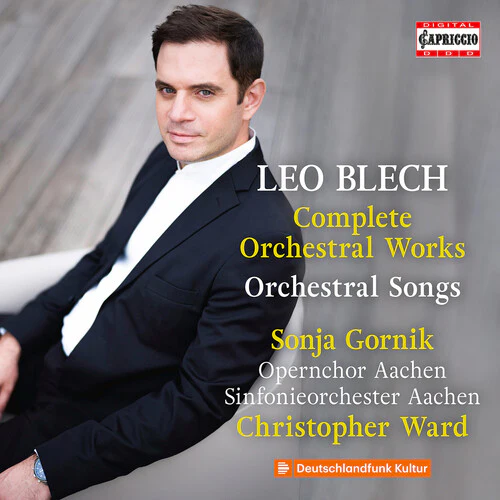
The closest Leo Blech (1880–1959) gets to fame these days is being mistaken for Ernest Bloch. Actually, some might still remember his seminal work as an opera conductor in Berlin, where he worked for almost half a century (except for the Nazi years, when he lived in exile, avoiding a far worse fate). But his compositions – either operas or involving the voice in some other way – have disappeared from the repertoire. What a shame, because his music is, while less probing than that of his contemporary Bloch’s, very much charming in the style of, say, Humperdinck or Rheinberger. This release constitutes the first part of an upcoming celebration of Blech by Capriccio, which will later release a 2-CD recording of his opera The Alpine King and the Misanthrope.
REVIEW:
In the times we are living through, the music of Leo Blech recorded for this CD could be characterized as eco-music. The majority of the works describe nature in an idyllic, idealized state, as we wish it back only too gladly.
Now Leo Blech had to contend with quite different problems during his lifetime. As a celebrated conductor with Jewish roots, he was ostracized by the Nazis in the mid-1930s, was forced into retirement and went into exile.
For Leo Blech, music and nature were undoubtedly a refuge to a peaceful world. This is reflected in his compositions, beginning on this recording with Waldwanderung, an atmospheric contemplation of nature interpreted by the Aachen Symphony Orchestra under Christopher Ward with fine texture, lyrical wind choir and delicate string sounds.
Overall, we are dealing with extremely sensitive interpretations. Especially in the works with vocal instrumentation, Christopher Ward lets the orchestra sing and the great potential of the wonderful melodies come to full fruition.
The symphonic poem Die Nonne, on the other hand, is gripping and highly dramatic. The historical and emotional connection with Leo Blech, who was born in Aachen, repeatedly drives the entire ensemble to committed interpretations. In the end, the result is a coherent and noble homage to the composer Leo Blech
-- Pizzicato
The closest Leo Blech (1880–1959) gets to fame these days is being mistaken for Ernest Bloch. Actually, some might still remember his seminal work as an opera conductor in Berlin, where he worked for almost half a century (except for the Nazi years, when he lived in exile, avoiding a far worse fate). But his compositions – either operas or involving the voice in some other way – have disappeared from the repertoire. What a shame, because his music is, while less probing than that of his contemporary Bloch’s, very much charming in the style of, say, Humperdinck or Rheinberger. This release constitutes the first part of an upcoming celebration of Blech by Capriccio, which will later release a 2-CD recording of his opera The Alpine King and the Misanthrope.
REVIEW:
In the times we are living through, the music of Leo Blech recorded for this CD could be characterized as eco-music. The majority of the works describe nature in an idyllic, idealized state, as we wish it back only too gladly.
Now Leo Blech had to contend with quite different problems during his lifetime. As a celebrated conductor with Jewish roots, he was ostracized by the Nazis in the mid-1930s, was forced into retirement and went into exile.
For Leo Blech, music and nature were undoubtedly a refuge to a peaceful world. This is reflected in his compositions, beginning on this recording with Waldwanderung, an atmospheric contemplation of nature interpreted by the Aachen Symphony Orchestra under Christopher Ward with fine texture, lyrical wind choir and delicate string sounds.
Overall, we are dealing with extremely sensitive interpretations. Especially in the works with vocal instrumentation, Christopher Ward lets the orchestra sing and the great potential of the wonderful melodies come to full fruition.
The symphonic poem Die Nonne, on the other hand, is gripping and highly dramatic. The historical and emotional connection with Leo Blech, who was born in Aachen, repeatedly drives the entire ensemble to committed interpretations. In the end, the result is a coherent and noble homage to the composer Leo Blech
-- Pizzicato
Original: $16.99
-65%$16.99
$5.95Description
The closest Leo Blech (1880–1959) gets to fame these days is being mistaken for Ernest Bloch. Actually, some might still remember his seminal work as an opera conductor in Berlin, where he worked for almost half a century (except for the Nazi years, when he lived in exile, avoiding a far worse fate). But his compositions – either operas or involving the voice in some other way – have disappeared from the repertoire. What a shame, because his music is, while less probing than that of his contemporary Bloch’s, very much charming in the style of, say, Humperdinck or Rheinberger. This release constitutes the first part of an upcoming celebration of Blech by Capriccio, which will later release a 2-CD recording of his opera The Alpine King and the Misanthrope.
REVIEW:
In the times we are living through, the music of Leo Blech recorded for this CD could be characterized as eco-music. The majority of the works describe nature in an idyllic, idealized state, as we wish it back only too gladly.
Now Leo Blech had to contend with quite different problems during his lifetime. As a celebrated conductor with Jewish roots, he was ostracized by the Nazis in the mid-1930s, was forced into retirement and went into exile.
For Leo Blech, music and nature were undoubtedly a refuge to a peaceful world. This is reflected in his compositions, beginning on this recording with Waldwanderung, an atmospheric contemplation of nature interpreted by the Aachen Symphony Orchestra under Christopher Ward with fine texture, lyrical wind choir and delicate string sounds.
Overall, we are dealing with extremely sensitive interpretations. Especially in the works with vocal instrumentation, Christopher Ward lets the orchestra sing and the great potential of the wonderful melodies come to full fruition.
The symphonic poem Die Nonne, on the other hand, is gripping and highly dramatic. The historical and emotional connection with Leo Blech, who was born in Aachen, repeatedly drives the entire ensemble to committed interpretations. In the end, the result is a coherent and noble homage to the composer Leo Blech
-- Pizzicato