🎉 Up to 70% Off Selected ItemsShop Sale

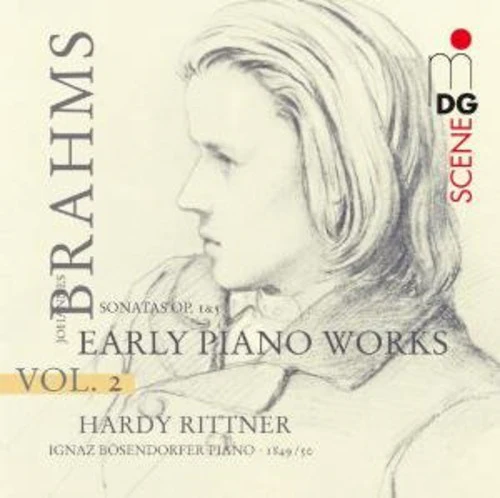
Brahms: Early Piano Works Vol 2 / Hardy Rittner
This is a hybrid Super Audio CD playable on both regular and Super Audio CD players.
3250600.az_BRAHMS_Piano_Sonatas_1.html
BRAHMS Piano Sonatas: No. 1 in C; No. 3 in f • Hardy Rittner (pn) • MDG 9041538 (Hybrid multichannel SACD: 67:51)
“One of the best new solo Brahms albums to come my way in quite some time” was how I described Volume 1 of Hardy Rittner’s survey of Brahms’s early piano works in 32:1. Volume 2 adds the First and Third Sonatas to the Second Sonata, Variations on a Theme of Schumann , and ballades previously released. For this recording, Rittner plays a slightly earlier piano, one made in 1849–50, from the workshop of Ignaz Bösendorfer. On Volume 1, he played an instrument made in 1851.
I’ve always wondered why Brahms never wrote another piano sonata after having written three huge and enormously difficult essays in the form before his 21st birthday. It wasn’t for lack of wanting to. We know that his initial sketches for what would eventually become the D-Minor Piano Concerto began as a sonata for two pianos. The same is true of the F-Minor Piano Quintet, which Brahms did preserve and publish as op. 34b. But in both cases, these were conceived for two keyboards, not one. Brahms was an accomplished pianist, appearing publicly in that capacity on a regular basis, so one would think that the solo piano sonata would have been a logical vehicle for him to exploit. My conjecture—and it’s just that—is that even though the piano, by every evidence of the sound of the instrument on this disc (an instrument of exactly the same vintage as the sonatas), had evolved to its approximately modern-day state, it was still incapable of producing the symphonic sound and textures Brahms was able to achieve in his chamber works that joined piano with strings. The Bösendorfer here—serial number 1665—is of the new rounded case design with separate fallboard, a compass of seven octaves, and a length of over seven and a half feet. It also has both damper and una corda pedals.
A reading of any history of the piano’s evolution will tell you that, except for body length, which increased to approximately nine feet in the early 20th century, and continuing refinements to the frame and key mechanisms, most of the technical innovations, such as the double escapement action, the single piece cast iron frame, felt-covered hammers, the sostenuto pedal, and over-stringing were all inventions and improvements of the 19th century, some dating from even before Brahms was born. So, for all intents and purposes, Rittner’s Bösendorfer is much closer to a Steinway Model D than it is to any instrument Mozart would have known.
The sonic impact of this hybrid multichannel SACD is palpable, as it was on Volume 1. I find myself, however, not quite as wowed by Rittner’s readings of these two sonatas as I was by his previous release. His playing, technically, is still most impressive. But he is competing here against a number of pianists who have earned very high marks in this repertoire. I’m thinking in particular of Emanuel Ax and Mikhail Rudy. What seems ever so slightly lacking to me in Rittner’s performances is Brahms’s youthful exuberance, the sense of a young man barely out of his teens feeling, if not sowing, his oats. There’s just a bit of reserve or holding back in some of the go-for-broke passages, where Ax and Rudy throw caution to the winds and abandon themselves to Brahms’s unleashed passions.
This is a very minor criticism and should not put anyone off from acquiring this disc. Just to hear these works performed on an instrument that Brahms himself might have played, and captured in a recording of such depth and physical presence, is enough to offset any trifling reservation I may have expressed. If Rittner and MDG are planning a full run at all of Brahms’s works for solo piano, I definitely look forward to future installments.
FANFARE: Jerry Dubins
BRAHMS Piano Sonatas: No. 1 in C; No. 3 in f • Hardy Rittner (pn) • MDG 9041538 (Hybrid multichannel SACD: 67:51)
“One of the best new solo Brahms albums to come my way in quite some time” was how I described Volume 1 of Hardy Rittner’s survey of Brahms’s early piano works in 32:1. Volume 2 adds the First and Third Sonatas to the Second Sonata, Variations on a Theme of Schumann , and ballades previously released. For this recording, Rittner plays a slightly earlier piano, one made in 1849–50, from the workshop of Ignaz Bösendorfer. On Volume 1, he played an instrument made in 1851.
I’ve always wondered why Brahms never wrote another piano sonata after having written three huge and enormously difficult essays in the form before his 21st birthday. It wasn’t for lack of wanting to. We know that his initial sketches for what would eventually become the D-Minor Piano Concerto began as a sonata for two pianos. The same is true of the F-Minor Piano Quintet, which Brahms did preserve and publish as op. 34b. But in both cases, these were conceived for two keyboards, not one. Brahms was an accomplished pianist, appearing publicly in that capacity on a regular basis, so one would think that the solo piano sonata would have been a logical vehicle for him to exploit. My conjecture—and it’s just that—is that even though the piano, by every evidence of the sound of the instrument on this disc (an instrument of exactly the same vintage as the sonatas), had evolved to its approximately modern-day state, it was still incapable of producing the symphonic sound and textures Brahms was able to achieve in his chamber works that joined piano with strings. The Bösendorfer here—serial number 1665—is of the new rounded case design with separate fallboard, a compass of seven octaves, and a length of over seven and a half feet. It also has both damper and una corda pedals.
A reading of any history of the piano’s evolution will tell you that, except for body length, which increased to approximately nine feet in the early 20th century, and continuing refinements to the frame and key mechanisms, most of the technical innovations, such as the double escapement action, the single piece cast iron frame, felt-covered hammers, the sostenuto pedal, and over-stringing were all inventions and improvements of the 19th century, some dating from even before Brahms was born. So, for all intents and purposes, Rittner’s Bösendorfer is much closer to a Steinway Model D than it is to any instrument Mozart would have known.
The sonic impact of this hybrid multichannel SACD is palpable, as it was on Volume 1. I find myself, however, not quite as wowed by Rittner’s readings of these two sonatas as I was by his previous release. His playing, technically, is still most impressive. But he is competing here against a number of pianists who have earned very high marks in this repertoire. I’m thinking in particular of Emanuel Ax and Mikhail Rudy. What seems ever so slightly lacking to me in Rittner’s performances is Brahms’s youthful exuberance, the sense of a young man barely out of his teens feeling, if not sowing, his oats. There’s just a bit of reserve or holding back in some of the go-for-broke passages, where Ax and Rudy throw caution to the winds and abandon themselves to Brahms’s unleashed passions.
This is a very minor criticism and should not put anyone off from acquiring this disc. Just to hear these works performed on an instrument that Brahms himself might have played, and captured in a recording of such depth and physical presence, is enough to offset any trifling reservation I may have expressed. If Rittner and MDG are planning a full run at all of Brahms’s works for solo piano, I definitely look forward to future installments.
FANFARE: Jerry Dubins
This is a hybrid Super Audio CD playable on both regular and Super Audio CD players.
3250600.az_BRAHMS_Piano_Sonatas_1.html
BRAHMS Piano Sonatas: No. 1 in C; No. 3 in f • Hardy Rittner (pn) • MDG 9041538 (Hybrid multichannel SACD: 67:51)
“One of the best new solo Brahms albums to come my way in quite some time” was how I described Volume 1 of Hardy Rittner’s survey of Brahms’s early piano works in 32:1. Volume 2 adds the First and Third Sonatas to the Second Sonata, Variations on a Theme of Schumann , and ballades previously released. For this recording, Rittner plays a slightly earlier piano, one made in 1849–50, from the workshop of Ignaz Bösendorfer. On Volume 1, he played an instrument made in 1851.
I’ve always wondered why Brahms never wrote another piano sonata after having written three huge and enormously difficult essays in the form before his 21st birthday. It wasn’t for lack of wanting to. We know that his initial sketches for what would eventually become the D-Minor Piano Concerto began as a sonata for two pianos. The same is true of the F-Minor Piano Quintet, which Brahms did preserve and publish as op. 34b. But in both cases, these were conceived for two keyboards, not one. Brahms was an accomplished pianist, appearing publicly in that capacity on a regular basis, so one would think that the solo piano sonata would have been a logical vehicle for him to exploit. My conjecture—and it’s just that—is that even though the piano, by every evidence of the sound of the instrument on this disc (an instrument of exactly the same vintage as the sonatas), had evolved to its approximately modern-day state, it was still incapable of producing the symphonic sound and textures Brahms was able to achieve in his chamber works that joined piano with strings. The Bösendorfer here—serial number 1665—is of the new rounded case design with separate fallboard, a compass of seven octaves, and a length of over seven and a half feet. It also has both damper and una corda pedals.
A reading of any history of the piano’s evolution will tell you that, except for body length, which increased to approximately nine feet in the early 20th century, and continuing refinements to the frame and key mechanisms, most of the technical innovations, such as the double escapement action, the single piece cast iron frame, felt-covered hammers, the sostenuto pedal, and over-stringing were all inventions and improvements of the 19th century, some dating from even before Brahms was born. So, for all intents and purposes, Rittner’s Bösendorfer is much closer to a Steinway Model D than it is to any instrument Mozart would have known.
The sonic impact of this hybrid multichannel SACD is palpable, as it was on Volume 1. I find myself, however, not quite as wowed by Rittner’s readings of these two sonatas as I was by his previous release. His playing, technically, is still most impressive. But he is competing here against a number of pianists who have earned very high marks in this repertoire. I’m thinking in particular of Emanuel Ax and Mikhail Rudy. What seems ever so slightly lacking to me in Rittner’s performances is Brahms’s youthful exuberance, the sense of a young man barely out of his teens feeling, if not sowing, his oats. There’s just a bit of reserve or holding back in some of the go-for-broke passages, where Ax and Rudy throw caution to the winds and abandon themselves to Brahms’s unleashed passions.
This is a very minor criticism and should not put anyone off from acquiring this disc. Just to hear these works performed on an instrument that Brahms himself might have played, and captured in a recording of such depth and physical presence, is enough to offset any trifling reservation I may have expressed. If Rittner and MDG are planning a full run at all of Brahms’s works for solo piano, I definitely look forward to future installments.
FANFARE: Jerry Dubins
BRAHMS Piano Sonatas: No. 1 in C; No. 3 in f • Hardy Rittner (pn) • MDG 9041538 (Hybrid multichannel SACD: 67:51)
“One of the best new solo Brahms albums to come my way in quite some time” was how I described Volume 1 of Hardy Rittner’s survey of Brahms’s early piano works in 32:1. Volume 2 adds the First and Third Sonatas to the Second Sonata, Variations on a Theme of Schumann , and ballades previously released. For this recording, Rittner plays a slightly earlier piano, one made in 1849–50, from the workshop of Ignaz Bösendorfer. On Volume 1, he played an instrument made in 1851.
I’ve always wondered why Brahms never wrote another piano sonata after having written three huge and enormously difficult essays in the form before his 21st birthday. It wasn’t for lack of wanting to. We know that his initial sketches for what would eventually become the D-Minor Piano Concerto began as a sonata for two pianos. The same is true of the F-Minor Piano Quintet, which Brahms did preserve and publish as op. 34b. But in both cases, these were conceived for two keyboards, not one. Brahms was an accomplished pianist, appearing publicly in that capacity on a regular basis, so one would think that the solo piano sonata would have been a logical vehicle for him to exploit. My conjecture—and it’s just that—is that even though the piano, by every evidence of the sound of the instrument on this disc (an instrument of exactly the same vintage as the sonatas), had evolved to its approximately modern-day state, it was still incapable of producing the symphonic sound and textures Brahms was able to achieve in his chamber works that joined piano with strings. The Bösendorfer here—serial number 1665—is of the new rounded case design with separate fallboard, a compass of seven octaves, and a length of over seven and a half feet. It also has both damper and una corda pedals.
A reading of any history of the piano’s evolution will tell you that, except for body length, which increased to approximately nine feet in the early 20th century, and continuing refinements to the frame and key mechanisms, most of the technical innovations, such as the double escapement action, the single piece cast iron frame, felt-covered hammers, the sostenuto pedal, and over-stringing were all inventions and improvements of the 19th century, some dating from even before Brahms was born. So, for all intents and purposes, Rittner’s Bösendorfer is much closer to a Steinway Model D than it is to any instrument Mozart would have known.
The sonic impact of this hybrid multichannel SACD is palpable, as it was on Volume 1. I find myself, however, not quite as wowed by Rittner’s readings of these two sonatas as I was by his previous release. His playing, technically, is still most impressive. But he is competing here against a number of pianists who have earned very high marks in this repertoire. I’m thinking in particular of Emanuel Ax and Mikhail Rudy. What seems ever so slightly lacking to me in Rittner’s performances is Brahms’s youthful exuberance, the sense of a young man barely out of his teens feeling, if not sowing, his oats. There’s just a bit of reserve or holding back in some of the go-for-broke passages, where Ax and Rudy throw caution to the winds and abandon themselves to Brahms’s unleashed passions.
This is a very minor criticism and should not put anyone off from acquiring this disc. Just to hear these works performed on an instrument that Brahms himself might have played, and captured in a recording of such depth and physical presence, is enough to offset any trifling reservation I may have expressed. If Rittner and MDG are planning a full run at all of Brahms’s works for solo piano, I definitely look forward to future installments.
FANFARE: Jerry Dubins
$8.75
Original: $24.99
-65%Brahms: Early Piano Works Vol 2 / Hardy Rittner—
$24.99
$8.75Description
This is a hybrid Super Audio CD playable on both regular and Super Audio CD players.
3250600.az_BRAHMS_Piano_Sonatas_1.html
BRAHMS Piano Sonatas: No. 1 in C; No. 3 in f • Hardy Rittner (pn) • MDG 9041538 (Hybrid multichannel SACD: 67:51)
“One of the best new solo Brahms albums to come my way in quite some time” was how I described Volume 1 of Hardy Rittner’s survey of Brahms’s early piano works in 32:1. Volume 2 adds the First and Third Sonatas to the Second Sonata, Variations on a Theme of Schumann , and ballades previously released. For this recording, Rittner plays a slightly earlier piano, one made in 1849–50, from the workshop of Ignaz Bösendorfer. On Volume 1, he played an instrument made in 1851.
I’ve always wondered why Brahms never wrote another piano sonata after having written three huge and enormously difficult essays in the form before his 21st birthday. It wasn’t for lack of wanting to. We know that his initial sketches for what would eventually become the D-Minor Piano Concerto began as a sonata for two pianos. The same is true of the F-Minor Piano Quintet, which Brahms did preserve and publish as op. 34b. But in both cases, these were conceived for two keyboards, not one. Brahms was an accomplished pianist, appearing publicly in that capacity on a regular basis, so one would think that the solo piano sonata would have been a logical vehicle for him to exploit. My conjecture—and it’s just that—is that even though the piano, by every evidence of the sound of the instrument on this disc (an instrument of exactly the same vintage as the sonatas), had evolved to its approximately modern-day state, it was still incapable of producing the symphonic sound and textures Brahms was able to achieve in his chamber works that joined piano with strings. The Bösendorfer here—serial number 1665—is of the new rounded case design with separate fallboard, a compass of seven octaves, and a length of over seven and a half feet. It also has both damper and una corda pedals.
A reading of any history of the piano’s evolution will tell you that, except for body length, which increased to approximately nine feet in the early 20th century, and continuing refinements to the frame and key mechanisms, most of the technical innovations, such as the double escapement action, the single piece cast iron frame, felt-covered hammers, the sostenuto pedal, and over-stringing were all inventions and improvements of the 19th century, some dating from even before Brahms was born. So, for all intents and purposes, Rittner’s Bösendorfer is much closer to a Steinway Model D than it is to any instrument Mozart would have known.
The sonic impact of this hybrid multichannel SACD is palpable, as it was on Volume 1. I find myself, however, not quite as wowed by Rittner’s readings of these two sonatas as I was by his previous release. His playing, technically, is still most impressive. But he is competing here against a number of pianists who have earned very high marks in this repertoire. I’m thinking in particular of Emanuel Ax and Mikhail Rudy. What seems ever so slightly lacking to me in Rittner’s performances is Brahms’s youthful exuberance, the sense of a young man barely out of his teens feeling, if not sowing, his oats. There’s just a bit of reserve or holding back in some of the go-for-broke passages, where Ax and Rudy throw caution to the winds and abandon themselves to Brahms’s unleashed passions.
This is a very minor criticism and should not put anyone off from acquiring this disc. Just to hear these works performed on an instrument that Brahms himself might have played, and captured in a recording of such depth and physical presence, is enough to offset any trifling reservation I may have expressed. If Rittner and MDG are planning a full run at all of Brahms’s works for solo piano, I definitely look forward to future installments.
FANFARE: Jerry Dubins
BRAHMS Piano Sonatas: No. 1 in C; No. 3 in f • Hardy Rittner (pn) • MDG 9041538 (Hybrid multichannel SACD: 67:51)
“One of the best new solo Brahms albums to come my way in quite some time” was how I described Volume 1 of Hardy Rittner’s survey of Brahms’s early piano works in 32:1. Volume 2 adds the First and Third Sonatas to the Second Sonata, Variations on a Theme of Schumann , and ballades previously released. For this recording, Rittner plays a slightly earlier piano, one made in 1849–50, from the workshop of Ignaz Bösendorfer. On Volume 1, he played an instrument made in 1851.
I’ve always wondered why Brahms never wrote another piano sonata after having written three huge and enormously difficult essays in the form before his 21st birthday. It wasn’t for lack of wanting to. We know that his initial sketches for what would eventually become the D-Minor Piano Concerto began as a sonata for two pianos. The same is true of the F-Minor Piano Quintet, which Brahms did preserve and publish as op. 34b. But in both cases, these were conceived for two keyboards, not one. Brahms was an accomplished pianist, appearing publicly in that capacity on a regular basis, so one would think that the solo piano sonata would have been a logical vehicle for him to exploit. My conjecture—and it’s just that—is that even though the piano, by every evidence of the sound of the instrument on this disc (an instrument of exactly the same vintage as the sonatas), had evolved to its approximately modern-day state, it was still incapable of producing the symphonic sound and textures Brahms was able to achieve in his chamber works that joined piano with strings. The Bösendorfer here—serial number 1665—is of the new rounded case design with separate fallboard, a compass of seven octaves, and a length of over seven and a half feet. It also has both damper and una corda pedals.
A reading of any history of the piano’s evolution will tell you that, except for body length, which increased to approximately nine feet in the early 20th century, and continuing refinements to the frame and key mechanisms, most of the technical innovations, such as the double escapement action, the single piece cast iron frame, felt-covered hammers, the sostenuto pedal, and over-stringing were all inventions and improvements of the 19th century, some dating from even before Brahms was born. So, for all intents and purposes, Rittner’s Bösendorfer is much closer to a Steinway Model D than it is to any instrument Mozart would have known.
The sonic impact of this hybrid multichannel SACD is palpable, as it was on Volume 1. I find myself, however, not quite as wowed by Rittner’s readings of these two sonatas as I was by his previous release. His playing, technically, is still most impressive. But he is competing here against a number of pianists who have earned very high marks in this repertoire. I’m thinking in particular of Emanuel Ax and Mikhail Rudy. What seems ever so slightly lacking to me in Rittner’s performances is Brahms’s youthful exuberance, the sense of a young man barely out of his teens feeling, if not sowing, his oats. There’s just a bit of reserve or holding back in some of the go-for-broke passages, where Ax and Rudy throw caution to the winds and abandon themselves to Brahms’s unleashed passions.
This is a very minor criticism and should not put anyone off from acquiring this disc. Just to hear these works performed on an instrument that Brahms himself might have played, and captured in a recording of such depth and physical presence, is enough to offset any trifling reservation I may have expressed. If Rittner and MDG are planning a full run at all of Brahms’s works for solo piano, I definitely look forward to future installments.
FANFARE: Jerry Dubins