🎉 Up to 70% Off Selected ItemsShop Sale

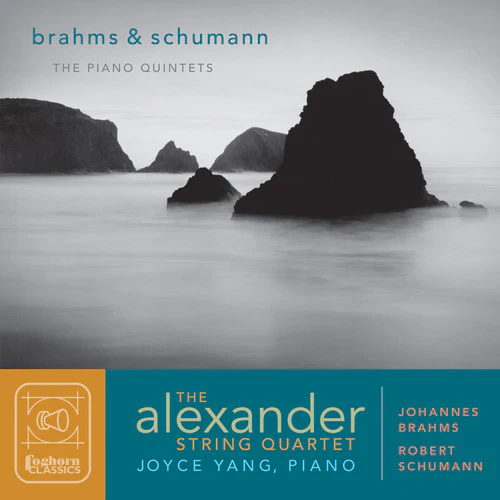
Brahms, Schumann: Piano Quintets / Joyce, Alexander String Quartet
SCHUMANN Piano Quintet. BRAHMS Piano Quintet • Alexander Str Qrt; Joyce Yang (pn) • FOGHORN 2014 (70:24)
One would think that the Schumann and Brahms piano quintets would make natural partners on disc; yet, they’ve been paired together fewer times than I’d have thought. I found no more than half a dozen such couplings, and interestingly, of those, only one (not counting the present Alexander Quartet’s version) is anywhere near recent, and that is a 2007 recording with the Artemis Quartet and Leif Ove Andsnes on Virgin, which received a less than favorable review from me in 31:4. Three others fall into the historical category: a recording issued by Pearl with the Busch Quartet and Rudolf Serkin (Brahms, 1938; Schumann, 1942); a recording issued in a three-disc set by Testament with the Hollywood Quartet and Victor Aller (Brahms, 1954; Schumann, 1955); and a recording by Doremi with the Tel Aviv Quartet and Pnina Salzman (Brahms, 1974; Schumann, 1983). There’s also a pairing of the two works on a 2000 Globe CD, featuring the Rubio Quartet and Paul Komen.
This led me to wonder why these two piano quintets by two men who held each other in high esteem, and whose lives intersected in very personal ways, would not be joined together on disc more often. Then, listening to them, one after the other, as they’re programmed on the Alexander’s CD—the Schumann first, the Brahms second—some possible reasons presented themselves.
To begin with, the Brahms Piano Quintet dwarfs the Schumann, and not just in its duration, which is some 12 minutes longer, but in the thickness of its textures, the weightiness of its material, and especially the ponderousness of its piano part. Schumann, the keyboard virtuoso who wrote such magnificent music for his own instrument, also seemed to understand intuitively how to combine piano and strings in a way that was balanced and transparent and that allowed for the strings to be heard on an equal footing. He leveled the playing field. Steven Ritter, in a 34:1 review of the Quintet performed by the Leipzig Quartet and Christian Zacharias on MDG, wrote, “Schumann in this piece knew what he was writing for, and the balance among the strings with the piano is well-nigh perfect.” Exactly right.
Brahms, too, was reputedly a formidable pianist, but his writing for the instrument, at least in his earlier works, was of a different nature. It was muscular, bulky, and dense. For the string players in his Quintet, it’s a constant struggle to be heard.
Then there’s the music itself. Much of Schumann’s Quintet gives off a feeling of spontaneous inspiration. For the most part, it’s a buoyant, ebullient work. Brahms’s Quintet is not spontaneous sounding at all. Much of it, with its convoluted rhythmic contortions, sounds laboriously worked out. Add to that a score containing some of Brahms’s most violent music, and in the very dark key of F Minor—which, according to Christian Schubart’s Ideen zu einer Aesthetik der Tonkunst (Ideas for an Aesthetic of Sound Art) (1806), expresses “deep depression, funereal lament, groans of misery, and longing for the grave”—and you have a work that’s grim, desperate, and brutal in three of its four movements. Can there be any more sudden or crueler ending to a piece than the fateful three-note thud that decapitates the Finale dead in its tracks?
The piano quintets by Schumann and Brahms are indeed very different works, which, on emotional and psychological levels, probably wouldn’t make compatible marriage partners.
There’s also the age difference to take into account. Schumann composed his Quintet in 1842, more than 10 years before he and Clara met Brahms for the first time in Düsseldorf in 1853. By the time Brahms completed his Piano Quintet in 1864, Schumann had been dead for eight years.
But Brahms’s Quintet was one of those works that had a lengthy gestation and a difficult birth, struggling to find its final form. Originally, it took shape as a two-cello String Quintet. Had Brahms not destroyed that first version, it would have been his only string quintet scored for two cellos, following the example of Schubert’s great C-Major Quintet. As it turned out, Brahms’s only two extant string quintets, opp. 88 and 111, are scored for two violas, following the examples of Mozart.
Unhappy with the piece as a String Quintet, Brahms next revised it as a Sonata for Two Pianos. He was well enough satisfied with that version not to have destroyed it, but Clara Schumann and Hermann Levi, who performed the two-piano version together in concert, both felt that the piece needed a bigger, perhaps orchestral, treatment. Brahms wasn’t ready yet to write a symphony, but he took his friends’ advice to heart, and rearranged the score one last time as the Piano Quintet we know today. The two-piano version, however, was preserved and published as op. 34b. But filed under the category of “can’t leave well-enough alone,” the destroyed two-cello Quintet version was exhumed in a speculative reconstruction by Anssi Karttunen and recorded at least once that I know of, on a Toccata Classics CD (TOCC0066).
The Alexander’s Schumann is indeed breathtaking, as much for its sweeping lyricism and emotional responsiveness to the music’s impassioned Romantic gestures, as for its technical precision, ensemble balance, and tonal bloom. It stands head and shoulders, by far, above any of the recent recordings of the work to come my way. I already mentioned the disappointing Artemis effort; and even more recently, I found the Fine Arts Quartet’s entry with pianist Xiayin Wang on Naxos “workmanlike and professional, but not emotionally moving or inspiring.” Yet another letdown was a live recording from the Heimbach Festival with Christian Tetzlaff, Lars Vogt, and friends, a performance I found wanting for a bit more rehearsal time.
Quite honestly, until the arrival of this new version of the Schumann from the Alexander Quartet and Joyce Yang, my favorites have been a performance by the Schubert Ensemble on ASV, reviewed in 30:3, and the classic 1966 recording by the Guarneri Quartet with Arthur Rubinstein, a review of which (assuming it was reviewed) most likely predates the Fanfare Archive. The Alexander’s Schumann is simply wonderful, taking pride of place among all others with which I’m familiar.
The Brahms Quintet, too, is special. The hair-on-fire Scherzo, in particular, is a guided tour through Brahms’s rhythmic arsenal. If the players thoroughly appreciate the pulse-quickening, heart-pounding effect this movement is intended to have, and they deliver it accordingly, it should make you want to jump out of your skin. No one, of course, has literally ever done such a thing; it’s just an expression, like being beside oneself, which, according to quantum theory, at least, is a possibility. But I have to say that the Alexander’s performance is super-charged and electrifyingly exciting. Needless to say, the ensemble’s terrific reading of Brahms’s Piano Quintet is not limited to just the Scherzo. This new recording of the Schumann and Brahms piano quintets will be a serious contender for my year-end Want List.
FANFARE: Jerry Dubins
One would think that the Schumann and Brahms piano quintets would make natural partners on disc; yet, they’ve been paired together fewer times than I’d have thought. I found no more than half a dozen such couplings, and interestingly, of those, only one (not counting the present Alexander Quartet’s version) is anywhere near recent, and that is a 2007 recording with the Artemis Quartet and Leif Ove Andsnes on Virgin, which received a less than favorable review from me in 31:4. Three others fall into the historical category: a recording issued by Pearl with the Busch Quartet and Rudolf Serkin (Brahms, 1938; Schumann, 1942); a recording issued in a three-disc set by Testament with the Hollywood Quartet and Victor Aller (Brahms, 1954; Schumann, 1955); and a recording by Doremi with the Tel Aviv Quartet and Pnina Salzman (Brahms, 1974; Schumann, 1983). There’s also a pairing of the two works on a 2000 Globe CD, featuring the Rubio Quartet and Paul Komen.
This led me to wonder why these two piano quintets by two men who held each other in high esteem, and whose lives intersected in very personal ways, would not be joined together on disc more often. Then, listening to them, one after the other, as they’re programmed on the Alexander’s CD—the Schumann first, the Brahms second—some possible reasons presented themselves.
To begin with, the Brahms Piano Quintet dwarfs the Schumann, and not just in its duration, which is some 12 minutes longer, but in the thickness of its textures, the weightiness of its material, and especially the ponderousness of its piano part. Schumann, the keyboard virtuoso who wrote such magnificent music for his own instrument, also seemed to understand intuitively how to combine piano and strings in a way that was balanced and transparent and that allowed for the strings to be heard on an equal footing. He leveled the playing field. Steven Ritter, in a 34:1 review of the Quintet performed by the Leipzig Quartet and Christian Zacharias on MDG, wrote, “Schumann in this piece knew what he was writing for, and the balance among the strings with the piano is well-nigh perfect.” Exactly right.
Brahms, too, was reputedly a formidable pianist, but his writing for the instrument, at least in his earlier works, was of a different nature. It was muscular, bulky, and dense. For the string players in his Quintet, it’s a constant struggle to be heard.
Then there’s the music itself. Much of Schumann’s Quintet gives off a feeling of spontaneous inspiration. For the most part, it’s a buoyant, ebullient work. Brahms’s Quintet is not spontaneous sounding at all. Much of it, with its convoluted rhythmic contortions, sounds laboriously worked out. Add to that a score containing some of Brahms’s most violent music, and in the very dark key of F Minor—which, according to Christian Schubart’s Ideen zu einer Aesthetik der Tonkunst (Ideas for an Aesthetic of Sound Art) (1806), expresses “deep depression, funereal lament, groans of misery, and longing for the grave”—and you have a work that’s grim, desperate, and brutal in three of its four movements. Can there be any more sudden or crueler ending to a piece than the fateful three-note thud that decapitates the Finale dead in its tracks?
The piano quintets by Schumann and Brahms are indeed very different works, which, on emotional and psychological levels, probably wouldn’t make compatible marriage partners.
There’s also the age difference to take into account. Schumann composed his Quintet in 1842, more than 10 years before he and Clara met Brahms for the first time in Düsseldorf in 1853. By the time Brahms completed his Piano Quintet in 1864, Schumann had been dead for eight years.
But Brahms’s Quintet was one of those works that had a lengthy gestation and a difficult birth, struggling to find its final form. Originally, it took shape as a two-cello String Quintet. Had Brahms not destroyed that first version, it would have been his only string quintet scored for two cellos, following the example of Schubert’s great C-Major Quintet. As it turned out, Brahms’s only two extant string quintets, opp. 88 and 111, are scored for two violas, following the examples of Mozart.
Unhappy with the piece as a String Quintet, Brahms next revised it as a Sonata for Two Pianos. He was well enough satisfied with that version not to have destroyed it, but Clara Schumann and Hermann Levi, who performed the two-piano version together in concert, both felt that the piece needed a bigger, perhaps orchestral, treatment. Brahms wasn’t ready yet to write a symphony, but he took his friends’ advice to heart, and rearranged the score one last time as the Piano Quintet we know today. The two-piano version, however, was preserved and published as op. 34b. But filed under the category of “can’t leave well-enough alone,” the destroyed two-cello Quintet version was exhumed in a speculative reconstruction by Anssi Karttunen and recorded at least once that I know of, on a Toccata Classics CD (TOCC0066).
The Alexander’s Schumann is indeed breathtaking, as much for its sweeping lyricism and emotional responsiveness to the music’s impassioned Romantic gestures, as for its technical precision, ensemble balance, and tonal bloom. It stands head and shoulders, by far, above any of the recent recordings of the work to come my way. I already mentioned the disappointing Artemis effort; and even more recently, I found the Fine Arts Quartet’s entry with pianist Xiayin Wang on Naxos “workmanlike and professional, but not emotionally moving or inspiring.” Yet another letdown was a live recording from the Heimbach Festival with Christian Tetzlaff, Lars Vogt, and friends, a performance I found wanting for a bit more rehearsal time.
Quite honestly, until the arrival of this new version of the Schumann from the Alexander Quartet and Joyce Yang, my favorites have been a performance by the Schubert Ensemble on ASV, reviewed in 30:3, and the classic 1966 recording by the Guarneri Quartet with Arthur Rubinstein, a review of which (assuming it was reviewed) most likely predates the Fanfare Archive. The Alexander’s Schumann is simply wonderful, taking pride of place among all others with which I’m familiar.
The Brahms Quintet, too, is special. The hair-on-fire Scherzo, in particular, is a guided tour through Brahms’s rhythmic arsenal. If the players thoroughly appreciate the pulse-quickening, heart-pounding effect this movement is intended to have, and they deliver it accordingly, it should make you want to jump out of your skin. No one, of course, has literally ever done such a thing; it’s just an expression, like being beside oneself, which, according to quantum theory, at least, is a possibility. But I have to say that the Alexander’s performance is super-charged and electrifyingly exciting. Needless to say, the ensemble’s terrific reading of Brahms’s Piano Quintet is not limited to just the Scherzo. This new recording of the Schumann and Brahms piano quintets will be a serious contender for my year-end Want List.
FANFARE: Jerry Dubins
SCHUMANN Piano Quintet. BRAHMS Piano Quintet • Alexander Str Qrt; Joyce Yang (pn) • FOGHORN 2014 (70:24)
One would think that the Schumann and Brahms piano quintets would make natural partners on disc; yet, they’ve been paired together fewer times than I’d have thought. I found no more than half a dozen such couplings, and interestingly, of those, only one (not counting the present Alexander Quartet’s version) is anywhere near recent, and that is a 2007 recording with the Artemis Quartet and Leif Ove Andsnes on Virgin, which received a less than favorable review from me in 31:4. Three others fall into the historical category: a recording issued by Pearl with the Busch Quartet and Rudolf Serkin (Brahms, 1938; Schumann, 1942); a recording issued in a three-disc set by Testament with the Hollywood Quartet and Victor Aller (Brahms, 1954; Schumann, 1955); and a recording by Doremi with the Tel Aviv Quartet and Pnina Salzman (Brahms, 1974; Schumann, 1983). There’s also a pairing of the two works on a 2000 Globe CD, featuring the Rubio Quartet and Paul Komen.
This led me to wonder why these two piano quintets by two men who held each other in high esteem, and whose lives intersected in very personal ways, would not be joined together on disc more often. Then, listening to them, one after the other, as they’re programmed on the Alexander’s CD—the Schumann first, the Brahms second—some possible reasons presented themselves.
To begin with, the Brahms Piano Quintet dwarfs the Schumann, and not just in its duration, which is some 12 minutes longer, but in the thickness of its textures, the weightiness of its material, and especially the ponderousness of its piano part. Schumann, the keyboard virtuoso who wrote such magnificent music for his own instrument, also seemed to understand intuitively how to combine piano and strings in a way that was balanced and transparent and that allowed for the strings to be heard on an equal footing. He leveled the playing field. Steven Ritter, in a 34:1 review of the Quintet performed by the Leipzig Quartet and Christian Zacharias on MDG, wrote, “Schumann in this piece knew what he was writing for, and the balance among the strings with the piano is well-nigh perfect.” Exactly right.
Brahms, too, was reputedly a formidable pianist, but his writing for the instrument, at least in his earlier works, was of a different nature. It was muscular, bulky, and dense. For the string players in his Quintet, it’s a constant struggle to be heard.
Then there’s the music itself. Much of Schumann’s Quintet gives off a feeling of spontaneous inspiration. For the most part, it’s a buoyant, ebullient work. Brahms’s Quintet is not spontaneous sounding at all. Much of it, with its convoluted rhythmic contortions, sounds laboriously worked out. Add to that a score containing some of Brahms’s most violent music, and in the very dark key of F Minor—which, according to Christian Schubart’s Ideen zu einer Aesthetik der Tonkunst (Ideas for an Aesthetic of Sound Art) (1806), expresses “deep depression, funereal lament, groans of misery, and longing for the grave”—and you have a work that’s grim, desperate, and brutal in three of its four movements. Can there be any more sudden or crueler ending to a piece than the fateful three-note thud that decapitates the Finale dead in its tracks?
The piano quintets by Schumann and Brahms are indeed very different works, which, on emotional and psychological levels, probably wouldn’t make compatible marriage partners.
There’s also the age difference to take into account. Schumann composed his Quintet in 1842, more than 10 years before he and Clara met Brahms for the first time in Düsseldorf in 1853. By the time Brahms completed his Piano Quintet in 1864, Schumann had been dead for eight years.
But Brahms’s Quintet was one of those works that had a lengthy gestation and a difficult birth, struggling to find its final form. Originally, it took shape as a two-cello String Quintet. Had Brahms not destroyed that first version, it would have been his only string quintet scored for two cellos, following the example of Schubert’s great C-Major Quintet. As it turned out, Brahms’s only two extant string quintets, opp. 88 and 111, are scored for two violas, following the examples of Mozart.
Unhappy with the piece as a String Quintet, Brahms next revised it as a Sonata for Two Pianos. He was well enough satisfied with that version not to have destroyed it, but Clara Schumann and Hermann Levi, who performed the two-piano version together in concert, both felt that the piece needed a bigger, perhaps orchestral, treatment. Brahms wasn’t ready yet to write a symphony, but he took his friends’ advice to heart, and rearranged the score one last time as the Piano Quintet we know today. The two-piano version, however, was preserved and published as op. 34b. But filed under the category of “can’t leave well-enough alone,” the destroyed two-cello Quintet version was exhumed in a speculative reconstruction by Anssi Karttunen and recorded at least once that I know of, on a Toccata Classics CD (TOCC0066).
The Alexander’s Schumann is indeed breathtaking, as much for its sweeping lyricism and emotional responsiveness to the music’s impassioned Romantic gestures, as for its technical precision, ensemble balance, and tonal bloom. It stands head and shoulders, by far, above any of the recent recordings of the work to come my way. I already mentioned the disappointing Artemis effort; and even more recently, I found the Fine Arts Quartet’s entry with pianist Xiayin Wang on Naxos “workmanlike and professional, but not emotionally moving or inspiring.” Yet another letdown was a live recording from the Heimbach Festival with Christian Tetzlaff, Lars Vogt, and friends, a performance I found wanting for a bit more rehearsal time.
Quite honestly, until the arrival of this new version of the Schumann from the Alexander Quartet and Joyce Yang, my favorites have been a performance by the Schubert Ensemble on ASV, reviewed in 30:3, and the classic 1966 recording by the Guarneri Quartet with Arthur Rubinstein, a review of which (assuming it was reviewed) most likely predates the Fanfare Archive. The Alexander’s Schumann is simply wonderful, taking pride of place among all others with which I’m familiar.
The Brahms Quintet, too, is special. The hair-on-fire Scherzo, in particular, is a guided tour through Brahms’s rhythmic arsenal. If the players thoroughly appreciate the pulse-quickening, heart-pounding effect this movement is intended to have, and they deliver it accordingly, it should make you want to jump out of your skin. No one, of course, has literally ever done such a thing; it’s just an expression, like being beside oneself, which, according to quantum theory, at least, is a possibility. But I have to say that the Alexander’s performance is super-charged and electrifyingly exciting. Needless to say, the ensemble’s terrific reading of Brahms’s Piano Quintet is not limited to just the Scherzo. This new recording of the Schumann and Brahms piano quintets will be a serious contender for my year-end Want List.
FANFARE: Jerry Dubins
One would think that the Schumann and Brahms piano quintets would make natural partners on disc; yet, they’ve been paired together fewer times than I’d have thought. I found no more than half a dozen such couplings, and interestingly, of those, only one (not counting the present Alexander Quartet’s version) is anywhere near recent, and that is a 2007 recording with the Artemis Quartet and Leif Ove Andsnes on Virgin, which received a less than favorable review from me in 31:4. Three others fall into the historical category: a recording issued by Pearl with the Busch Quartet and Rudolf Serkin (Brahms, 1938; Schumann, 1942); a recording issued in a three-disc set by Testament with the Hollywood Quartet and Victor Aller (Brahms, 1954; Schumann, 1955); and a recording by Doremi with the Tel Aviv Quartet and Pnina Salzman (Brahms, 1974; Schumann, 1983). There’s also a pairing of the two works on a 2000 Globe CD, featuring the Rubio Quartet and Paul Komen.
This led me to wonder why these two piano quintets by two men who held each other in high esteem, and whose lives intersected in very personal ways, would not be joined together on disc more often. Then, listening to them, one after the other, as they’re programmed on the Alexander’s CD—the Schumann first, the Brahms second—some possible reasons presented themselves.
To begin with, the Brahms Piano Quintet dwarfs the Schumann, and not just in its duration, which is some 12 minutes longer, but in the thickness of its textures, the weightiness of its material, and especially the ponderousness of its piano part. Schumann, the keyboard virtuoso who wrote such magnificent music for his own instrument, also seemed to understand intuitively how to combine piano and strings in a way that was balanced and transparent and that allowed for the strings to be heard on an equal footing. He leveled the playing field. Steven Ritter, in a 34:1 review of the Quintet performed by the Leipzig Quartet and Christian Zacharias on MDG, wrote, “Schumann in this piece knew what he was writing for, and the balance among the strings with the piano is well-nigh perfect.” Exactly right.
Brahms, too, was reputedly a formidable pianist, but his writing for the instrument, at least in his earlier works, was of a different nature. It was muscular, bulky, and dense. For the string players in his Quintet, it’s a constant struggle to be heard.
Then there’s the music itself. Much of Schumann’s Quintet gives off a feeling of spontaneous inspiration. For the most part, it’s a buoyant, ebullient work. Brahms’s Quintet is not spontaneous sounding at all. Much of it, with its convoluted rhythmic contortions, sounds laboriously worked out. Add to that a score containing some of Brahms’s most violent music, and in the very dark key of F Minor—which, according to Christian Schubart’s Ideen zu einer Aesthetik der Tonkunst (Ideas for an Aesthetic of Sound Art) (1806), expresses “deep depression, funereal lament, groans of misery, and longing for the grave”—and you have a work that’s grim, desperate, and brutal in three of its four movements. Can there be any more sudden or crueler ending to a piece than the fateful three-note thud that decapitates the Finale dead in its tracks?
The piano quintets by Schumann and Brahms are indeed very different works, which, on emotional and psychological levels, probably wouldn’t make compatible marriage partners.
There’s also the age difference to take into account. Schumann composed his Quintet in 1842, more than 10 years before he and Clara met Brahms for the first time in Düsseldorf in 1853. By the time Brahms completed his Piano Quintet in 1864, Schumann had been dead for eight years.
But Brahms’s Quintet was one of those works that had a lengthy gestation and a difficult birth, struggling to find its final form. Originally, it took shape as a two-cello String Quintet. Had Brahms not destroyed that first version, it would have been his only string quintet scored for two cellos, following the example of Schubert’s great C-Major Quintet. As it turned out, Brahms’s only two extant string quintets, opp. 88 and 111, are scored for two violas, following the examples of Mozart.
Unhappy with the piece as a String Quintet, Brahms next revised it as a Sonata for Two Pianos. He was well enough satisfied with that version not to have destroyed it, but Clara Schumann and Hermann Levi, who performed the two-piano version together in concert, both felt that the piece needed a bigger, perhaps orchestral, treatment. Brahms wasn’t ready yet to write a symphony, but he took his friends’ advice to heart, and rearranged the score one last time as the Piano Quintet we know today. The two-piano version, however, was preserved and published as op. 34b. But filed under the category of “can’t leave well-enough alone,” the destroyed two-cello Quintet version was exhumed in a speculative reconstruction by Anssi Karttunen and recorded at least once that I know of, on a Toccata Classics CD (TOCC0066).
The Alexander’s Schumann is indeed breathtaking, as much for its sweeping lyricism and emotional responsiveness to the music’s impassioned Romantic gestures, as for its technical precision, ensemble balance, and tonal bloom. It stands head and shoulders, by far, above any of the recent recordings of the work to come my way. I already mentioned the disappointing Artemis effort; and even more recently, I found the Fine Arts Quartet’s entry with pianist Xiayin Wang on Naxos “workmanlike and professional, but not emotionally moving or inspiring.” Yet another letdown was a live recording from the Heimbach Festival with Christian Tetzlaff, Lars Vogt, and friends, a performance I found wanting for a bit more rehearsal time.
Quite honestly, until the arrival of this new version of the Schumann from the Alexander Quartet and Joyce Yang, my favorites have been a performance by the Schubert Ensemble on ASV, reviewed in 30:3, and the classic 1966 recording by the Guarneri Quartet with Arthur Rubinstein, a review of which (assuming it was reviewed) most likely predates the Fanfare Archive. The Alexander’s Schumann is simply wonderful, taking pride of place among all others with which I’m familiar.
The Brahms Quintet, too, is special. The hair-on-fire Scherzo, in particular, is a guided tour through Brahms’s rhythmic arsenal. If the players thoroughly appreciate the pulse-quickening, heart-pounding effect this movement is intended to have, and they deliver it accordingly, it should make you want to jump out of your skin. No one, of course, has literally ever done such a thing; it’s just an expression, like being beside oneself, which, according to quantum theory, at least, is a possibility. But I have to say that the Alexander’s performance is super-charged and electrifyingly exciting. Needless to say, the ensemble’s terrific reading of Brahms’s Piano Quintet is not limited to just the Scherzo. This new recording of the Schumann and Brahms piano quintets will be a serious contender for my year-end Want List.
FANFARE: Jerry Dubins
$12.99
Brahms, Schumann: Piano Quintets / Joyce, Alexander String Quartet—
$12.99
Description
SCHUMANN Piano Quintet. BRAHMS Piano Quintet • Alexander Str Qrt; Joyce Yang (pn) • FOGHORN 2014 (70:24)
One would think that the Schumann and Brahms piano quintets would make natural partners on disc; yet, they’ve been paired together fewer times than I’d have thought. I found no more than half a dozen such couplings, and interestingly, of those, only one (not counting the present Alexander Quartet’s version) is anywhere near recent, and that is a 2007 recording with the Artemis Quartet and Leif Ove Andsnes on Virgin, which received a less than favorable review from me in 31:4. Three others fall into the historical category: a recording issued by Pearl with the Busch Quartet and Rudolf Serkin (Brahms, 1938; Schumann, 1942); a recording issued in a three-disc set by Testament with the Hollywood Quartet and Victor Aller (Brahms, 1954; Schumann, 1955); and a recording by Doremi with the Tel Aviv Quartet and Pnina Salzman (Brahms, 1974; Schumann, 1983). There’s also a pairing of the two works on a 2000 Globe CD, featuring the Rubio Quartet and Paul Komen.
This led me to wonder why these two piano quintets by two men who held each other in high esteem, and whose lives intersected in very personal ways, would not be joined together on disc more often. Then, listening to them, one after the other, as they’re programmed on the Alexander’s CD—the Schumann first, the Brahms second—some possible reasons presented themselves.
To begin with, the Brahms Piano Quintet dwarfs the Schumann, and not just in its duration, which is some 12 minutes longer, but in the thickness of its textures, the weightiness of its material, and especially the ponderousness of its piano part. Schumann, the keyboard virtuoso who wrote such magnificent music for his own instrument, also seemed to understand intuitively how to combine piano and strings in a way that was balanced and transparent and that allowed for the strings to be heard on an equal footing. He leveled the playing field. Steven Ritter, in a 34:1 review of the Quintet performed by the Leipzig Quartet and Christian Zacharias on MDG, wrote, “Schumann in this piece knew what he was writing for, and the balance among the strings with the piano is well-nigh perfect.” Exactly right.
Brahms, too, was reputedly a formidable pianist, but his writing for the instrument, at least in his earlier works, was of a different nature. It was muscular, bulky, and dense. For the string players in his Quintet, it’s a constant struggle to be heard.
Then there’s the music itself. Much of Schumann’s Quintet gives off a feeling of spontaneous inspiration. For the most part, it’s a buoyant, ebullient work. Brahms’s Quintet is not spontaneous sounding at all. Much of it, with its convoluted rhythmic contortions, sounds laboriously worked out. Add to that a score containing some of Brahms’s most violent music, and in the very dark key of F Minor—which, according to Christian Schubart’s Ideen zu einer Aesthetik der Tonkunst (Ideas for an Aesthetic of Sound Art) (1806), expresses “deep depression, funereal lament, groans of misery, and longing for the grave”—and you have a work that’s grim, desperate, and brutal in three of its four movements. Can there be any more sudden or crueler ending to a piece than the fateful three-note thud that decapitates the Finale dead in its tracks?
The piano quintets by Schumann and Brahms are indeed very different works, which, on emotional and psychological levels, probably wouldn’t make compatible marriage partners.
There’s also the age difference to take into account. Schumann composed his Quintet in 1842, more than 10 years before he and Clara met Brahms for the first time in Düsseldorf in 1853. By the time Brahms completed his Piano Quintet in 1864, Schumann had been dead for eight years.
But Brahms’s Quintet was one of those works that had a lengthy gestation and a difficult birth, struggling to find its final form. Originally, it took shape as a two-cello String Quintet. Had Brahms not destroyed that first version, it would have been his only string quintet scored for two cellos, following the example of Schubert’s great C-Major Quintet. As it turned out, Brahms’s only two extant string quintets, opp. 88 and 111, are scored for two violas, following the examples of Mozart.
Unhappy with the piece as a String Quintet, Brahms next revised it as a Sonata for Two Pianos. He was well enough satisfied with that version not to have destroyed it, but Clara Schumann and Hermann Levi, who performed the two-piano version together in concert, both felt that the piece needed a bigger, perhaps orchestral, treatment. Brahms wasn’t ready yet to write a symphony, but he took his friends’ advice to heart, and rearranged the score one last time as the Piano Quintet we know today. The two-piano version, however, was preserved and published as op. 34b. But filed under the category of “can’t leave well-enough alone,” the destroyed two-cello Quintet version was exhumed in a speculative reconstruction by Anssi Karttunen and recorded at least once that I know of, on a Toccata Classics CD (TOCC0066).
The Alexander’s Schumann is indeed breathtaking, as much for its sweeping lyricism and emotional responsiveness to the music’s impassioned Romantic gestures, as for its technical precision, ensemble balance, and tonal bloom. It stands head and shoulders, by far, above any of the recent recordings of the work to come my way. I already mentioned the disappointing Artemis effort; and even more recently, I found the Fine Arts Quartet’s entry with pianist Xiayin Wang on Naxos “workmanlike and professional, but not emotionally moving or inspiring.” Yet another letdown was a live recording from the Heimbach Festival with Christian Tetzlaff, Lars Vogt, and friends, a performance I found wanting for a bit more rehearsal time.
Quite honestly, until the arrival of this new version of the Schumann from the Alexander Quartet and Joyce Yang, my favorites have been a performance by the Schubert Ensemble on ASV, reviewed in 30:3, and the classic 1966 recording by the Guarneri Quartet with Arthur Rubinstein, a review of which (assuming it was reviewed) most likely predates the Fanfare Archive. The Alexander’s Schumann is simply wonderful, taking pride of place among all others with which I’m familiar.
The Brahms Quintet, too, is special. The hair-on-fire Scherzo, in particular, is a guided tour through Brahms’s rhythmic arsenal. If the players thoroughly appreciate the pulse-quickening, heart-pounding effect this movement is intended to have, and they deliver it accordingly, it should make you want to jump out of your skin. No one, of course, has literally ever done such a thing; it’s just an expression, like being beside oneself, which, according to quantum theory, at least, is a possibility. But I have to say that the Alexander’s performance is super-charged and electrifyingly exciting. Needless to say, the ensemble’s terrific reading of Brahms’s Piano Quintet is not limited to just the Scherzo. This new recording of the Schumann and Brahms piano quintets will be a serious contender for my year-end Want List.
FANFARE: Jerry Dubins
One would think that the Schumann and Brahms piano quintets would make natural partners on disc; yet, they’ve been paired together fewer times than I’d have thought. I found no more than half a dozen such couplings, and interestingly, of those, only one (not counting the present Alexander Quartet’s version) is anywhere near recent, and that is a 2007 recording with the Artemis Quartet and Leif Ove Andsnes on Virgin, which received a less than favorable review from me in 31:4. Three others fall into the historical category: a recording issued by Pearl with the Busch Quartet and Rudolf Serkin (Brahms, 1938; Schumann, 1942); a recording issued in a three-disc set by Testament with the Hollywood Quartet and Victor Aller (Brahms, 1954; Schumann, 1955); and a recording by Doremi with the Tel Aviv Quartet and Pnina Salzman (Brahms, 1974; Schumann, 1983). There’s also a pairing of the two works on a 2000 Globe CD, featuring the Rubio Quartet and Paul Komen.
This led me to wonder why these two piano quintets by two men who held each other in high esteem, and whose lives intersected in very personal ways, would not be joined together on disc more often. Then, listening to them, one after the other, as they’re programmed on the Alexander’s CD—the Schumann first, the Brahms second—some possible reasons presented themselves.
To begin with, the Brahms Piano Quintet dwarfs the Schumann, and not just in its duration, which is some 12 minutes longer, but in the thickness of its textures, the weightiness of its material, and especially the ponderousness of its piano part. Schumann, the keyboard virtuoso who wrote such magnificent music for his own instrument, also seemed to understand intuitively how to combine piano and strings in a way that was balanced and transparent and that allowed for the strings to be heard on an equal footing. He leveled the playing field. Steven Ritter, in a 34:1 review of the Quintet performed by the Leipzig Quartet and Christian Zacharias on MDG, wrote, “Schumann in this piece knew what he was writing for, and the balance among the strings with the piano is well-nigh perfect.” Exactly right.
Brahms, too, was reputedly a formidable pianist, but his writing for the instrument, at least in his earlier works, was of a different nature. It was muscular, bulky, and dense. For the string players in his Quintet, it’s a constant struggle to be heard.
Then there’s the music itself. Much of Schumann’s Quintet gives off a feeling of spontaneous inspiration. For the most part, it’s a buoyant, ebullient work. Brahms’s Quintet is not spontaneous sounding at all. Much of it, with its convoluted rhythmic contortions, sounds laboriously worked out. Add to that a score containing some of Brahms’s most violent music, and in the very dark key of F Minor—which, according to Christian Schubart’s Ideen zu einer Aesthetik der Tonkunst (Ideas for an Aesthetic of Sound Art) (1806), expresses “deep depression, funereal lament, groans of misery, and longing for the grave”—and you have a work that’s grim, desperate, and brutal in three of its four movements. Can there be any more sudden or crueler ending to a piece than the fateful three-note thud that decapitates the Finale dead in its tracks?
The piano quintets by Schumann and Brahms are indeed very different works, which, on emotional and psychological levels, probably wouldn’t make compatible marriage partners.
There’s also the age difference to take into account. Schumann composed his Quintet in 1842, more than 10 years before he and Clara met Brahms for the first time in Düsseldorf in 1853. By the time Brahms completed his Piano Quintet in 1864, Schumann had been dead for eight years.
But Brahms’s Quintet was one of those works that had a lengthy gestation and a difficult birth, struggling to find its final form. Originally, it took shape as a two-cello String Quintet. Had Brahms not destroyed that first version, it would have been his only string quintet scored for two cellos, following the example of Schubert’s great C-Major Quintet. As it turned out, Brahms’s only two extant string quintets, opp. 88 and 111, are scored for two violas, following the examples of Mozart.
Unhappy with the piece as a String Quintet, Brahms next revised it as a Sonata for Two Pianos. He was well enough satisfied with that version not to have destroyed it, but Clara Schumann and Hermann Levi, who performed the two-piano version together in concert, both felt that the piece needed a bigger, perhaps orchestral, treatment. Brahms wasn’t ready yet to write a symphony, but he took his friends’ advice to heart, and rearranged the score one last time as the Piano Quintet we know today. The two-piano version, however, was preserved and published as op. 34b. But filed under the category of “can’t leave well-enough alone,” the destroyed two-cello Quintet version was exhumed in a speculative reconstruction by Anssi Karttunen and recorded at least once that I know of, on a Toccata Classics CD (TOCC0066).
The Alexander’s Schumann is indeed breathtaking, as much for its sweeping lyricism and emotional responsiveness to the music’s impassioned Romantic gestures, as for its technical precision, ensemble balance, and tonal bloom. It stands head and shoulders, by far, above any of the recent recordings of the work to come my way. I already mentioned the disappointing Artemis effort; and even more recently, I found the Fine Arts Quartet’s entry with pianist Xiayin Wang on Naxos “workmanlike and professional, but not emotionally moving or inspiring.” Yet another letdown was a live recording from the Heimbach Festival with Christian Tetzlaff, Lars Vogt, and friends, a performance I found wanting for a bit more rehearsal time.
Quite honestly, until the arrival of this new version of the Schumann from the Alexander Quartet and Joyce Yang, my favorites have been a performance by the Schubert Ensemble on ASV, reviewed in 30:3, and the classic 1966 recording by the Guarneri Quartet with Arthur Rubinstein, a review of which (assuming it was reviewed) most likely predates the Fanfare Archive. The Alexander’s Schumann is simply wonderful, taking pride of place among all others with which I’m familiar.
The Brahms Quintet, too, is special. The hair-on-fire Scherzo, in particular, is a guided tour through Brahms’s rhythmic arsenal. If the players thoroughly appreciate the pulse-quickening, heart-pounding effect this movement is intended to have, and they deliver it accordingly, it should make you want to jump out of your skin. No one, of course, has literally ever done such a thing; it’s just an expression, like being beside oneself, which, according to quantum theory, at least, is a possibility. But I have to say that the Alexander’s performance is super-charged and electrifyingly exciting. Needless to say, the ensemble’s terrific reading of Brahms’s Piano Quintet is not limited to just the Scherzo. This new recording of the Schumann and Brahms piano quintets will be a serious contender for my year-end Want List.
FANFARE: Jerry Dubins