🎉 Up to 70% Off Selected ItemsShop Sale

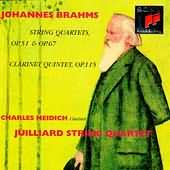
Brahms: String Quartets, Clarinet Quintet / Juilliard Quartet, Neidich
Charles Neidich’s fastidiously cerebral account of the Clarinet Quintet is exemplary, while the Juilliard’s interpretations of the three string quartets are the stuff of charismatic greatness.
Pathological self-doubt consigned twenty Brahms quartets to oblivion between 1853 and 1873. At forty, still awed by Beethoven (‘you have no idea how it feels,’ he lamented, ‘continually hearing such a giant behind you’), he adjudged his Op. 51 works worthy of publication, though Beethoven’s spectral presence lingered until the completion of his First Symphony and Op. 67 quartet in 1876. Op. 51/1, its turbulent emotions repressed behind austere polyphonic formalism, receives assured playing from the Britten Quartet. Here, and throughout this set, its taut, incisive manner, juxtaposing athleticism, poignancy and physical stress, seems admirable. However, EMI’s recording is closely focused and fails to exploit the ambient potential of St George’s Church, Brandon Hill, Bristol.
The Juilliard Quartet, heard in the acoustically inviting Troy Savings Bank Music Hall in New York, has phenomenal empathy with the Brahmsian idiom; its accounts are more eloquently considered, passionately argued, and are imbued with an opulence which the Brittens never equal. Brahms’s personal maxim ‘Frei, aber einsam’ (‘Free, but solitary’), the dictum of his majestic A minor quartet, assumes lyrically imploring gravity here; first violinist Robert Mann, among the great quartet leaders of the century, has seldom sounded so beguiling.
Charles Neidich’s fastidiously cerebral account of the richest fruit of Brahms’s friendship with Meiningen clarinettist Richard Mühlfeld, the Clarinet Quintet, Op. 115, is exemplary. Neidich sounds aptly conservative beside Richard Stoltzman’s burgeoning RCA Victor performance with the Tokyo Quartet, while the Juilliard’s interpretations of the three string quartets are the stuff of charismatic greatness.
Performance: 5 (out of 5), Sound: 5 (out of 5)
-- Michael Jameson, BBC Music Magazine
Pathological self-doubt consigned twenty Brahms quartets to oblivion between 1853 and 1873. At forty, still awed by Beethoven (‘you have no idea how it feels,’ he lamented, ‘continually hearing such a giant behind you’), he adjudged his Op. 51 works worthy of publication, though Beethoven’s spectral presence lingered until the completion of his First Symphony and Op. 67 quartet in 1876. Op. 51/1, its turbulent emotions repressed behind austere polyphonic formalism, receives assured playing from the Britten Quartet. Here, and throughout this set, its taut, incisive manner, juxtaposing athleticism, poignancy and physical stress, seems admirable. However, EMI’s recording is closely focused and fails to exploit the ambient potential of St George’s Church, Brandon Hill, Bristol.
The Juilliard Quartet, heard in the acoustically inviting Troy Savings Bank Music Hall in New York, has phenomenal empathy with the Brahmsian idiom; its accounts are more eloquently considered, passionately argued, and are imbued with an opulence which the Brittens never equal. Brahms’s personal maxim ‘Frei, aber einsam’ (‘Free, but solitary’), the dictum of his majestic A minor quartet, assumes lyrically imploring gravity here; first violinist Robert Mann, among the great quartet leaders of the century, has seldom sounded so beguiling.
Charles Neidich’s fastidiously cerebral account of the richest fruit of Brahms’s friendship with Meiningen clarinettist Richard Mühlfeld, the Clarinet Quintet, Op. 115, is exemplary. Neidich sounds aptly conservative beside Richard Stoltzman’s burgeoning RCA Victor performance with the Tokyo Quartet, while the Juilliard’s interpretations of the three string quartets are the stuff of charismatic greatness.
Performance: 5 (out of 5), Sound: 5 (out of 5)
-- Michael Jameson, BBC Music Magazine
Charles Neidich’s fastidiously cerebral account of the Clarinet Quintet is exemplary, while the Juilliard’s interpretations of the three string quartets are the stuff of charismatic greatness.
Pathological self-doubt consigned twenty Brahms quartets to oblivion between 1853 and 1873. At forty, still awed by Beethoven (‘you have no idea how it feels,’ he lamented, ‘continually hearing such a giant behind you’), he adjudged his Op. 51 works worthy of publication, though Beethoven’s spectral presence lingered until the completion of his First Symphony and Op. 67 quartet in 1876. Op. 51/1, its turbulent emotions repressed behind austere polyphonic formalism, receives assured playing from the Britten Quartet. Here, and throughout this set, its taut, incisive manner, juxtaposing athleticism, poignancy and physical stress, seems admirable. However, EMI’s recording is closely focused and fails to exploit the ambient potential of St George’s Church, Brandon Hill, Bristol.
The Juilliard Quartet, heard in the acoustically inviting Troy Savings Bank Music Hall in New York, has phenomenal empathy with the Brahmsian idiom; its accounts are more eloquently considered, passionately argued, and are imbued with an opulence which the Brittens never equal. Brahms’s personal maxim ‘Frei, aber einsam’ (‘Free, but solitary’), the dictum of his majestic A minor quartet, assumes lyrically imploring gravity here; first violinist Robert Mann, among the great quartet leaders of the century, has seldom sounded so beguiling.
Charles Neidich’s fastidiously cerebral account of the richest fruit of Brahms’s friendship with Meiningen clarinettist Richard Mühlfeld, the Clarinet Quintet, Op. 115, is exemplary. Neidich sounds aptly conservative beside Richard Stoltzman’s burgeoning RCA Victor performance with the Tokyo Quartet, while the Juilliard’s interpretations of the three string quartets are the stuff of charismatic greatness.
Performance: 5 (out of 5), Sound: 5 (out of 5)
-- Michael Jameson, BBC Music Magazine
Pathological self-doubt consigned twenty Brahms quartets to oblivion between 1853 and 1873. At forty, still awed by Beethoven (‘you have no idea how it feels,’ he lamented, ‘continually hearing such a giant behind you’), he adjudged his Op. 51 works worthy of publication, though Beethoven’s spectral presence lingered until the completion of his First Symphony and Op. 67 quartet in 1876. Op. 51/1, its turbulent emotions repressed behind austere polyphonic formalism, receives assured playing from the Britten Quartet. Here, and throughout this set, its taut, incisive manner, juxtaposing athleticism, poignancy and physical stress, seems admirable. However, EMI’s recording is closely focused and fails to exploit the ambient potential of St George’s Church, Brandon Hill, Bristol.
The Juilliard Quartet, heard in the acoustically inviting Troy Savings Bank Music Hall in New York, has phenomenal empathy with the Brahmsian idiom; its accounts are more eloquently considered, passionately argued, and are imbued with an opulence which the Brittens never equal. Brahms’s personal maxim ‘Frei, aber einsam’ (‘Free, but solitary’), the dictum of his majestic A minor quartet, assumes lyrically imploring gravity here; first violinist Robert Mann, among the great quartet leaders of the century, has seldom sounded so beguiling.
Charles Neidich’s fastidiously cerebral account of the richest fruit of Brahms’s friendship with Meiningen clarinettist Richard Mühlfeld, the Clarinet Quintet, Op. 115, is exemplary. Neidich sounds aptly conservative beside Richard Stoltzman’s burgeoning RCA Victor performance with the Tokyo Quartet, while the Juilliard’s interpretations of the three string quartets are the stuff of charismatic greatness.
Performance: 5 (out of 5), Sound: 5 (out of 5)
-- Michael Jameson, BBC Music Magazine
$6.65
Original: $18.99
-65%Brahms: String Quartets, Clarinet Quintet / Juilliard Quartet, Neidich—
$18.99
$6.65Description
Charles Neidich’s fastidiously cerebral account of the Clarinet Quintet is exemplary, while the Juilliard’s interpretations of the three string quartets are the stuff of charismatic greatness.
Pathological self-doubt consigned twenty Brahms quartets to oblivion between 1853 and 1873. At forty, still awed by Beethoven (‘you have no idea how it feels,’ he lamented, ‘continually hearing such a giant behind you’), he adjudged his Op. 51 works worthy of publication, though Beethoven’s spectral presence lingered until the completion of his First Symphony and Op. 67 quartet in 1876. Op. 51/1, its turbulent emotions repressed behind austere polyphonic formalism, receives assured playing from the Britten Quartet. Here, and throughout this set, its taut, incisive manner, juxtaposing athleticism, poignancy and physical stress, seems admirable. However, EMI’s recording is closely focused and fails to exploit the ambient potential of St George’s Church, Brandon Hill, Bristol.
The Juilliard Quartet, heard in the acoustically inviting Troy Savings Bank Music Hall in New York, has phenomenal empathy with the Brahmsian idiom; its accounts are more eloquently considered, passionately argued, and are imbued with an opulence which the Brittens never equal. Brahms’s personal maxim ‘Frei, aber einsam’ (‘Free, but solitary’), the dictum of his majestic A minor quartet, assumes lyrically imploring gravity here; first violinist Robert Mann, among the great quartet leaders of the century, has seldom sounded so beguiling.
Charles Neidich’s fastidiously cerebral account of the richest fruit of Brahms’s friendship with Meiningen clarinettist Richard Mühlfeld, the Clarinet Quintet, Op. 115, is exemplary. Neidich sounds aptly conservative beside Richard Stoltzman’s burgeoning RCA Victor performance with the Tokyo Quartet, while the Juilliard’s interpretations of the three string quartets are the stuff of charismatic greatness.
Performance: 5 (out of 5), Sound: 5 (out of 5)
-- Michael Jameson, BBC Music Magazine
Pathological self-doubt consigned twenty Brahms quartets to oblivion between 1853 and 1873. At forty, still awed by Beethoven (‘you have no idea how it feels,’ he lamented, ‘continually hearing such a giant behind you’), he adjudged his Op. 51 works worthy of publication, though Beethoven’s spectral presence lingered until the completion of his First Symphony and Op. 67 quartet in 1876. Op. 51/1, its turbulent emotions repressed behind austere polyphonic formalism, receives assured playing from the Britten Quartet. Here, and throughout this set, its taut, incisive manner, juxtaposing athleticism, poignancy and physical stress, seems admirable. However, EMI’s recording is closely focused and fails to exploit the ambient potential of St George’s Church, Brandon Hill, Bristol.
The Juilliard Quartet, heard in the acoustically inviting Troy Savings Bank Music Hall in New York, has phenomenal empathy with the Brahmsian idiom; its accounts are more eloquently considered, passionately argued, and are imbued with an opulence which the Brittens never equal. Brahms’s personal maxim ‘Frei, aber einsam’ (‘Free, but solitary’), the dictum of his majestic A minor quartet, assumes lyrically imploring gravity here; first violinist Robert Mann, among the great quartet leaders of the century, has seldom sounded so beguiling.
Charles Neidich’s fastidiously cerebral account of the richest fruit of Brahms’s friendship with Meiningen clarinettist Richard Mühlfeld, the Clarinet Quintet, Op. 115, is exemplary. Neidich sounds aptly conservative beside Richard Stoltzman’s burgeoning RCA Victor performance with the Tokyo Quartet, while the Juilliard’s interpretations of the three string quartets are the stuff of charismatic greatness.
Performance: 5 (out of 5), Sound: 5 (out of 5)
-- Michael Jameson, BBC Music Magazine