🎉 Up to 70% Off Selected ItemsShop Sale

1 / 2
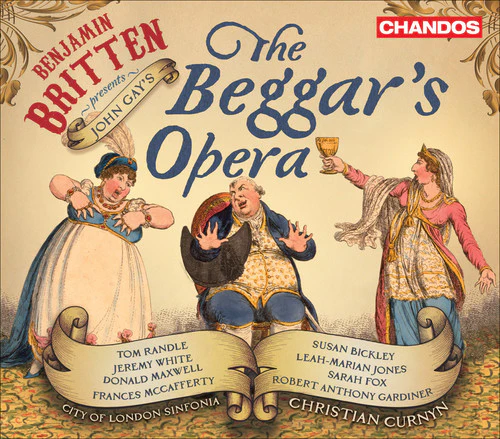
Britten: Beggar's Opera / Curnyn, Bickley, White, Jones, Randle
This Chandos production must now be first choice for this work.
Welcome to John Gay’s and Benjamin Britten’s romp through some seamy but also colourful and vibrant elements of 18 th century London. This work established the ballad opera in which spoken dialogue alternated with musical items. Gay’s satirical words were set to well-known traditional and popular tunes. Two hundred and twenty years later Britten added 20 th century accompaniments.
What’s entirely Britten here is the fresh caterwauling Overture (tr. 2) in which the various characters are given brief sound-portraits. There’s an oboe of sinuous sweetness for Polly (0:40), a cavorting clarinet for Macheath (1:29), suave strings and a jocular bassoon for the highwaymen (2:35) and a bantering circus-like master of ceremonies style for Mr Peachum (3:25). It’s all terrifically realized by the City of London Sinfonia who play marvellously throughout.
But what of the songs? Filch’s ‘’Tis woman that seduces all Mankind’ (tr. 5) is a good example of Britten allowing an original tune free rein while giving it modern dress with balmy woodwind and harp. The heroine Polly comes in (tr.12) to strains of her first song over which there are snatches of dialogue. This, like the melodrama which shortly follows (tr. 20), is Britten’s neat way of subverting the claim in the opening dialogue that this opera will have no “unnatural” recitative. Polly’s first song, ‘Virgins are like the fair flower in its lustre’ has as its tune Purcell’s ‘What shall I do to show how much I love him?’ from Dioclesian. Like its original, it is shown by Leah-Marian Jones to be at once wistful and coy. Her duet with Susan Bickley’s Mrs Peachum, ’O Polly, you might have toyed and kissed’ (tr. 15) catches well a cosy lullaby make-believe, aided by the gently rocking strings’ accompaniment. It’s lovely but only fleeting. Another notable accompaniment is the flutter-tonguing flute illustrating Polly’s ‘The Turtle thus with plaintive crying’ (tr. 19).
The highwayman hero Macheath enters and Tom Randle proves courteous enough to Jones’ simpering. The duet between Macheath and Polly, ’Were I laid on Greenland’s coast’ (tr. 22) is sweetly done but I felt the singers were over-conscious of the need to match the flowing orchestration and then the addition of chorus and drum. Some of the natural freshness is lost that’s present in the 1963 Aldeburgh Festival staging on DVD (Decca 074 3329). In this Chandos CD ‘The Miser thus a shilling sees’ (tr. 24) responds better to the typical careful attention of conductor Christian Curnyn’s approach. The disciplined emphasis of rhythm in its thorny progression matches the text’s poetic expression of loss. A pity, however, the second appearance of “Till home and friends are lost at last” (1:54) isn’t, as marked in the score ‘(in the distance)’ as the lovers go their separate ways. It’s an effect achieved in the BBC broadcast recording of the original 1948 production conducted by Britten (Pearl GEM 0225).
The highwaymen’s ’Fill ev’ry glass’ (tr. 26) is a drinking song of the sturdy, resolute variety in 2009 where a lustier abandon was shown in 1948. ‘Let us take the road’ (tr. 28) is infused with eagerness because of the excitement Britten and Curnyn convey in sketching the approach of the coach. Tom Randle’s Macheath has a too cultivated spoken voice but his singing is virile enough. You can hear this in ‘If the heart of a man is depressed with cares’ (tr. 29), marked as a caressing Andante backed by sweetly musing violin solo and rocking clarinet. Again I felt the line was held back a little in deference to the detail of the accompaniment. At this point Macheath is visited by a parade of prostitutes and what’s entertaining in the Decca DVD is rather curious here. With no sounds incorporated of women moving around, squealing and the like , you might think Macheath is imagining it all. I guess this is so as not to detract from Britten’s own variety parade of instruments, a kind of ‘Young Person’s Guide to Women’. There’s a superb tambourine to enliven the headiness of ‘Youth’s the season made for joys’. Randle sings with sunny freedom the ad libitum ‘Ah’s above the chorus repeat, though the top C final phrase is left to a soprano. Now betrayed by the women, his ‘At the Tree I shall suffer with pleasure’ has a disciplined testiness but less venom than Decca’s Kenneth McKellar.
Again more telling in this Chandos production is the more meditative material. The opening song of Act 2, ‘Man may escape from rope and gun’ (CD2, tr. 2), where Randle shows how transfixed Macheath is in his repetition of ‘woman’, savours past joys even while aware they’re the cause of present pain. Sarah Fox, as Lucy Lockit, is scarily efficient in her spite in ‘Thus when a good Housewife sees a rat’ (tr. 3). Polly’s response is the more sensitively elegiac ‘Thus when the Swallow seeking prey’ (tr. 10) and here Leah-Marian Jones is rich, smooth and eloquent. For me, however, Macheath’s ‘How happy could I be with either’ (tr. 11) is taken so fast it becomes too much a tongue-twister virtuoso piece losing some of its whimsy. In 1948 Peter Pears’ lighter touch was more effective. Polly has the easier task of rising above all this with ‘Cease your funning’ (tr.12), whose merging into the chorus and distancing of perspective are successfully achieved before we’re brought back to earth with a vengeance by Lucy’s crisp, snappy ‘Why how now, Madam Flirt!’ (tr. 13). The finale begins with Lucy and Polly showing great resolve. ‘No power on earth can e’er divide’ (tr. 14) is well progressed by Curnyn to an exciting ‘Horay’ trio response from Macheath, Lockit and Peachum. The there’s then increasing speed with a backing chorus in Sullivanesque abandon.
The opening song of Act 3, Lucy’s ‘When young at the bar’ (tr. 16) should be familiar as the tune is Purcell’s ‘If love’s a sweet passion’ from The Fairy Queen. Fox invests it with its original sad yearning while Curnyn points the claustrophobic cloying nature of Britten’s rich scoring of the wry accompaniment. Of a different order and part of the score’s kaleidoscopic variety is the relished archness of Frances McCafferty as Mrs Trapes delivering ‘In the days of my youth I could bill like a dove’ (tr. 21) with relished archness. To this is added the raucous carousing of Lockit and Peachum. Shortly there’s also the poignancy of Lucy and Polly’s ‘A curse attends a woman’s love’ (tr. 25). The paradox that these two candidates for Macheath’s affection can at one moment be united in their shared sense of rejection and understanding of the impossibility of their situation and at the next daggers drawn as rivals and eager still to court Macheath with warm affection at ‘Hither, dear husband, turn your eyes’ (tr. 28) is exploited dramatically. Fox’s pleading for Macheath’s life with ‘When he holds up his hand’ (tr. 31) ought to be the more persuasive, aided by Britten’s obbligato oboe accompaniment. ‘The Charge is prepared’ is a stock, formal chorus considerably pepped up by Mrs Peachum’s triumphant ‘Ah’s and glissando shrieks over its orchestral postlude.
Britten creates a closing scena (tr. 34) with Macheath in the condemned cell at first extolling the virtues of drink when about to die, then recalling pretty women. This gives way to the questioning protest ‘must I die?’. This is well sung by Randle but doesn’t quite have Pears’ grasp of the torment of ever-fluctuating contrasts of mood. Polly and Lucy offer a moving show of support, ‘Would I might be hanged’ to the heavily insistent backdrop of the funeral knell. In 1948 Britten’s knell is less weighty but more searing. Macheath realistically confesses ‘my courage is out’. The spoken dialogue wipes this all away. The highwaymen begin an address directly to the audience to demand the playwright provides a reprieve and all the players join in so the work can end with a dance. This bit of trickery and the rejection of the moral that vice must be punished works better in sound alone than the quicker and tamer removal of justice in the DVD. So you finish the Chandos sound recording remembering the company’s lusty tra-las and Fox’s top C.
This Chandos is the fullest version of the three currently available in the UK, playing at 117:52 in comparison with Decca’s 93:50 and Pearl’s 79:03. The differences are largely down to the Chandos including more of Gay’s spoken dialogue with alterations and additions by Tyrone Guthrie though even here I’d guess about a quarter of the dialogue published in the full and vocal scores has been cut. I don’t think this is a disadvantage because there’s a good deal of repetition in the text anyway. However, some musical numbers are also cut in the other recordings: Mrs Peachum’s ‘If Love the Virgin’s Heart invade’ (CD1 tr. 9) can only be heard here. To see the piece staged is a benefit. On the DVD the dialogue generally has a touch more pace and life, being less self-conscious in delivery. In the same vein the switch from dialogue to music flows more seamlessly and the folksong origins of many of the tunes are delivered with a more disarmingly innocent directness. The feeling between the characters is clearer in the ensemble numbers. The 1948 recording is striking for the verve of Britten’s direction, the charm of Pears’ light heroic manner and the lovely unforced upper register of Nancy Evans as Polly. Listen to her in ‘The Miser thus a shilling sees’. On the other hand it also at times adopts an over-romantic style, as in ‘O Polly, you might have toyed and kissed’ or is too patrician as in ‘Virgins are like the fair flower’.
To conclude, then, although sometimes more studied and deliberate than it might be, including careful points of emphasis within the dialogue, this Chandos production must now be first choice for this work. It also offers you in most luxuriant detail the colour and density of Britten’s orchestration.
-- Michael Greenhalgh, MusicWeb International
Welcome to John Gay’s and Benjamin Britten’s romp through some seamy but also colourful and vibrant elements of 18 th century London. This work established the ballad opera in which spoken dialogue alternated with musical items. Gay’s satirical words were set to well-known traditional and popular tunes. Two hundred and twenty years later Britten added 20 th century accompaniments.
What’s entirely Britten here is the fresh caterwauling Overture (tr. 2) in which the various characters are given brief sound-portraits. There’s an oboe of sinuous sweetness for Polly (0:40), a cavorting clarinet for Macheath (1:29), suave strings and a jocular bassoon for the highwaymen (2:35) and a bantering circus-like master of ceremonies style for Mr Peachum (3:25). It’s all terrifically realized by the City of London Sinfonia who play marvellously throughout.
But what of the songs? Filch’s ‘’Tis woman that seduces all Mankind’ (tr. 5) is a good example of Britten allowing an original tune free rein while giving it modern dress with balmy woodwind and harp. The heroine Polly comes in (tr.12) to strains of her first song over which there are snatches of dialogue. This, like the melodrama which shortly follows (tr. 20), is Britten’s neat way of subverting the claim in the opening dialogue that this opera will have no “unnatural” recitative. Polly’s first song, ‘Virgins are like the fair flower in its lustre’ has as its tune Purcell’s ‘What shall I do to show how much I love him?’ from Dioclesian. Like its original, it is shown by Leah-Marian Jones to be at once wistful and coy. Her duet with Susan Bickley’s Mrs Peachum, ’O Polly, you might have toyed and kissed’ (tr. 15) catches well a cosy lullaby make-believe, aided by the gently rocking strings’ accompaniment. It’s lovely but only fleeting. Another notable accompaniment is the flutter-tonguing flute illustrating Polly’s ‘The Turtle thus with plaintive crying’ (tr. 19).
The highwayman hero Macheath enters and Tom Randle proves courteous enough to Jones’ simpering. The duet between Macheath and Polly, ’Were I laid on Greenland’s coast’ (tr. 22) is sweetly done but I felt the singers were over-conscious of the need to match the flowing orchestration and then the addition of chorus and drum. Some of the natural freshness is lost that’s present in the 1963 Aldeburgh Festival staging on DVD (Decca 074 3329). In this Chandos CD ‘The Miser thus a shilling sees’ (tr. 24) responds better to the typical careful attention of conductor Christian Curnyn’s approach. The disciplined emphasis of rhythm in its thorny progression matches the text’s poetic expression of loss. A pity, however, the second appearance of “Till home and friends are lost at last” (1:54) isn’t, as marked in the score ‘(in the distance)’ as the lovers go their separate ways. It’s an effect achieved in the BBC broadcast recording of the original 1948 production conducted by Britten (Pearl GEM 0225).
The highwaymen’s ’Fill ev’ry glass’ (tr. 26) is a drinking song of the sturdy, resolute variety in 2009 where a lustier abandon was shown in 1948. ‘Let us take the road’ (tr. 28) is infused with eagerness because of the excitement Britten and Curnyn convey in sketching the approach of the coach. Tom Randle’s Macheath has a too cultivated spoken voice but his singing is virile enough. You can hear this in ‘If the heart of a man is depressed with cares’ (tr. 29), marked as a caressing Andante backed by sweetly musing violin solo and rocking clarinet. Again I felt the line was held back a little in deference to the detail of the accompaniment. At this point Macheath is visited by a parade of prostitutes and what’s entertaining in the Decca DVD is rather curious here. With no sounds incorporated of women moving around, squealing and the like , you might think Macheath is imagining it all. I guess this is so as not to detract from Britten’s own variety parade of instruments, a kind of ‘Young Person’s Guide to Women’. There’s a superb tambourine to enliven the headiness of ‘Youth’s the season made for joys’. Randle sings with sunny freedom the ad libitum ‘Ah’s above the chorus repeat, though the top C final phrase is left to a soprano. Now betrayed by the women, his ‘At the Tree I shall suffer with pleasure’ has a disciplined testiness but less venom than Decca’s Kenneth McKellar.
Again more telling in this Chandos production is the more meditative material. The opening song of Act 2, ‘Man may escape from rope and gun’ (CD2, tr. 2), where Randle shows how transfixed Macheath is in his repetition of ‘woman’, savours past joys even while aware they’re the cause of present pain. Sarah Fox, as Lucy Lockit, is scarily efficient in her spite in ‘Thus when a good Housewife sees a rat’ (tr. 3). Polly’s response is the more sensitively elegiac ‘Thus when the Swallow seeking prey’ (tr. 10) and here Leah-Marian Jones is rich, smooth and eloquent. For me, however, Macheath’s ‘How happy could I be with either’ (tr. 11) is taken so fast it becomes too much a tongue-twister virtuoso piece losing some of its whimsy. In 1948 Peter Pears’ lighter touch was more effective. Polly has the easier task of rising above all this with ‘Cease your funning’ (tr.12), whose merging into the chorus and distancing of perspective are successfully achieved before we’re brought back to earth with a vengeance by Lucy’s crisp, snappy ‘Why how now, Madam Flirt!’ (tr. 13). The finale begins with Lucy and Polly showing great resolve. ‘No power on earth can e’er divide’ (tr. 14) is well progressed by Curnyn to an exciting ‘Horay’ trio response from Macheath, Lockit and Peachum. The there’s then increasing speed with a backing chorus in Sullivanesque abandon.
The opening song of Act 3, Lucy’s ‘When young at the bar’ (tr. 16) should be familiar as the tune is Purcell’s ‘If love’s a sweet passion’ from The Fairy Queen. Fox invests it with its original sad yearning while Curnyn points the claustrophobic cloying nature of Britten’s rich scoring of the wry accompaniment. Of a different order and part of the score’s kaleidoscopic variety is the relished archness of Frances McCafferty as Mrs Trapes delivering ‘In the days of my youth I could bill like a dove’ (tr. 21) with relished archness. To this is added the raucous carousing of Lockit and Peachum. Shortly there’s also the poignancy of Lucy and Polly’s ‘A curse attends a woman’s love’ (tr. 25). The paradox that these two candidates for Macheath’s affection can at one moment be united in their shared sense of rejection and understanding of the impossibility of their situation and at the next daggers drawn as rivals and eager still to court Macheath with warm affection at ‘Hither, dear husband, turn your eyes’ (tr. 28) is exploited dramatically. Fox’s pleading for Macheath’s life with ‘When he holds up his hand’ (tr. 31) ought to be the more persuasive, aided by Britten’s obbligato oboe accompaniment. ‘The Charge is prepared’ is a stock, formal chorus considerably pepped up by Mrs Peachum’s triumphant ‘Ah’s and glissando shrieks over its orchestral postlude.
Britten creates a closing scena (tr. 34) with Macheath in the condemned cell at first extolling the virtues of drink when about to die, then recalling pretty women. This gives way to the questioning protest ‘must I die?’. This is well sung by Randle but doesn’t quite have Pears’ grasp of the torment of ever-fluctuating contrasts of mood. Polly and Lucy offer a moving show of support, ‘Would I might be hanged’ to the heavily insistent backdrop of the funeral knell. In 1948 Britten’s knell is less weighty but more searing. Macheath realistically confesses ‘my courage is out’. The spoken dialogue wipes this all away. The highwaymen begin an address directly to the audience to demand the playwright provides a reprieve and all the players join in so the work can end with a dance. This bit of trickery and the rejection of the moral that vice must be punished works better in sound alone than the quicker and tamer removal of justice in the DVD. So you finish the Chandos sound recording remembering the company’s lusty tra-las and Fox’s top C.
This Chandos is the fullest version of the three currently available in the UK, playing at 117:52 in comparison with Decca’s 93:50 and Pearl’s 79:03. The differences are largely down to the Chandos including more of Gay’s spoken dialogue with alterations and additions by Tyrone Guthrie though even here I’d guess about a quarter of the dialogue published in the full and vocal scores has been cut. I don’t think this is a disadvantage because there’s a good deal of repetition in the text anyway. However, some musical numbers are also cut in the other recordings: Mrs Peachum’s ‘If Love the Virgin’s Heart invade’ (CD1 tr. 9) can only be heard here. To see the piece staged is a benefit. On the DVD the dialogue generally has a touch more pace and life, being less self-conscious in delivery. In the same vein the switch from dialogue to music flows more seamlessly and the folksong origins of many of the tunes are delivered with a more disarmingly innocent directness. The feeling between the characters is clearer in the ensemble numbers. The 1948 recording is striking for the verve of Britten’s direction, the charm of Pears’ light heroic manner and the lovely unforced upper register of Nancy Evans as Polly. Listen to her in ‘The Miser thus a shilling sees’. On the other hand it also at times adopts an over-romantic style, as in ‘O Polly, you might have toyed and kissed’ or is too patrician as in ‘Virgins are like the fair flower’.
To conclude, then, although sometimes more studied and deliberate than it might be, including careful points of emphasis within the dialogue, this Chandos production must now be first choice for this work. It also offers you in most luxuriant detail the colour and density of Britten’s orchestration.
-- Michael Greenhalgh, MusicWeb International
This Chandos production must now be first choice for this work.
Welcome to John Gay’s and Benjamin Britten’s romp through some seamy but also colourful and vibrant elements of 18 th century London. This work established the ballad opera in which spoken dialogue alternated with musical items. Gay’s satirical words were set to well-known traditional and popular tunes. Two hundred and twenty years later Britten added 20 th century accompaniments.
What’s entirely Britten here is the fresh caterwauling Overture (tr. 2) in which the various characters are given brief sound-portraits. There’s an oboe of sinuous sweetness for Polly (0:40), a cavorting clarinet for Macheath (1:29), suave strings and a jocular bassoon for the highwaymen (2:35) and a bantering circus-like master of ceremonies style for Mr Peachum (3:25). It’s all terrifically realized by the City of London Sinfonia who play marvellously throughout.
But what of the songs? Filch’s ‘’Tis woman that seduces all Mankind’ (tr. 5) is a good example of Britten allowing an original tune free rein while giving it modern dress with balmy woodwind and harp. The heroine Polly comes in (tr.12) to strains of her first song over which there are snatches of dialogue. This, like the melodrama which shortly follows (tr. 20), is Britten’s neat way of subverting the claim in the opening dialogue that this opera will have no “unnatural” recitative. Polly’s first song, ‘Virgins are like the fair flower in its lustre’ has as its tune Purcell’s ‘What shall I do to show how much I love him?’ from Dioclesian. Like its original, it is shown by Leah-Marian Jones to be at once wistful and coy. Her duet with Susan Bickley’s Mrs Peachum, ’O Polly, you might have toyed and kissed’ (tr. 15) catches well a cosy lullaby make-believe, aided by the gently rocking strings’ accompaniment. It’s lovely but only fleeting. Another notable accompaniment is the flutter-tonguing flute illustrating Polly’s ‘The Turtle thus with plaintive crying’ (tr. 19).
The highwayman hero Macheath enters and Tom Randle proves courteous enough to Jones’ simpering. The duet between Macheath and Polly, ’Were I laid on Greenland’s coast’ (tr. 22) is sweetly done but I felt the singers were over-conscious of the need to match the flowing orchestration and then the addition of chorus and drum. Some of the natural freshness is lost that’s present in the 1963 Aldeburgh Festival staging on DVD (Decca 074 3329). In this Chandos CD ‘The Miser thus a shilling sees’ (tr. 24) responds better to the typical careful attention of conductor Christian Curnyn’s approach. The disciplined emphasis of rhythm in its thorny progression matches the text’s poetic expression of loss. A pity, however, the second appearance of “Till home and friends are lost at last” (1:54) isn’t, as marked in the score ‘(in the distance)’ as the lovers go their separate ways. It’s an effect achieved in the BBC broadcast recording of the original 1948 production conducted by Britten (Pearl GEM 0225).
The highwaymen’s ’Fill ev’ry glass’ (tr. 26) is a drinking song of the sturdy, resolute variety in 2009 where a lustier abandon was shown in 1948. ‘Let us take the road’ (tr. 28) is infused with eagerness because of the excitement Britten and Curnyn convey in sketching the approach of the coach. Tom Randle’s Macheath has a too cultivated spoken voice but his singing is virile enough. You can hear this in ‘If the heart of a man is depressed with cares’ (tr. 29), marked as a caressing Andante backed by sweetly musing violin solo and rocking clarinet. Again I felt the line was held back a little in deference to the detail of the accompaniment. At this point Macheath is visited by a parade of prostitutes and what’s entertaining in the Decca DVD is rather curious here. With no sounds incorporated of women moving around, squealing and the like , you might think Macheath is imagining it all. I guess this is so as not to detract from Britten’s own variety parade of instruments, a kind of ‘Young Person’s Guide to Women’. There’s a superb tambourine to enliven the headiness of ‘Youth’s the season made for joys’. Randle sings with sunny freedom the ad libitum ‘Ah’s above the chorus repeat, though the top C final phrase is left to a soprano. Now betrayed by the women, his ‘At the Tree I shall suffer with pleasure’ has a disciplined testiness but less venom than Decca’s Kenneth McKellar.
Again more telling in this Chandos production is the more meditative material. The opening song of Act 2, ‘Man may escape from rope and gun’ (CD2, tr. 2), where Randle shows how transfixed Macheath is in his repetition of ‘woman’, savours past joys even while aware they’re the cause of present pain. Sarah Fox, as Lucy Lockit, is scarily efficient in her spite in ‘Thus when a good Housewife sees a rat’ (tr. 3). Polly’s response is the more sensitively elegiac ‘Thus when the Swallow seeking prey’ (tr. 10) and here Leah-Marian Jones is rich, smooth and eloquent. For me, however, Macheath’s ‘How happy could I be with either’ (tr. 11) is taken so fast it becomes too much a tongue-twister virtuoso piece losing some of its whimsy. In 1948 Peter Pears’ lighter touch was more effective. Polly has the easier task of rising above all this with ‘Cease your funning’ (tr.12), whose merging into the chorus and distancing of perspective are successfully achieved before we’re brought back to earth with a vengeance by Lucy’s crisp, snappy ‘Why how now, Madam Flirt!’ (tr. 13). The finale begins with Lucy and Polly showing great resolve. ‘No power on earth can e’er divide’ (tr. 14) is well progressed by Curnyn to an exciting ‘Horay’ trio response from Macheath, Lockit and Peachum. The there’s then increasing speed with a backing chorus in Sullivanesque abandon.
The opening song of Act 3, Lucy’s ‘When young at the bar’ (tr. 16) should be familiar as the tune is Purcell’s ‘If love’s a sweet passion’ from The Fairy Queen. Fox invests it with its original sad yearning while Curnyn points the claustrophobic cloying nature of Britten’s rich scoring of the wry accompaniment. Of a different order and part of the score’s kaleidoscopic variety is the relished archness of Frances McCafferty as Mrs Trapes delivering ‘In the days of my youth I could bill like a dove’ (tr. 21) with relished archness. To this is added the raucous carousing of Lockit and Peachum. Shortly there’s also the poignancy of Lucy and Polly’s ‘A curse attends a woman’s love’ (tr. 25). The paradox that these two candidates for Macheath’s affection can at one moment be united in their shared sense of rejection and understanding of the impossibility of their situation and at the next daggers drawn as rivals and eager still to court Macheath with warm affection at ‘Hither, dear husband, turn your eyes’ (tr. 28) is exploited dramatically. Fox’s pleading for Macheath’s life with ‘When he holds up his hand’ (tr. 31) ought to be the more persuasive, aided by Britten’s obbligato oboe accompaniment. ‘The Charge is prepared’ is a stock, formal chorus considerably pepped up by Mrs Peachum’s triumphant ‘Ah’s and glissando shrieks over its orchestral postlude.
Britten creates a closing scena (tr. 34) with Macheath in the condemned cell at first extolling the virtues of drink when about to die, then recalling pretty women. This gives way to the questioning protest ‘must I die?’. This is well sung by Randle but doesn’t quite have Pears’ grasp of the torment of ever-fluctuating contrasts of mood. Polly and Lucy offer a moving show of support, ‘Would I might be hanged’ to the heavily insistent backdrop of the funeral knell. In 1948 Britten’s knell is less weighty but more searing. Macheath realistically confesses ‘my courage is out’. The spoken dialogue wipes this all away. The highwaymen begin an address directly to the audience to demand the playwright provides a reprieve and all the players join in so the work can end with a dance. This bit of trickery and the rejection of the moral that vice must be punished works better in sound alone than the quicker and tamer removal of justice in the DVD. So you finish the Chandos sound recording remembering the company’s lusty tra-las and Fox’s top C.
This Chandos is the fullest version of the three currently available in the UK, playing at 117:52 in comparison with Decca’s 93:50 and Pearl’s 79:03. The differences are largely down to the Chandos including more of Gay’s spoken dialogue with alterations and additions by Tyrone Guthrie though even here I’d guess about a quarter of the dialogue published in the full and vocal scores has been cut. I don’t think this is a disadvantage because there’s a good deal of repetition in the text anyway. However, some musical numbers are also cut in the other recordings: Mrs Peachum’s ‘If Love the Virgin’s Heart invade’ (CD1 tr. 9) can only be heard here. To see the piece staged is a benefit. On the DVD the dialogue generally has a touch more pace and life, being less self-conscious in delivery. In the same vein the switch from dialogue to music flows more seamlessly and the folksong origins of many of the tunes are delivered with a more disarmingly innocent directness. The feeling between the characters is clearer in the ensemble numbers. The 1948 recording is striking for the verve of Britten’s direction, the charm of Pears’ light heroic manner and the lovely unforced upper register of Nancy Evans as Polly. Listen to her in ‘The Miser thus a shilling sees’. On the other hand it also at times adopts an over-romantic style, as in ‘O Polly, you might have toyed and kissed’ or is too patrician as in ‘Virgins are like the fair flower’.
To conclude, then, although sometimes more studied and deliberate than it might be, including careful points of emphasis within the dialogue, this Chandos production must now be first choice for this work. It also offers you in most luxuriant detail the colour and density of Britten’s orchestration.
-- Michael Greenhalgh, MusicWeb International
Welcome to John Gay’s and Benjamin Britten’s romp through some seamy but also colourful and vibrant elements of 18 th century London. This work established the ballad opera in which spoken dialogue alternated with musical items. Gay’s satirical words were set to well-known traditional and popular tunes. Two hundred and twenty years later Britten added 20 th century accompaniments.
What’s entirely Britten here is the fresh caterwauling Overture (tr. 2) in which the various characters are given brief sound-portraits. There’s an oboe of sinuous sweetness for Polly (0:40), a cavorting clarinet for Macheath (1:29), suave strings and a jocular bassoon for the highwaymen (2:35) and a bantering circus-like master of ceremonies style for Mr Peachum (3:25). It’s all terrifically realized by the City of London Sinfonia who play marvellously throughout.
But what of the songs? Filch’s ‘’Tis woman that seduces all Mankind’ (tr. 5) is a good example of Britten allowing an original tune free rein while giving it modern dress with balmy woodwind and harp. The heroine Polly comes in (tr.12) to strains of her first song over which there are snatches of dialogue. This, like the melodrama which shortly follows (tr. 20), is Britten’s neat way of subverting the claim in the opening dialogue that this opera will have no “unnatural” recitative. Polly’s first song, ‘Virgins are like the fair flower in its lustre’ has as its tune Purcell’s ‘What shall I do to show how much I love him?’ from Dioclesian. Like its original, it is shown by Leah-Marian Jones to be at once wistful and coy. Her duet with Susan Bickley’s Mrs Peachum, ’O Polly, you might have toyed and kissed’ (tr. 15) catches well a cosy lullaby make-believe, aided by the gently rocking strings’ accompaniment. It’s lovely but only fleeting. Another notable accompaniment is the flutter-tonguing flute illustrating Polly’s ‘The Turtle thus with plaintive crying’ (tr. 19).
The highwayman hero Macheath enters and Tom Randle proves courteous enough to Jones’ simpering. The duet between Macheath and Polly, ’Were I laid on Greenland’s coast’ (tr. 22) is sweetly done but I felt the singers were over-conscious of the need to match the flowing orchestration and then the addition of chorus and drum. Some of the natural freshness is lost that’s present in the 1963 Aldeburgh Festival staging on DVD (Decca 074 3329). In this Chandos CD ‘The Miser thus a shilling sees’ (tr. 24) responds better to the typical careful attention of conductor Christian Curnyn’s approach. The disciplined emphasis of rhythm in its thorny progression matches the text’s poetic expression of loss. A pity, however, the second appearance of “Till home and friends are lost at last” (1:54) isn’t, as marked in the score ‘(in the distance)’ as the lovers go their separate ways. It’s an effect achieved in the BBC broadcast recording of the original 1948 production conducted by Britten (Pearl GEM 0225).
The highwaymen’s ’Fill ev’ry glass’ (tr. 26) is a drinking song of the sturdy, resolute variety in 2009 where a lustier abandon was shown in 1948. ‘Let us take the road’ (tr. 28) is infused with eagerness because of the excitement Britten and Curnyn convey in sketching the approach of the coach. Tom Randle’s Macheath has a too cultivated spoken voice but his singing is virile enough. You can hear this in ‘If the heart of a man is depressed with cares’ (tr. 29), marked as a caressing Andante backed by sweetly musing violin solo and rocking clarinet. Again I felt the line was held back a little in deference to the detail of the accompaniment. At this point Macheath is visited by a parade of prostitutes and what’s entertaining in the Decca DVD is rather curious here. With no sounds incorporated of women moving around, squealing and the like , you might think Macheath is imagining it all. I guess this is so as not to detract from Britten’s own variety parade of instruments, a kind of ‘Young Person’s Guide to Women’. There’s a superb tambourine to enliven the headiness of ‘Youth’s the season made for joys’. Randle sings with sunny freedom the ad libitum ‘Ah’s above the chorus repeat, though the top C final phrase is left to a soprano. Now betrayed by the women, his ‘At the Tree I shall suffer with pleasure’ has a disciplined testiness but less venom than Decca’s Kenneth McKellar.
Again more telling in this Chandos production is the more meditative material. The opening song of Act 2, ‘Man may escape from rope and gun’ (CD2, tr. 2), where Randle shows how transfixed Macheath is in his repetition of ‘woman’, savours past joys even while aware they’re the cause of present pain. Sarah Fox, as Lucy Lockit, is scarily efficient in her spite in ‘Thus when a good Housewife sees a rat’ (tr. 3). Polly’s response is the more sensitively elegiac ‘Thus when the Swallow seeking prey’ (tr. 10) and here Leah-Marian Jones is rich, smooth and eloquent. For me, however, Macheath’s ‘How happy could I be with either’ (tr. 11) is taken so fast it becomes too much a tongue-twister virtuoso piece losing some of its whimsy. In 1948 Peter Pears’ lighter touch was more effective. Polly has the easier task of rising above all this with ‘Cease your funning’ (tr.12), whose merging into the chorus and distancing of perspective are successfully achieved before we’re brought back to earth with a vengeance by Lucy’s crisp, snappy ‘Why how now, Madam Flirt!’ (tr. 13). The finale begins with Lucy and Polly showing great resolve. ‘No power on earth can e’er divide’ (tr. 14) is well progressed by Curnyn to an exciting ‘Horay’ trio response from Macheath, Lockit and Peachum. The there’s then increasing speed with a backing chorus in Sullivanesque abandon.
The opening song of Act 3, Lucy’s ‘When young at the bar’ (tr. 16) should be familiar as the tune is Purcell’s ‘If love’s a sweet passion’ from The Fairy Queen. Fox invests it with its original sad yearning while Curnyn points the claustrophobic cloying nature of Britten’s rich scoring of the wry accompaniment. Of a different order and part of the score’s kaleidoscopic variety is the relished archness of Frances McCafferty as Mrs Trapes delivering ‘In the days of my youth I could bill like a dove’ (tr. 21) with relished archness. To this is added the raucous carousing of Lockit and Peachum. Shortly there’s also the poignancy of Lucy and Polly’s ‘A curse attends a woman’s love’ (tr. 25). The paradox that these two candidates for Macheath’s affection can at one moment be united in their shared sense of rejection and understanding of the impossibility of their situation and at the next daggers drawn as rivals and eager still to court Macheath with warm affection at ‘Hither, dear husband, turn your eyes’ (tr. 28) is exploited dramatically. Fox’s pleading for Macheath’s life with ‘When he holds up his hand’ (tr. 31) ought to be the more persuasive, aided by Britten’s obbligato oboe accompaniment. ‘The Charge is prepared’ is a stock, formal chorus considerably pepped up by Mrs Peachum’s triumphant ‘Ah’s and glissando shrieks over its orchestral postlude.
Britten creates a closing scena (tr. 34) with Macheath in the condemned cell at first extolling the virtues of drink when about to die, then recalling pretty women. This gives way to the questioning protest ‘must I die?’. This is well sung by Randle but doesn’t quite have Pears’ grasp of the torment of ever-fluctuating contrasts of mood. Polly and Lucy offer a moving show of support, ‘Would I might be hanged’ to the heavily insistent backdrop of the funeral knell. In 1948 Britten’s knell is less weighty but more searing. Macheath realistically confesses ‘my courage is out’. The spoken dialogue wipes this all away. The highwaymen begin an address directly to the audience to demand the playwright provides a reprieve and all the players join in so the work can end with a dance. This bit of trickery and the rejection of the moral that vice must be punished works better in sound alone than the quicker and tamer removal of justice in the DVD. So you finish the Chandos sound recording remembering the company’s lusty tra-las and Fox’s top C.
This Chandos is the fullest version of the three currently available in the UK, playing at 117:52 in comparison with Decca’s 93:50 and Pearl’s 79:03. The differences are largely down to the Chandos including more of Gay’s spoken dialogue with alterations and additions by Tyrone Guthrie though even here I’d guess about a quarter of the dialogue published in the full and vocal scores has been cut. I don’t think this is a disadvantage because there’s a good deal of repetition in the text anyway. However, some musical numbers are also cut in the other recordings: Mrs Peachum’s ‘If Love the Virgin’s Heart invade’ (CD1 tr. 9) can only be heard here. To see the piece staged is a benefit. On the DVD the dialogue generally has a touch more pace and life, being less self-conscious in delivery. In the same vein the switch from dialogue to music flows more seamlessly and the folksong origins of many of the tunes are delivered with a more disarmingly innocent directness. The feeling between the characters is clearer in the ensemble numbers. The 1948 recording is striking for the verve of Britten’s direction, the charm of Pears’ light heroic manner and the lovely unforced upper register of Nancy Evans as Polly. Listen to her in ‘The Miser thus a shilling sees’. On the other hand it also at times adopts an over-romantic style, as in ‘O Polly, you might have toyed and kissed’ or is too patrician as in ‘Virgins are like the fair flower’.
To conclude, then, although sometimes more studied and deliberate than it might be, including careful points of emphasis within the dialogue, this Chandos production must now be first choice for this work. It also offers you in most luxuriant detail the colour and density of Britten’s orchestration.
-- Michael Greenhalgh, MusicWeb International
$43.99
Britten: Beggar's Opera / Curnyn, Bickley, White, Jones, Randle—
$43.99
Description
This Chandos production must now be first choice for this work.
Welcome to John Gay’s and Benjamin Britten’s romp through some seamy but also colourful and vibrant elements of 18 th century London. This work established the ballad opera in which spoken dialogue alternated with musical items. Gay’s satirical words were set to well-known traditional and popular tunes. Two hundred and twenty years later Britten added 20 th century accompaniments.
What’s entirely Britten here is the fresh caterwauling Overture (tr. 2) in which the various characters are given brief sound-portraits. There’s an oboe of sinuous sweetness for Polly (0:40), a cavorting clarinet for Macheath (1:29), suave strings and a jocular bassoon for the highwaymen (2:35) and a bantering circus-like master of ceremonies style for Mr Peachum (3:25). It’s all terrifically realized by the City of London Sinfonia who play marvellously throughout.
But what of the songs? Filch’s ‘’Tis woman that seduces all Mankind’ (tr. 5) is a good example of Britten allowing an original tune free rein while giving it modern dress with balmy woodwind and harp. The heroine Polly comes in (tr.12) to strains of her first song over which there are snatches of dialogue. This, like the melodrama which shortly follows (tr. 20), is Britten’s neat way of subverting the claim in the opening dialogue that this opera will have no “unnatural” recitative. Polly’s first song, ‘Virgins are like the fair flower in its lustre’ has as its tune Purcell’s ‘What shall I do to show how much I love him?’ from Dioclesian. Like its original, it is shown by Leah-Marian Jones to be at once wistful and coy. Her duet with Susan Bickley’s Mrs Peachum, ’O Polly, you might have toyed and kissed’ (tr. 15) catches well a cosy lullaby make-believe, aided by the gently rocking strings’ accompaniment. It’s lovely but only fleeting. Another notable accompaniment is the flutter-tonguing flute illustrating Polly’s ‘The Turtle thus with plaintive crying’ (tr. 19).
The highwayman hero Macheath enters and Tom Randle proves courteous enough to Jones’ simpering. The duet between Macheath and Polly, ’Were I laid on Greenland’s coast’ (tr. 22) is sweetly done but I felt the singers were over-conscious of the need to match the flowing orchestration and then the addition of chorus and drum. Some of the natural freshness is lost that’s present in the 1963 Aldeburgh Festival staging on DVD (Decca 074 3329). In this Chandos CD ‘The Miser thus a shilling sees’ (tr. 24) responds better to the typical careful attention of conductor Christian Curnyn’s approach. The disciplined emphasis of rhythm in its thorny progression matches the text’s poetic expression of loss. A pity, however, the second appearance of “Till home and friends are lost at last” (1:54) isn’t, as marked in the score ‘(in the distance)’ as the lovers go their separate ways. It’s an effect achieved in the BBC broadcast recording of the original 1948 production conducted by Britten (Pearl GEM 0225).
The highwaymen’s ’Fill ev’ry glass’ (tr. 26) is a drinking song of the sturdy, resolute variety in 2009 where a lustier abandon was shown in 1948. ‘Let us take the road’ (tr. 28) is infused with eagerness because of the excitement Britten and Curnyn convey in sketching the approach of the coach. Tom Randle’s Macheath has a too cultivated spoken voice but his singing is virile enough. You can hear this in ‘If the heart of a man is depressed with cares’ (tr. 29), marked as a caressing Andante backed by sweetly musing violin solo and rocking clarinet. Again I felt the line was held back a little in deference to the detail of the accompaniment. At this point Macheath is visited by a parade of prostitutes and what’s entertaining in the Decca DVD is rather curious here. With no sounds incorporated of women moving around, squealing and the like , you might think Macheath is imagining it all. I guess this is so as not to detract from Britten’s own variety parade of instruments, a kind of ‘Young Person’s Guide to Women’. There’s a superb tambourine to enliven the headiness of ‘Youth’s the season made for joys’. Randle sings with sunny freedom the ad libitum ‘Ah’s above the chorus repeat, though the top C final phrase is left to a soprano. Now betrayed by the women, his ‘At the Tree I shall suffer with pleasure’ has a disciplined testiness but less venom than Decca’s Kenneth McKellar.
Again more telling in this Chandos production is the more meditative material. The opening song of Act 2, ‘Man may escape from rope and gun’ (CD2, tr. 2), where Randle shows how transfixed Macheath is in his repetition of ‘woman’, savours past joys even while aware they’re the cause of present pain. Sarah Fox, as Lucy Lockit, is scarily efficient in her spite in ‘Thus when a good Housewife sees a rat’ (tr. 3). Polly’s response is the more sensitively elegiac ‘Thus when the Swallow seeking prey’ (tr. 10) and here Leah-Marian Jones is rich, smooth and eloquent. For me, however, Macheath’s ‘How happy could I be with either’ (tr. 11) is taken so fast it becomes too much a tongue-twister virtuoso piece losing some of its whimsy. In 1948 Peter Pears’ lighter touch was more effective. Polly has the easier task of rising above all this with ‘Cease your funning’ (tr.12), whose merging into the chorus and distancing of perspective are successfully achieved before we’re brought back to earth with a vengeance by Lucy’s crisp, snappy ‘Why how now, Madam Flirt!’ (tr. 13). The finale begins with Lucy and Polly showing great resolve. ‘No power on earth can e’er divide’ (tr. 14) is well progressed by Curnyn to an exciting ‘Horay’ trio response from Macheath, Lockit and Peachum. The there’s then increasing speed with a backing chorus in Sullivanesque abandon.
The opening song of Act 3, Lucy’s ‘When young at the bar’ (tr. 16) should be familiar as the tune is Purcell’s ‘If love’s a sweet passion’ from The Fairy Queen. Fox invests it with its original sad yearning while Curnyn points the claustrophobic cloying nature of Britten’s rich scoring of the wry accompaniment. Of a different order and part of the score’s kaleidoscopic variety is the relished archness of Frances McCafferty as Mrs Trapes delivering ‘In the days of my youth I could bill like a dove’ (tr. 21) with relished archness. To this is added the raucous carousing of Lockit and Peachum. Shortly there’s also the poignancy of Lucy and Polly’s ‘A curse attends a woman’s love’ (tr. 25). The paradox that these two candidates for Macheath’s affection can at one moment be united in their shared sense of rejection and understanding of the impossibility of their situation and at the next daggers drawn as rivals and eager still to court Macheath with warm affection at ‘Hither, dear husband, turn your eyes’ (tr. 28) is exploited dramatically. Fox’s pleading for Macheath’s life with ‘When he holds up his hand’ (tr. 31) ought to be the more persuasive, aided by Britten’s obbligato oboe accompaniment. ‘The Charge is prepared’ is a stock, formal chorus considerably pepped up by Mrs Peachum’s triumphant ‘Ah’s and glissando shrieks over its orchestral postlude.
Britten creates a closing scena (tr. 34) with Macheath in the condemned cell at first extolling the virtues of drink when about to die, then recalling pretty women. This gives way to the questioning protest ‘must I die?’. This is well sung by Randle but doesn’t quite have Pears’ grasp of the torment of ever-fluctuating contrasts of mood. Polly and Lucy offer a moving show of support, ‘Would I might be hanged’ to the heavily insistent backdrop of the funeral knell. In 1948 Britten’s knell is less weighty but more searing. Macheath realistically confesses ‘my courage is out’. The spoken dialogue wipes this all away. The highwaymen begin an address directly to the audience to demand the playwright provides a reprieve and all the players join in so the work can end with a dance. This bit of trickery and the rejection of the moral that vice must be punished works better in sound alone than the quicker and tamer removal of justice in the DVD. So you finish the Chandos sound recording remembering the company’s lusty tra-las and Fox’s top C.
This Chandos is the fullest version of the three currently available in the UK, playing at 117:52 in comparison with Decca’s 93:50 and Pearl’s 79:03. The differences are largely down to the Chandos including more of Gay’s spoken dialogue with alterations and additions by Tyrone Guthrie though even here I’d guess about a quarter of the dialogue published in the full and vocal scores has been cut. I don’t think this is a disadvantage because there’s a good deal of repetition in the text anyway. However, some musical numbers are also cut in the other recordings: Mrs Peachum’s ‘If Love the Virgin’s Heart invade’ (CD1 tr. 9) can only be heard here. To see the piece staged is a benefit. On the DVD the dialogue generally has a touch more pace and life, being less self-conscious in delivery. In the same vein the switch from dialogue to music flows more seamlessly and the folksong origins of many of the tunes are delivered with a more disarmingly innocent directness. The feeling between the characters is clearer in the ensemble numbers. The 1948 recording is striking for the verve of Britten’s direction, the charm of Pears’ light heroic manner and the lovely unforced upper register of Nancy Evans as Polly. Listen to her in ‘The Miser thus a shilling sees’. On the other hand it also at times adopts an over-romantic style, as in ‘O Polly, you might have toyed and kissed’ or is too patrician as in ‘Virgins are like the fair flower’.
To conclude, then, although sometimes more studied and deliberate than it might be, including careful points of emphasis within the dialogue, this Chandos production must now be first choice for this work. It also offers you in most luxuriant detail the colour and density of Britten’s orchestration.
-- Michael Greenhalgh, MusicWeb International
Welcome to John Gay’s and Benjamin Britten’s romp through some seamy but also colourful and vibrant elements of 18 th century London. This work established the ballad opera in which spoken dialogue alternated with musical items. Gay’s satirical words were set to well-known traditional and popular tunes. Two hundred and twenty years later Britten added 20 th century accompaniments.
What’s entirely Britten here is the fresh caterwauling Overture (tr. 2) in which the various characters are given brief sound-portraits. There’s an oboe of sinuous sweetness for Polly (0:40), a cavorting clarinet for Macheath (1:29), suave strings and a jocular bassoon for the highwaymen (2:35) and a bantering circus-like master of ceremonies style for Mr Peachum (3:25). It’s all terrifically realized by the City of London Sinfonia who play marvellously throughout.
But what of the songs? Filch’s ‘’Tis woman that seduces all Mankind’ (tr. 5) is a good example of Britten allowing an original tune free rein while giving it modern dress with balmy woodwind and harp. The heroine Polly comes in (tr.12) to strains of her first song over which there are snatches of dialogue. This, like the melodrama which shortly follows (tr. 20), is Britten’s neat way of subverting the claim in the opening dialogue that this opera will have no “unnatural” recitative. Polly’s first song, ‘Virgins are like the fair flower in its lustre’ has as its tune Purcell’s ‘What shall I do to show how much I love him?’ from Dioclesian. Like its original, it is shown by Leah-Marian Jones to be at once wistful and coy. Her duet with Susan Bickley’s Mrs Peachum, ’O Polly, you might have toyed and kissed’ (tr. 15) catches well a cosy lullaby make-believe, aided by the gently rocking strings’ accompaniment. It’s lovely but only fleeting. Another notable accompaniment is the flutter-tonguing flute illustrating Polly’s ‘The Turtle thus with plaintive crying’ (tr. 19).
The highwayman hero Macheath enters and Tom Randle proves courteous enough to Jones’ simpering. The duet between Macheath and Polly, ’Were I laid on Greenland’s coast’ (tr. 22) is sweetly done but I felt the singers were over-conscious of the need to match the flowing orchestration and then the addition of chorus and drum. Some of the natural freshness is lost that’s present in the 1963 Aldeburgh Festival staging on DVD (Decca 074 3329). In this Chandos CD ‘The Miser thus a shilling sees’ (tr. 24) responds better to the typical careful attention of conductor Christian Curnyn’s approach. The disciplined emphasis of rhythm in its thorny progression matches the text’s poetic expression of loss. A pity, however, the second appearance of “Till home and friends are lost at last” (1:54) isn’t, as marked in the score ‘(in the distance)’ as the lovers go their separate ways. It’s an effect achieved in the BBC broadcast recording of the original 1948 production conducted by Britten (Pearl GEM 0225).
The highwaymen’s ’Fill ev’ry glass’ (tr. 26) is a drinking song of the sturdy, resolute variety in 2009 where a lustier abandon was shown in 1948. ‘Let us take the road’ (tr. 28) is infused with eagerness because of the excitement Britten and Curnyn convey in sketching the approach of the coach. Tom Randle’s Macheath has a too cultivated spoken voice but his singing is virile enough. You can hear this in ‘If the heart of a man is depressed with cares’ (tr. 29), marked as a caressing Andante backed by sweetly musing violin solo and rocking clarinet. Again I felt the line was held back a little in deference to the detail of the accompaniment. At this point Macheath is visited by a parade of prostitutes and what’s entertaining in the Decca DVD is rather curious here. With no sounds incorporated of women moving around, squealing and the like , you might think Macheath is imagining it all. I guess this is so as not to detract from Britten’s own variety parade of instruments, a kind of ‘Young Person’s Guide to Women’. There’s a superb tambourine to enliven the headiness of ‘Youth’s the season made for joys’. Randle sings with sunny freedom the ad libitum ‘Ah’s above the chorus repeat, though the top C final phrase is left to a soprano. Now betrayed by the women, his ‘At the Tree I shall suffer with pleasure’ has a disciplined testiness but less venom than Decca’s Kenneth McKellar.
Again more telling in this Chandos production is the more meditative material. The opening song of Act 2, ‘Man may escape from rope and gun’ (CD2, tr. 2), where Randle shows how transfixed Macheath is in his repetition of ‘woman’, savours past joys even while aware they’re the cause of present pain. Sarah Fox, as Lucy Lockit, is scarily efficient in her spite in ‘Thus when a good Housewife sees a rat’ (tr. 3). Polly’s response is the more sensitively elegiac ‘Thus when the Swallow seeking prey’ (tr. 10) and here Leah-Marian Jones is rich, smooth and eloquent. For me, however, Macheath’s ‘How happy could I be with either’ (tr. 11) is taken so fast it becomes too much a tongue-twister virtuoso piece losing some of its whimsy. In 1948 Peter Pears’ lighter touch was more effective. Polly has the easier task of rising above all this with ‘Cease your funning’ (tr.12), whose merging into the chorus and distancing of perspective are successfully achieved before we’re brought back to earth with a vengeance by Lucy’s crisp, snappy ‘Why how now, Madam Flirt!’ (tr. 13). The finale begins with Lucy and Polly showing great resolve. ‘No power on earth can e’er divide’ (tr. 14) is well progressed by Curnyn to an exciting ‘Horay’ trio response from Macheath, Lockit and Peachum. The there’s then increasing speed with a backing chorus in Sullivanesque abandon.
The opening song of Act 3, Lucy’s ‘When young at the bar’ (tr. 16) should be familiar as the tune is Purcell’s ‘If love’s a sweet passion’ from The Fairy Queen. Fox invests it with its original sad yearning while Curnyn points the claustrophobic cloying nature of Britten’s rich scoring of the wry accompaniment. Of a different order and part of the score’s kaleidoscopic variety is the relished archness of Frances McCafferty as Mrs Trapes delivering ‘In the days of my youth I could bill like a dove’ (tr. 21) with relished archness. To this is added the raucous carousing of Lockit and Peachum. Shortly there’s also the poignancy of Lucy and Polly’s ‘A curse attends a woman’s love’ (tr. 25). The paradox that these two candidates for Macheath’s affection can at one moment be united in their shared sense of rejection and understanding of the impossibility of their situation and at the next daggers drawn as rivals and eager still to court Macheath with warm affection at ‘Hither, dear husband, turn your eyes’ (tr. 28) is exploited dramatically. Fox’s pleading for Macheath’s life with ‘When he holds up his hand’ (tr. 31) ought to be the more persuasive, aided by Britten’s obbligato oboe accompaniment. ‘The Charge is prepared’ is a stock, formal chorus considerably pepped up by Mrs Peachum’s triumphant ‘Ah’s and glissando shrieks over its orchestral postlude.
Britten creates a closing scena (tr. 34) with Macheath in the condemned cell at first extolling the virtues of drink when about to die, then recalling pretty women. This gives way to the questioning protest ‘must I die?’. This is well sung by Randle but doesn’t quite have Pears’ grasp of the torment of ever-fluctuating contrasts of mood. Polly and Lucy offer a moving show of support, ‘Would I might be hanged’ to the heavily insistent backdrop of the funeral knell. In 1948 Britten’s knell is less weighty but more searing. Macheath realistically confesses ‘my courage is out’. The spoken dialogue wipes this all away. The highwaymen begin an address directly to the audience to demand the playwright provides a reprieve and all the players join in so the work can end with a dance. This bit of trickery and the rejection of the moral that vice must be punished works better in sound alone than the quicker and tamer removal of justice in the DVD. So you finish the Chandos sound recording remembering the company’s lusty tra-las and Fox’s top C.
This Chandos is the fullest version of the three currently available in the UK, playing at 117:52 in comparison with Decca’s 93:50 and Pearl’s 79:03. The differences are largely down to the Chandos including more of Gay’s spoken dialogue with alterations and additions by Tyrone Guthrie though even here I’d guess about a quarter of the dialogue published in the full and vocal scores has been cut. I don’t think this is a disadvantage because there’s a good deal of repetition in the text anyway. However, some musical numbers are also cut in the other recordings: Mrs Peachum’s ‘If Love the Virgin’s Heart invade’ (CD1 tr. 9) can only be heard here. To see the piece staged is a benefit. On the DVD the dialogue generally has a touch more pace and life, being less self-conscious in delivery. In the same vein the switch from dialogue to music flows more seamlessly and the folksong origins of many of the tunes are delivered with a more disarmingly innocent directness. The feeling between the characters is clearer in the ensemble numbers. The 1948 recording is striking for the verve of Britten’s direction, the charm of Pears’ light heroic manner and the lovely unforced upper register of Nancy Evans as Polly. Listen to her in ‘The Miser thus a shilling sees’. On the other hand it also at times adopts an over-romantic style, as in ‘O Polly, you might have toyed and kissed’ or is too patrician as in ‘Virgins are like the fair flower’.
To conclude, then, although sometimes more studied and deliberate than it might be, including careful points of emphasis within the dialogue, this Chandos production must now be first choice for this work. It also offers you in most luxuriant detail the colour and density of Britten’s orchestration.
-- Michael Greenhalgh, MusicWeb International