🎉 Up to 70% Off Selected ItemsShop Sale

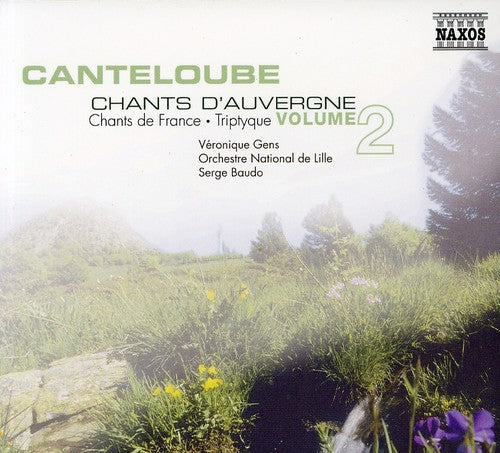
Canteloube: Chants d'Auvergne 2 / Gens, Calais, Baudo

There's more to Canteloube than the Auvergne, so splendidly shown here
For her second CD devoted to Joseph Canteloube’s vocal music, Véronique Gens has looked beyond the celebrated, much-recorded Chants d’Auvergne, and back to Tryptique, composed in 1913. Canteloube dedicated this to Maggie Teyte but the First World War interrupted its progress, and it was not until 1923 that Jane Campredon gave the premiere, with the Colonne orchestra conducted by Gabriel Pierné.
A setting of three poems by Roger Frêne, its lush, not to say extravagant orchestration anticipates Canteloube’s later folksong settings. The influence of both Ravel and Debussy is obvious, maybe also Stravinsky (it was, after all, the year of The Rite of Spring). The first section, “Offrande à l’été” is an ardent love song, with some pretty giddy scoring for harps. The central “Lunaire” has a more mysterious, yearning feel, with a lovely little dissonance at the word “cendre”, as the poet imagines the leaves turning to ash. The finale, “Hymne dans l’aurore” is an ecstatic prayer to Pan, celebrating every wonder of nature. The final cry, “Mon âme s’ouvre ainsi qu’une aube étincellante! O Pan!” is marked in the score crescendo en grandissant, and Gens, Serge Baudo and the Lille Orchestra rise to the moment with splendid force. It is really surprising that this work has not become better known; any soprano wanting to look beyond the obvious repertory should welcome it.
The rest of the disc is taken up with those remaining Auvergne songs not included on the earlier issue, conducted by Jean-Claude Casadesus (4/05). Once again, Gens proves that an authentic knowledge of the dialect is a great advantage. The much later group from Chants de France makes a pleasant end to the recital, but it is Tryptique that has to be heard.
-- Patrick O'Connor, Gramophone [12/2007]
Véronique Gens sings beautifully throughout and shows a fine understanding … perfectly at ease.
Since Stokowski’s and Anna Moffo’s pioneering recording of selections from Canteloube’s Chants d’Auvergne, these beautiful folk-song arrangements have become part of many sopranos’ repertoire. One can name Kiri Te Kanawa, Jill Gomez, Frederica von Stade and others having had a go at these ravishing works. Véronique Gens has already recorded a first volume with the same orchestra conducted by Jean-Claude Casadesus (Naxos 8.557491) favourably reviewed here by Anne Ozorio.
In spite of a varied output of chamber and orchestral music also including an opera Le Mas, the composer is now mainly known for his colourful, yet often subtle arrangements. In fact, next to the now celebrated Chants d’Auvergne, he also collected and arranged folk-songs from the Basque country, some of which were recorded some time ago (on Audivis). The present selection of nine folk songs, a few of which are new to me, beautifully complements Gens’ first instalment. What makes this release particularly worth having is the inclusion of a selection from Les Chants de France and, more importantly to my mind, that of the fine Triptyque composed in 1914 but first performed in 1925. In these settings of poems by Roger Frêne, a poet unknown to me about whom I could not find any useful information, Canteloube proves himself the heir of the likes of Fauré, Duparc and Chausson. At the same time he is attentive to the musical trends of his time: Debussy and Ravel. There is much orchestral refinement in these fine settings with more than a touch of Impressionism. I was particularly impressed by the third song Hymne dans l’aurore. It paints a strongly atmospheric evocation of the coming of dawn crowned by a glowing sunrise.
In Chants de France, Canteloube continues his labour of love with French folk-song and brings comparable subtlety and refinement to bear. In much the same way as in Chants d’Auvergne, the composer succeeds in wrapping his arrangements in superb orchestral guise, while bringing out some surprising and unexpected touches. Just try the first song, the celebrated Auprès de ma blonde; in which the composer eschews any mawkishness and vulgarity. In the last one, D’où venez-vous fillette? Has some salty rhythmic surprises in the accompaniment. The other arrangements in this selection, likewise those from Chants d’Auvergne, alternate touching tenderness, mild sorrow and earthy humour. A most welcome addition to the catalogue, although I wanted more of them given the somewhat short total playing time of this otherwise desirable release.
Véronique Gens sings beautifully throughout and shows a fine understanding of the Auvergne dialect. I think I remember a recent interview - was it in Gramophone? - in which she mentioned that she had family roots in the Auvergne and that these folk-songs meant a great deal to her. That certainly shows in her performances; but she is equally and equally perfectly at ease with the other works featured here.
Serge Baudo is highly regarded for his sympathy with French music of the first half of the 20th century and beyond. Once again he proves a most reliable and inspired partner. A pity, though, that the words of Triptyque could not be printed in the insert notes, although Gens’ excellent diction more than compensates.
-- Hubert Culot, MusicWeb International
There's more to Canteloube than the Auvergne, so splendidly shown here
For her second CD devoted to Joseph Canteloube’s vocal music, Véronique Gens has looked beyond the celebrated, much-recorded Chants d’Auvergne, and back to Tryptique, composed in 1913. Canteloube dedicated this to Maggie Teyte but the First World War interrupted its progress, and it was not until 1923 that Jane Campredon gave the premiere, with the Colonne orchestra conducted by Gabriel Pierné.
A setting of three poems by Roger Frêne, its lush, not to say extravagant orchestration anticipates Canteloube’s later folksong settings. The influence of both Ravel and Debussy is obvious, maybe also Stravinsky (it was, after all, the year of The Rite of Spring). The first section, “Offrande à l’été” is an ardent love song, with some pretty giddy scoring for harps. The central “Lunaire” has a more mysterious, yearning feel, with a lovely little dissonance at the word “cendre”, as the poet imagines the leaves turning to ash. The finale, “Hymne dans l’aurore” is an ecstatic prayer to Pan, celebrating every wonder of nature. The final cry, “Mon âme s’ouvre ainsi qu’une aube étincellante! O Pan!” is marked in the score crescendo en grandissant, and Gens, Serge Baudo and the Lille Orchestra rise to the moment with splendid force. It is really surprising that this work has not become better known; any soprano wanting to look beyond the obvious repertory should welcome it.
The rest of the disc is taken up with those remaining Auvergne songs not included on the earlier issue, conducted by Jean-Claude Casadesus (4/05). Once again, Gens proves that an authentic knowledge of the dialect is a great advantage. The much later group from Chants de France makes a pleasant end to the recital, but it is Tryptique that has to be heard.
-- Patrick O'Connor, Gramophone [12/2007]
Véronique Gens sings beautifully throughout and shows a fine understanding … perfectly at ease.
Since Stokowski’s and Anna Moffo’s pioneering recording of selections from Canteloube’s Chants d’Auvergne, these beautiful folk-song arrangements have become part of many sopranos’ repertoire. One can name Kiri Te Kanawa, Jill Gomez, Frederica von Stade and others having had a go at these ravishing works. Véronique Gens has already recorded a first volume with the same orchestra conducted by Jean-Claude Casadesus (Naxos 8.557491) favourably reviewed here by Anne Ozorio.
In spite of a varied output of chamber and orchestral music also including an opera Le Mas, the composer is now mainly known for his colourful, yet often subtle arrangements. In fact, next to the now celebrated Chants d’Auvergne, he also collected and arranged folk-songs from the Basque country, some of which were recorded some time ago (on Audivis). The present selection of nine folk songs, a few of which are new to me, beautifully complements Gens’ first instalment. What makes this release particularly worth having is the inclusion of a selection from Les Chants de France and, more importantly to my mind, that of the fine Triptyque composed in 1914 but first performed in 1925. In these settings of poems by Roger Frêne, a poet unknown to me about whom I could not find any useful information, Canteloube proves himself the heir of the likes of Fauré, Duparc and Chausson. At the same time he is attentive to the musical trends of his time: Debussy and Ravel. There is much orchestral refinement in these fine settings with more than a touch of Impressionism. I was particularly impressed by the third song Hymne dans l’aurore. It paints a strongly atmospheric evocation of the coming of dawn crowned by a glowing sunrise.
In Chants de France, Canteloube continues his labour of love with French folk-song and brings comparable subtlety and refinement to bear. In much the same way as in Chants d’Auvergne, the composer succeeds in wrapping his arrangements in superb orchestral guise, while bringing out some surprising and unexpected touches. Just try the first song, the celebrated Auprès de ma blonde; in which the composer eschews any mawkishness and vulgarity. In the last one, D’où venez-vous fillette? Has some salty rhythmic surprises in the accompaniment. The other arrangements in this selection, likewise those from Chants d’Auvergne, alternate touching tenderness, mild sorrow and earthy humour. A most welcome addition to the catalogue, although I wanted more of them given the somewhat short total playing time of this otherwise desirable release.
Véronique Gens sings beautifully throughout and shows a fine understanding of the Auvergne dialect. I think I remember a recent interview - was it in Gramophone? - in which she mentioned that she had family roots in the Auvergne and that these folk-songs meant a great deal to her. That certainly shows in her performances; but she is equally and equally perfectly at ease with the other works featured here.
Serge Baudo is highly regarded for his sympathy with French music of the first half of the 20th century and beyond. Once again he proves a most reliable and inspired partner. A pity, though, that the words of Triptyque could not be printed in the insert notes, although Gens’ excellent diction more than compensates.
-- Hubert Culot, MusicWeb International
$7.00
Original: $19.99
-65%Canteloube: Chants d'Auvergne 2 / Gens, Calais, Baudo—
$19.99
$7.00Description
There's more to Canteloube than the Auvergne, so splendidly shown here
For her second CD devoted to Joseph Canteloube’s vocal music, Véronique Gens has looked beyond the celebrated, much-recorded Chants d’Auvergne, and back to Tryptique, composed in 1913. Canteloube dedicated this to Maggie Teyte but the First World War interrupted its progress, and it was not until 1923 that Jane Campredon gave the premiere, with the Colonne orchestra conducted by Gabriel Pierné.
A setting of three poems by Roger Frêne, its lush, not to say extravagant orchestration anticipates Canteloube’s later folksong settings. The influence of both Ravel and Debussy is obvious, maybe also Stravinsky (it was, after all, the year of The Rite of Spring). The first section, “Offrande à l’été” is an ardent love song, with some pretty giddy scoring for harps. The central “Lunaire” has a more mysterious, yearning feel, with a lovely little dissonance at the word “cendre”, as the poet imagines the leaves turning to ash. The finale, “Hymne dans l’aurore” is an ecstatic prayer to Pan, celebrating every wonder of nature. The final cry, “Mon âme s’ouvre ainsi qu’une aube étincellante! O Pan!” is marked in the score crescendo en grandissant, and Gens, Serge Baudo and the Lille Orchestra rise to the moment with splendid force. It is really surprising that this work has not become better known; any soprano wanting to look beyond the obvious repertory should welcome it.
The rest of the disc is taken up with those remaining Auvergne songs not included on the earlier issue, conducted by Jean-Claude Casadesus (4/05). Once again, Gens proves that an authentic knowledge of the dialect is a great advantage. The much later group from Chants de France makes a pleasant end to the recital, but it is Tryptique that has to be heard.
-- Patrick O'Connor, Gramophone [12/2007]
Véronique Gens sings beautifully throughout and shows a fine understanding … perfectly at ease.
Since Stokowski’s and Anna Moffo’s pioneering recording of selections from Canteloube’s Chants d’Auvergne, these beautiful folk-song arrangements have become part of many sopranos’ repertoire. One can name Kiri Te Kanawa, Jill Gomez, Frederica von Stade and others having had a go at these ravishing works. Véronique Gens has already recorded a first volume with the same orchestra conducted by Jean-Claude Casadesus (Naxos 8.557491) favourably reviewed here by Anne Ozorio.
In spite of a varied output of chamber and orchestral music also including an opera Le Mas, the composer is now mainly known for his colourful, yet often subtle arrangements. In fact, next to the now celebrated Chants d’Auvergne, he also collected and arranged folk-songs from the Basque country, some of which were recorded some time ago (on Audivis). The present selection of nine folk songs, a few of which are new to me, beautifully complements Gens’ first instalment. What makes this release particularly worth having is the inclusion of a selection from Les Chants de France and, more importantly to my mind, that of the fine Triptyque composed in 1914 but first performed in 1925. In these settings of poems by Roger Frêne, a poet unknown to me about whom I could not find any useful information, Canteloube proves himself the heir of the likes of Fauré, Duparc and Chausson. At the same time he is attentive to the musical trends of his time: Debussy and Ravel. There is much orchestral refinement in these fine settings with more than a touch of Impressionism. I was particularly impressed by the third song Hymne dans l’aurore. It paints a strongly atmospheric evocation of the coming of dawn crowned by a glowing sunrise.
In Chants de France, Canteloube continues his labour of love with French folk-song and brings comparable subtlety and refinement to bear. In much the same way as in Chants d’Auvergne, the composer succeeds in wrapping his arrangements in superb orchestral guise, while bringing out some surprising and unexpected touches. Just try the first song, the celebrated Auprès de ma blonde; in which the composer eschews any mawkishness and vulgarity. In the last one, D’où venez-vous fillette? Has some salty rhythmic surprises in the accompaniment. The other arrangements in this selection, likewise those from Chants d’Auvergne, alternate touching tenderness, mild sorrow and earthy humour. A most welcome addition to the catalogue, although I wanted more of them given the somewhat short total playing time of this otherwise desirable release.
Véronique Gens sings beautifully throughout and shows a fine understanding of the Auvergne dialect. I think I remember a recent interview - was it in Gramophone? - in which she mentioned that she had family roots in the Auvergne and that these folk-songs meant a great deal to her. That certainly shows in her performances; but she is equally and equally perfectly at ease with the other works featured here.
Serge Baudo is highly regarded for his sympathy with French music of the first half of the 20th century and beyond. Once again he proves a most reliable and inspired partner. A pity, though, that the words of Triptyque could not be printed in the insert notes, although Gens’ excellent diction more than compensates.
-- Hubert Culot, MusicWeb International