🎉 Up to 70% Off Selected ItemsShop Sale

1 / 2
Caron: Masses & Chansons / The Sound And The Fury
CARON Masses and Chansons • The Sound and the Fury • FRA BERNARDO 1207302 (3 CDs: 190:22)
Next to nothing is known of more than a few composers from the early Renaissance. Who is “Hyett,” that survives in a single work found in the Gyffard Partbooks? Who was the Trecento composer known only as “Maestro Piero,” of whom eight works (six madrigals, two examples of caccia ) remain?
It’s fairly safe to single out Firminus (in the Latin; or Fermin, or Fremin—popular names in Amiens at the time) Caron from that ghostly lot as the most illustrious in his day. Compère, no minor judge in matters musical, referred to Busnois, Dussart, and Caron as magister cantilenarum . Tinctorus wrote of Ockeghem, Busnois, Regis, and Caron as composing the most outstanding music he’d ever heard. (He also named Caron among several composers that were reported to him as poorly educated, as Tinctorus like his contemporaries set great store by a completed university education. But this was probably out of date when it was written, since in that same year, 1473, Caron is mentioned in a legal document as maistre , or Master of Arts.) Others among his contemporaries, as well as scholars of succeeding generations, continued to place Caron among the leading musicians of his time. The manuscript trading trails across Europe (their time’s equivalent of our group emails) that constituted the surest way of circulating sacred and secular music saw Caron’s works turning up repeatedly in Italy. He was popular, and a good thing, too, since although new and doctored texts by unknown hands not infrequently were added to extant works in transmission—editor Jaap van Benthem’s liner notes suggest this occurred to more than half Caron’s chansons—it helped save a good many of his compositions when the French Revolution went on a rampage through the cathedrals of France.
Yet little enough is known today of Caron’s life. Thanks to recently discovered source documents, a possible birth date has been suggested in the late 1430s, in Amiens. He may have come from a well-to-do middle class background, judging from a loan he regularly received payment on later in life, and the registered sale of a house with attachments owned by the man who was probably his deceased father: a well-to-do shoemaker with apprentices and servants. Beyond this lies that shadowy land named vague conjecture. He may have been trained at Cambrai, or in Amiens; may have worked in proximity to Busnois (“Accueilly m’a la belle” suggests the strong influence of the latter), and possibly known Dufay; may have served Charles the Bold in Burgundy—or at least, spent some time in some form of musical service there, accounting for his poor showing in the chansonniers compiled around 1470 in Loire Valley, part of the kingdom of France. His music begins turning up in fewer manuscripts in the mid-1470s, suggesting a possible terminus, but it’s more accurate to simply state that sources for any music he may have written at that time or later, assuming he lived that long, had dried up. Compared to the larger-than-life Busnois, Caron’s personality remains that of a shade.
It is the chansons that history repeatedly praises to us, but only seven are included here, and they comprise just two-thirds of one of the three discs on this new recording. As if to lower our expectations of them further, The Sound and the Fury (or at least their recording company, Fra Bernardo) has left out all texts and translations. I could wish they had done otherwise, as the entire lot collectively comprises a highlight of the set. Caron was innovative for his period, as Montagna notes in his “Caron, Hayne, Compère: a Transmission Reassessment,” for his imitative entrances, though he didn’t stop there. Those imitative textures are apt to occur flexibly, within a carefully varied texture that includes homophony, free movement, staggered, irregular contrapuntal entries (“Helas m’amour”) and the interplay of voices in quick exchange or diverse groups (“Mort du mercy”). The clarity of his parts at all times must be mentioned as well, along with the naturalness with which, at least in some of the of chansons heard here, Caron’s melodic line follows the phrasing of traditional French folksong (the short but charming “Du tout ainsi”). Geneviève Thibault, in her Grove I article on Caron, is just as enthusiastic while pointing out that his superius parts “have a beautiful melodic curve” that does not end with each verse line; and that’s certainly true of “Cuidez vous” and “S’il est ainsy.”
The five Masses supplied in this set ( L’Homme arme, Jesus autem, Accueilly m’a a la belle, Sanguis sanctorum, Clemens et benigna ) are in the five standard movements for their time and place: Kyrie, Gloria, Credo, Sanctus, and Agnus Dei. They all survive only in Italian sources, with the already mentioned caveat about text substitution applying. (As well as other caveats to accurate recreation: aging, ink corrosion, editorial transmission errors, and the crude, destructive cutting out of illuminated details have all played their part in rendering the results less than fully satisfactory.) The Sound and The Fury consists of five singers—a countertenor, two tenors, and two basses, along with a lutenist for “Du tout ainsi”—so there’s no doubling. This reinforces to our ears both Caron’s almost obsessively varied textures, and his preference for fragmenting the cantus firmus . Here, too, he was ahead of his time. In turn, Alan Atlas in his Renaissance Music takes evident delight in the way Caron incorporates an Italian song (“Madonna par la torno”), a French chanson (“Hélas, mestresse, m’amie”), and Johannes Joye’s chanson “Mercy mon duiel” into the Marian Mass, Clemens et benigna , in such a way as to make both textual and musical additions function as glosses.
Contrary to the norm in such matters, The Sound and the Fury isn’t a concertizing group. Aside from the very occasional recital, they gather solely for recording purposes, though they clearly spend much time in rehearsals. (You couldn’t get through this music with any semblance of dignity if you didn’t.) The Anglo-German ensemble focuses on the Franco-Flemish school and, if comments in the liner notes are any judge, they take the “sweet” side of the debate in matters of musica ficta . Their sound is tight and disciplined, with excellent enunciation and pitch control, though there are some moments (more in the chansons than in the Masses, oddly enough) where a few notes are split for breath’s sake. The engineering is among the best I’ve heard of sacred choral music of the period, being spacious and very forward, with a slight reverberance.
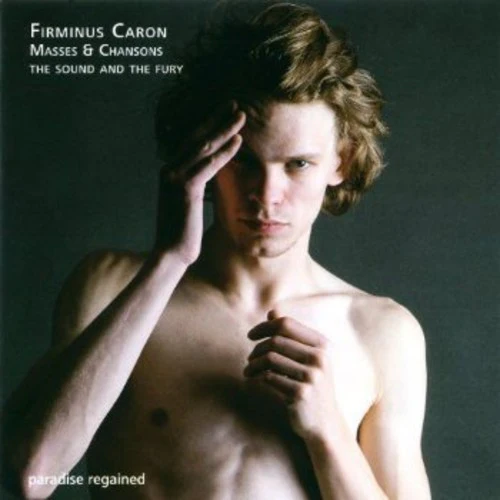
The texts would definitely help with the chansons, and the photographer responsible for the box’s artwork (the upper torso of some late teen looking out sternly, trying to impress us as he makes what he apparently figures is a karate chop with one hand) needs a courteous reminder of the music’s subject. But in all other respects I’m delighted with this set.
FANFARE: Barry Brenesal
CARON Masses and Chansons • The Sound and the Fury • FRA BERNARDO 1207302 (3 CDs: 190:22)
Next to nothing is known of more than a few composers from the early Renaissance. Who is “Hyett,” that survives in a single work found in the Gyffard Partbooks? Who was the Trecento composer known only as “Maestro Piero,” of whom eight works (six madrigals, two examples of caccia ) remain?
It’s fairly safe to single out Firminus (in the Latin; or Fermin, or Fremin—popular names in Amiens at the time) Caron from that ghostly lot as the most illustrious in his day. Compère, no minor judge in matters musical, referred to Busnois, Dussart, and Caron as magister cantilenarum . Tinctorus wrote of Ockeghem, Busnois, Regis, and Caron as composing the most outstanding music he’d ever heard. (He also named Caron among several composers that were reported to him as poorly educated, as Tinctorus like his contemporaries set great store by a completed university education. But this was probably out of date when it was written, since in that same year, 1473, Caron is mentioned in a legal document as maistre , or Master of Arts.) Others among his contemporaries, as well as scholars of succeeding generations, continued to place Caron among the leading musicians of his time. The manuscript trading trails across Europe (their time’s equivalent of our group emails) that constituted the surest way of circulating sacred and secular music saw Caron’s works turning up repeatedly in Italy. He was popular, and a good thing, too, since although new and doctored texts by unknown hands not infrequently were added to extant works in transmission—editor Jaap van Benthem’s liner notes suggest this occurred to more than half Caron’s chansons—it helped save a good many of his compositions when the French Revolution went on a rampage through the cathedrals of France.
Yet little enough is known today of Caron’s life. Thanks to recently discovered source documents, a possible birth date has been suggested in the late 1430s, in Amiens. He may have come from a well-to-do middle class background, judging from a loan he regularly received payment on later in life, and the registered sale of a house with attachments owned by the man who was probably his deceased father: a well-to-do shoemaker with apprentices and servants. Beyond this lies that shadowy land named vague conjecture. He may have been trained at Cambrai, or in Amiens; may have worked in proximity to Busnois (“Accueilly m’a la belle” suggests the strong influence of the latter), and possibly known Dufay; may have served Charles the Bold in Burgundy—or at least, spent some time in some form of musical service there, accounting for his poor showing in the chansonniers compiled around 1470 in Loire Valley, part of the kingdom of France. His music begins turning up in fewer manuscripts in the mid-1470s, suggesting a possible terminus, but it’s more accurate to simply state that sources for any music he may have written at that time or later, assuming he lived that long, had dried up. Compared to the larger-than-life Busnois, Caron’s personality remains that of a shade.
It is the chansons that history repeatedly praises to us, but only seven are included here, and they comprise just two-thirds of one of the three discs on this new recording. As if to lower our expectations of them further, The Sound and the Fury (or at least their recording company, Fra Bernardo) has left out all texts and translations. I could wish they had done otherwise, as the entire lot collectively comprises a highlight of the set. Caron was innovative for his period, as Montagna notes in his “Caron, Hayne, Compère: a Transmission Reassessment,” for his imitative entrances, though he didn’t stop there. Those imitative textures are apt to occur flexibly, within a carefully varied texture that includes homophony, free movement, staggered, irregular contrapuntal entries (“Helas m’amour”) and the interplay of voices in quick exchange or diverse groups (“Mort du mercy”). The clarity of his parts at all times must be mentioned as well, along with the naturalness with which, at least in some of the of chansons heard here, Caron’s melodic line follows the phrasing of traditional French folksong (the short but charming “Du tout ainsi”). Geneviève Thibault, in her Grove I article on Caron, is just as enthusiastic while pointing out that his superius parts “have a beautiful melodic curve” that does not end with each verse line; and that’s certainly true of “Cuidez vous” and “S’il est ainsy.”
The five Masses supplied in this set ( L’Homme arme, Jesus autem, Accueilly m’a a la belle, Sanguis sanctorum, Clemens et benigna ) are in the five standard movements for their time and place: Kyrie, Gloria, Credo, Sanctus, and Agnus Dei. They all survive only in Italian sources, with the already mentioned caveat about text substitution applying. (As well as other caveats to accurate recreation: aging, ink corrosion, editorial transmission errors, and the crude, destructive cutting out of illuminated details have all played their part in rendering the results less than fully satisfactory.) The Sound and The Fury consists of five singers—a countertenor, two tenors, and two basses, along with a lutenist for “Du tout ainsi”—so there’s no doubling. This reinforces to our ears both Caron’s almost obsessively varied textures, and his preference for fragmenting the cantus firmus . Here, too, he was ahead of his time. In turn, Alan Atlas in his Renaissance Music takes evident delight in the way Caron incorporates an Italian song (“Madonna par la torno”), a French chanson (“Hélas, mestresse, m’amie”), and Johannes Joye’s chanson “Mercy mon duiel” into the Marian Mass, Clemens et benigna , in such a way as to make both textual and musical additions function as glosses.
Contrary to the norm in such matters, The Sound and the Fury isn’t a concertizing group. Aside from the very occasional recital, they gather solely for recording purposes, though they clearly spend much time in rehearsals. (You couldn’t get through this music with any semblance of dignity if you didn’t.) The Anglo-German ensemble focuses on the Franco-Flemish school and, if comments in the liner notes are any judge, they take the “sweet” side of the debate in matters of musica ficta . Their sound is tight and disciplined, with excellent enunciation and pitch control, though there are some moments (more in the chansons than in the Masses, oddly enough) where a few notes are split for breath’s sake. The engineering is among the best I’ve heard of sacred choral music of the period, being spacious and very forward, with a slight reverberance.
The texts would definitely help with the chansons, and the photographer responsible for the box’s artwork (the upper torso of some late teen looking out sternly, trying to impress us as he makes what he apparently figures is a karate chop with one hand) needs a courteous reminder of the music’s subject. But in all other respects I’m delighted with this set.
FANFARE: Barry Brenesal
$20.65
Original: $58.99
-65%Caron: Masses & Chansons / The Sound And The Fury—
$58.99
$20.65Description
CARON Masses and Chansons • The Sound and the Fury • FRA BERNARDO 1207302 (3 CDs: 190:22)
Next to nothing is known of more than a few composers from the early Renaissance. Who is “Hyett,” that survives in a single work found in the Gyffard Partbooks? Who was the Trecento composer known only as “Maestro Piero,” of whom eight works (six madrigals, two examples of caccia ) remain?
It’s fairly safe to single out Firminus (in the Latin; or Fermin, or Fremin—popular names in Amiens at the time) Caron from that ghostly lot as the most illustrious in his day. Compère, no minor judge in matters musical, referred to Busnois, Dussart, and Caron as magister cantilenarum . Tinctorus wrote of Ockeghem, Busnois, Regis, and Caron as composing the most outstanding music he’d ever heard. (He also named Caron among several composers that were reported to him as poorly educated, as Tinctorus like his contemporaries set great store by a completed university education. But this was probably out of date when it was written, since in that same year, 1473, Caron is mentioned in a legal document as maistre , or Master of Arts.) Others among his contemporaries, as well as scholars of succeeding generations, continued to place Caron among the leading musicians of his time. The manuscript trading trails across Europe (their time’s equivalent of our group emails) that constituted the surest way of circulating sacred and secular music saw Caron’s works turning up repeatedly in Italy. He was popular, and a good thing, too, since although new and doctored texts by unknown hands not infrequently were added to extant works in transmission—editor Jaap van Benthem’s liner notes suggest this occurred to more than half Caron’s chansons—it helped save a good many of his compositions when the French Revolution went on a rampage through the cathedrals of France.
Yet little enough is known today of Caron’s life. Thanks to recently discovered source documents, a possible birth date has been suggested in the late 1430s, in Amiens. He may have come from a well-to-do middle class background, judging from a loan he regularly received payment on later in life, and the registered sale of a house with attachments owned by the man who was probably his deceased father: a well-to-do shoemaker with apprentices and servants. Beyond this lies that shadowy land named vague conjecture. He may have been trained at Cambrai, or in Amiens; may have worked in proximity to Busnois (“Accueilly m’a la belle” suggests the strong influence of the latter), and possibly known Dufay; may have served Charles the Bold in Burgundy—or at least, spent some time in some form of musical service there, accounting for his poor showing in the chansonniers compiled around 1470 in Loire Valley, part of the kingdom of France. His music begins turning up in fewer manuscripts in the mid-1470s, suggesting a possible terminus, but it’s more accurate to simply state that sources for any music he may have written at that time or later, assuming he lived that long, had dried up. Compared to the larger-than-life Busnois, Caron’s personality remains that of a shade.
It is the chansons that history repeatedly praises to us, but only seven are included here, and they comprise just two-thirds of one of the three discs on this new recording. As if to lower our expectations of them further, The Sound and the Fury (or at least their recording company, Fra Bernardo) has left out all texts and translations. I could wish they had done otherwise, as the entire lot collectively comprises a highlight of the set. Caron was innovative for his period, as Montagna notes in his “Caron, Hayne, Compère: a Transmission Reassessment,” for his imitative entrances, though he didn’t stop there. Those imitative textures are apt to occur flexibly, within a carefully varied texture that includes homophony, free movement, staggered, irregular contrapuntal entries (“Helas m’amour”) and the interplay of voices in quick exchange or diverse groups (“Mort du mercy”). The clarity of his parts at all times must be mentioned as well, along with the naturalness with which, at least in some of the of chansons heard here, Caron’s melodic line follows the phrasing of traditional French folksong (the short but charming “Du tout ainsi”). Geneviève Thibault, in her Grove I article on Caron, is just as enthusiastic while pointing out that his superius parts “have a beautiful melodic curve” that does not end with each verse line; and that’s certainly true of “Cuidez vous” and “S’il est ainsy.”
The five Masses supplied in this set ( L’Homme arme, Jesus autem, Accueilly m’a a la belle, Sanguis sanctorum, Clemens et benigna ) are in the five standard movements for their time and place: Kyrie, Gloria, Credo, Sanctus, and Agnus Dei. They all survive only in Italian sources, with the already mentioned caveat about text substitution applying. (As well as other caveats to accurate recreation: aging, ink corrosion, editorial transmission errors, and the crude, destructive cutting out of illuminated details have all played their part in rendering the results less than fully satisfactory.) The Sound and The Fury consists of five singers—a countertenor, two tenors, and two basses, along with a lutenist for “Du tout ainsi”—so there’s no doubling. This reinforces to our ears both Caron’s almost obsessively varied textures, and his preference for fragmenting the cantus firmus . Here, too, he was ahead of his time. In turn, Alan Atlas in his Renaissance Music takes evident delight in the way Caron incorporates an Italian song (“Madonna par la torno”), a French chanson (“Hélas, mestresse, m’amie”), and Johannes Joye’s chanson “Mercy mon duiel” into the Marian Mass, Clemens et benigna , in such a way as to make both textual and musical additions function as glosses.
Contrary to the norm in such matters, The Sound and the Fury isn’t a concertizing group. Aside from the very occasional recital, they gather solely for recording purposes, though they clearly spend much time in rehearsals. (You couldn’t get through this music with any semblance of dignity if you didn’t.) The Anglo-German ensemble focuses on the Franco-Flemish school and, if comments in the liner notes are any judge, they take the “sweet” side of the debate in matters of musica ficta . Their sound is tight and disciplined, with excellent enunciation and pitch control, though there are some moments (more in the chansons than in the Masses, oddly enough) where a few notes are split for breath’s sake. The engineering is among the best I’ve heard of sacred choral music of the period, being spacious and very forward, with a slight reverberance.
The texts would definitely help with the chansons, and the photographer responsible for the box’s artwork (the upper torso of some late teen looking out sternly, trying to impress us as he makes what he apparently figures is a karate chop with one hand) needs a courteous reminder of the music’s subject. But in all other respects I’m delighted with this set.
FANFARE: Barry Brenesal