🎉 Up to 70% Off Selected ItemsShop Sale

1 / 2
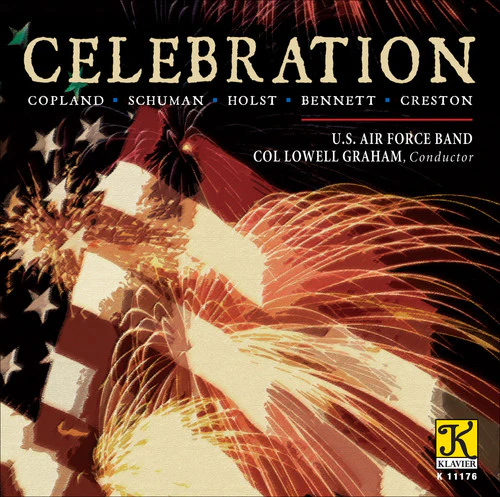
Celebration / Lowell Graham, U.S. Air Force Band
CELEBRATION • Col. Lowell Graham, cond; United States Air Force Band • KLAVIER K11176 (66: 01)
COPLAND An Outdoor Overture. SCHUMAN New England Triptych. HOLST Hammersmith. BENNETT Suite of Old American Dances. CRESTON Celebration Overture
This collection of band repertoire staples benefits from performances that are never less than first-rate, captured in stunning sound. All were either originally composed for band or transcribed for the medium by the composer.
The two transcriptions—Aaron Copland’s An Outdoor Overture and William Schuman’s New England Triptych— are perhaps the least successful works on the program, especially when compared to their orchestral counterparts. This is especially true of Schuman’s three-movement suite based on Revolutionary War songs by William Billings, the band transcription of which is substantially inferior to its orchestral cousin. Schuman prepared the band version of the third movement, “Chester,” around the same time he composed the original work, altering and expanding the music until it essentially became a new piece. The resultant work, the brilliant Chester Overture, is more often than not performed as a freestanding, independent piece. Sadly, the other two movements of the triptych did not fare as well. For the band transcription of the first movement, “Be Glad Then, America,” Schuman added a good deal of gratuitous ornamentation, as well as additional percussion parts that can only be described as perfunctory. The mystery and ominous foreboding of the original introduction are completely absent here. This movement also suffers from thick, turgid textures, as does the second movement, “When Jesus Wept,” which was originally scored very transparently for strings with solo parts for oboe, bassoon, and tenor drum. In the band version, Schuman reassigned the oboe and bassoon solos to trumpet and euphonium. Why I don’t know, but as a result, the music’s poignancy and pathos are substantially diminished. There are also a couple of notational errors (actual wrong notes printed in the sheet music) in the solo euphonium part that are not corrected in this performance (though to be fair, they rarely are).
The remaining works are all band originals. Gustav Holst’s Hammersmith of 1930 was inspired by the composer’s evening walks along the Thames during which he not only absorbed the sounds of the river itself, but also the revelry and gaiety emanating from the numerous pubs and taverns along the river’s banks. A somber, dirge-like prelude, constructed over a brooding ground bass, gives way to a boisterous, rollicking scherzo, only to eventually return as the work’s solemn coda. Though considered to be something of a “sacred cow” in the band repertoire, I must admit that the work has always left me a bit cold. (Heresy, I know.) Robert Russell Bennett’s Suite of Old American Dances is exactly what the title describes, each of its five movements—“Cake Walk,” “Schottische,” “Western One-Step,” “Wallflower Waltz,” and “Rag”—perfectly evoking the simple nostalgia of bygone Americana. The program comes to an exhilarating conclusion with a rousing account of Paul Creston’s exuberant Celebration Overture , a masterly three-part work highlighted by a particularly lovely ballad as its central section.
These recordings, all of which are among the finest this music has ever received, were originally available only through official Department of the Air Force channels. First released in 1996, though only to schools, libraries, radio stations, and other “official” recipients, these superb performances are now available to the general public for the first time. As there are many other first-rate recordings from this source still in the vaults, we can only hope that this disc will be followed by many, many more.
FANFARE: Merlin Patterson
CELEBRATION • Col. Lowell Graham, cond; United States Air Force Band • KLAVIER K11176 (66: 01)
COPLAND An Outdoor Overture. SCHUMAN New England Triptych. HOLST Hammersmith. BENNETT Suite of Old American Dances. CRESTON Celebration Overture
This collection of band repertoire staples benefits from performances that are never less than first-rate, captured in stunning sound. All were either originally composed for band or transcribed for the medium by the composer.
The two transcriptions—Aaron Copland’s An Outdoor Overture and William Schuman’s New England Triptych— are perhaps the least successful works on the program, especially when compared to their orchestral counterparts. This is especially true of Schuman’s three-movement suite based on Revolutionary War songs by William Billings, the band transcription of which is substantially inferior to its orchestral cousin. Schuman prepared the band version of the third movement, “Chester,” around the same time he composed the original work, altering and expanding the music until it essentially became a new piece. The resultant work, the brilliant Chester Overture, is more often than not performed as a freestanding, independent piece. Sadly, the other two movements of the triptych did not fare as well. For the band transcription of the first movement, “Be Glad Then, America,” Schuman added a good deal of gratuitous ornamentation, as well as additional percussion parts that can only be described as perfunctory. The mystery and ominous foreboding of the original introduction are completely absent here. This movement also suffers from thick, turgid textures, as does the second movement, “When Jesus Wept,” which was originally scored very transparently for strings with solo parts for oboe, bassoon, and tenor drum. In the band version, Schuman reassigned the oboe and bassoon solos to trumpet and euphonium. Why I don’t know, but as a result, the music’s poignancy and pathos are substantially diminished. There are also a couple of notational errors (actual wrong notes printed in the sheet music) in the solo euphonium part that are not corrected in this performance (though to be fair, they rarely are).
The remaining works are all band originals. Gustav Holst’s Hammersmith of 1930 was inspired by the composer’s evening walks along the Thames during which he not only absorbed the sounds of the river itself, but also the revelry and gaiety emanating from the numerous pubs and taverns along the river’s banks. A somber, dirge-like prelude, constructed over a brooding ground bass, gives way to a boisterous, rollicking scherzo, only to eventually return as the work’s solemn coda. Though considered to be something of a “sacred cow” in the band repertoire, I must admit that the work has always left me a bit cold. (Heresy, I know.) Robert Russell Bennett’s Suite of Old American Dances is exactly what the title describes, each of its five movements—“Cake Walk,” “Schottische,” “Western One-Step,” “Wallflower Waltz,” and “Rag”—perfectly evoking the simple nostalgia of bygone Americana. The program comes to an exhilarating conclusion with a rousing account of Paul Creston’s exuberant Celebration Overture , a masterly three-part work highlighted by a particularly lovely ballad as its central section.
These recordings, all of which are among the finest this music has ever received, were originally available only through official Department of the Air Force channels. First released in 1996, though only to schools, libraries, radio stations, and other “official” recipients, these superb performances are now available to the general public for the first time. As there are many other first-rate recordings from this source still in the vaults, we can only hope that this disc will be followed by many, many more.
FANFARE: Merlin Patterson
$18.99
Celebration / Lowell Graham, U.S. Air Force Band—
$18.99
Description
CELEBRATION • Col. Lowell Graham, cond; United States Air Force Band • KLAVIER K11176 (66: 01)
COPLAND An Outdoor Overture. SCHUMAN New England Triptych. HOLST Hammersmith. BENNETT Suite of Old American Dances. CRESTON Celebration Overture
This collection of band repertoire staples benefits from performances that are never less than first-rate, captured in stunning sound. All were either originally composed for band or transcribed for the medium by the composer.
The two transcriptions—Aaron Copland’s An Outdoor Overture and William Schuman’s New England Triptych— are perhaps the least successful works on the program, especially when compared to their orchestral counterparts. This is especially true of Schuman’s three-movement suite based on Revolutionary War songs by William Billings, the band transcription of which is substantially inferior to its orchestral cousin. Schuman prepared the band version of the third movement, “Chester,” around the same time he composed the original work, altering and expanding the music until it essentially became a new piece. The resultant work, the brilliant Chester Overture, is more often than not performed as a freestanding, independent piece. Sadly, the other two movements of the triptych did not fare as well. For the band transcription of the first movement, “Be Glad Then, America,” Schuman added a good deal of gratuitous ornamentation, as well as additional percussion parts that can only be described as perfunctory. The mystery and ominous foreboding of the original introduction are completely absent here. This movement also suffers from thick, turgid textures, as does the second movement, “When Jesus Wept,” which was originally scored very transparently for strings with solo parts for oboe, bassoon, and tenor drum. In the band version, Schuman reassigned the oboe and bassoon solos to trumpet and euphonium. Why I don’t know, but as a result, the music’s poignancy and pathos are substantially diminished. There are also a couple of notational errors (actual wrong notes printed in the sheet music) in the solo euphonium part that are not corrected in this performance (though to be fair, they rarely are).
The remaining works are all band originals. Gustav Holst’s Hammersmith of 1930 was inspired by the composer’s evening walks along the Thames during which he not only absorbed the sounds of the river itself, but also the revelry and gaiety emanating from the numerous pubs and taverns along the river’s banks. A somber, dirge-like prelude, constructed over a brooding ground bass, gives way to a boisterous, rollicking scherzo, only to eventually return as the work’s solemn coda. Though considered to be something of a “sacred cow” in the band repertoire, I must admit that the work has always left me a bit cold. (Heresy, I know.) Robert Russell Bennett’s Suite of Old American Dances is exactly what the title describes, each of its five movements—“Cake Walk,” “Schottische,” “Western One-Step,” “Wallflower Waltz,” and “Rag”—perfectly evoking the simple nostalgia of bygone Americana. The program comes to an exhilarating conclusion with a rousing account of Paul Creston’s exuberant Celebration Overture , a masterly three-part work highlighted by a particularly lovely ballad as its central section.
These recordings, all of which are among the finest this music has ever received, were originally available only through official Department of the Air Force channels. First released in 1996, though only to schools, libraries, radio stations, and other “official” recipients, these superb performances are now available to the general public for the first time. As there are many other first-rate recordings from this source still in the vaults, we can only hope that this disc will be followed by many, many more.
FANFARE: Merlin Patterson