🎉 Up to 70% Off Selected ItemsShop Sale

1 / 2
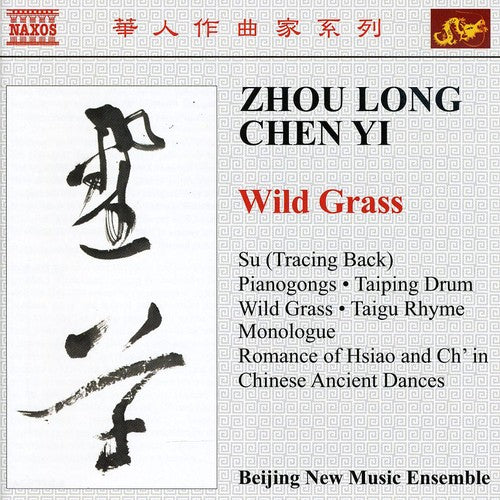
Chinese Classics - Wild Grass / Beijing New Music Ensemble
ZHOU LONG Su (Tracing Back). Pianogongs. Taiping Drum. Wild Grass. Taigu Rhyme. CHEN YI Monologue (Impression on “The True Story of Ah Q”). Romance of Hsiao and Ch’in. Chinese Ancient Dances • Beijing New Music Ens • NAXOS 8.570604 (56: 04)
Elsewhere in this issue (or the next) I review another disc in Naxos’s “Chinese Classics” series—three string quartets by Ge Gan-Ru. This one is no less worthwhile, and in fact probably will be more appealing to the average listener. (I say that only because I don’t think the average listener relishes George Crumb’s Black Angels , for example, but perhaps I am mistaken.)
These two composers were born in 1953. Both currently teach at the Conservatory of the University of Missouri in Kansas City, and both studied at the Central Conservatory in Beijing and at Columbia University in New York. Both also are married—to each other! While Ge Gan-Ru usually is described as “China’s first avant-garde composer,” Zhou Long and Chen Yi seem to have less confrontational musical personalities. Their music is most assuredly not derivative, however, nor does it have that picture-postcard quality that sometimes pervades earlier classical music by Chinese composers. In fact, I’d go so far as to say that these two composers speak with more distinctive voices than Ge Gan-Ru, who seems very connected to his Western avant-garde influences.
The works on this CD were composed for a variety of instrumental combinations. Some call for traditional Chinese instruments to be paired with Western instruments. Su , for example, is for flute and the zither-like guqin, and Pianogongs is for piano and luo, the gongs traditionally used in Chinese opera. It seems to me that Zhou and Chen are doing something similar to what Chopin and Piazzolla used to do, that is, taking their country’s indigenous genres of music and transforming them into something both personal and original.
All of this music is interesting. Some of it is terrifically exciting. Taigu Rhyme , which closes this CD, is scored for clarinet, violin, cello, and three traditional drummers, and the latter build up an impressive head of steam as the music hurtles along. The clarinet imitates the sound of the guanzi, a reed instrument related to the oboe—another example of how some modern Chinese composers are synthesizing East and West, and old and new.
The very existence of the Beijing New Music Ensemble demonstrates how quickly things are changing in China. Founded in 2005, and consisting (it appears) of an international array of musicians, it has presented dozens of new works in China and elsewhere. I have little to compare them to, but the performances seem to be on the highest possible level. This digital recording was made in the studios of Beijing’s China Record Company—in itself, a marker of both change and continuity.
These works are challenging and emotionally rich, and require no special pleading. Anyone interested in the continuing evolution of Chinese culture needs to give this excellent CD a listen.
FANFARE: Raymond Tuttle
ZHOU LONG Su (Tracing Back). Pianogongs. Taiping Drum. Wild Grass. Taigu Rhyme. CHEN YI Monologue (Impression on “The True Story of Ah Q”). Romance of Hsiao and Ch’in. Chinese Ancient Dances • Beijing New Music Ens • NAXOS 8.570604 (56: 04)
Elsewhere in this issue (or the next) I review another disc in Naxos’s “Chinese Classics” series—three string quartets by Ge Gan-Ru. This one is no less worthwhile, and in fact probably will be more appealing to the average listener. (I say that only because I don’t think the average listener relishes George Crumb’s Black Angels , for example, but perhaps I am mistaken.)
These two composers were born in 1953. Both currently teach at the Conservatory of the University of Missouri in Kansas City, and both studied at the Central Conservatory in Beijing and at Columbia University in New York. Both also are married—to each other! While Ge Gan-Ru usually is described as “China’s first avant-garde composer,” Zhou Long and Chen Yi seem to have less confrontational musical personalities. Their music is most assuredly not derivative, however, nor does it have that picture-postcard quality that sometimes pervades earlier classical music by Chinese composers. In fact, I’d go so far as to say that these two composers speak with more distinctive voices than Ge Gan-Ru, who seems very connected to his Western avant-garde influences.
The works on this CD were composed for a variety of instrumental combinations. Some call for traditional Chinese instruments to be paired with Western instruments. Su , for example, is for flute and the zither-like guqin, and Pianogongs is for piano and luo, the gongs traditionally used in Chinese opera. It seems to me that Zhou and Chen are doing something similar to what Chopin and Piazzolla used to do, that is, taking their country’s indigenous genres of music and transforming them into something both personal and original.
All of this music is interesting. Some of it is terrifically exciting. Taigu Rhyme , which closes this CD, is scored for clarinet, violin, cello, and three traditional drummers, and the latter build up an impressive head of steam as the music hurtles along. The clarinet imitates the sound of the guanzi, a reed instrument related to the oboe—another example of how some modern Chinese composers are synthesizing East and West, and old and new.
The very existence of the Beijing New Music Ensemble demonstrates how quickly things are changing in China. Founded in 2005, and consisting (it appears) of an international array of musicians, it has presented dozens of new works in China and elsewhere. I have little to compare them to, but the performances seem to be on the highest possible level. This digital recording was made in the studios of Beijing’s China Record Company—in itself, a marker of both change and continuity.
These works are challenging and emotionally rich, and require no special pleading. Anyone interested in the continuing evolution of Chinese culture needs to give this excellent CD a listen.
FANFARE: Raymond Tuttle
$9.99
Chinese Classics - Wild Grass / Beijing New Music Ensemble—
$9.99
Description
ZHOU LONG Su (Tracing Back). Pianogongs. Taiping Drum. Wild Grass. Taigu Rhyme. CHEN YI Monologue (Impression on “The True Story of Ah Q”). Romance of Hsiao and Ch’in. Chinese Ancient Dances • Beijing New Music Ens • NAXOS 8.570604 (56: 04)
Elsewhere in this issue (or the next) I review another disc in Naxos’s “Chinese Classics” series—three string quartets by Ge Gan-Ru. This one is no less worthwhile, and in fact probably will be more appealing to the average listener. (I say that only because I don’t think the average listener relishes George Crumb’s Black Angels , for example, but perhaps I am mistaken.)
These two composers were born in 1953. Both currently teach at the Conservatory of the University of Missouri in Kansas City, and both studied at the Central Conservatory in Beijing and at Columbia University in New York. Both also are married—to each other! While Ge Gan-Ru usually is described as “China’s first avant-garde composer,” Zhou Long and Chen Yi seem to have less confrontational musical personalities. Their music is most assuredly not derivative, however, nor does it have that picture-postcard quality that sometimes pervades earlier classical music by Chinese composers. In fact, I’d go so far as to say that these two composers speak with more distinctive voices than Ge Gan-Ru, who seems very connected to his Western avant-garde influences.
The works on this CD were composed for a variety of instrumental combinations. Some call for traditional Chinese instruments to be paired with Western instruments. Su , for example, is for flute and the zither-like guqin, and Pianogongs is for piano and luo, the gongs traditionally used in Chinese opera. It seems to me that Zhou and Chen are doing something similar to what Chopin and Piazzolla used to do, that is, taking their country’s indigenous genres of music and transforming them into something both personal and original.
All of this music is interesting. Some of it is terrifically exciting. Taigu Rhyme , which closes this CD, is scored for clarinet, violin, cello, and three traditional drummers, and the latter build up an impressive head of steam as the music hurtles along. The clarinet imitates the sound of the guanzi, a reed instrument related to the oboe—another example of how some modern Chinese composers are synthesizing East and West, and old and new.
The very existence of the Beijing New Music Ensemble demonstrates how quickly things are changing in China. Founded in 2005, and consisting (it appears) of an international array of musicians, it has presented dozens of new works in China and elsewhere. I have little to compare them to, but the performances seem to be on the highest possible level. This digital recording was made in the studios of Beijing’s China Record Company—in itself, a marker of both change and continuity.
These works are challenging and emotionally rich, and require no special pleading. Anyone interested in the continuing evolution of Chinese culture needs to give this excellent CD a listen.
FANFARE: Raymond Tuttle