🎉 Up to 70% Off Selected ItemsShop Sale

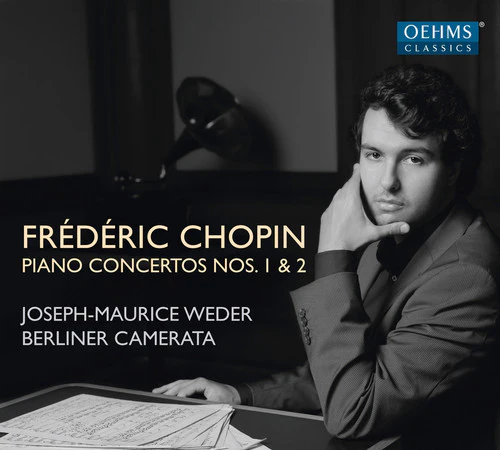
Chopin: Piano Concertos Nos. 1 & 2 (Arr. B. Kominek)
The piano concertos of Fr�d�ric Chopin are amongst the greatest and best-known orchestral works of the 19th century. It is thus no wonder that every pianist would like to play them and, of course, record them as well. Joseph-Maurice Weder, winner of the SWISS AMBASSADOR'S AWARD 2013 in London, has achieved this in the unusual ensemble of the piano sextet. Chopin Concertos with Joseph-Maurice Weder and the Berlin Camerata. During the 19th century, the practice of transcribing orchestral works for smaller ensembles was widespread- in the age prior to recordings, this was an indispensible way of helping compositions achieve their breakthrough with the public.
The piano concertos of Fr�d�ric Chopin are amongst the greatest and best-known orchestral works of the 19th century. It is thus no wonder that every pianist would like to play them and, of course, record them as well. Joseph-Maurice Weder, winner of the SWISS AMBASSADOR'S AWARD 2013 in London, has achieved this in the unusual ensemble of the piano sextet. Chopin Concertos with Joseph-Maurice Weder and the Berlin Camerata. During the 19th century, the practice of transcribing orchestral works for smaller ensembles was widespread- in the age prior to recordings, this was an indispensible way of helping compositions achieve their breakthrough with the public.
$9.99
Chopin: Piano Concertos Nos. 1 & 2 (Arr. B. Kominek)—
$9.99
Description
The piano concertos of Fr�d�ric Chopin are amongst the greatest and best-known orchestral works of the 19th century. It is thus no wonder that every pianist would like to play them and, of course, record them as well. Joseph-Maurice Weder, winner of the SWISS AMBASSADOR'S AWARD 2013 in London, has achieved this in the unusual ensemble of the piano sextet. Chopin Concertos with Joseph-Maurice Weder and the Berlin Camerata. During the 19th century, the practice of transcribing orchestral works for smaller ensembles was widespread- in the age prior to recordings, this was an indispensible way of helping compositions achieve their breakthrough with the public.