🎉 Up to 70% Off Selected ItemsShop Sale

1 / 2
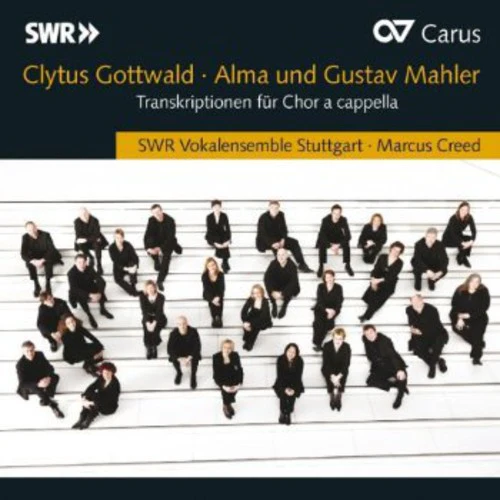
Clytus Gottwald: Alma & Gustav Mahler Transcriptionen Fur Chor A Cappella
MAHLER (transcr. Gottwald) Erinnerung. Wo die schönen Trompeten blasen. Um Mitternacht. Die zwei blauen Augen. Urlicht. Ich bin der Welt abhanden gekommen. Scheiden und Meiden. Es sungen drei Engel. Im Abendrot. A. MAHLER (transcr. Gottwald) Drei frühe Lieder • Marcus Creed, cond; SWR Vocal Ens Stuttgart • CARUS 83.370 (63:41 Text and Translation)
Once upon a time (1960, to be exact), choral conductor Clytus Gottwald created the Schola Cantorum Stuttgart, a chamber choir whose specialty was music by that era’s most avant-garde composers . . . Ligeti, Ferneyhough, Penderecki, and so on. This ensemble attracted the attention of Pierre Boulez, and it was Boulez who inspired Gottwald to transcribe Ravel’s song Soupir for the ensemble. The results were so effective that Gottwald continued transcribing other works for his ensemble, including music—some of it not even vocal—by Gustav Mahler and his wife Alma. Those transcriptions have outlasted Schola Cantorum Stuttgart. The ensemble disbanded in 1990, but within the past few years, several of Gottwald’s transcriptions have been recorded by the French ensemble Accentus (for the Naïve label), and English conductor Marcus Creed has taken them up for Carus with one of his ensembles, the SWR Vokalensemble Stuttgart. (It doesn’t hurt that the printing arm of Carus publishes three of these selections.) Almost none of them have been recorded before, the exceptions being Die zwei blauen Augen, Ich bin der Welt abhanden gekommen , and Scheiden und Meiden. Im Abendrot is a transcription of the Adagietto from Mahler’s Symphony No. 5. Accentus has recorded a different transcription, believe it or not, of that same music, prepared by Gérard Pesson. Gottwald’s transcription uses the same Eichendorff text that Strauss used in his Four Last Songs.
This disc reveals the SWR Vokalensemble Stuttgart to be spiritual descendents of Gottwald’s ensemble. In the 1970s, there was no practical reason why Mahler’s music needed to be treated this way. It is my impression that Gottwald did it because it presented him with an interesting intellectual puzzle, and as a challenge for Schola Cantorum Stuttgart. These “auxiliary” transcriptions (to use Gottwald’s word, from the interview printed in Carus’s booklet) present the music in a striking and different light, and help to make Mahler’s music a little strange again, which is not a bad thing in a world in which we risk being overexposed to Mahler. (Imagine saying that 60 years ago!) These transcriptions are not likely to appear on the next program of your local amateur choir. They are, in fact, intimidatingly complex and difficult. For example, the transcriptions of Ich bin der Welt abhanden gekommen and Im Abendrot require a 16-part ensemble. Overall, these transcriptions are punishing exercises in breath and pitch control, in the modulation and matching of vocal colors, and in the precise blending of sound. What is needed, really, is a team of vocal gymnasts who can approach the music as if with one mind.
Fortunately, it is unlikely that any performers will stumble blindly into this repertoire, and the recorded performances I’ve heard are uniformly excellent, but not identical. One can hear Gottwald’s Schola Cantorum Stuttgart perform Ich bin der Welt abhanden gekommen in a giant doorstop of a CD set (no longer in print) from Cadenza/Bayer. Gottwald is significantly faster than Creed, to good effect, and solo voices come out of the texture more prominently than they do for Creed. Gottwald’s ensemble is more closely microphoned, and the effect is almost claustrophobic. Creed’s ensemble, while a bit more impersonal, may come a hair closer to technical perfection. Accentus (directed by Laurence Equilbey) adopts almost exactly the same tempo as Gottwald, but the ensemble’s sound is less warm than either Gottwald’s or Creed’s. Given the song’s text, I find Accentus too edgy, but still mightily impressive.
The only caveat I have about the present disc—also about the other two I’ve mentioned—is that these transcriptions are so intense that emotional and intellectual fatigue is a risk for listeners. Several tracks into Creed’s disc I asked myself, “Why are they singing so loudly?,” but then I realized it wasn’t the volume as much it was the laser-like concentration of the transcriptions and the performances. Beautiful stuff, this, but it is far from relaxing!
FANFARE: Raymond Tuttle
MAHLER (transcr. Gottwald) Erinnerung. Wo die schönen Trompeten blasen. Um Mitternacht. Die zwei blauen Augen. Urlicht. Ich bin der Welt abhanden gekommen. Scheiden und Meiden. Es sungen drei Engel. Im Abendrot. A. MAHLER (transcr. Gottwald) Drei frühe Lieder • Marcus Creed, cond; SWR Vocal Ens Stuttgart • CARUS 83.370 (63:41 Text and Translation)
Once upon a time (1960, to be exact), choral conductor Clytus Gottwald created the Schola Cantorum Stuttgart, a chamber choir whose specialty was music by that era’s most avant-garde composers . . . Ligeti, Ferneyhough, Penderecki, and so on. This ensemble attracted the attention of Pierre Boulez, and it was Boulez who inspired Gottwald to transcribe Ravel’s song Soupir for the ensemble. The results were so effective that Gottwald continued transcribing other works for his ensemble, including music—some of it not even vocal—by Gustav Mahler and his wife Alma. Those transcriptions have outlasted Schola Cantorum Stuttgart. The ensemble disbanded in 1990, but within the past few years, several of Gottwald’s transcriptions have been recorded by the French ensemble Accentus (for the Naïve label), and English conductor Marcus Creed has taken them up for Carus with one of his ensembles, the SWR Vokalensemble Stuttgart. (It doesn’t hurt that the printing arm of Carus publishes three of these selections.) Almost none of them have been recorded before, the exceptions being Die zwei blauen Augen, Ich bin der Welt abhanden gekommen , and Scheiden und Meiden. Im Abendrot is a transcription of the Adagietto from Mahler’s Symphony No. 5. Accentus has recorded a different transcription, believe it or not, of that same music, prepared by Gérard Pesson. Gottwald’s transcription uses the same Eichendorff text that Strauss used in his Four Last Songs.
This disc reveals the SWR Vokalensemble Stuttgart to be spiritual descendents of Gottwald’s ensemble. In the 1970s, there was no practical reason why Mahler’s music needed to be treated this way. It is my impression that Gottwald did it because it presented him with an interesting intellectual puzzle, and as a challenge for Schola Cantorum Stuttgart. These “auxiliary” transcriptions (to use Gottwald’s word, from the interview printed in Carus’s booklet) present the music in a striking and different light, and help to make Mahler’s music a little strange again, which is not a bad thing in a world in which we risk being overexposed to Mahler. (Imagine saying that 60 years ago!) These transcriptions are not likely to appear on the next program of your local amateur choir. They are, in fact, intimidatingly complex and difficult. For example, the transcriptions of Ich bin der Welt abhanden gekommen and Im Abendrot require a 16-part ensemble. Overall, these transcriptions are punishing exercises in breath and pitch control, in the modulation and matching of vocal colors, and in the precise blending of sound. What is needed, really, is a team of vocal gymnasts who can approach the music as if with one mind.
Fortunately, it is unlikely that any performers will stumble blindly into this repertoire, and the recorded performances I’ve heard are uniformly excellent, but not identical. One can hear Gottwald’s Schola Cantorum Stuttgart perform Ich bin der Welt abhanden gekommen in a giant doorstop of a CD set (no longer in print) from Cadenza/Bayer. Gottwald is significantly faster than Creed, to good effect, and solo voices come out of the texture more prominently than they do for Creed. Gottwald’s ensemble is more closely microphoned, and the effect is almost claustrophobic. Creed’s ensemble, while a bit more impersonal, may come a hair closer to technical perfection. Accentus (directed by Laurence Equilbey) adopts almost exactly the same tempo as Gottwald, but the ensemble’s sound is less warm than either Gottwald’s or Creed’s. Given the song’s text, I find Accentus too edgy, but still mightily impressive.
The only caveat I have about the present disc—also about the other two I’ve mentioned—is that these transcriptions are so intense that emotional and intellectual fatigue is a risk for listeners. Several tracks into Creed’s disc I asked myself, “Why are they singing so loudly?,” but then I realized it wasn’t the volume as much it was the laser-like concentration of the transcriptions and the performances. Beautiful stuff, this, but it is far from relaxing!
FANFARE: Raymond Tuttle
$7.35
Original: $20.99
-65%Clytus Gottwald: Alma & Gustav Mahler Transcriptionen Fur Chor A Cappella—
$20.99
$7.35Description
MAHLER (transcr. Gottwald) Erinnerung. Wo die schönen Trompeten blasen. Um Mitternacht. Die zwei blauen Augen. Urlicht. Ich bin der Welt abhanden gekommen. Scheiden und Meiden. Es sungen drei Engel. Im Abendrot. A. MAHLER (transcr. Gottwald) Drei frühe Lieder • Marcus Creed, cond; SWR Vocal Ens Stuttgart • CARUS 83.370 (63:41 Text and Translation)
Once upon a time (1960, to be exact), choral conductor Clytus Gottwald created the Schola Cantorum Stuttgart, a chamber choir whose specialty was music by that era’s most avant-garde composers . . . Ligeti, Ferneyhough, Penderecki, and so on. This ensemble attracted the attention of Pierre Boulez, and it was Boulez who inspired Gottwald to transcribe Ravel’s song Soupir for the ensemble. The results were so effective that Gottwald continued transcribing other works for his ensemble, including music—some of it not even vocal—by Gustav Mahler and his wife Alma. Those transcriptions have outlasted Schola Cantorum Stuttgart. The ensemble disbanded in 1990, but within the past few years, several of Gottwald’s transcriptions have been recorded by the French ensemble Accentus (for the Naïve label), and English conductor Marcus Creed has taken them up for Carus with one of his ensembles, the SWR Vokalensemble Stuttgart. (It doesn’t hurt that the printing arm of Carus publishes three of these selections.) Almost none of them have been recorded before, the exceptions being Die zwei blauen Augen, Ich bin der Welt abhanden gekommen , and Scheiden und Meiden. Im Abendrot is a transcription of the Adagietto from Mahler’s Symphony No. 5. Accentus has recorded a different transcription, believe it or not, of that same music, prepared by Gérard Pesson. Gottwald’s transcription uses the same Eichendorff text that Strauss used in his Four Last Songs.
This disc reveals the SWR Vokalensemble Stuttgart to be spiritual descendents of Gottwald’s ensemble. In the 1970s, there was no practical reason why Mahler’s music needed to be treated this way. It is my impression that Gottwald did it because it presented him with an interesting intellectual puzzle, and as a challenge for Schola Cantorum Stuttgart. These “auxiliary” transcriptions (to use Gottwald’s word, from the interview printed in Carus’s booklet) present the music in a striking and different light, and help to make Mahler’s music a little strange again, which is not a bad thing in a world in which we risk being overexposed to Mahler. (Imagine saying that 60 years ago!) These transcriptions are not likely to appear on the next program of your local amateur choir. They are, in fact, intimidatingly complex and difficult. For example, the transcriptions of Ich bin der Welt abhanden gekommen and Im Abendrot require a 16-part ensemble. Overall, these transcriptions are punishing exercises in breath and pitch control, in the modulation and matching of vocal colors, and in the precise blending of sound. What is needed, really, is a team of vocal gymnasts who can approach the music as if with one mind.
Fortunately, it is unlikely that any performers will stumble blindly into this repertoire, and the recorded performances I’ve heard are uniformly excellent, but not identical. One can hear Gottwald’s Schola Cantorum Stuttgart perform Ich bin der Welt abhanden gekommen in a giant doorstop of a CD set (no longer in print) from Cadenza/Bayer. Gottwald is significantly faster than Creed, to good effect, and solo voices come out of the texture more prominently than they do for Creed. Gottwald’s ensemble is more closely microphoned, and the effect is almost claustrophobic. Creed’s ensemble, while a bit more impersonal, may come a hair closer to technical perfection. Accentus (directed by Laurence Equilbey) adopts almost exactly the same tempo as Gottwald, but the ensemble’s sound is less warm than either Gottwald’s or Creed’s. Given the song’s text, I find Accentus too edgy, but still mightily impressive.
The only caveat I have about the present disc—also about the other two I’ve mentioned—is that these transcriptions are so intense that emotional and intellectual fatigue is a risk for listeners. Several tracks into Creed’s disc I asked myself, “Why are they singing so loudly?,” but then I realized it wasn’t the volume as much it was the laser-like concentration of the transcriptions and the performances. Beautiful stuff, this, but it is far from relaxing!
FANFARE: Raymond Tuttle