🎉 Up to 70% Off Selected ItemsShop Sale

1 / 2
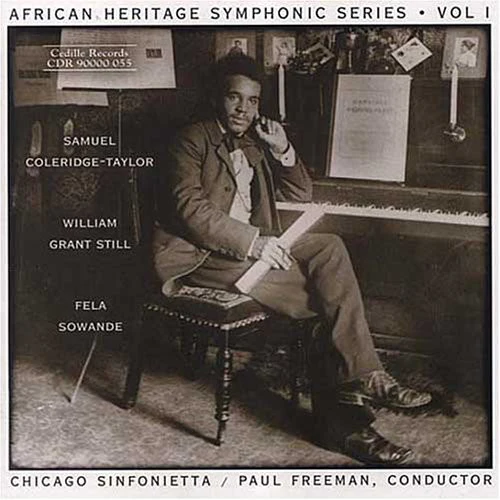
African Heritage Symphonic Series Vol 1 - Coleridge-Taylor, Still, Sowande / Freeman
Cedille Records intends its African Heritage Symphonic Series as a follow-up to CBS Records' Black Composers Series from the 1970s, and I'm happy to say Volume 1 makes for a strong start. Samuel Coleridge-Taylor (1875-1912), chiefly remembered for his cantata based on Longfellow's Hiawatha, actually was British-born, and his music is understandably more European sounding than that of his African American colleagues, though in some cases you can hear instances of traditionally African harmonic modulations. Thus, the Danse Nègre from the African Suite (1898) sounds sort of like Vaughan-Williams' The Wasps spiced up by Dvorak's Slavonic Dances. Dvorak is a composer who comes to mind again in the Petite Suite de Concert (1910), where Coleridge-Taylor exhibits the same qualities of tunefulness, rhythmic fluency, and sparkling orchestration as the Czech master.
William Grant Still (1895-1978) greatly admired Coleridge-Taylor, but he also was heavily influenced by the great jazz musicians of his time, in particular W.C. Handy, known as the "Father of the Blues". It's the sound of the blues that opens Still's Symphony No. 1, and to hear it in full symphonic dress immediately calls to mind George Gershwin (both composers knew each other's music). Various forms of jazz and blues permeate the symphony, yet Still constructs his work according to classic symphonic principles, and the result is a highly original, thought-provoking, and ultimately enjoyable creation.
From the African diaspora, we turn to the motherland for the music of Fela Sowande (1906-87). Sowande's Africa Suite (1930) utilizes traditional melodies of his native Nigeria, allowing us to hear the actual modes and rhythms of Africa presented in European orchestral timbres--a hybrid that works thanks to conductor Paul Freeman's rhythmic exactitude and to enthusiastic playing by the Chicago Sinfonietta. Freeman and his band give vibrant performances of the Coleridge-Taylor works as well, and show a far less self-conscious demeanor in the Still Symphony than Neeme Jarvi and the Detroit Symphony Orchestra, playing with much more relaxed authenticity and "cool". Cedille's recording is a model of three-dimensional realism, making this disc both a sonic and musical treasure.
--Victor Carr Jr., ClassicsToday.com
William Grant Still (1895-1978) greatly admired Coleridge-Taylor, but he also was heavily influenced by the great jazz musicians of his time, in particular W.C. Handy, known as the "Father of the Blues". It's the sound of the blues that opens Still's Symphony No. 1, and to hear it in full symphonic dress immediately calls to mind George Gershwin (both composers knew each other's music). Various forms of jazz and blues permeate the symphony, yet Still constructs his work according to classic symphonic principles, and the result is a highly original, thought-provoking, and ultimately enjoyable creation.
From the African diaspora, we turn to the motherland for the music of Fela Sowande (1906-87). Sowande's Africa Suite (1930) utilizes traditional melodies of his native Nigeria, allowing us to hear the actual modes and rhythms of Africa presented in European orchestral timbres--a hybrid that works thanks to conductor Paul Freeman's rhythmic exactitude and to enthusiastic playing by the Chicago Sinfonietta. Freeman and his band give vibrant performances of the Coleridge-Taylor works as well, and show a far less self-conscious demeanor in the Still Symphony than Neeme Jarvi and the Detroit Symphony Orchestra, playing with much more relaxed authenticity and "cool". Cedille's recording is a model of three-dimensional realism, making this disc both a sonic and musical treasure.
--Victor Carr Jr., ClassicsToday.com
Cedille Records intends its African Heritage Symphonic Series as a follow-up to CBS Records' Black Composers Series from the 1970s, and I'm happy to say Volume 1 makes for a strong start. Samuel Coleridge-Taylor (1875-1912), chiefly remembered for his cantata based on Longfellow's Hiawatha, actually was British-born, and his music is understandably more European sounding than that of his African American colleagues, though in some cases you can hear instances of traditionally African harmonic modulations. Thus, the Danse Nègre from the African Suite (1898) sounds sort of like Vaughan-Williams' The Wasps spiced up by Dvorak's Slavonic Dances. Dvorak is a composer who comes to mind again in the Petite Suite de Concert (1910), where Coleridge-Taylor exhibits the same qualities of tunefulness, rhythmic fluency, and sparkling orchestration as the Czech master.
William Grant Still (1895-1978) greatly admired Coleridge-Taylor, but he also was heavily influenced by the great jazz musicians of his time, in particular W.C. Handy, known as the "Father of the Blues". It's the sound of the blues that opens Still's Symphony No. 1, and to hear it in full symphonic dress immediately calls to mind George Gershwin (both composers knew each other's music). Various forms of jazz and blues permeate the symphony, yet Still constructs his work according to classic symphonic principles, and the result is a highly original, thought-provoking, and ultimately enjoyable creation.
From the African diaspora, we turn to the motherland for the music of Fela Sowande (1906-87). Sowande's Africa Suite (1930) utilizes traditional melodies of his native Nigeria, allowing us to hear the actual modes and rhythms of Africa presented in European orchestral timbres--a hybrid that works thanks to conductor Paul Freeman's rhythmic exactitude and to enthusiastic playing by the Chicago Sinfonietta. Freeman and his band give vibrant performances of the Coleridge-Taylor works as well, and show a far less self-conscious demeanor in the Still Symphony than Neeme Jarvi and the Detroit Symphony Orchestra, playing with much more relaxed authenticity and "cool". Cedille's recording is a model of three-dimensional realism, making this disc both a sonic and musical treasure.
--Victor Carr Jr., ClassicsToday.com
William Grant Still (1895-1978) greatly admired Coleridge-Taylor, but he also was heavily influenced by the great jazz musicians of his time, in particular W.C. Handy, known as the "Father of the Blues". It's the sound of the blues that opens Still's Symphony No. 1, and to hear it in full symphonic dress immediately calls to mind George Gershwin (both composers knew each other's music). Various forms of jazz and blues permeate the symphony, yet Still constructs his work according to classic symphonic principles, and the result is a highly original, thought-provoking, and ultimately enjoyable creation.
From the African diaspora, we turn to the motherland for the music of Fela Sowande (1906-87). Sowande's Africa Suite (1930) utilizes traditional melodies of his native Nigeria, allowing us to hear the actual modes and rhythms of Africa presented in European orchestral timbres--a hybrid that works thanks to conductor Paul Freeman's rhythmic exactitude and to enthusiastic playing by the Chicago Sinfonietta. Freeman and his band give vibrant performances of the Coleridge-Taylor works as well, and show a far less self-conscious demeanor in the Still Symphony than Neeme Jarvi and the Detroit Symphony Orchestra, playing with much more relaxed authenticity and "cool". Cedille's recording is a model of three-dimensional realism, making this disc both a sonic and musical treasure.
--Victor Carr Jr., ClassicsToday.com
$19.99
African Heritage Symphonic Series Vol 1 - Coleridge-Taylor, Still, Sowande / Freeman—
$19.99
Description
Cedille Records intends its African Heritage Symphonic Series as a follow-up to CBS Records' Black Composers Series from the 1970s, and I'm happy to say Volume 1 makes for a strong start. Samuel Coleridge-Taylor (1875-1912), chiefly remembered for his cantata based on Longfellow's Hiawatha, actually was British-born, and his music is understandably more European sounding than that of his African American colleagues, though in some cases you can hear instances of traditionally African harmonic modulations. Thus, the Danse Nègre from the African Suite (1898) sounds sort of like Vaughan-Williams' The Wasps spiced up by Dvorak's Slavonic Dances. Dvorak is a composer who comes to mind again in the Petite Suite de Concert (1910), where Coleridge-Taylor exhibits the same qualities of tunefulness, rhythmic fluency, and sparkling orchestration as the Czech master.
William Grant Still (1895-1978) greatly admired Coleridge-Taylor, but he also was heavily influenced by the great jazz musicians of his time, in particular W.C. Handy, known as the "Father of the Blues". It's the sound of the blues that opens Still's Symphony No. 1, and to hear it in full symphonic dress immediately calls to mind George Gershwin (both composers knew each other's music). Various forms of jazz and blues permeate the symphony, yet Still constructs his work according to classic symphonic principles, and the result is a highly original, thought-provoking, and ultimately enjoyable creation.
From the African diaspora, we turn to the motherland for the music of Fela Sowande (1906-87). Sowande's Africa Suite (1930) utilizes traditional melodies of his native Nigeria, allowing us to hear the actual modes and rhythms of Africa presented in European orchestral timbres--a hybrid that works thanks to conductor Paul Freeman's rhythmic exactitude and to enthusiastic playing by the Chicago Sinfonietta. Freeman and his band give vibrant performances of the Coleridge-Taylor works as well, and show a far less self-conscious demeanor in the Still Symphony than Neeme Jarvi and the Detroit Symphony Orchestra, playing with much more relaxed authenticity and "cool". Cedille's recording is a model of three-dimensional realism, making this disc both a sonic and musical treasure.
--Victor Carr Jr., ClassicsToday.com
William Grant Still (1895-1978) greatly admired Coleridge-Taylor, but he also was heavily influenced by the great jazz musicians of his time, in particular W.C. Handy, known as the "Father of the Blues". It's the sound of the blues that opens Still's Symphony No. 1, and to hear it in full symphonic dress immediately calls to mind George Gershwin (both composers knew each other's music). Various forms of jazz and blues permeate the symphony, yet Still constructs his work according to classic symphonic principles, and the result is a highly original, thought-provoking, and ultimately enjoyable creation.
From the African diaspora, we turn to the motherland for the music of Fela Sowande (1906-87). Sowande's Africa Suite (1930) utilizes traditional melodies of his native Nigeria, allowing us to hear the actual modes and rhythms of Africa presented in European orchestral timbres--a hybrid that works thanks to conductor Paul Freeman's rhythmic exactitude and to enthusiastic playing by the Chicago Sinfonietta. Freeman and his band give vibrant performances of the Coleridge-Taylor works as well, and show a far less self-conscious demeanor in the Still Symphony than Neeme Jarvi and the Detroit Symphony Orchestra, playing with much more relaxed authenticity and "cool". Cedille's recording is a model of three-dimensional realism, making this disc both a sonic and musical treasure.
--Victor Carr Jr., ClassicsToday.com