🎉 Up to 70% Off Selected ItemsShop Sale

1 / 2
Complete Crumb Edition Vol 8 / Robert Shannon
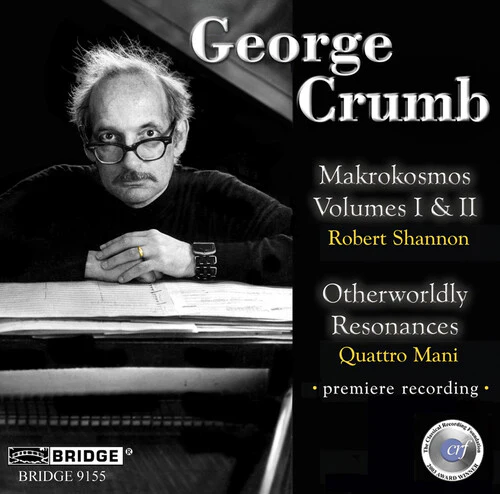
Complete Crumb Edition, Volume 8 George Crumb: Makrokosmos, Volumes I and II, for Amplified Piano (1972-73); Robert Shannon, piano; Otherworldly Resonances (2002), for Two Amplified Pianos (premiere recording), Quattro Mani
The latest volume in BRIDGE'S award-winning survey of George Crumb complete works presents a new recording of a major Crumb cycle and the premiere of a new composition for two pianos. Makrokosmos I and II have come to be regarded as landmark compositions in the piano repertoire, requiring the pianist to display a virtuoso's control of both the keyboard and the inside of the piano. In addition, the performer is asked to whistle, speak, and sing, while simultaneously playing some of the most dramatic and fantasy-filled piano music of the late twentieth century. Robert Shannon, a leading exponent of Crumb's music, gives the 67 minute cycle of 24 "zodiac" pieces a spectacular reading. The duo piano team, Quattro Mani, has also had a long association with Crumb's music, and can be heard playing Crumb's music on BRIDGE 9105, a disc that received ‘Best of Year' honors from Fanfare, and highest ratings from France's Repertoire, and the USA's ClassicsToday.com. In 2002, Crumb composed "Otherworldy Resonances", a 10 minute quasi-passacaglia for Quattro Mani. Based on a hypnotic four-note motif, this 10 minute composition marks Crumb's return to writing piano music after a hiatus of nearly 15 years. Both of these recordings, as with the rest of this series, were supervised by the composer.
R E V I E W S
Fanfare magazine
Bridge’s essential Crumb series takes on one of the monuments in the composer’s canon with this release. The Makrokosmos I and II (1972–73) are two sets of 12 piano pieces each (based on the Zodiac), and are perhaps the definitive catalog of Crumb’s re-imagining of the instrument. All the trademark innovations of “extended techniques” are here, from rattling paper threaded through the strings, to interior pizzicatos, to glissando harmonics, to—well, the list just goes on and on. Every movement has surprises; each is a unique, mysterious landscape. There are also highly theatrical gestures, which involve the performer vocalizing with chants, whistles, shouts, whispers, and musically mimetic sounds. I’ll admit that while I believe Crumb is one of the most important American composers of the second half of the 20th century and the creator of some of the most beautiful and imaginative music of our time, these pieces remain somewhat problematic for me. At times, the desire to expand the expressive palette goes so far over the top as to verge on kitsch. This goes especially for the vocalizing, which can sound a little like the soundtrack of those live-action haunted houses that spring up on Halloween. Also, the music is so episodic that it can be hard to feel a formal motivation that is more than the astrological program.
That off my chest, I’ll say that for most of the time I can still sit back and enjoy Crumb’s fertile inventiveness, his desire to stretch boundaries and communicate directly, and the sheer sonic expansiveness of the whole set. One does have a sense of constant surprise and delight that an entire orchestra of colors is extracted from this single instrument. There’s also a genuine tenderness amidst the Grand Guignol moments, a nostalgia for the passage of past beauties (such as when a wisp of Chopin’s Fantasie-Impromptu suddenly emerges and submerges from the depths) that is strangely allied to that of another composer, Valentin Silvestrov. One more point to mention is that the second set seems much more focused and organic than the first. It seems to move faster, even though it is only four minutes shorter in this rendition.
Otherworldly Resonances (2002) is yet another of the wonderful pieces emerging from Crumb’s recent prolificity. His style hasn’t changed much at all—the techniques, the gestures, the melodic and harmonic formulas all remain similar to what they were two to three decades ago—but somehow the music has found a new calm and balance, and has become a little more abstract without losing any luster or poetry. Crumb, one of the most genuinely modest of great artists, would probably be the first to admit he’s not found something new after his great discoveries of the 1960s and 1970s. But that really doesn’t matter, because these new works are strong, individual, and memorable. In them, the composer seems able to accept who he is, and to share his gifts generously. This two-piano work is a compact epilogue to the grand cycles of Makrokosmos III (“Music for a Summer Evening”) and “Celestial Mechanics” (Makrokosmos IV), but extremely effective for its deliberately narrowed focus. A simple four-note ostinato is passed between the keyboards and surrounded with a constantly mutating garland of events—flashes of lightning, lullabies, delicate ornaments. The result is genuinely hypnotic. It should be simplistic, but instead it touches on something more profound.
All the performances are outstanding, but I must give special notice to Robert Shannon, who plays the Makrokosmos with a level of passion and authority that’s breathtaking. His precision and confidence in the inside-the-keyboard techniques makes this fiendishly difficult material sound quite natural, and will help future players codify the music’s performance practice and redefine virtuosity (and I say this with all respect and admiration for the pioneering premiere recordings of the works by their dedicatees, David Burge and Robert Miller; Shannon simply represents the next step of a new generation). His dazzling passagework in the fast sections reminds us how exciting fast Crumb can be, and that the composer is not all laid-back, glacial vistas.
In the end, an important release of enduring music. Where it bumps up against my aesthetic is probably more my issue than the music’s—it is a landmark of the literature, and I suspect it will be around for quite a while after I’m gone.
Robert Carl, FANFARE
The latest volume in BRIDGE'S award-winning survey of George Crumb complete works presents a new recording of a major Crumb cycle and the premiere of a new composition for two pianos. Makrokosmos I and II have come to be regarded as landmark compositions in the piano repertoire, requiring the pianist to display a virtuoso's control of both the keyboard and the inside of the piano. In addition, the performer is asked to whistle, speak, and sing, while simultaneously playing some of the most dramatic and fantasy-filled piano music of the late twentieth century. Robert Shannon, a leading exponent of Crumb's music, gives the 67 minute cycle of 24 "zodiac" pieces a spectacular reading. The duo piano team, Quattro Mani, has also had a long association with Crumb's music, and can be heard playing Crumb's music on BRIDGE 9105, a disc that received ‘Best of Year' honors from Fanfare, and highest ratings from France's Repertoire, and the USA's ClassicsToday.com. In 2002, Crumb composed "Otherworldy Resonances", a 10 minute quasi-passacaglia for Quattro Mani. Based on a hypnotic four-note motif, this 10 minute composition marks Crumb's return to writing piano music after a hiatus of nearly 15 years. Both of these recordings, as with the rest of this series, were supervised by the composer.
R E V I E W S
Fanfare magazine
Bridge’s essential Crumb series takes on one of the monuments in the composer’s canon with this release. The Makrokosmos I and II (1972–73) are two sets of 12 piano pieces each (based on the Zodiac), and are perhaps the definitive catalog of Crumb’s re-imagining of the instrument. All the trademark innovations of “extended techniques” are here, from rattling paper threaded through the strings, to interior pizzicatos, to glissando harmonics, to—well, the list just goes on and on. Every movement has surprises; each is a unique, mysterious landscape. There are also highly theatrical gestures, which involve the performer vocalizing with chants, whistles, shouts, whispers, and musically mimetic sounds. I’ll admit that while I believe Crumb is one of the most important American composers of the second half of the 20th century and the creator of some of the most beautiful and imaginative music of our time, these pieces remain somewhat problematic for me. At times, the desire to expand the expressive palette goes so far over the top as to verge on kitsch. This goes especially for the vocalizing, which can sound a little like the soundtrack of those live-action haunted houses that spring up on Halloween. Also, the music is so episodic that it can be hard to feel a formal motivation that is more than the astrological program.
That off my chest, I’ll say that for most of the time I can still sit back and enjoy Crumb’s fertile inventiveness, his desire to stretch boundaries and communicate directly, and the sheer sonic expansiveness of the whole set. One does have a sense of constant surprise and delight that an entire orchestra of colors is extracted from this single instrument. There’s also a genuine tenderness amidst the Grand Guignol moments, a nostalgia for the passage of past beauties (such as when a wisp of Chopin’s Fantasie-Impromptu suddenly emerges and submerges from the depths) that is strangely allied to that of another composer, Valentin Silvestrov. One more point to mention is that the second set seems much more focused and organic than the first. It seems to move faster, even though it is only four minutes shorter in this rendition.
Otherworldly Resonances (2002) is yet another of the wonderful pieces emerging from Crumb’s recent prolificity. His style hasn’t changed much at all—the techniques, the gestures, the melodic and harmonic formulas all remain similar to what they were two to three decades ago—but somehow the music has found a new calm and balance, and has become a little more abstract without losing any luster or poetry. Crumb, one of the most genuinely modest of great artists, would probably be the first to admit he’s not found something new after his great discoveries of the 1960s and 1970s. But that really doesn’t matter, because these new works are strong, individual, and memorable. In them, the composer seems able to accept who he is, and to share his gifts generously. This two-piano work is a compact epilogue to the grand cycles of Makrokosmos III (“Music for a Summer Evening”) and “Celestial Mechanics” (Makrokosmos IV), but extremely effective for its deliberately narrowed focus. A simple four-note ostinato is passed between the keyboards and surrounded with a constantly mutating garland of events—flashes of lightning, lullabies, delicate ornaments. The result is genuinely hypnotic. It should be simplistic, but instead it touches on something more profound.
All the performances are outstanding, but I must give special notice to Robert Shannon, who plays the Makrokosmos with a level of passion and authority that’s breathtaking. His precision and confidence in the inside-the-keyboard techniques makes this fiendishly difficult material sound quite natural, and will help future players codify the music’s performance practice and redefine virtuosity (and I say this with all respect and admiration for the pioneering premiere recordings of the works by their dedicatees, David Burge and Robert Miller; Shannon simply represents the next step of a new generation). His dazzling passagework in the fast sections reminds us how exciting fast Crumb can be, and that the composer is not all laid-back, glacial vistas.
In the end, an important release of enduring music. Where it bumps up against my aesthetic is probably more my issue than the music’s—it is a landmark of the literature, and I suspect it will be around for quite a while after I’m gone.
Robert Carl, FANFARE
Complete Crumb Edition, Volume 8 George Crumb: Makrokosmos, Volumes I and II, for Amplified Piano (1972-73); Robert Shannon, piano; Otherworldly Resonances (2002), for Two Amplified Pianos (premiere recording), Quattro Mani
The latest volume in BRIDGE'S award-winning survey of George Crumb complete works presents a new recording of a major Crumb cycle and the premiere of a new composition for two pianos. Makrokosmos I and II have come to be regarded as landmark compositions in the piano repertoire, requiring the pianist to display a virtuoso's control of both the keyboard and the inside of the piano. In addition, the performer is asked to whistle, speak, and sing, while simultaneously playing some of the most dramatic and fantasy-filled piano music of the late twentieth century. Robert Shannon, a leading exponent of Crumb's music, gives the 67 minute cycle of 24 "zodiac" pieces a spectacular reading. The duo piano team, Quattro Mani, has also had a long association with Crumb's music, and can be heard playing Crumb's music on BRIDGE 9105, a disc that received ‘Best of Year' honors from Fanfare, and highest ratings from France's Repertoire, and the USA's ClassicsToday.com. In 2002, Crumb composed "Otherworldy Resonances", a 10 minute quasi-passacaglia for Quattro Mani. Based on a hypnotic four-note motif, this 10 minute composition marks Crumb's return to writing piano music after a hiatus of nearly 15 years. Both of these recordings, as with the rest of this series, were supervised by the composer.
R E V I E W S
Fanfare magazine
Bridge’s essential Crumb series takes on one of the monuments in the composer’s canon with this release. The Makrokosmos I and II (1972–73) are two sets of 12 piano pieces each (based on the Zodiac), and are perhaps the definitive catalog of Crumb’s re-imagining of the instrument. All the trademark innovations of “extended techniques” are here, from rattling paper threaded through the strings, to interior pizzicatos, to glissando harmonics, to—well, the list just goes on and on. Every movement has surprises; each is a unique, mysterious landscape. There are also highly theatrical gestures, which involve the performer vocalizing with chants, whistles, shouts, whispers, and musically mimetic sounds. I’ll admit that while I believe Crumb is one of the most important American composers of the second half of the 20th century and the creator of some of the most beautiful and imaginative music of our time, these pieces remain somewhat problematic for me. At times, the desire to expand the expressive palette goes so far over the top as to verge on kitsch. This goes especially for the vocalizing, which can sound a little like the soundtrack of those live-action haunted houses that spring up on Halloween. Also, the music is so episodic that it can be hard to feel a formal motivation that is more than the astrological program.
That off my chest, I’ll say that for most of the time I can still sit back and enjoy Crumb’s fertile inventiveness, his desire to stretch boundaries and communicate directly, and the sheer sonic expansiveness of the whole set. One does have a sense of constant surprise and delight that an entire orchestra of colors is extracted from this single instrument. There’s also a genuine tenderness amidst the Grand Guignol moments, a nostalgia for the passage of past beauties (such as when a wisp of Chopin’s Fantasie-Impromptu suddenly emerges and submerges from the depths) that is strangely allied to that of another composer, Valentin Silvestrov. One more point to mention is that the second set seems much more focused and organic than the first. It seems to move faster, even though it is only four minutes shorter in this rendition.
Otherworldly Resonances (2002) is yet another of the wonderful pieces emerging from Crumb’s recent prolificity. His style hasn’t changed much at all—the techniques, the gestures, the melodic and harmonic formulas all remain similar to what they were two to three decades ago—but somehow the music has found a new calm and balance, and has become a little more abstract without losing any luster or poetry. Crumb, one of the most genuinely modest of great artists, would probably be the first to admit he’s not found something new after his great discoveries of the 1960s and 1970s. But that really doesn’t matter, because these new works are strong, individual, and memorable. In them, the composer seems able to accept who he is, and to share his gifts generously. This two-piano work is a compact epilogue to the grand cycles of Makrokosmos III (“Music for a Summer Evening”) and “Celestial Mechanics” (Makrokosmos IV), but extremely effective for its deliberately narrowed focus. A simple four-note ostinato is passed between the keyboards and surrounded with a constantly mutating garland of events—flashes of lightning, lullabies, delicate ornaments. The result is genuinely hypnotic. It should be simplistic, but instead it touches on something more profound.
All the performances are outstanding, but I must give special notice to Robert Shannon, who plays the Makrokosmos with a level of passion and authority that’s breathtaking. His precision and confidence in the inside-the-keyboard techniques makes this fiendishly difficult material sound quite natural, and will help future players codify the music’s performance practice and redefine virtuosity (and I say this with all respect and admiration for the pioneering premiere recordings of the works by their dedicatees, David Burge and Robert Miller; Shannon simply represents the next step of a new generation). His dazzling passagework in the fast sections reminds us how exciting fast Crumb can be, and that the composer is not all laid-back, glacial vistas.
In the end, an important release of enduring music. Where it bumps up against my aesthetic is probably more my issue than the music’s—it is a landmark of the literature, and I suspect it will be around for quite a while after I’m gone.
Robert Carl, FANFARE
The latest volume in BRIDGE'S award-winning survey of George Crumb complete works presents a new recording of a major Crumb cycle and the premiere of a new composition for two pianos. Makrokosmos I and II have come to be regarded as landmark compositions in the piano repertoire, requiring the pianist to display a virtuoso's control of both the keyboard and the inside of the piano. In addition, the performer is asked to whistle, speak, and sing, while simultaneously playing some of the most dramatic and fantasy-filled piano music of the late twentieth century. Robert Shannon, a leading exponent of Crumb's music, gives the 67 minute cycle of 24 "zodiac" pieces a spectacular reading. The duo piano team, Quattro Mani, has also had a long association with Crumb's music, and can be heard playing Crumb's music on BRIDGE 9105, a disc that received ‘Best of Year' honors from Fanfare, and highest ratings from France's Repertoire, and the USA's ClassicsToday.com. In 2002, Crumb composed "Otherworldy Resonances", a 10 minute quasi-passacaglia for Quattro Mani. Based on a hypnotic four-note motif, this 10 minute composition marks Crumb's return to writing piano music after a hiatus of nearly 15 years. Both of these recordings, as with the rest of this series, were supervised by the composer.
R E V I E W S
Fanfare magazine
Bridge’s essential Crumb series takes on one of the monuments in the composer’s canon with this release. The Makrokosmos I and II (1972–73) are two sets of 12 piano pieces each (based on the Zodiac), and are perhaps the definitive catalog of Crumb’s re-imagining of the instrument. All the trademark innovations of “extended techniques” are here, from rattling paper threaded through the strings, to interior pizzicatos, to glissando harmonics, to—well, the list just goes on and on. Every movement has surprises; each is a unique, mysterious landscape. There are also highly theatrical gestures, which involve the performer vocalizing with chants, whistles, shouts, whispers, and musically mimetic sounds. I’ll admit that while I believe Crumb is one of the most important American composers of the second half of the 20th century and the creator of some of the most beautiful and imaginative music of our time, these pieces remain somewhat problematic for me. At times, the desire to expand the expressive palette goes so far over the top as to verge on kitsch. This goes especially for the vocalizing, which can sound a little like the soundtrack of those live-action haunted houses that spring up on Halloween. Also, the music is so episodic that it can be hard to feel a formal motivation that is more than the astrological program.
That off my chest, I’ll say that for most of the time I can still sit back and enjoy Crumb’s fertile inventiveness, his desire to stretch boundaries and communicate directly, and the sheer sonic expansiveness of the whole set. One does have a sense of constant surprise and delight that an entire orchestra of colors is extracted from this single instrument. There’s also a genuine tenderness amidst the Grand Guignol moments, a nostalgia for the passage of past beauties (such as when a wisp of Chopin’s Fantasie-Impromptu suddenly emerges and submerges from the depths) that is strangely allied to that of another composer, Valentin Silvestrov. One more point to mention is that the second set seems much more focused and organic than the first. It seems to move faster, even though it is only four minutes shorter in this rendition.
Otherworldly Resonances (2002) is yet another of the wonderful pieces emerging from Crumb’s recent prolificity. His style hasn’t changed much at all—the techniques, the gestures, the melodic and harmonic formulas all remain similar to what they were two to three decades ago—but somehow the music has found a new calm and balance, and has become a little more abstract without losing any luster or poetry. Crumb, one of the most genuinely modest of great artists, would probably be the first to admit he’s not found something new after his great discoveries of the 1960s and 1970s. But that really doesn’t matter, because these new works are strong, individual, and memorable. In them, the composer seems able to accept who he is, and to share his gifts generously. This two-piano work is a compact epilogue to the grand cycles of Makrokosmos III (“Music for a Summer Evening”) and “Celestial Mechanics” (Makrokosmos IV), but extremely effective for its deliberately narrowed focus. A simple four-note ostinato is passed between the keyboards and surrounded with a constantly mutating garland of events—flashes of lightning, lullabies, delicate ornaments. The result is genuinely hypnotic. It should be simplistic, but instead it touches on something more profound.
All the performances are outstanding, but I must give special notice to Robert Shannon, who plays the Makrokosmos with a level of passion and authority that’s breathtaking. His precision and confidence in the inside-the-keyboard techniques makes this fiendishly difficult material sound quite natural, and will help future players codify the music’s performance practice and redefine virtuosity (and I say this with all respect and admiration for the pioneering premiere recordings of the works by their dedicatees, David Burge and Robert Miller; Shannon simply represents the next step of a new generation). His dazzling passagework in the fast sections reminds us how exciting fast Crumb can be, and that the composer is not all laid-back, glacial vistas.
In the end, an important release of enduring music. Where it bumps up against my aesthetic is probably more my issue than the music’s—it is a landmark of the literature, and I suspect it will be around for quite a while after I’m gone.
Robert Carl, FANFARE
$18.99
Complete Crumb Edition Vol 8 / Robert Shannon—
$18.99
Description
Complete Crumb Edition, Volume 8 George Crumb: Makrokosmos, Volumes I and II, for Amplified Piano (1972-73); Robert Shannon, piano; Otherworldly Resonances (2002), for Two Amplified Pianos (premiere recording), Quattro Mani
The latest volume in BRIDGE'S award-winning survey of George Crumb complete works presents a new recording of a major Crumb cycle and the premiere of a new composition for two pianos. Makrokosmos I and II have come to be regarded as landmark compositions in the piano repertoire, requiring the pianist to display a virtuoso's control of both the keyboard and the inside of the piano. In addition, the performer is asked to whistle, speak, and sing, while simultaneously playing some of the most dramatic and fantasy-filled piano music of the late twentieth century. Robert Shannon, a leading exponent of Crumb's music, gives the 67 minute cycle of 24 "zodiac" pieces a spectacular reading. The duo piano team, Quattro Mani, has also had a long association with Crumb's music, and can be heard playing Crumb's music on BRIDGE 9105, a disc that received ‘Best of Year' honors from Fanfare, and highest ratings from France's Repertoire, and the USA's ClassicsToday.com. In 2002, Crumb composed "Otherworldy Resonances", a 10 minute quasi-passacaglia for Quattro Mani. Based on a hypnotic four-note motif, this 10 minute composition marks Crumb's return to writing piano music after a hiatus of nearly 15 years. Both of these recordings, as with the rest of this series, were supervised by the composer.
R E V I E W S
Fanfare magazine
Bridge’s essential Crumb series takes on one of the monuments in the composer’s canon with this release. The Makrokosmos I and II (1972–73) are two sets of 12 piano pieces each (based on the Zodiac), and are perhaps the definitive catalog of Crumb’s re-imagining of the instrument. All the trademark innovations of “extended techniques” are here, from rattling paper threaded through the strings, to interior pizzicatos, to glissando harmonics, to—well, the list just goes on and on. Every movement has surprises; each is a unique, mysterious landscape. There are also highly theatrical gestures, which involve the performer vocalizing with chants, whistles, shouts, whispers, and musically mimetic sounds. I’ll admit that while I believe Crumb is one of the most important American composers of the second half of the 20th century and the creator of some of the most beautiful and imaginative music of our time, these pieces remain somewhat problematic for me. At times, the desire to expand the expressive palette goes so far over the top as to verge on kitsch. This goes especially for the vocalizing, which can sound a little like the soundtrack of those live-action haunted houses that spring up on Halloween. Also, the music is so episodic that it can be hard to feel a formal motivation that is more than the astrological program.
That off my chest, I’ll say that for most of the time I can still sit back and enjoy Crumb’s fertile inventiveness, his desire to stretch boundaries and communicate directly, and the sheer sonic expansiveness of the whole set. One does have a sense of constant surprise and delight that an entire orchestra of colors is extracted from this single instrument. There’s also a genuine tenderness amidst the Grand Guignol moments, a nostalgia for the passage of past beauties (such as when a wisp of Chopin’s Fantasie-Impromptu suddenly emerges and submerges from the depths) that is strangely allied to that of another composer, Valentin Silvestrov. One more point to mention is that the second set seems much more focused and organic than the first. It seems to move faster, even though it is only four minutes shorter in this rendition.
Otherworldly Resonances (2002) is yet another of the wonderful pieces emerging from Crumb’s recent prolificity. His style hasn’t changed much at all—the techniques, the gestures, the melodic and harmonic formulas all remain similar to what they were two to three decades ago—but somehow the music has found a new calm and balance, and has become a little more abstract without losing any luster or poetry. Crumb, one of the most genuinely modest of great artists, would probably be the first to admit he’s not found something new after his great discoveries of the 1960s and 1970s. But that really doesn’t matter, because these new works are strong, individual, and memorable. In them, the composer seems able to accept who he is, and to share his gifts generously. This two-piano work is a compact epilogue to the grand cycles of Makrokosmos III (“Music for a Summer Evening”) and “Celestial Mechanics” (Makrokosmos IV), but extremely effective for its deliberately narrowed focus. A simple four-note ostinato is passed between the keyboards and surrounded with a constantly mutating garland of events—flashes of lightning, lullabies, delicate ornaments. The result is genuinely hypnotic. It should be simplistic, but instead it touches on something more profound.
All the performances are outstanding, but I must give special notice to Robert Shannon, who plays the Makrokosmos with a level of passion and authority that’s breathtaking. His precision and confidence in the inside-the-keyboard techniques makes this fiendishly difficult material sound quite natural, and will help future players codify the music’s performance practice and redefine virtuosity (and I say this with all respect and admiration for the pioneering premiere recordings of the works by their dedicatees, David Burge and Robert Miller; Shannon simply represents the next step of a new generation). His dazzling passagework in the fast sections reminds us how exciting fast Crumb can be, and that the composer is not all laid-back, glacial vistas.
In the end, an important release of enduring music. Where it bumps up against my aesthetic is probably more my issue than the music’s—it is a landmark of the literature, and I suspect it will be around for quite a while after I’m gone.
Robert Carl, FANFARE
The latest volume in BRIDGE'S award-winning survey of George Crumb complete works presents a new recording of a major Crumb cycle and the premiere of a new composition for two pianos. Makrokosmos I and II have come to be regarded as landmark compositions in the piano repertoire, requiring the pianist to display a virtuoso's control of both the keyboard and the inside of the piano. In addition, the performer is asked to whistle, speak, and sing, while simultaneously playing some of the most dramatic and fantasy-filled piano music of the late twentieth century. Robert Shannon, a leading exponent of Crumb's music, gives the 67 minute cycle of 24 "zodiac" pieces a spectacular reading. The duo piano team, Quattro Mani, has also had a long association with Crumb's music, and can be heard playing Crumb's music on BRIDGE 9105, a disc that received ‘Best of Year' honors from Fanfare, and highest ratings from France's Repertoire, and the USA's ClassicsToday.com. In 2002, Crumb composed "Otherworldy Resonances", a 10 minute quasi-passacaglia for Quattro Mani. Based on a hypnotic four-note motif, this 10 minute composition marks Crumb's return to writing piano music after a hiatus of nearly 15 years. Both of these recordings, as with the rest of this series, were supervised by the composer.
R E V I E W S
Fanfare magazine
Bridge’s essential Crumb series takes on one of the monuments in the composer’s canon with this release. The Makrokosmos I and II (1972–73) are two sets of 12 piano pieces each (based on the Zodiac), and are perhaps the definitive catalog of Crumb’s re-imagining of the instrument. All the trademark innovations of “extended techniques” are here, from rattling paper threaded through the strings, to interior pizzicatos, to glissando harmonics, to—well, the list just goes on and on. Every movement has surprises; each is a unique, mysterious landscape. There are also highly theatrical gestures, which involve the performer vocalizing with chants, whistles, shouts, whispers, and musically mimetic sounds. I’ll admit that while I believe Crumb is one of the most important American composers of the second half of the 20th century and the creator of some of the most beautiful and imaginative music of our time, these pieces remain somewhat problematic for me. At times, the desire to expand the expressive palette goes so far over the top as to verge on kitsch. This goes especially for the vocalizing, which can sound a little like the soundtrack of those live-action haunted houses that spring up on Halloween. Also, the music is so episodic that it can be hard to feel a formal motivation that is more than the astrological program.
That off my chest, I’ll say that for most of the time I can still sit back and enjoy Crumb’s fertile inventiveness, his desire to stretch boundaries and communicate directly, and the sheer sonic expansiveness of the whole set. One does have a sense of constant surprise and delight that an entire orchestra of colors is extracted from this single instrument. There’s also a genuine tenderness amidst the Grand Guignol moments, a nostalgia for the passage of past beauties (such as when a wisp of Chopin’s Fantasie-Impromptu suddenly emerges and submerges from the depths) that is strangely allied to that of another composer, Valentin Silvestrov. One more point to mention is that the second set seems much more focused and organic than the first. It seems to move faster, even though it is only four minutes shorter in this rendition.
Otherworldly Resonances (2002) is yet another of the wonderful pieces emerging from Crumb’s recent prolificity. His style hasn’t changed much at all—the techniques, the gestures, the melodic and harmonic formulas all remain similar to what they were two to three decades ago—but somehow the music has found a new calm and balance, and has become a little more abstract without losing any luster or poetry. Crumb, one of the most genuinely modest of great artists, would probably be the first to admit he’s not found something new after his great discoveries of the 1960s and 1970s. But that really doesn’t matter, because these new works are strong, individual, and memorable. In them, the composer seems able to accept who he is, and to share his gifts generously. This two-piano work is a compact epilogue to the grand cycles of Makrokosmos III (“Music for a Summer Evening”) and “Celestial Mechanics” (Makrokosmos IV), but extremely effective for its deliberately narrowed focus. A simple four-note ostinato is passed between the keyboards and surrounded with a constantly mutating garland of events—flashes of lightning, lullabies, delicate ornaments. The result is genuinely hypnotic. It should be simplistic, but instead it touches on something more profound.
All the performances are outstanding, but I must give special notice to Robert Shannon, who plays the Makrokosmos with a level of passion and authority that’s breathtaking. His precision and confidence in the inside-the-keyboard techniques makes this fiendishly difficult material sound quite natural, and will help future players codify the music’s performance practice and redefine virtuosity (and I say this with all respect and admiration for the pioneering premiere recordings of the works by their dedicatees, David Burge and Robert Miller; Shannon simply represents the next step of a new generation). His dazzling passagework in the fast sections reminds us how exciting fast Crumb can be, and that the composer is not all laid-back, glacial vistas.
In the end, an important release of enduring music. Where it bumps up against my aesthetic is probably more my issue than the music’s—it is a landmark of the literature, and I suspect it will be around for quite a while after I’m gone.
Robert Carl, FANFARE