🎉 Up to 70% Off Selected ItemsShop Sale

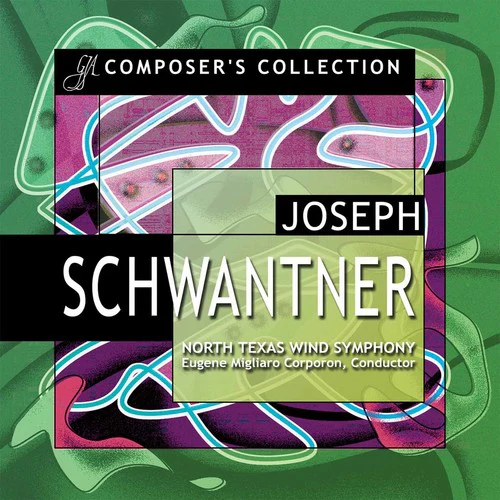
Composer's Collection - Schwantner / Corporon, North Texas
An excellent companion to the recent Schwantner release from Hyperion is this compendium of the composer’s music for wind symphony: four original works (composed between 1977 and 2004) plus a transcription of his sensational and justly popular Percussion Concerto. Not surprisingly, my general comments about Schwantner’s work in the review of the Hyperion release apply here as well, so I will refrain from repeating myself. The chief difference, however, is that while the orchestral repertoire, which sustains itself through an immortal canon of “masterpieces,” strenuously resists new entrants, the wind-ensemble repertoire, younger and more flexible, welcomes newcomers readily. Hence, most of the pieces featured here have already developed widespread reputations through frequent performances.
The earliest work is . . . and the mountains rising nowhere. By the time this review appears, the piece will be 30 years old. It represented an important turning point in Schwantner’s creative development as he emerged from the academic world of serial composition into his own more poetic and evocative musical language. Its premiere by the Eastman Wind Ensemble at a conference of the College Band Directors National Association in 1977 reportedly made a stunning impact on the many band conductors in attendance, and gave birth to a new approach in composing for winds and percussion, one that left the neo-Classicism of much of the mid-20th-century band repertoire far behind. James Popejoy’s program notes for this GIA release state, “This work in particular has had a profound effect on the wind ensemble movement since its premiere and is generally considered as one of the most important and pivotal compositions for winds and percussion of the last thirty years.” . . . and the mountains rising nowhere is scored for amplified piano, 50 percussion instruments, orchestral winds and brass, and tuned glass crystals. The players are expected to sing and whistle as well. So strikingly original is Schwantner’s treatment of the ensemble that one is not immediately aware of the absence of strings, or that one is listening to a band. The performance here is extraordinary and breathtaking. The amplified piano plays a strong role in the work, as it does in each of the four compositions for wind ensemble. The brilliant Polish-born pianist Adam Wodnicki is credited as soloist in mountains. It is not clear from the notes whether he fills this role in the other pieces as well.
. . . and the mountains rising nowhere is so accessible that its impact is immediate, so it’s no surprise that it spawned so many similar works in its wake. Of course, some of these similar works came from the pen of Schwantner himself. From a Dark Millennium (1980), written for the Mid-America Conference Band Directors Association, is one such, and it almost outdoes its predecessor with regard to fantastic sonic imagery. This work also exists in a reduced scoring for chamber ensemble, with the title Sanctuary.
Schwantner’s next wind ensemble effort was In evening’s stillness . . .. Composed in 1996 on commission from the Illinois College Band Directors Association, it is very much like the two preceding pieces in overall concept, although, to its credit, it remains fresh and effective. In fact, Schwantner envisions that the three pieces could be performed as a single work in three sections.
The most recent piece presented here is Recoil, composed in 2004 for the University of Connecticut Wind Ensemble. It calls for a somewhat larger ensemble than the previous works, and is also a more active, exciting piece, with lots of rhythmic energy. All four of these works are immediate in their impact and vivid in their imagery, calling to mind visions ranging from ancient rituals of mysterious sorcerers to futuristic landscapes of other worlds.
The remaining work is the transcription for band of Schwantner’s 1994 Percussion Concerto, which he had dedicated to the memory of Stephen Albert, the gifted composer who died in a car accident in 1992 at the age of 51. The work was commissioned by the New York Philharmonic on behalf of its principal percussionist Christopher Lamb, who gave the first performance, under the direction of Leonard Slatkin. The Concerto was recorded in 1998 by the celebrated percussionist Evelyn Glennie, with Slatkin leading the National Symphony Orchestra (reviewed in Fanfare 21:6) in a stupendous performance. It has since been performed numerous times throughout the world. In 1997, Andrew Boysen, Jr. transcribed the work for wind symphony, under Schwantner’s supervision, making it available for performance by the many highly proficient college wind ensembles. Like Recoil, just described, and A Sudden Rainbow (on the Hyperion disc), the Percussion Concerto displays the sense of direction and forward momentum often missing from Schwantner’s music, with the result that these three are among his most effective and fully satisfying compositions. The Concerto’s tremendously exciting first movement seems to show the influence of Steve Reich in its use of irregularly accented ostinato patterns. The elegiac second movement is the emotional core of the work—intensely evocative, conjuring an atmosphere of dark mystery, against which a soft, heartbeat-like motif grows gradually to a tremendous climax. The third movement returns to the rapid, rhythmically aggressive manner of the first movement, with a lengthy, partly improvised, cadenza. The transcription for band is highly effective on its own terms, giving no indication of anything “missing,” although I must admit to a preference for the orchestral version, when the two are placed in direct comparison. But the key factor here may not be the transcription, but, rather, the performance: although soloist Christopher Deane, a member of the percussion faculty of the University of North Texas, does an excellent job on the whole, he takes a curiously slow tempo in the finale, making that movement alone four minutes longer than in the Glennie performance, with the result that the finale seems a bit of a letdown. However, that is really the only criticism I have about any of the performances on this two-CD set. Throughout the set, the North Texas Wind Symphony plays brilliantly, and the sound quality of the recording is breathtaking.
As I stated in my review of the Hyperion release, enthusiasts of Schwantner’s music will definitely enjoy this recording, which may be ordered from www.archivmusic.com. However, some prospective purchasers may balk at being asked to pay $24 for a set that lasts only 83 minutes.
FANFARE: Walter Simmons
The earliest work is . . . and the mountains rising nowhere. By the time this review appears, the piece will be 30 years old. It represented an important turning point in Schwantner’s creative development as he emerged from the academic world of serial composition into his own more poetic and evocative musical language. Its premiere by the Eastman Wind Ensemble at a conference of the College Band Directors National Association in 1977 reportedly made a stunning impact on the many band conductors in attendance, and gave birth to a new approach in composing for winds and percussion, one that left the neo-Classicism of much of the mid-20th-century band repertoire far behind. James Popejoy’s program notes for this GIA release state, “This work in particular has had a profound effect on the wind ensemble movement since its premiere and is generally considered as one of the most important and pivotal compositions for winds and percussion of the last thirty years.” . . . and the mountains rising nowhere is scored for amplified piano, 50 percussion instruments, orchestral winds and brass, and tuned glass crystals. The players are expected to sing and whistle as well. So strikingly original is Schwantner’s treatment of the ensemble that one is not immediately aware of the absence of strings, or that one is listening to a band. The performance here is extraordinary and breathtaking. The amplified piano plays a strong role in the work, as it does in each of the four compositions for wind ensemble. The brilliant Polish-born pianist Adam Wodnicki is credited as soloist in mountains. It is not clear from the notes whether he fills this role in the other pieces as well.
. . . and the mountains rising nowhere is so accessible that its impact is immediate, so it’s no surprise that it spawned so many similar works in its wake. Of course, some of these similar works came from the pen of Schwantner himself. From a Dark Millennium (1980), written for the Mid-America Conference Band Directors Association, is one such, and it almost outdoes its predecessor with regard to fantastic sonic imagery. This work also exists in a reduced scoring for chamber ensemble, with the title Sanctuary.
Schwantner’s next wind ensemble effort was In evening’s stillness . . .. Composed in 1996 on commission from the Illinois College Band Directors Association, it is very much like the two preceding pieces in overall concept, although, to its credit, it remains fresh and effective. In fact, Schwantner envisions that the three pieces could be performed as a single work in three sections.
The most recent piece presented here is Recoil, composed in 2004 for the University of Connecticut Wind Ensemble. It calls for a somewhat larger ensemble than the previous works, and is also a more active, exciting piece, with lots of rhythmic energy. All four of these works are immediate in their impact and vivid in their imagery, calling to mind visions ranging from ancient rituals of mysterious sorcerers to futuristic landscapes of other worlds.
The remaining work is the transcription for band of Schwantner’s 1994 Percussion Concerto, which he had dedicated to the memory of Stephen Albert, the gifted composer who died in a car accident in 1992 at the age of 51. The work was commissioned by the New York Philharmonic on behalf of its principal percussionist Christopher Lamb, who gave the first performance, under the direction of Leonard Slatkin. The Concerto was recorded in 1998 by the celebrated percussionist Evelyn Glennie, with Slatkin leading the National Symphony Orchestra (reviewed in Fanfare 21:6) in a stupendous performance. It has since been performed numerous times throughout the world. In 1997, Andrew Boysen, Jr. transcribed the work for wind symphony, under Schwantner’s supervision, making it available for performance by the many highly proficient college wind ensembles. Like Recoil, just described, and A Sudden Rainbow (on the Hyperion disc), the Percussion Concerto displays the sense of direction and forward momentum often missing from Schwantner’s music, with the result that these three are among his most effective and fully satisfying compositions. The Concerto’s tremendously exciting first movement seems to show the influence of Steve Reich in its use of irregularly accented ostinato patterns. The elegiac second movement is the emotional core of the work—intensely evocative, conjuring an atmosphere of dark mystery, against which a soft, heartbeat-like motif grows gradually to a tremendous climax. The third movement returns to the rapid, rhythmically aggressive manner of the first movement, with a lengthy, partly improvised, cadenza. The transcription for band is highly effective on its own terms, giving no indication of anything “missing,” although I must admit to a preference for the orchestral version, when the two are placed in direct comparison. But the key factor here may not be the transcription, but, rather, the performance: although soloist Christopher Deane, a member of the percussion faculty of the University of North Texas, does an excellent job on the whole, he takes a curiously slow tempo in the finale, making that movement alone four minutes longer than in the Glennie performance, with the result that the finale seems a bit of a letdown. However, that is really the only criticism I have about any of the performances on this two-CD set. Throughout the set, the North Texas Wind Symphony plays brilliantly, and the sound quality of the recording is breathtaking.
As I stated in my review of the Hyperion release, enthusiasts of Schwantner’s music will definitely enjoy this recording, which may be ordered from www.archivmusic.com. However, some prospective purchasers may balk at being asked to pay $24 for a set that lasts only 83 minutes.
FANFARE: Walter Simmons
An excellent companion to the recent Schwantner release from Hyperion is this compendium of the composer’s music for wind symphony: four original works (composed between 1977 and 2004) plus a transcription of his sensational and justly popular Percussion Concerto. Not surprisingly, my general comments about Schwantner’s work in the review of the Hyperion release apply here as well, so I will refrain from repeating myself. The chief difference, however, is that while the orchestral repertoire, which sustains itself through an immortal canon of “masterpieces,” strenuously resists new entrants, the wind-ensemble repertoire, younger and more flexible, welcomes newcomers readily. Hence, most of the pieces featured here have already developed widespread reputations through frequent performances.
The earliest work is . . . and the mountains rising nowhere. By the time this review appears, the piece will be 30 years old. It represented an important turning point in Schwantner’s creative development as he emerged from the academic world of serial composition into his own more poetic and evocative musical language. Its premiere by the Eastman Wind Ensemble at a conference of the College Band Directors National Association in 1977 reportedly made a stunning impact on the many band conductors in attendance, and gave birth to a new approach in composing for winds and percussion, one that left the neo-Classicism of much of the mid-20th-century band repertoire far behind. James Popejoy’s program notes for this GIA release state, “This work in particular has had a profound effect on the wind ensemble movement since its premiere and is generally considered as one of the most important and pivotal compositions for winds and percussion of the last thirty years.” . . . and the mountains rising nowhere is scored for amplified piano, 50 percussion instruments, orchestral winds and brass, and tuned glass crystals. The players are expected to sing and whistle as well. So strikingly original is Schwantner’s treatment of the ensemble that one is not immediately aware of the absence of strings, or that one is listening to a band. The performance here is extraordinary and breathtaking. The amplified piano plays a strong role in the work, as it does in each of the four compositions for wind ensemble. The brilliant Polish-born pianist Adam Wodnicki is credited as soloist in mountains. It is not clear from the notes whether he fills this role in the other pieces as well.
. . . and the mountains rising nowhere is so accessible that its impact is immediate, so it’s no surprise that it spawned so many similar works in its wake. Of course, some of these similar works came from the pen of Schwantner himself. From a Dark Millennium (1980), written for the Mid-America Conference Band Directors Association, is one such, and it almost outdoes its predecessor with regard to fantastic sonic imagery. This work also exists in a reduced scoring for chamber ensemble, with the title Sanctuary.
Schwantner’s next wind ensemble effort was In evening’s stillness . . .. Composed in 1996 on commission from the Illinois College Band Directors Association, it is very much like the two preceding pieces in overall concept, although, to its credit, it remains fresh and effective. In fact, Schwantner envisions that the three pieces could be performed as a single work in three sections.
The most recent piece presented here is Recoil, composed in 2004 for the University of Connecticut Wind Ensemble. It calls for a somewhat larger ensemble than the previous works, and is also a more active, exciting piece, with lots of rhythmic energy. All four of these works are immediate in their impact and vivid in their imagery, calling to mind visions ranging from ancient rituals of mysterious sorcerers to futuristic landscapes of other worlds.
The remaining work is the transcription for band of Schwantner’s 1994 Percussion Concerto, which he had dedicated to the memory of Stephen Albert, the gifted composer who died in a car accident in 1992 at the age of 51. The work was commissioned by the New York Philharmonic on behalf of its principal percussionist Christopher Lamb, who gave the first performance, under the direction of Leonard Slatkin. The Concerto was recorded in 1998 by the celebrated percussionist Evelyn Glennie, with Slatkin leading the National Symphony Orchestra (reviewed in Fanfare 21:6) in a stupendous performance. It has since been performed numerous times throughout the world. In 1997, Andrew Boysen, Jr. transcribed the work for wind symphony, under Schwantner’s supervision, making it available for performance by the many highly proficient college wind ensembles. Like Recoil, just described, and A Sudden Rainbow (on the Hyperion disc), the Percussion Concerto displays the sense of direction and forward momentum often missing from Schwantner’s music, with the result that these three are among his most effective and fully satisfying compositions. The Concerto’s tremendously exciting first movement seems to show the influence of Steve Reich in its use of irregularly accented ostinato patterns. The elegiac second movement is the emotional core of the work—intensely evocative, conjuring an atmosphere of dark mystery, against which a soft, heartbeat-like motif grows gradually to a tremendous climax. The third movement returns to the rapid, rhythmically aggressive manner of the first movement, with a lengthy, partly improvised, cadenza. The transcription for band is highly effective on its own terms, giving no indication of anything “missing,” although I must admit to a preference for the orchestral version, when the two are placed in direct comparison. But the key factor here may not be the transcription, but, rather, the performance: although soloist Christopher Deane, a member of the percussion faculty of the University of North Texas, does an excellent job on the whole, he takes a curiously slow tempo in the finale, making that movement alone four minutes longer than in the Glennie performance, with the result that the finale seems a bit of a letdown. However, that is really the only criticism I have about any of the performances on this two-CD set. Throughout the set, the North Texas Wind Symphony plays brilliantly, and the sound quality of the recording is breathtaking.
As I stated in my review of the Hyperion release, enthusiasts of Schwantner’s music will definitely enjoy this recording, which may be ordered from www.archivmusic.com. However, some prospective purchasers may balk at being asked to pay $24 for a set that lasts only 83 minutes.
FANFARE: Walter Simmons
The earliest work is . . . and the mountains rising nowhere. By the time this review appears, the piece will be 30 years old. It represented an important turning point in Schwantner’s creative development as he emerged from the academic world of serial composition into his own more poetic and evocative musical language. Its premiere by the Eastman Wind Ensemble at a conference of the College Band Directors National Association in 1977 reportedly made a stunning impact on the many band conductors in attendance, and gave birth to a new approach in composing for winds and percussion, one that left the neo-Classicism of much of the mid-20th-century band repertoire far behind. James Popejoy’s program notes for this GIA release state, “This work in particular has had a profound effect on the wind ensemble movement since its premiere and is generally considered as one of the most important and pivotal compositions for winds and percussion of the last thirty years.” . . . and the mountains rising nowhere is scored for amplified piano, 50 percussion instruments, orchestral winds and brass, and tuned glass crystals. The players are expected to sing and whistle as well. So strikingly original is Schwantner’s treatment of the ensemble that one is not immediately aware of the absence of strings, or that one is listening to a band. The performance here is extraordinary and breathtaking. The amplified piano plays a strong role in the work, as it does in each of the four compositions for wind ensemble. The brilliant Polish-born pianist Adam Wodnicki is credited as soloist in mountains. It is not clear from the notes whether he fills this role in the other pieces as well.
. . . and the mountains rising nowhere is so accessible that its impact is immediate, so it’s no surprise that it spawned so many similar works in its wake. Of course, some of these similar works came from the pen of Schwantner himself. From a Dark Millennium (1980), written for the Mid-America Conference Band Directors Association, is one such, and it almost outdoes its predecessor with regard to fantastic sonic imagery. This work also exists in a reduced scoring for chamber ensemble, with the title Sanctuary.
Schwantner’s next wind ensemble effort was In evening’s stillness . . .. Composed in 1996 on commission from the Illinois College Band Directors Association, it is very much like the two preceding pieces in overall concept, although, to its credit, it remains fresh and effective. In fact, Schwantner envisions that the three pieces could be performed as a single work in three sections.
The most recent piece presented here is Recoil, composed in 2004 for the University of Connecticut Wind Ensemble. It calls for a somewhat larger ensemble than the previous works, and is also a more active, exciting piece, with lots of rhythmic energy. All four of these works are immediate in their impact and vivid in their imagery, calling to mind visions ranging from ancient rituals of mysterious sorcerers to futuristic landscapes of other worlds.
The remaining work is the transcription for band of Schwantner’s 1994 Percussion Concerto, which he had dedicated to the memory of Stephen Albert, the gifted composer who died in a car accident in 1992 at the age of 51. The work was commissioned by the New York Philharmonic on behalf of its principal percussionist Christopher Lamb, who gave the first performance, under the direction of Leonard Slatkin. The Concerto was recorded in 1998 by the celebrated percussionist Evelyn Glennie, with Slatkin leading the National Symphony Orchestra (reviewed in Fanfare 21:6) in a stupendous performance. It has since been performed numerous times throughout the world. In 1997, Andrew Boysen, Jr. transcribed the work for wind symphony, under Schwantner’s supervision, making it available for performance by the many highly proficient college wind ensembles. Like Recoil, just described, and A Sudden Rainbow (on the Hyperion disc), the Percussion Concerto displays the sense of direction and forward momentum often missing from Schwantner’s music, with the result that these three are among his most effective and fully satisfying compositions. The Concerto’s tremendously exciting first movement seems to show the influence of Steve Reich in its use of irregularly accented ostinato patterns. The elegiac second movement is the emotional core of the work—intensely evocative, conjuring an atmosphere of dark mystery, against which a soft, heartbeat-like motif grows gradually to a tremendous climax. The third movement returns to the rapid, rhythmically aggressive manner of the first movement, with a lengthy, partly improvised, cadenza. The transcription for band is highly effective on its own terms, giving no indication of anything “missing,” although I must admit to a preference for the orchestral version, when the two are placed in direct comparison. But the key factor here may not be the transcription, but, rather, the performance: although soloist Christopher Deane, a member of the percussion faculty of the University of North Texas, does an excellent job on the whole, he takes a curiously slow tempo in the finale, making that movement alone four minutes longer than in the Glennie performance, with the result that the finale seems a bit of a letdown. However, that is really the only criticism I have about any of the performances on this two-CD set. Throughout the set, the North Texas Wind Symphony plays brilliantly, and the sound quality of the recording is breathtaking.
As I stated in my review of the Hyperion release, enthusiasts of Schwantner’s music will definitely enjoy this recording, which may be ordered from www.archivmusic.com. However, some prospective purchasers may balk at being asked to pay $24 for a set that lasts only 83 minutes.
FANFARE: Walter Simmons
$9.80
Original: $27.99
-65%Composer's Collection - Schwantner / Corporon, North Texas—
$27.99
$9.80Description
An excellent companion to the recent Schwantner release from Hyperion is this compendium of the composer’s music for wind symphony: four original works (composed between 1977 and 2004) plus a transcription of his sensational and justly popular Percussion Concerto. Not surprisingly, my general comments about Schwantner’s work in the review of the Hyperion release apply here as well, so I will refrain from repeating myself. The chief difference, however, is that while the orchestral repertoire, which sustains itself through an immortal canon of “masterpieces,” strenuously resists new entrants, the wind-ensemble repertoire, younger and more flexible, welcomes newcomers readily. Hence, most of the pieces featured here have already developed widespread reputations through frequent performances.
The earliest work is . . . and the mountains rising nowhere. By the time this review appears, the piece will be 30 years old. It represented an important turning point in Schwantner’s creative development as he emerged from the academic world of serial composition into his own more poetic and evocative musical language. Its premiere by the Eastman Wind Ensemble at a conference of the College Band Directors National Association in 1977 reportedly made a stunning impact on the many band conductors in attendance, and gave birth to a new approach in composing for winds and percussion, one that left the neo-Classicism of much of the mid-20th-century band repertoire far behind. James Popejoy’s program notes for this GIA release state, “This work in particular has had a profound effect on the wind ensemble movement since its premiere and is generally considered as one of the most important and pivotal compositions for winds and percussion of the last thirty years.” . . . and the mountains rising nowhere is scored for amplified piano, 50 percussion instruments, orchestral winds and brass, and tuned glass crystals. The players are expected to sing and whistle as well. So strikingly original is Schwantner’s treatment of the ensemble that one is not immediately aware of the absence of strings, or that one is listening to a band. The performance here is extraordinary and breathtaking. The amplified piano plays a strong role in the work, as it does in each of the four compositions for wind ensemble. The brilliant Polish-born pianist Adam Wodnicki is credited as soloist in mountains. It is not clear from the notes whether he fills this role in the other pieces as well.
. . . and the mountains rising nowhere is so accessible that its impact is immediate, so it’s no surprise that it spawned so many similar works in its wake. Of course, some of these similar works came from the pen of Schwantner himself. From a Dark Millennium (1980), written for the Mid-America Conference Band Directors Association, is one such, and it almost outdoes its predecessor with regard to fantastic sonic imagery. This work also exists in a reduced scoring for chamber ensemble, with the title Sanctuary.
Schwantner’s next wind ensemble effort was In evening’s stillness . . .. Composed in 1996 on commission from the Illinois College Band Directors Association, it is very much like the two preceding pieces in overall concept, although, to its credit, it remains fresh and effective. In fact, Schwantner envisions that the three pieces could be performed as a single work in three sections.
The most recent piece presented here is Recoil, composed in 2004 for the University of Connecticut Wind Ensemble. It calls for a somewhat larger ensemble than the previous works, and is also a more active, exciting piece, with lots of rhythmic energy. All four of these works are immediate in their impact and vivid in their imagery, calling to mind visions ranging from ancient rituals of mysterious sorcerers to futuristic landscapes of other worlds.
The remaining work is the transcription for band of Schwantner’s 1994 Percussion Concerto, which he had dedicated to the memory of Stephen Albert, the gifted composer who died in a car accident in 1992 at the age of 51. The work was commissioned by the New York Philharmonic on behalf of its principal percussionist Christopher Lamb, who gave the first performance, under the direction of Leonard Slatkin. The Concerto was recorded in 1998 by the celebrated percussionist Evelyn Glennie, with Slatkin leading the National Symphony Orchestra (reviewed in Fanfare 21:6) in a stupendous performance. It has since been performed numerous times throughout the world. In 1997, Andrew Boysen, Jr. transcribed the work for wind symphony, under Schwantner’s supervision, making it available for performance by the many highly proficient college wind ensembles. Like Recoil, just described, and A Sudden Rainbow (on the Hyperion disc), the Percussion Concerto displays the sense of direction and forward momentum often missing from Schwantner’s music, with the result that these three are among his most effective and fully satisfying compositions. The Concerto’s tremendously exciting first movement seems to show the influence of Steve Reich in its use of irregularly accented ostinato patterns. The elegiac second movement is the emotional core of the work—intensely evocative, conjuring an atmosphere of dark mystery, against which a soft, heartbeat-like motif grows gradually to a tremendous climax. The third movement returns to the rapid, rhythmically aggressive manner of the first movement, with a lengthy, partly improvised, cadenza. The transcription for band is highly effective on its own terms, giving no indication of anything “missing,” although I must admit to a preference for the orchestral version, when the two are placed in direct comparison. But the key factor here may not be the transcription, but, rather, the performance: although soloist Christopher Deane, a member of the percussion faculty of the University of North Texas, does an excellent job on the whole, he takes a curiously slow tempo in the finale, making that movement alone four minutes longer than in the Glennie performance, with the result that the finale seems a bit of a letdown. However, that is really the only criticism I have about any of the performances on this two-CD set. Throughout the set, the North Texas Wind Symphony plays brilliantly, and the sound quality of the recording is breathtaking.
As I stated in my review of the Hyperion release, enthusiasts of Schwantner’s music will definitely enjoy this recording, which may be ordered from www.archivmusic.com. However, some prospective purchasers may balk at being asked to pay $24 for a set that lasts only 83 minutes.
FANFARE: Walter Simmons
The earliest work is . . . and the mountains rising nowhere. By the time this review appears, the piece will be 30 years old. It represented an important turning point in Schwantner’s creative development as he emerged from the academic world of serial composition into his own more poetic and evocative musical language. Its premiere by the Eastman Wind Ensemble at a conference of the College Band Directors National Association in 1977 reportedly made a stunning impact on the many band conductors in attendance, and gave birth to a new approach in composing for winds and percussion, one that left the neo-Classicism of much of the mid-20th-century band repertoire far behind. James Popejoy’s program notes for this GIA release state, “This work in particular has had a profound effect on the wind ensemble movement since its premiere and is generally considered as one of the most important and pivotal compositions for winds and percussion of the last thirty years.” . . . and the mountains rising nowhere is scored for amplified piano, 50 percussion instruments, orchestral winds and brass, and tuned glass crystals. The players are expected to sing and whistle as well. So strikingly original is Schwantner’s treatment of the ensemble that one is not immediately aware of the absence of strings, or that one is listening to a band. The performance here is extraordinary and breathtaking. The amplified piano plays a strong role in the work, as it does in each of the four compositions for wind ensemble. The brilliant Polish-born pianist Adam Wodnicki is credited as soloist in mountains. It is not clear from the notes whether he fills this role in the other pieces as well.
. . . and the mountains rising nowhere is so accessible that its impact is immediate, so it’s no surprise that it spawned so many similar works in its wake. Of course, some of these similar works came from the pen of Schwantner himself. From a Dark Millennium (1980), written for the Mid-America Conference Band Directors Association, is one such, and it almost outdoes its predecessor with regard to fantastic sonic imagery. This work also exists in a reduced scoring for chamber ensemble, with the title Sanctuary.
Schwantner’s next wind ensemble effort was In evening’s stillness . . .. Composed in 1996 on commission from the Illinois College Band Directors Association, it is very much like the two preceding pieces in overall concept, although, to its credit, it remains fresh and effective. In fact, Schwantner envisions that the three pieces could be performed as a single work in three sections.
The most recent piece presented here is Recoil, composed in 2004 for the University of Connecticut Wind Ensemble. It calls for a somewhat larger ensemble than the previous works, and is also a more active, exciting piece, with lots of rhythmic energy. All four of these works are immediate in their impact and vivid in their imagery, calling to mind visions ranging from ancient rituals of mysterious sorcerers to futuristic landscapes of other worlds.
The remaining work is the transcription for band of Schwantner’s 1994 Percussion Concerto, which he had dedicated to the memory of Stephen Albert, the gifted composer who died in a car accident in 1992 at the age of 51. The work was commissioned by the New York Philharmonic on behalf of its principal percussionist Christopher Lamb, who gave the first performance, under the direction of Leonard Slatkin. The Concerto was recorded in 1998 by the celebrated percussionist Evelyn Glennie, with Slatkin leading the National Symphony Orchestra (reviewed in Fanfare 21:6) in a stupendous performance. It has since been performed numerous times throughout the world. In 1997, Andrew Boysen, Jr. transcribed the work for wind symphony, under Schwantner’s supervision, making it available for performance by the many highly proficient college wind ensembles. Like Recoil, just described, and A Sudden Rainbow (on the Hyperion disc), the Percussion Concerto displays the sense of direction and forward momentum often missing from Schwantner’s music, with the result that these three are among his most effective and fully satisfying compositions. The Concerto’s tremendously exciting first movement seems to show the influence of Steve Reich in its use of irregularly accented ostinato patterns. The elegiac second movement is the emotional core of the work—intensely evocative, conjuring an atmosphere of dark mystery, against which a soft, heartbeat-like motif grows gradually to a tremendous climax. The third movement returns to the rapid, rhythmically aggressive manner of the first movement, with a lengthy, partly improvised, cadenza. The transcription for band is highly effective on its own terms, giving no indication of anything “missing,” although I must admit to a preference for the orchestral version, when the two are placed in direct comparison. But the key factor here may not be the transcription, but, rather, the performance: although soloist Christopher Deane, a member of the percussion faculty of the University of North Texas, does an excellent job on the whole, he takes a curiously slow tempo in the finale, making that movement alone four minutes longer than in the Glennie performance, with the result that the finale seems a bit of a letdown. However, that is really the only criticism I have about any of the performances on this two-CD set. Throughout the set, the North Texas Wind Symphony plays brilliantly, and the sound quality of the recording is breathtaking.
As I stated in my review of the Hyperion release, enthusiasts of Schwantner’s music will definitely enjoy this recording, which may be ordered from www.archivmusic.com. However, some prospective purchasers may balk at being asked to pay $24 for a set that lasts only 83 minutes.
FANFARE: Walter Simmons






















