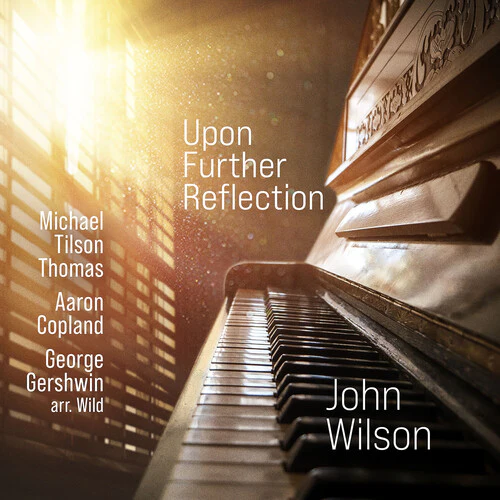
Upon Further Reflection - Copland, Tilson Thomas & Wild / Wilson
Pianist John Wilson, like his mentor Michael Tilson Thomas, is a servant of the music rather than its dictator and he knows both when and how to step back and let it speak.
The dynamic young American pianist John Wilson first encountered Michael Tilson Thomas (affectionately known as "MTT") in 2015 when he was a fellow with the New World Symphony. John’s protégé status quickly evolved to that of close confidant and collaborator, leading to this solo debut album featuring the world-premiere recording of the title track, MTT’s three-movement suite for piano, Upon Further Reflection. MTT explains innumerable influences that are embedded throughout the work, including the piano music of Debussy and Schumann, bossa nova, gamelan, ragas, Monteverdi, Berg, and Peggy Lee’s rendition of the song "Alley Cat," all of which “flowed together in a way that seemed completely natural... to me anyway.” In 2019, John premiered a portion of Upon Further Reflection that was broadcast live on MediciTV to an audience of over 50,000. John embellishes the album’s Americana theme with two titans of the solo piano repertoire – Aaron Copland’s early Piano Sonata – a work lesser-heard than the composer’s other works for solo piano – and Earl Wild’s virtuoso arrangements of seven of George Gershwin’s most iconic tunes.
REVIEW:
Given the scope and versatility of his long conducting career, it’s no surprise that Michael Tilson Thomas’s work as a composer has, until now, largely passed under the radar. In recent years, though, it’s begun to emerge. MTT’s latest champion is the pianist John Wilson, a former fellow with the conductor’s New World Symphony and a brilliantly gifted pianist.
His new album, Upon Further Reflection takes its cue from Tilson Thomas: the title track is a three-movement meditation on the artist’s early life, while subsequent selections by Earl Wild and Aaron Copland draw out different strands of MTT’s personality and long career. Taken together, the program paints an affecting portrait.
Upon Further Reflection is an ingratiating piece. Its freshness derives partly from its eclecticism – echoes of jazz, bossa nova, and Broadway collide with more abstracted, nostalgic expressivity – and partly from its wild virtuosity. Indeed, no small part of the thrill of Wilson’s performance is hearing the terrific dexterity with which the pianist dispatches its busiest textures (particularly the concluding “You Come Here Often?,” its material adapted from an aborted 1977 musical).
While Wilson’s just as comfortable with the music’s more ruminative moments – the reflective and somewhat brooding outer thirds in “Sunset Soliloquy (Whitsett Avenue 1963)” are tenderly shaped – much of this piece, like MTT, is smartly extroverted. The profile of the refrains in “Bygone Beguine (1973)” grow in intensity and definition as the movement proceeds, but they never lose their soulful vibe.
Filling out the disc are Wild’s 7 Virtuoso Etudes after Gershwin and Copland’s Piano Sonata.
The Wild set, with their knowing adaptations of familiar tunes, fit smartly alongside Reflection. And Wilson, whose playing is magnificently secure and flawlessly balanced, gives a reading that rivals Wild’s own for character; it exceeds it for recorded quality.
Wilson’s account of Copland’s Piano Sonata is shaped with similar thoughtfulness. This 1942 score is years removed from the populist composer of that day – its harmonic acerbity recalls the Piano Variations of 1930 much more than Rodeo or Appalachian Spring. Regardless, it’s a powerfully-structured work whose three movements chart a course from turbulence to nervous peace.
The pianist has got real sympathy for this music: how it’s structured, how the melodic line develops, its drama is paced, the shifting tone colors, and so on. His control of dynamic contrasts and balances in the first movement are masterful, as is his transition in to the driving Allegro. In the central Vivace, the music shimmers, while the stentorian, oracular gestures at the start of the finale simply melt into the movement’s concluding diatonic counterpoint.
True, that transition provides one of the most powerful contrasts on this disc – and it’s more a compositional accomplishment than an interpretive one. But Wilson, like his mentor MTT, is a servant of the music rather than its dictator and he knows both when and how to step back and let it speak. The result is a performance of raw power and touching beauty.
-- The Arts Fuse (Jonathan Blumhofer)
Pianist John Wilson, like his mentor Michael Tilson Thomas, is a servant of the music rather than its dictator and he knows both when and how to step back and let it speak.
The dynamic young American pianist John Wilson first encountered Michael Tilson Thomas (affectionately known as "MTT") in 2015 when he was a fellow with the New World Symphony. John’s protégé status quickly evolved to that of close confidant and collaborator, leading to this solo debut album featuring the world-premiere recording of the title track, MTT’s three-movement suite for piano, Upon Further Reflection. MTT explains innumerable influences that are embedded throughout the work, including the piano music of Debussy and Schumann, bossa nova, gamelan, ragas, Monteverdi, Berg, and Peggy Lee’s rendition of the song "Alley Cat," all of which “flowed together in a way that seemed completely natural... to me anyway.” In 2019, John premiered a portion of Upon Further Reflection that was broadcast live on MediciTV to an audience of over 50,000. John embellishes the album’s Americana theme with two titans of the solo piano repertoire – Aaron Copland’s early Piano Sonata – a work lesser-heard than the composer’s other works for solo piano – and Earl Wild’s virtuoso arrangements of seven of George Gershwin’s most iconic tunes.
REVIEW:
Given the scope and versatility of his long conducting career, it’s no surprise that Michael Tilson Thomas’s work as a composer has, until now, largely passed under the radar. In recent years, though, it’s begun to emerge. MTT’s latest champion is the pianist John Wilson, a former fellow with the conductor’s New World Symphony and a brilliantly gifted pianist.
His new album, Upon Further Reflection takes its cue from Tilson Thomas: the title track is a three-movement meditation on the artist’s early life, while subsequent selections by Earl Wild and Aaron Copland draw out different strands of MTT’s personality and long career. Taken together, the program paints an affecting portrait.
Upon Further Reflection is an ingratiating piece. Its freshness derives partly from its eclecticism – echoes of jazz, bossa nova, and Broadway collide with more abstracted, nostalgic expressivity – and partly from its wild virtuosity. Indeed, no small part of the thrill of Wilson’s performance is hearing the terrific dexterity with which the pianist dispatches its busiest textures (particularly the concluding “You Come Here Often?,” its material adapted from an aborted 1977 musical).
While Wilson’s just as comfortable with the music’s more ruminative moments – the reflective and somewhat brooding outer thirds in “Sunset Soliloquy (Whitsett Avenue 1963)” are tenderly shaped – much of this piece, like MTT, is smartly extroverted. The profile of the refrains in “Bygone Beguine (1973)” grow in intensity and definition as the movement proceeds, but they never lose their soulful vibe.
Filling out the disc are Wild’s 7 Virtuoso Etudes after Gershwin and Copland’s Piano Sonata.
The Wild set, with their knowing adaptations of familiar tunes, fit smartly alongside Reflection. And Wilson, whose playing is magnificently secure and flawlessly balanced, gives a reading that rivals Wild’s own for character; it exceeds it for recorded quality.
Wilson’s account of Copland’s Piano Sonata is shaped with similar thoughtfulness. This 1942 score is years removed from the populist composer of that day – its harmonic acerbity recalls the Piano Variations of 1930 much more than Rodeo or Appalachian Spring. Regardless, it’s a powerfully-structured work whose three movements chart a course from turbulence to nervous peace.
The pianist has got real sympathy for this music: how it’s structured, how the melodic line develops, its drama is paced, the shifting tone colors, and so on. His control of dynamic contrasts and balances in the first movement are masterful, as is his transition in to the driving Allegro. In the central Vivace, the music shimmers, while the stentorian, oracular gestures at the start of the finale simply melt into the movement’s concluding diatonic counterpoint.
True, that transition provides one of the most powerful contrasts on this disc – and it’s more a compositional accomplishment than an interpretive one. But Wilson, like his mentor MTT, is a servant of the music rather than its dictator and he knows both when and how to step back and let it speak. The result is a performance of raw power and touching beauty.
-- The Arts Fuse (Jonathan Blumhofer)
Original: $9.99
-65%$9.99
$3.50Description
Pianist John Wilson, like his mentor Michael Tilson Thomas, is a servant of the music rather than its dictator and he knows both when and how to step back and let it speak.
The dynamic young American pianist John Wilson first encountered Michael Tilson Thomas (affectionately known as "MTT") in 2015 when he was a fellow with the New World Symphony. John’s protégé status quickly evolved to that of close confidant and collaborator, leading to this solo debut album featuring the world-premiere recording of the title track, MTT’s three-movement suite for piano, Upon Further Reflection. MTT explains innumerable influences that are embedded throughout the work, including the piano music of Debussy and Schumann, bossa nova, gamelan, ragas, Monteverdi, Berg, and Peggy Lee’s rendition of the song "Alley Cat," all of which “flowed together in a way that seemed completely natural... to me anyway.” In 2019, John premiered a portion of Upon Further Reflection that was broadcast live on MediciTV to an audience of over 50,000. John embellishes the album’s Americana theme with two titans of the solo piano repertoire – Aaron Copland’s early Piano Sonata – a work lesser-heard than the composer’s other works for solo piano – and Earl Wild’s virtuoso arrangements of seven of George Gershwin’s most iconic tunes.
REVIEW:
Given the scope and versatility of his long conducting career, it’s no surprise that Michael Tilson Thomas’s work as a composer has, until now, largely passed under the radar. In recent years, though, it’s begun to emerge. MTT’s latest champion is the pianist John Wilson, a former fellow with the conductor’s New World Symphony and a brilliantly gifted pianist.
His new album, Upon Further Reflection takes its cue from Tilson Thomas: the title track is a three-movement meditation on the artist’s early life, while subsequent selections by Earl Wild and Aaron Copland draw out different strands of MTT’s personality and long career. Taken together, the program paints an affecting portrait.
Upon Further Reflection is an ingratiating piece. Its freshness derives partly from its eclecticism – echoes of jazz, bossa nova, and Broadway collide with more abstracted, nostalgic expressivity – and partly from its wild virtuosity. Indeed, no small part of the thrill of Wilson’s performance is hearing the terrific dexterity with which the pianist dispatches its busiest textures (particularly the concluding “You Come Here Often?,” its material adapted from an aborted 1977 musical).
While Wilson’s just as comfortable with the music’s more ruminative moments – the reflective and somewhat brooding outer thirds in “Sunset Soliloquy (Whitsett Avenue 1963)” are tenderly shaped – much of this piece, like MTT, is smartly extroverted. The profile of the refrains in “Bygone Beguine (1973)” grow in intensity and definition as the movement proceeds, but they never lose their soulful vibe.
Filling out the disc are Wild’s 7 Virtuoso Etudes after Gershwin and Copland’s Piano Sonata.
The Wild set, with their knowing adaptations of familiar tunes, fit smartly alongside Reflection. And Wilson, whose playing is magnificently secure and flawlessly balanced, gives a reading that rivals Wild’s own for character; it exceeds it for recorded quality.
Wilson’s account of Copland’s Piano Sonata is shaped with similar thoughtfulness. This 1942 score is years removed from the populist composer of that day – its harmonic acerbity recalls the Piano Variations of 1930 much more than Rodeo or Appalachian Spring. Regardless, it’s a powerfully-structured work whose three movements chart a course from turbulence to nervous peace.
The pianist has got real sympathy for this music: how it’s structured, how the melodic line develops, its drama is paced, the shifting tone colors, and so on. His control of dynamic contrasts and balances in the first movement are masterful, as is his transition in to the driving Allegro. In the central Vivace, the music shimmers, while the stentorian, oracular gestures at the start of the finale simply melt into the movement’s concluding diatonic counterpoint.
True, that transition provides one of the most powerful contrasts on this disc – and it’s more a compositional accomplishment than an interpretive one. But Wilson, like his mentor MTT, is a servant of the music rather than its dictator and he knows both when and how to step back and let it speak. The result is a performance of raw power and touching beauty.
-- The Arts Fuse (Jonathan Blumhofer)