🎉 Up to 70% Off Selected ItemsShop Sale

1 / 2
Corelli: 12 Sonatas, Op. 5 / Trio Corelli
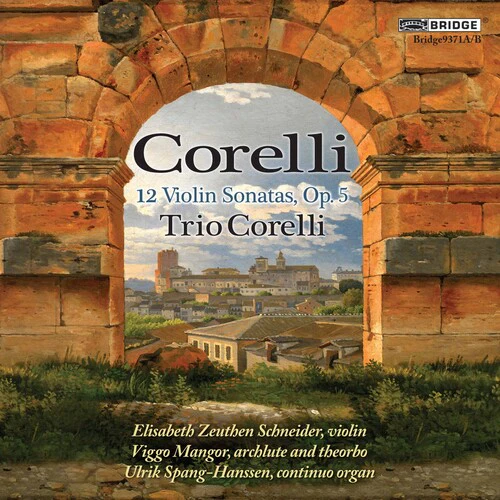
CORELLI 12 Violin Sonatas, op. 5 • Corelli Trio • BRIDGE 9371 (2 CDs: 125:34)
Here is an absolutely dazzling album that I reviewed, more or less, on a whim. Arcangelo Corelli, a fine composer who certainly introduced some innovations (those marvelous and unexpected string slides that take your breath away), wasn’t exactly a Buxtehude or a Bach, yet as this two-CD set amply proves, his music can certainly hold its own in interest and especially in charm with anyone from the Baroque era, even his fellow Italians Scarlatti and Vivaldi.
Of course, as in the case of virtually all music, the aural impact is highly dependent on the performer, and on this recording we have a truly inspired violinist in Elisabeth Zeuthen Schneider. In the booklet she is quoted as saying that Corelli’s sonatas “are an invitation to explore the most sunny and expressive voices of the violin as well as having the fun of the dancing and wild abandon of ‘La Folia’ that closes the whole set of 12 sonatas.” Further on, she makes a distinction between the church sonatas on disc 1, which she feels explore “more profound and spiritual feelings” than the chamber sonatas on disc 2, but even in those first six sonatas Schneider’s playing is sunny, singing, and full of vitality. I think that she just can’t help herself from feeling good while playing this music; I certainly couldn’t help smiling or feeling good all through the sonatas on the first disc. Schneider’s playing has that same rare combination of sweetness, elegance, charm, and sheer sunniness that one heard in the playing of Yehudi Menuhin. Also, different from most historically informed violinists, she is not averse to playing a few notes with a light vibrato, which adds piquancy and charm to her interpretations.
Moving from disc 1 to disc 2, the secular sonatas, one notices very little difference in general layout, tempos, or indeed inflection. I find Schneider’s playing no lighter, more buoyant, or infectious than on CD 1, but then again, there’s no drop-off in quality, either. She’s just plain good.
An interesting observation: All of the church sonatas are in major keys, but half of the secular sonatas are in minor, including, of course, “La Folia.” In the latter, Schneider pulls out all the stops—literally, including double-stops!—and her performance is indeed lively.
Like so many trio sonatas of this era, the accompanying instruments are just that—background to the soloist. As a result, despite the fact that they are well-trained musicians who play well, there’s really not a lot one can say about Viggo Mangor on archlute and theorbo or Ulrik Spang-Hanssen on continuo organ except that they are there, they give good support, and they keep the rhythm light.
In the booklet, it says that Corelli was a quiet man who “never devoted much time to self-promotion” and “didn’t nurse his reputation publicly in his later years.” Apparently, much the same can be said of the Corelli Trio, for although there are bios of all three musicians, there’s not a single word as to how or why they formed or call themselves “Corelli Trio”! But you certainly won’t keep their presence much of a secret once you hear this album.
FANFARE: Lynn René Bayley
CORELLI 12 Violin Sonatas, op. 5 • Corelli Trio • BRIDGE 9371 (2 CDs: 125:34)
Here is an absolutely dazzling album that I reviewed, more or less, on a whim. Arcangelo Corelli, a fine composer who certainly introduced some innovations (those marvelous and unexpected string slides that take your breath away), wasn’t exactly a Buxtehude or a Bach, yet as this two-CD set amply proves, his music can certainly hold its own in interest and especially in charm with anyone from the Baroque era, even his fellow Italians Scarlatti and Vivaldi.
Of course, as in the case of virtually all music, the aural impact is highly dependent on the performer, and on this recording we have a truly inspired violinist in Elisabeth Zeuthen Schneider. In the booklet she is quoted as saying that Corelli’s sonatas “are an invitation to explore the most sunny and expressive voices of the violin as well as having the fun of the dancing and wild abandon of ‘La Folia’ that closes the whole set of 12 sonatas.” Further on, she makes a distinction between the church sonatas on disc 1, which she feels explore “more profound and spiritual feelings” than the chamber sonatas on disc 2, but even in those first six sonatas Schneider’s playing is sunny, singing, and full of vitality. I think that she just can’t help herself from feeling good while playing this music; I certainly couldn’t help smiling or feeling good all through the sonatas on the first disc. Schneider’s playing has that same rare combination of sweetness, elegance, charm, and sheer sunniness that one heard in the playing of Yehudi Menuhin. Also, different from most historically informed violinists, she is not averse to playing a few notes with a light vibrato, which adds piquancy and charm to her interpretations.
Moving from disc 1 to disc 2, the secular sonatas, one notices very little difference in general layout, tempos, or indeed inflection. I find Schneider’s playing no lighter, more buoyant, or infectious than on CD 1, but then again, there’s no drop-off in quality, either. She’s just plain good.
An interesting observation: All of the church sonatas are in major keys, but half of the secular sonatas are in minor, including, of course, “La Folia.” In the latter, Schneider pulls out all the stops—literally, including double-stops!—and her performance is indeed lively.
Like so many trio sonatas of this era, the accompanying instruments are just that—background to the soloist. As a result, despite the fact that they are well-trained musicians who play well, there’s really not a lot one can say about Viggo Mangor on archlute and theorbo or Ulrik Spang-Hanssen on continuo organ except that they are there, they give good support, and they keep the rhythm light.
In the booklet, it says that Corelli was a quiet man who “never devoted much time to self-promotion” and “didn’t nurse his reputation publicly in his later years.” Apparently, much the same can be said of the Corelli Trio, for although there are bios of all three musicians, there’s not a single word as to how or why they formed or call themselves “Corelli Trio”! But you certainly won’t keep their presence much of a secret once you hear this album.
FANFARE: Lynn René Bayley
$14.99
Corelli: 12 Sonatas, Op. 5 / Trio Corelli—
$14.99
Description
CORELLI 12 Violin Sonatas, op. 5 • Corelli Trio • BRIDGE 9371 (2 CDs: 125:34)
Here is an absolutely dazzling album that I reviewed, more or less, on a whim. Arcangelo Corelli, a fine composer who certainly introduced some innovations (those marvelous and unexpected string slides that take your breath away), wasn’t exactly a Buxtehude or a Bach, yet as this two-CD set amply proves, his music can certainly hold its own in interest and especially in charm with anyone from the Baroque era, even his fellow Italians Scarlatti and Vivaldi.
Of course, as in the case of virtually all music, the aural impact is highly dependent on the performer, and on this recording we have a truly inspired violinist in Elisabeth Zeuthen Schneider. In the booklet she is quoted as saying that Corelli’s sonatas “are an invitation to explore the most sunny and expressive voices of the violin as well as having the fun of the dancing and wild abandon of ‘La Folia’ that closes the whole set of 12 sonatas.” Further on, she makes a distinction between the church sonatas on disc 1, which she feels explore “more profound and spiritual feelings” than the chamber sonatas on disc 2, but even in those first six sonatas Schneider’s playing is sunny, singing, and full of vitality. I think that she just can’t help herself from feeling good while playing this music; I certainly couldn’t help smiling or feeling good all through the sonatas on the first disc. Schneider’s playing has that same rare combination of sweetness, elegance, charm, and sheer sunniness that one heard in the playing of Yehudi Menuhin. Also, different from most historically informed violinists, she is not averse to playing a few notes with a light vibrato, which adds piquancy and charm to her interpretations.
Moving from disc 1 to disc 2, the secular sonatas, one notices very little difference in general layout, tempos, or indeed inflection. I find Schneider’s playing no lighter, more buoyant, or infectious than on CD 1, but then again, there’s no drop-off in quality, either. She’s just plain good.
An interesting observation: All of the church sonatas are in major keys, but half of the secular sonatas are in minor, including, of course, “La Folia.” In the latter, Schneider pulls out all the stops—literally, including double-stops!—and her performance is indeed lively.
Like so many trio sonatas of this era, the accompanying instruments are just that—background to the soloist. As a result, despite the fact that they are well-trained musicians who play well, there’s really not a lot one can say about Viggo Mangor on archlute and theorbo or Ulrik Spang-Hanssen on continuo organ except that they are there, they give good support, and they keep the rhythm light.
In the booklet, it says that Corelli was a quiet man who “never devoted much time to self-promotion” and “didn’t nurse his reputation publicly in his later years.” Apparently, much the same can be said of the Corelli Trio, for although there are bios of all three musicians, there’s not a single word as to how or why they formed or call themselves “Corelli Trio”! But you certainly won’t keep their presence much of a secret once you hear this album.
FANFARE: Lynn René Bayley