🎉 Up to 70% Off Selected ItemsShop Sale

1 / 2
D'Albert: Symphony in F / Markl, MDR SO
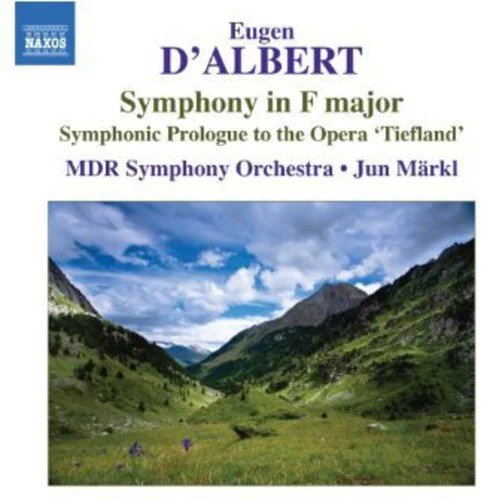
D’ALBERT Tiefland: Symphonic Prologue. Symphony in F, Op. 4 • Jun Märkl, cond; MDR Leipzig RSO • NAXOS 8.572805 (62:40)
A recording of Eugen d’Albert’s early Symphony in F Major appeared on CPO three years ago and was reviewed by James A. Altena in 33:6. That version was conducted by Herman Bäumer leading the Osnabrücker Symphony Orchestra. D’Albert’s life story is reasonably well known, so it needn’t be recapped at length. In short, he was born in Glasgow, studied in London, and at 17 won a scholarship to study in Austria. There he was so taken with Austro-German music and culture that he repudiated his English training as worthless and from that day forward considered himself a right and proper German. He studied with Liszt, met Brahms, and built a career as one of the foremost piano virtuosos of his day. Between 1904 and 1905, d’Albert toured the U.S., and in 1907 succeeded Joseph Joachim as director of Berlin’s Hochschulefür Musik. D’Albert counted among his circle of associates and friends, Richard Strauss, who dedicated his Burleske to him, Hans Pfitzner, Engelbert Humperdinck, and Ignatz Waghalter (see the interview with Irmina Trynkos in 36:3). D’Albert’s personal life was a bit of a mess. Like Henry VIII, he married and divorced six times, though as far as we know, all of d’Albert’s wives kept their heads. When connubial contentment eluded him, he comforted himself in the arms of a mistress. His love of Germany and all things German must have soured when the First World War broke out, for in 1914, he moved to Zurich and became a Swiss citizen. He died, however, in Riga, Latvia, where he’d traveled to secure a divorce from his sixth wife.
Little by little d’Albert’s interest in composing began to overtake his career as a pianist. His output is not insignificant. It includes 21 operas, of which the seventh, Tiefland , first staged in 1903, was a major success, playing in houses around the world. It still holds the boards today, though mainly in Austria and Germany. Other works include a Cello Concerto, two piano concertos (available on Volume 9 of Hyperion’s “Romantic Piano Concerto” series), a couple of string quartets, an overture to Grillparzer’s Esther , a Piano Sonata, a handful of solo piano pieces, and lots and lots of songs.
Note: d’Albert composed the overture to Gilbert and Sullivan’s Patience in 1881, just prior to his departure for Austria. Except for the cello concerto, the two piano concertos, the symphony on this disc, and his opera, Tiefland , plus several recordings of excerpts therefrom, not a lot else by d’Albert has found its way onto disc.
Another note: if you’re searching ArkivMusic for d’Albert, you’ll find him listed under the letter “A,” as Albert, Eugène d’—odd, since the site lists D’Indy as D’Indy, Vincent. Maybe it has something to do with the lowercase “d” vs. the uppercase “D.” Amazon and the Fanfare Archive put d’Albert under “D,” but the Archive purges the apostrophe, giving his name as dAlbert. How many ways can you spell “dog?” How about “dawg?”
I concur in the opinion of others that d’Albert’s compositional strength lies mainly in his mastery of the craft; his thematic ideas lend themselves well to development and he knows his way around the orchestra. I find it a bit more difficult, however, to concur with colleague Altena that Brahms and Schumann are ever-present in d’Albert’s 1886 symphony. If you’ve not heard the piece before, my guess is you would find its soundscape rather generic, as if fashioned from some factory-made, synthetic, wash-and-wear fabric. The garment fits the style of the day, but the pants are somehow baggy and nondescript. Granted, d’Albert was only 22 when he composed his one and only symphony, but attractive as it is in the moment, it’s not the sort of work whose melodies or other features linger.
If the opening strains of the Symphonic Prologue to Tiefland recall the opening of the Scène aux champs movement from Berlioz’s Symphonie fantastique , it’s with good reason. D’Albert is painting a similar pastoral scene in which two shepherds are heard calling to each other on their pipes. Following that, the music seems to meander along a path on which it first meets, greets, and passes Wagner, only to encounter Debussy around the next bend walking his poodles, Pelléas et Mélisande . I confess to never having heard d’Albert’s opera, Tiefland , but if the rest of it is anything like the Prologue, I can understand the work’s success; it’s actually quite alluring, more so I would say than the symphony. But then the symphony is one of the composer’s earliest orchestral efforts—only the Piano Concerto No. 1 of 1884 predates it—whereas Tiefland came after d’Albert’s self-styled conversion to German-hood, and is a mature work by a composer already seasoned in writing for the stage by six previous operas.
I’m unfortunately not familiar with the CPO recording Altena reviewed, but this current release by Jun Märkl and the MDR Leipzig Radio Symphony Orchestra strikes me as eminently satisfactory. Playing and recording are both topnotch, and if you’re not acquainted with d’Albert’s music, this disc, at Naxos’s budget price, is an excellent way to gain some familiarity with it—enough, at least, to know whether you might care to explore further. On those grounds, recommended.
FANFARE: Jerry Dubins
D’ALBERT Tiefland: Symphonic Prologue. Symphony in F, Op. 4 • Jun Märkl, cond; MDR Leipzig RSO • NAXOS 8.572805 (62:40)
A recording of Eugen d’Albert’s early Symphony in F Major appeared on CPO three years ago and was reviewed by James A. Altena in 33:6. That version was conducted by Herman Bäumer leading the Osnabrücker Symphony Orchestra. D’Albert’s life story is reasonably well known, so it needn’t be recapped at length. In short, he was born in Glasgow, studied in London, and at 17 won a scholarship to study in Austria. There he was so taken with Austro-German music and culture that he repudiated his English training as worthless and from that day forward considered himself a right and proper German. He studied with Liszt, met Brahms, and built a career as one of the foremost piano virtuosos of his day. Between 1904 and 1905, d’Albert toured the U.S., and in 1907 succeeded Joseph Joachim as director of Berlin’s Hochschulefür Musik. D’Albert counted among his circle of associates and friends, Richard Strauss, who dedicated his Burleske to him, Hans Pfitzner, Engelbert Humperdinck, and Ignatz Waghalter (see the interview with Irmina Trynkos in 36:3). D’Albert’s personal life was a bit of a mess. Like Henry VIII, he married and divorced six times, though as far as we know, all of d’Albert’s wives kept their heads. When connubial contentment eluded him, he comforted himself in the arms of a mistress. His love of Germany and all things German must have soured when the First World War broke out, for in 1914, he moved to Zurich and became a Swiss citizen. He died, however, in Riga, Latvia, where he’d traveled to secure a divorce from his sixth wife.
Little by little d’Albert’s interest in composing began to overtake his career as a pianist. His output is not insignificant. It includes 21 operas, of which the seventh, Tiefland , first staged in 1903, was a major success, playing in houses around the world. It still holds the boards today, though mainly in Austria and Germany. Other works include a Cello Concerto, two piano concertos (available on Volume 9 of Hyperion’s “Romantic Piano Concerto” series), a couple of string quartets, an overture to Grillparzer’s Esther , a Piano Sonata, a handful of solo piano pieces, and lots and lots of songs.
Note: d’Albert composed the overture to Gilbert and Sullivan’s Patience in 1881, just prior to his departure for Austria. Except for the cello concerto, the two piano concertos, the symphony on this disc, and his opera, Tiefland , plus several recordings of excerpts therefrom, not a lot else by d’Albert has found its way onto disc.
Another note: if you’re searching ArkivMusic for d’Albert, you’ll find him listed under the letter “A,” as Albert, Eugène d’—odd, since the site lists D’Indy as D’Indy, Vincent. Maybe it has something to do with the lowercase “d” vs. the uppercase “D.” Amazon and the Fanfare Archive put d’Albert under “D,” but the Archive purges the apostrophe, giving his name as dAlbert. How many ways can you spell “dog?” How about “dawg?”
I concur in the opinion of others that d’Albert’s compositional strength lies mainly in his mastery of the craft; his thematic ideas lend themselves well to development and he knows his way around the orchestra. I find it a bit more difficult, however, to concur with colleague Altena that Brahms and Schumann are ever-present in d’Albert’s 1886 symphony. If you’ve not heard the piece before, my guess is you would find its soundscape rather generic, as if fashioned from some factory-made, synthetic, wash-and-wear fabric. The garment fits the style of the day, but the pants are somehow baggy and nondescript. Granted, d’Albert was only 22 when he composed his one and only symphony, but attractive as it is in the moment, it’s not the sort of work whose melodies or other features linger.
If the opening strains of the Symphonic Prologue to Tiefland recall the opening of the Scène aux champs movement from Berlioz’s Symphonie fantastique , it’s with good reason. D’Albert is painting a similar pastoral scene in which two shepherds are heard calling to each other on their pipes. Following that, the music seems to meander along a path on which it first meets, greets, and passes Wagner, only to encounter Debussy around the next bend walking his poodles, Pelléas et Mélisande . I confess to never having heard d’Albert’s opera, Tiefland , but if the rest of it is anything like the Prologue, I can understand the work’s success; it’s actually quite alluring, more so I would say than the symphony. But then the symphony is one of the composer’s earliest orchestral efforts—only the Piano Concerto No. 1 of 1884 predates it—whereas Tiefland came after d’Albert’s self-styled conversion to German-hood, and is a mature work by a composer already seasoned in writing for the stage by six previous operas.
I’m unfortunately not familiar with the CPO recording Altena reviewed, but this current release by Jun Märkl and the MDR Leipzig Radio Symphony Orchestra strikes me as eminently satisfactory. Playing and recording are both topnotch, and if you’re not acquainted with d’Albert’s music, this disc, at Naxos’s budget price, is an excellent way to gain some familiarity with it—enough, at least, to know whether you might care to explore further. On those grounds, recommended.
FANFARE: Jerry Dubins
$9.99
D'Albert: Symphony in F / Markl, MDR SO—
$9.99
Description
D’ALBERT Tiefland: Symphonic Prologue. Symphony in F, Op. 4 • Jun Märkl, cond; MDR Leipzig RSO • NAXOS 8.572805 (62:40)
A recording of Eugen d’Albert’s early Symphony in F Major appeared on CPO three years ago and was reviewed by James A. Altena in 33:6. That version was conducted by Herman Bäumer leading the Osnabrücker Symphony Orchestra. D’Albert’s life story is reasonably well known, so it needn’t be recapped at length. In short, he was born in Glasgow, studied in London, and at 17 won a scholarship to study in Austria. There he was so taken with Austro-German music and culture that he repudiated his English training as worthless and from that day forward considered himself a right and proper German. He studied with Liszt, met Brahms, and built a career as one of the foremost piano virtuosos of his day. Between 1904 and 1905, d’Albert toured the U.S., and in 1907 succeeded Joseph Joachim as director of Berlin’s Hochschulefür Musik. D’Albert counted among his circle of associates and friends, Richard Strauss, who dedicated his Burleske to him, Hans Pfitzner, Engelbert Humperdinck, and Ignatz Waghalter (see the interview with Irmina Trynkos in 36:3). D’Albert’s personal life was a bit of a mess. Like Henry VIII, he married and divorced six times, though as far as we know, all of d’Albert’s wives kept their heads. When connubial contentment eluded him, he comforted himself in the arms of a mistress. His love of Germany and all things German must have soured when the First World War broke out, for in 1914, he moved to Zurich and became a Swiss citizen. He died, however, in Riga, Latvia, where he’d traveled to secure a divorce from his sixth wife.
Little by little d’Albert’s interest in composing began to overtake his career as a pianist. His output is not insignificant. It includes 21 operas, of which the seventh, Tiefland , first staged in 1903, was a major success, playing in houses around the world. It still holds the boards today, though mainly in Austria and Germany. Other works include a Cello Concerto, two piano concertos (available on Volume 9 of Hyperion’s “Romantic Piano Concerto” series), a couple of string quartets, an overture to Grillparzer’s Esther , a Piano Sonata, a handful of solo piano pieces, and lots and lots of songs.
Note: d’Albert composed the overture to Gilbert and Sullivan’s Patience in 1881, just prior to his departure for Austria. Except for the cello concerto, the two piano concertos, the symphony on this disc, and his opera, Tiefland , plus several recordings of excerpts therefrom, not a lot else by d’Albert has found its way onto disc.
Another note: if you’re searching ArkivMusic for d’Albert, you’ll find him listed under the letter “A,” as Albert, Eugène d’—odd, since the site lists D’Indy as D’Indy, Vincent. Maybe it has something to do with the lowercase “d” vs. the uppercase “D.” Amazon and the Fanfare Archive put d’Albert under “D,” but the Archive purges the apostrophe, giving his name as dAlbert. How many ways can you spell “dog?” How about “dawg?”
I concur in the opinion of others that d’Albert’s compositional strength lies mainly in his mastery of the craft; his thematic ideas lend themselves well to development and he knows his way around the orchestra. I find it a bit more difficult, however, to concur with colleague Altena that Brahms and Schumann are ever-present in d’Albert’s 1886 symphony. If you’ve not heard the piece before, my guess is you would find its soundscape rather generic, as if fashioned from some factory-made, synthetic, wash-and-wear fabric. The garment fits the style of the day, but the pants are somehow baggy and nondescript. Granted, d’Albert was only 22 when he composed his one and only symphony, but attractive as it is in the moment, it’s not the sort of work whose melodies or other features linger.
If the opening strains of the Symphonic Prologue to Tiefland recall the opening of the Scène aux champs movement from Berlioz’s Symphonie fantastique , it’s with good reason. D’Albert is painting a similar pastoral scene in which two shepherds are heard calling to each other on their pipes. Following that, the music seems to meander along a path on which it first meets, greets, and passes Wagner, only to encounter Debussy around the next bend walking his poodles, Pelléas et Mélisande . I confess to never having heard d’Albert’s opera, Tiefland , but if the rest of it is anything like the Prologue, I can understand the work’s success; it’s actually quite alluring, more so I would say than the symphony. But then the symphony is one of the composer’s earliest orchestral efforts—only the Piano Concerto No. 1 of 1884 predates it—whereas Tiefland came after d’Albert’s self-styled conversion to German-hood, and is a mature work by a composer already seasoned in writing for the stage by six previous operas.
I’m unfortunately not familiar with the CPO recording Altena reviewed, but this current release by Jun Märkl and the MDR Leipzig Radio Symphony Orchestra strikes me as eminently satisfactory. Playing and recording are both topnotch, and if you’re not acquainted with d’Albert’s music, this disc, at Naxos’s budget price, is an excellent way to gain some familiarity with it—enough, at least, to know whether you might care to explore further. On those grounds, recommended.
FANFARE: Jerry Dubins