🎉 Up to 70% Off Selected ItemsShop Sale

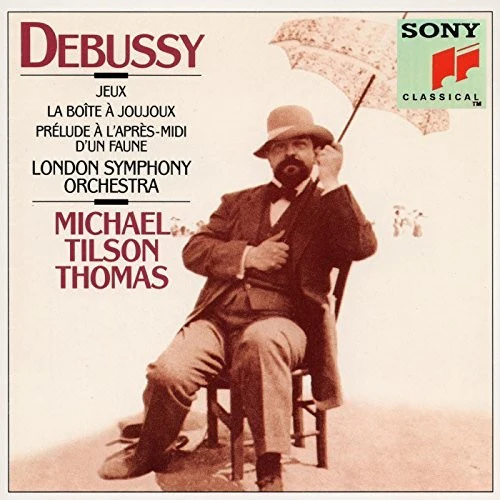
Debussy: Jeux, La Boite A Joujoux, Etc / Tilson Thomas
Maybe reviewers fuss too much about couplings, but in this case, with the Prelude a l'apresmidi dun faune these days extending the timings of virtually every Debussy issue, and with nearly two decades separating it from the later Jeux and La boite a joujoux, as well as it not being a ballet—oh, all right: it may have been conceived for the stage, and was choreographed (and vulgarized) by Nijinsky in 1912—surely a more enterprising choice in keeping with the theme would have been the contemporary and unjustly neglected ballet Khamma. With the standard of performance on offer here, that would indeed have formed a cherishable disc. As it happens, Tilson Thomas's Prelude is very fine: richly drawn and, compared to the recent versions from Boulez (DG) and Solti (Decca), traditionally drawn out, long-breathed and languorous. Overloud horns in the fourth bar would seem to forecast fog, not heat-haze; in other respects the balance (from EMI's Abbey Road Studio No. 1) is good, with integrated but focused solo strings, harps and antique cymbals.
"Toy-boxes are really towns in which the toys live like people" wrote Andre Helle who, in 1913, devised the scenario for La boite a joujoux (adding "or perhaps towns are just boxes in which people live like toys"). But Debussy made no attempt at meaningful symbolism; "something to amuse the children—nothing more" he said. In giving life to the wooden figures, and with its prominent role for piano, inevitably one's thoughts turn to Petrushka, far more dramatically effective, but hardly a children's story—well, not a child of 1913 anyway. Tilson Thomas is more artful than Torteher on Chandos: in the first tableau his doll dances her waltz with more look-at-me' allure and grace—Tortelier's rubato is comparatively (perhaps aptly) mechanical—and, after Punch has biffed the little soldier on the nose, an angrier captain pops his head out of the box. On the debit side, a wooden doll surely wouldn't pray as quietly as does the LSO clarinet in the following tableau after the battle (track 4, 4'45": the marking is only piano); the distant shepherd's piping in the third tableau is not really distant at all, and the flutes are too loud at the moment of embrace between the soldier and the doll at the end of the scene. Whilst I'm grumbling, Sony's notes don't include a synopsis—as entertainment, this music, unlike Jeux, is dependent on knowledge of the stage action (Chandos supply a detailed scenario). If forced to make a choice between the two, it would be Tilson Thomas; his is the more polished, confident and stylish account.
Perhaps Debussy was attracted to the idea of a children's ballet in 1913 to cleanse himself from the sins of Nijinsky's staging of his Prelude and Jeux (May 1912 and 1913 respectively). While enthusiastically welcoming Simon Rattle's Jeux (EMI), CH noted that the music's free-born invention was "sacrificed a little in favour of a richer romanticism". It could be argued, too, that Haitink (Philips) achieves his unrivalled clarity and delicacy at the expense of a degree of passion. I happen to feel that both, more successfully than Tilson Thomas, and in their quite different ways, achieve a special fantasy, and that contrejour lighting which Debussy was aiming at in his orchestration to oversimplify, it's a question of ensuring equal prominence for the woodwind. The LSO strings are unsteady in their opening four-bar chord (unusually played here as two plus two), but there's a line of accumulating energy from the main theme at fig. 51 (12'29") through to the climax at fig. 71 (16'23") which is less easy to feel in Rattle's and Haitink's accounts. With a slightly faster basic tempo this Jeux bears out Tilson Thomas's judgement, as he himself put it in GRAMOPHONE in February 1991, in knowing "what to hold on to and what to throw away".
-- Gramophone [11/1992]
"Toy-boxes are really towns in which the toys live like people" wrote Andre Helle who, in 1913, devised the scenario for La boite a joujoux (adding "or perhaps towns are just boxes in which people live like toys"). But Debussy made no attempt at meaningful symbolism; "something to amuse the children—nothing more" he said. In giving life to the wooden figures, and with its prominent role for piano, inevitably one's thoughts turn to Petrushka, far more dramatically effective, but hardly a children's story—well, not a child of 1913 anyway. Tilson Thomas is more artful than Torteher on Chandos: in the first tableau his doll dances her waltz with more look-at-me' allure and grace—Tortelier's rubato is comparatively (perhaps aptly) mechanical—and, after Punch has biffed the little soldier on the nose, an angrier captain pops his head out of the box. On the debit side, a wooden doll surely wouldn't pray as quietly as does the LSO clarinet in the following tableau after the battle (track 4, 4'45": the marking is only piano); the distant shepherd's piping in the third tableau is not really distant at all, and the flutes are too loud at the moment of embrace between the soldier and the doll at the end of the scene. Whilst I'm grumbling, Sony's notes don't include a synopsis—as entertainment, this music, unlike Jeux, is dependent on knowledge of the stage action (Chandos supply a detailed scenario). If forced to make a choice between the two, it would be Tilson Thomas; his is the more polished, confident and stylish account.
Perhaps Debussy was attracted to the idea of a children's ballet in 1913 to cleanse himself from the sins of Nijinsky's staging of his Prelude and Jeux (May 1912 and 1913 respectively). While enthusiastically welcoming Simon Rattle's Jeux (EMI), CH noted that the music's free-born invention was "sacrificed a little in favour of a richer romanticism". It could be argued, too, that Haitink (Philips) achieves his unrivalled clarity and delicacy at the expense of a degree of passion. I happen to feel that both, more successfully than Tilson Thomas, and in their quite different ways, achieve a special fantasy, and that contrejour lighting which Debussy was aiming at in his orchestration to oversimplify, it's a question of ensuring equal prominence for the woodwind. The LSO strings are unsteady in their opening four-bar chord (unusually played here as two plus two), but there's a line of accumulating energy from the main theme at fig. 51 (12'29") through to the climax at fig. 71 (16'23") which is less easy to feel in Rattle's and Haitink's accounts. With a slightly faster basic tempo this Jeux bears out Tilson Thomas's judgement, as he himself put it in GRAMOPHONE in February 1991, in knowing "what to hold on to and what to throw away".
-- Gramophone [11/1992]
Maybe reviewers fuss too much about couplings, but in this case, with the Prelude a l'apresmidi dun faune these days extending the timings of virtually every Debussy issue, and with nearly two decades separating it from the later Jeux and La boite a joujoux, as well as it not being a ballet—oh, all right: it may have been conceived for the stage, and was choreographed (and vulgarized) by Nijinsky in 1912—surely a more enterprising choice in keeping with the theme would have been the contemporary and unjustly neglected ballet Khamma. With the standard of performance on offer here, that would indeed have formed a cherishable disc. As it happens, Tilson Thomas's Prelude is very fine: richly drawn and, compared to the recent versions from Boulez (DG) and Solti (Decca), traditionally drawn out, long-breathed and languorous. Overloud horns in the fourth bar would seem to forecast fog, not heat-haze; in other respects the balance (from EMI's Abbey Road Studio No. 1) is good, with integrated but focused solo strings, harps and antique cymbals.
"Toy-boxes are really towns in which the toys live like people" wrote Andre Helle who, in 1913, devised the scenario for La boite a joujoux (adding "or perhaps towns are just boxes in which people live like toys"). But Debussy made no attempt at meaningful symbolism; "something to amuse the children—nothing more" he said. In giving life to the wooden figures, and with its prominent role for piano, inevitably one's thoughts turn to Petrushka, far more dramatically effective, but hardly a children's story—well, not a child of 1913 anyway. Tilson Thomas is more artful than Torteher on Chandos: in the first tableau his doll dances her waltz with more look-at-me' allure and grace—Tortelier's rubato is comparatively (perhaps aptly) mechanical—and, after Punch has biffed the little soldier on the nose, an angrier captain pops his head out of the box. On the debit side, a wooden doll surely wouldn't pray as quietly as does the LSO clarinet in the following tableau after the battle (track 4, 4'45": the marking is only piano); the distant shepherd's piping in the third tableau is not really distant at all, and the flutes are too loud at the moment of embrace between the soldier and the doll at the end of the scene. Whilst I'm grumbling, Sony's notes don't include a synopsis—as entertainment, this music, unlike Jeux, is dependent on knowledge of the stage action (Chandos supply a detailed scenario). If forced to make a choice between the two, it would be Tilson Thomas; his is the more polished, confident and stylish account.
Perhaps Debussy was attracted to the idea of a children's ballet in 1913 to cleanse himself from the sins of Nijinsky's staging of his Prelude and Jeux (May 1912 and 1913 respectively). While enthusiastically welcoming Simon Rattle's Jeux (EMI), CH noted that the music's free-born invention was "sacrificed a little in favour of a richer romanticism". It could be argued, too, that Haitink (Philips) achieves his unrivalled clarity and delicacy at the expense of a degree of passion. I happen to feel that both, more successfully than Tilson Thomas, and in their quite different ways, achieve a special fantasy, and that contrejour lighting which Debussy was aiming at in his orchestration to oversimplify, it's a question of ensuring equal prominence for the woodwind. The LSO strings are unsteady in their opening four-bar chord (unusually played here as two plus two), but there's a line of accumulating energy from the main theme at fig. 51 (12'29") through to the climax at fig. 71 (16'23") which is less easy to feel in Rattle's and Haitink's accounts. With a slightly faster basic tempo this Jeux bears out Tilson Thomas's judgement, as he himself put it in GRAMOPHONE in February 1991, in knowing "what to hold on to and what to throw away".
-- Gramophone [11/1992]
"Toy-boxes are really towns in which the toys live like people" wrote Andre Helle who, in 1913, devised the scenario for La boite a joujoux (adding "or perhaps towns are just boxes in which people live like toys"). But Debussy made no attempt at meaningful symbolism; "something to amuse the children—nothing more" he said. In giving life to the wooden figures, and with its prominent role for piano, inevitably one's thoughts turn to Petrushka, far more dramatically effective, but hardly a children's story—well, not a child of 1913 anyway. Tilson Thomas is more artful than Torteher on Chandos: in the first tableau his doll dances her waltz with more look-at-me' allure and grace—Tortelier's rubato is comparatively (perhaps aptly) mechanical—and, after Punch has biffed the little soldier on the nose, an angrier captain pops his head out of the box. On the debit side, a wooden doll surely wouldn't pray as quietly as does the LSO clarinet in the following tableau after the battle (track 4, 4'45": the marking is only piano); the distant shepherd's piping in the third tableau is not really distant at all, and the flutes are too loud at the moment of embrace between the soldier and the doll at the end of the scene. Whilst I'm grumbling, Sony's notes don't include a synopsis—as entertainment, this music, unlike Jeux, is dependent on knowledge of the stage action (Chandos supply a detailed scenario). If forced to make a choice between the two, it would be Tilson Thomas; his is the more polished, confident and stylish account.
Perhaps Debussy was attracted to the idea of a children's ballet in 1913 to cleanse himself from the sins of Nijinsky's staging of his Prelude and Jeux (May 1912 and 1913 respectively). While enthusiastically welcoming Simon Rattle's Jeux (EMI), CH noted that the music's free-born invention was "sacrificed a little in favour of a richer romanticism". It could be argued, too, that Haitink (Philips) achieves his unrivalled clarity and delicacy at the expense of a degree of passion. I happen to feel that both, more successfully than Tilson Thomas, and in their quite different ways, achieve a special fantasy, and that contrejour lighting which Debussy was aiming at in his orchestration to oversimplify, it's a question of ensuring equal prominence for the woodwind. The LSO strings are unsteady in their opening four-bar chord (unusually played here as two plus two), but there's a line of accumulating energy from the main theme at fig. 51 (12'29") through to the climax at fig. 71 (16'23") which is less easy to feel in Rattle's and Haitink's accounts. With a slightly faster basic tempo this Jeux bears out Tilson Thomas's judgement, as he himself put it in GRAMOPHONE in February 1991, in knowing "what to hold on to and what to throw away".
-- Gramophone [11/1992]
$6.30
Original: $17.99
-65%Debussy: Jeux, La Boite A Joujoux, Etc / Tilson Thomas—
$17.99
$6.30Description
Maybe reviewers fuss too much about couplings, but in this case, with the Prelude a l'apresmidi dun faune these days extending the timings of virtually every Debussy issue, and with nearly two decades separating it from the later Jeux and La boite a joujoux, as well as it not being a ballet—oh, all right: it may have been conceived for the stage, and was choreographed (and vulgarized) by Nijinsky in 1912—surely a more enterprising choice in keeping with the theme would have been the contemporary and unjustly neglected ballet Khamma. With the standard of performance on offer here, that would indeed have formed a cherishable disc. As it happens, Tilson Thomas's Prelude is very fine: richly drawn and, compared to the recent versions from Boulez (DG) and Solti (Decca), traditionally drawn out, long-breathed and languorous. Overloud horns in the fourth bar would seem to forecast fog, not heat-haze; in other respects the balance (from EMI's Abbey Road Studio No. 1) is good, with integrated but focused solo strings, harps and antique cymbals.
"Toy-boxes are really towns in which the toys live like people" wrote Andre Helle who, in 1913, devised the scenario for La boite a joujoux (adding "or perhaps towns are just boxes in which people live like toys"). But Debussy made no attempt at meaningful symbolism; "something to amuse the children—nothing more" he said. In giving life to the wooden figures, and with its prominent role for piano, inevitably one's thoughts turn to Petrushka, far more dramatically effective, but hardly a children's story—well, not a child of 1913 anyway. Tilson Thomas is more artful than Torteher on Chandos: in the first tableau his doll dances her waltz with more look-at-me' allure and grace—Tortelier's rubato is comparatively (perhaps aptly) mechanical—and, after Punch has biffed the little soldier on the nose, an angrier captain pops his head out of the box. On the debit side, a wooden doll surely wouldn't pray as quietly as does the LSO clarinet in the following tableau after the battle (track 4, 4'45": the marking is only piano); the distant shepherd's piping in the third tableau is not really distant at all, and the flutes are too loud at the moment of embrace between the soldier and the doll at the end of the scene. Whilst I'm grumbling, Sony's notes don't include a synopsis—as entertainment, this music, unlike Jeux, is dependent on knowledge of the stage action (Chandos supply a detailed scenario). If forced to make a choice between the two, it would be Tilson Thomas; his is the more polished, confident and stylish account.
Perhaps Debussy was attracted to the idea of a children's ballet in 1913 to cleanse himself from the sins of Nijinsky's staging of his Prelude and Jeux (May 1912 and 1913 respectively). While enthusiastically welcoming Simon Rattle's Jeux (EMI), CH noted that the music's free-born invention was "sacrificed a little in favour of a richer romanticism". It could be argued, too, that Haitink (Philips) achieves his unrivalled clarity and delicacy at the expense of a degree of passion. I happen to feel that both, more successfully than Tilson Thomas, and in their quite different ways, achieve a special fantasy, and that contrejour lighting which Debussy was aiming at in his orchestration to oversimplify, it's a question of ensuring equal prominence for the woodwind. The LSO strings are unsteady in their opening four-bar chord (unusually played here as two plus two), but there's a line of accumulating energy from the main theme at fig. 51 (12'29") through to the climax at fig. 71 (16'23") which is less easy to feel in Rattle's and Haitink's accounts. With a slightly faster basic tempo this Jeux bears out Tilson Thomas's judgement, as he himself put it in GRAMOPHONE in February 1991, in knowing "what to hold on to and what to throw away".
-- Gramophone [11/1992]
"Toy-boxes are really towns in which the toys live like people" wrote Andre Helle who, in 1913, devised the scenario for La boite a joujoux (adding "or perhaps towns are just boxes in which people live like toys"). But Debussy made no attempt at meaningful symbolism; "something to amuse the children—nothing more" he said. In giving life to the wooden figures, and with its prominent role for piano, inevitably one's thoughts turn to Petrushka, far more dramatically effective, but hardly a children's story—well, not a child of 1913 anyway. Tilson Thomas is more artful than Torteher on Chandos: in the first tableau his doll dances her waltz with more look-at-me' allure and grace—Tortelier's rubato is comparatively (perhaps aptly) mechanical—and, after Punch has biffed the little soldier on the nose, an angrier captain pops his head out of the box. On the debit side, a wooden doll surely wouldn't pray as quietly as does the LSO clarinet in the following tableau after the battle (track 4, 4'45": the marking is only piano); the distant shepherd's piping in the third tableau is not really distant at all, and the flutes are too loud at the moment of embrace between the soldier and the doll at the end of the scene. Whilst I'm grumbling, Sony's notes don't include a synopsis—as entertainment, this music, unlike Jeux, is dependent on knowledge of the stage action (Chandos supply a detailed scenario). If forced to make a choice between the two, it would be Tilson Thomas; his is the more polished, confident and stylish account.
Perhaps Debussy was attracted to the idea of a children's ballet in 1913 to cleanse himself from the sins of Nijinsky's staging of his Prelude and Jeux (May 1912 and 1913 respectively). While enthusiastically welcoming Simon Rattle's Jeux (EMI), CH noted that the music's free-born invention was "sacrificed a little in favour of a richer romanticism". It could be argued, too, that Haitink (Philips) achieves his unrivalled clarity and delicacy at the expense of a degree of passion. I happen to feel that both, more successfully than Tilson Thomas, and in their quite different ways, achieve a special fantasy, and that contrejour lighting which Debussy was aiming at in his orchestration to oversimplify, it's a question of ensuring equal prominence for the woodwind. The LSO strings are unsteady in their opening four-bar chord (unusually played here as two plus two), but there's a line of accumulating energy from the main theme at fig. 51 (12'29") through to the climax at fig. 71 (16'23") which is less easy to feel in Rattle's and Haitink's accounts. With a slightly faster basic tempo this Jeux bears out Tilson Thomas's judgement, as he himself put it in GRAMOPHONE in February 1991, in knowing "what to hold on to and what to throw away".
-- Gramophone [11/1992]